Blog Archives
Why Do The “Isms” That Affect Men Seem More Important?
“You’re never going to have this revolution happen unless there’s also a sexual revolution.”
That’s Bill Maher’s verdict on the push for Democracy in Egypt as he discussed the matter on his show, Real Time with Bill Maher.
Pro-feminist, Tavis Smiley, agreed that women need to be treated better. Yet he inserted a different spin: “When we have these conversations about how they treat women, as if we treat women better in our country, it demonizes Muslim men.”
The most well-meaning among us, men like Smiley, work hard to respect other cultures. Yet sometimes we need to discern whether powerful elements of a society are harming less powerful targets. And really, is pointing out a need for improvement “demonization”?
Mr. Smiley is a-okay in my book, and I appreciate his aim here. Yet there is plenty of room for change in cultures that (depending upon the country or province) stone women for being victims of rape, beat women for leaving home without a male relative, keep girls out of school, forbid women from driving, make divorce difficult for women but easy for men, remove battered women from shelters, and cut women’s genitals – leaving them in pain, crippled, or dead.
It’s a sad turn of events when early Islam did so much to improve women’s rights in the world. The Koran gave women the right to work, inherit and own property. Female infanticide and slavery were abolished. Women were given the right to consent to marry. Protections against abuse became instituted.
Today Islamic scholars like Dr. Jamal Badawi work to support women’s rights. Meanwhile, large majorities favor legal, political and professional freedoms for women in North Africa and many countries in the Middle East and the broader Muslim world, according to a 2007 Gallup poll. In fact, the Islamic culture of West Sumatra, Indonesia is one of the most peace-loving, egalitarian places on the planet.
Islam isn’t the problem. Neither are Muslim men.
Still, problems abound. Yet Smiley seems more concerned with ethnocentrism than sexism, given his desire to cut off conversation. Why do the “isms” that affect men seem more important? And did women have equal power to create the cultures that oppress them?
When ethnocentrism and sexism are at odds, which worries should prevail? Cultural relativism – don’t judge one culture from the perspective of another – is a good guide most of the time. But what if someone is being harmed? When people are killed for reasons other than self-defense, when they are crippled physically, emotionally, intellectually or spiritually, those circumstances must trump all others.
Must we worry more about offending those who create cultures that harm women than freeing women who are harmed by them?
Meanwhile, Islamic feminists complain that Western women can be too fearful of offending ethnic sensitivities to back their feminist sisters.
Now, is lecture the best way to handle this? Dialogue is better. Other cultures have perspectives that can benefit us, too. Perhaps we can learn from each other.
Love Tavis. But he insists we cannot criticize until we perfect ourselves. We’ll never be perfect. Still, we must fight oppression wherever it is found, here and there, to whatever degree we find it. Tolerating intolerance is not progressive.
Georgia Platts
Popular Posts on BroadBlogs
Early Islam’s Feminist Air
Did Women Create Burqa Culture?
Don’t Reject Your Culture, Even When It Mutilates You
Cultural Relativism: Must We Be Nazis to Criticize Them?
Share this:

The Constricting Bodice: Empowerment and Imprisonment?
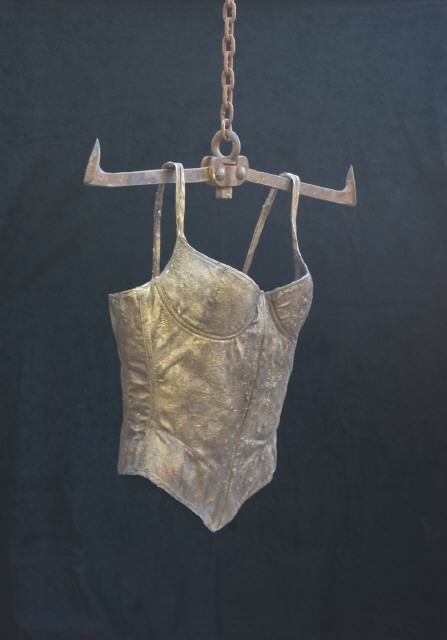
Bodice
— Angela Fortain
In her series “Overt Underthings” artist, Angela Fortain, considers a paradox: Distorting the body can both liberate and imprison, she says. Society dictates constraining fashions which, once dawned, create power over others.
Power over others?
By way of men’s desire, women’s envy.
The power to shape space as others turn in our direction.
Favors.
Lower status bowing to higher. Standing based on beauty – and what to make of that?
The power to gain love? Or sex? And must one undergo body-torture to attain either?
How might power become less available inside the constrained body?
Are the powers bestowed – or removed – substantive or superficial?
Finally, Fortain muses, “Separating the sensual object that once transformed the wearer into an object of sexuality allows us to examine the object, and our own desire.”
The power of objects… our own desire?
Fortain’s work provokes more questions than answers. As art should.
Georgia Platts
This piece was originally shown at “CONTROL,” an exhibition of California women artists presented by The Women’s Caucus for Art at New York’s Ceres Gallery, February 1 – February 26th, 2011.
For more on Angela Fortain’s work go to ARTslant.
Popular Posts on BroadBlogs
Spoon Fed Barbie (Part of the CONTROL series)
Men Aren’t Hard Wired To Find Breasts Attractive
Men Are Naturally Attracted To Unnatural Women
Surprises in Indiana University Sex Survey
Share this:

Spoon Fed Barbie
Surface appearances can be deceiving, says artist, Yvonne Escalante.
Commenting on the pieces shown here, she reflects,

- Spoon Fed


Baby's Rattle

- Sucker

As a first generation American, Escalante’s father had stressed American identity over cultural ties. Today, her work explores the conflict she feels, caught in the kaleidoscope of identity, gender roles, and societal norms.
Her work can be viewed this month at an exhibit titled, “CONTROL” at New York’s Ceres Gallery.
Here’s what these pieces say to me.
Like most little girls, I grew up spoon fed on Barbie. But not just Barbie. She was an emblem of all that mass media, friends and schoolmates, told me to be. A good shopper. Paired with Ken. Skinny and curvy all at once. The emblem of perfect womanhood, where body defines us.
Oddly, all this spoon feeding can lead to a dearth of feeding of any sort. I’ve gone through phases of not eating like I should, hoping to look like what turn out to be phony photoshopped images that don’t even resemble the starving models who posed for the pics.
What did I know?
Of course, skinny isn’t enough. We must be buxom, too. Which leads to unnecessary, and sometimes life-threatening, surgeries in pursuit of Barbie breasts. At least that’s what happens when boobs define us, creating our worth. For too many women and men, surface is all.
When women are told they must acquire surreal measurements, and when obtaining them is the source of self-worth, the pursuit takes unending time and energy.
Obsessed with diet and exercise, women can become distracted from the rest of life; so much so that (as Naomi Wolf can tell you) advances of the women’s movement can quickly wane. Frantic pursuit of the perfect body removes agitation for power of greater substance.
Hence, the pacifier. Here, called “Sucker.”
Any wonder the exhibit’s theme is “CONTROL”?
This piece can be viewed at “CONTROL,” an exhibition of California women artists presented by The Women’s Caucus for Art at New York’s Ceres Gallery, February 1 – February 26th, 2011.
For more on Yvonne Escalante’s work go to ARTslant.
Popular Posts on BroadBlogs
The Constricting Bodice: Empowerment and Imprisonment? (CONTROL series)
Men Finding Fewer Women “Porn-Worthy”
Men Are Naturally Attracted To Unnatural Women
Share this:

“Bitches and Dudes,” a.k.a. “Women and Men” on College Campuses
Researchers looking at the most commonly used words to describe women and men on college campuses made some interesting findings.
Labels for college men: guy, dude, boy (as in “one of my boys”), stud/homey
Labels for college women: babe, chick, slut, bitch
See a difference?
The words describing men are fairly neutral. The most negative term may be “boy,” implying immaturity, not manhood. But the phrase “one of my boys” is endearing and inclusive. “Homey” prompts thoughts of ghetto life – low class. But it also suggests streetwise toughness – a positive for men.
Stud is very positive, and was likely used a bit more ten years ago when this study was done. Player and pimp might be more common now, but they all create similar imagery: a sexually active man who is potent and adept at attracting women, conquering them, getting women to submit sexually. Powerful imagery.
And words for women? They are all sexualized. “Babe” and “chick” indicate sexual attractiveness, alerting us to how important beauty is for women.
But “babe” infantilizes, while suggesting endearment. The term can also describe men whom women are close to. “Chick” may have come from the word chic, meaning fashionable. But thoughts of a baby bird do suggest immaturity, with the added hint of animal status.
“Slut” is the counterpart to stud, but without the celebratory salute – quite the opposite. “Bitch” can have a similar meaning as in, “A bitch sleeps with everyone but me.” Of course, “extremely unpleasant personality” can be an alternate meaning.
When men seem so interested in getting sex it seems odd to use words that shame women’s sexuality and contribute to sexual dysfunction. Perhaps it all makes conquest, and the ensuing rise in self-regard, that much sweeter.
On the whole, terms describing women are much more negative than those labeling men.
Language affects our minds, it guides how we see the world and ourselves. For more on this, see my post on how language shapes us.
When words describe women as sexual, secondary, and degraded, both women and men come to see them that way, at least unconsciously. We see the effects when less evolved men easily throw these sticks and stones at women, or when too many women swallow the terms, and without much of a whimper.
Popular posts on BroadBlogs
Surprises in Indiana University Sex Survey
Women Learn the Breast Fetish, Too
Men Finding Fewer Women “Porn-Worthy”
Share this:

Men Have Higher Sex Drive. Why?
 While some women have stronger sex drives than some men, generally the pattern goes the other way.
Why is the male sex drive usually stronger?
Researchers at Indiana University say,
Women had a wider range of response, with some loving sex, and others feeling uninterested. Generally, women have more difficulty with arousal for both anatomical and psychological reasons.
Difficulty with arousal won’t likely lead to a strong sex drive. Biology and psychology both seem to play a role. Let’s start with biology.
Sexual Biology
According to Louann Brizendine, author of the books, The Female Brain and The Male Brain, the area governing sexuality takes up twice as much space in the male. And the part that controls desire to pursue is 2½ times greater, and more quickly activated. (This is exaggerated and stereotyped in the accompanying photo.)
Brizendine tells us that when the male brain is sexually activated pretty much everything but thoughts of sex shut down. Women certainly can stay focused, but they are more likely than men to be distracted with concerns about the kids’ lunches, a scheduled business meeting, or whether they’ll be labeled a “slut” the next day.
But Dr. Brizendine’s book has met criticism. Dr. Cordelia Fine is a University of Melbourne professor who specializes in social psychology and neuroscientific research. She points out that 1) neuroscience is in its infancy, 2) you cannot determine whether any particular brain is male or female at the individual level, and 3) brain structure is affected by experience. If a woman’s sexuality is punished and repressed, the parts of her brain associated with sexuality will be affected. If a man’s sexuality is celebrated, his brain will also be affected.
But anatomy could have an effect. A penis must ejaculate on a regular basis to create fresh sperm. A penis is also larger than a clitoris. Both of these things might make its workings more obvious so that boys are more likely to masturbate, and girls are less likely to get to know their bodies and what arouses them. An erect penis also gives men a lot of feedback, while women’s genitals seem to provide less: Men looking at a naked body are much more likely to feel aroused than women doing the same thing. But women’s bodies are also much more sexualized by our culture — that may play a role. And the repression of women’s sexuality in our society may also affect genital feedback to the brain.
Of course, men do have much more testosterone, crucial to sex drive. Even when women and men are both treated with testosterone for low libido, the hormone is less effective in women, according to Dr. Glenn Braunstein of Cedars Sinai Medical Center. But women are more sensitive to the testosterone that they do have.
But in women’s favor, they seem to be more capable of multiple orgasm. Some think women’s sex drive could be innately stronger than men’s for that reason. Who knows?
Sexual Psychology
Because psychology affects biology, I’ve already mentioned that women’s sexuality is more punished and repressed in our culture. Men who have sex have been variously praised as players, studs, Casanovas, Don Juans, and lady killers. They are “high-fived” for “scoring.” But women are called sluts, hoes, whores, skanks… Men sport a cocky cock, while a vagina is called “down there.” Or, women get screwed, rammed, nailed, cut, boned, banged, smacked, beaten, and f’d, in street parlance.
Sexual violence doesn’t help, either, and it’s something that more egalitarian, sex-positive societies lack.
Meanwhile, because women’s bodies are so much more sexualized and sexually revealed, men get far more provocation on a daily basis.
In societies where women’s sexuality is not repressed and not objectified, they greatly enjoy sex and behave in ways that are similar to men.
But in our repressive world, women experience more sexual problems. In fact, nearly half of American women report having experienced some form of sexual dysfunction. University of Texas, Austin researchers reported in Why Women Have Sex that one-third of women, aged 18-23, felt little sexual interest in the prior year. But only 14% of men did. Meanwhile, 30-40% of women reported difficulty climaxing. Among those in a relationship, 75% of men said they always had an orgasm, but only 26% of women did. This difference likely affects how much each gender desires sex, since one is more consistently rewarded.
Interest and enjoyment needn’t be such a problem for women. And culture, more than biology, seems to be the culprit. The University of Texas researchers note that women are easily orgasmic in cultures where women are expected to enjoy sexuality. But they aren’t in places where they are repressed.
While women are taught that they are bad if they like sex too much, men are taught the opposite. The male role casts men as being ever-desirous, which could propel them to live up to expectations.
Meanwhile, both men and women learn to see women as the sexier sex. So men can be with someone who’s very physically alluring. But women aren’t taught to see men in the same way. Men can focus on a breast fetish. What are women supposed to pay attention to? No fetish is attached to the male. No wonder we’re less interested.
Sex also provides one of the few vehicles for men to experience emotional closeness. Men need that intimacy, yet the male role leaves them repressing their emotions. Esther Perel, author of Mating in Captivity, feels that “For men, sex is the connection. Sex is the language men use to express their tender loving vulnerable side.”
So how do women and men come together? Large cultural changes would help. Seeing women primarily as the sexy half of the species doesn’t aid women’s sex drive. It would help women to live in a less sexually repressive culture, while men would gain from a less emotionally repressive society. But given that this is our reality, perhaps both women and men could use some counseling or therapy. Communication and acting from a place of love to accomodate each other would surely help, too.
Sure, some women really take pleasure in sexuality, but the heightened and more widespread enjoyment of our sisters who come out of non-shaming cultures tell us that women could be loving sex a whole lot more.
Popular Posts on BroadBlogs
Sex Drive: How Men and Women Match Up
Women Seeing Women as Sexier than Men
Orgasm: It’s All in the Mind
“Cock” vs “Down There”
Share this:

Real Women Competing With Porn Stars
 Overconsumption of porn is having unintended consequences.
Once upon a time men were hesitant to purchase pornography. Walk into an adult bookstore or movie house? Ring up a purchase with the girl at the counter? Way too embarrassing. But now internet porn is easily available in the anonymity of home. It’s even free. Porn has gone mainstream. Who doesn’t do it anymore?
But porntopia has an unexpected downside. Standards of sexiness are growing narrower. Some men expect their partners to act like porn stars. Sometimes both. Everyone ends up disappointed.
Young men and women are indeed being taught what sex is, how it looks, what its etiquette and expectations are, by pornographic training, and this is having a huge effect on how they interact.
So said Naomi Wolf after a college campus tour.
In sum: women are now expected to behave like actresses in porn flicks. Emphasis on “actress.” Even porn stars don’t behave that way at home.
And how do the actresses act? It’s male fantasy: It’s all about the guy.
Pamela Paul found something similar in her research for Pornified:
Among men who overconsume porn, real women are now expected to: Howl and moan with delight at the sight of the male member, or in anticipation of oral sex. They must enthusiastically swallow, let their boyfriends ejaculate on their faces and bodies, or maybe be peed upon. Suggesting an interest in lesbianism is always good. And through it all, they’re expected to have quick, easy orgasms. Ideally without much foreplay.
A man named Luis reported,
I’ve broken up with women who wouldn’t perform certain things.
Some recognize the problem. A man named Harrison stated,
I think that a guy’s expectations of his partner might be affected by the images he sees in porn. People’s expectations of their partner’s sexual performance or of what their partners might be willing to do might be unrealistic.
A 2004 Elle-MSNBC.com poll found that 35% of men felt sex with real woman had become less arousing. Twenty percent said the real thing couldn’t compete with virtual sex.
If women want to compete, they’ll need to become actresses, too. Not so much fun for them.
Women who bed these men end up feeling empty and unsatisfied. After watching porn with her boyfriend, a woman named Cara observed,
The women were all fake. No intimacy, nothing sensual. Even when he and I were intimate, the sex wasn’t intimate.
Perhaps this is what happens when sex objects have sex — and not when flesh and blood human beings have sex.
Distracted by candy, everyone ends up missing something more nourishing and substantive. We miss out on the deep, connected intimacy that brings so much meaning to relationship. Soul needs.
Why act in ways that leave us empty and spiritually wanting? Is he that into you to be worth it? The focus on his pleasure, only, suggests he is not.
Popular posts on BroadBlogs
Men Finding Fewer Women “Porn-Worthy”
Real Men Competing With Porn Stars
Men Watch Porn, Women Read Romance. Why?
Share this:

What Happens When You Beat A Sex Object?

Sexualizing abuse
What happens when you beat a sex object? Or hang her? Or rape her? Or hogtie and torture her?
Pop culture is filled with images of women as objects. It’s also filled with images of women as abused objects. But then, the two go hand in hand: Objects have no feelings to empathize with, no lives of their own to interrupt or worry about. They can exist just for sadistic pleasure.
Oddly, I’m not seeking to shame anyone who gets aroused by these images. People tend to unconsciously absorb their culture like a sponge – we all do. Even my women’s studies students and the feminist blogs I read register a taste for this stuff. No surprise that so many find it sexy, our society is so filled with these images.
At the same time, I’m not dismissing the issue. Whether you want to participate or fight it, at least have eyes open and look at the downside.
When I was a little girl I got a children’s book from the library. In one story a woman was punished: She was stripped, placed in a kettle-like contraption with spikes to poke her, and driven through the town in humiliation. That’s my first memory of sexualized abuse.
My second encounter was flipping TV stations as a child, and seeing a man throw a woman over his knee to spank her. Apparently, if I’d flipped through a magazine I could have seen an ad with the same image.

When I got older the Rolling Stones promoted their “Black and Blue” album with a picture of a woman bound and bruised.

At the movies women are killed – in sexy bras and panties – in popular horror flicks. In tamer fare, Scarlett started out resisting Rhett, but ended up enjoying a night of passion as “no” turned to “yes.” In the soaps, Luke raped Laura and they fell in love.

Devo’s “Whip It” showed a man whipping the clothes off a mannequin. The red hat from this video is now in the Smithsonian.
In magazines and billboards we are bombarded with ads depicting violence against women.

Romance novels and erotic tales tell stories of women who are abducted and raped and who fall in love with their captors. Mainstream movies like 9-1/2 Weeks and The Secretary depict women enjoying abuse at their lovers’ hands. Justine Timberlake slapped Janet Jackson around at the Super Bowl before ripping off her bodice. More recently Megan Fox gets beat up in a popular video that you can view over and over again. In the background Eminem mouths “I’m in flight high of a love drunk from the hate,” to which Rihanna replies, “I like the way it hurts.” And then there’s the porn world full of “no’s” turning to “yes.” Or “no” remaining “no,” but that’s sexy, too.
On a feminist website, one woman described the joys of being a sex slave avatar to a dominant man in the virtual world of “Second Life.” Another explained the appeal with the help of a poor understanding of evolutionary psychology: Through evolution, she explained, women have come to want male domination in their relationships.
 That’s not really what evolutionary psych says (and I have issues with that field, anyway). How would craving your own abuse, or even domination, be adaptive? Pain is meant to warn us to stop doing something. Women’s genes don’t crave poor treatment. If they did, we’d find eroticized violence in every culture, but we don’t. Egalitarian societies like those of the American Indian (before contact with patriarchy) did not sexualize abused women.
Here are two big problems with eroticizing male dominance and women’s pain: First, women and men can both come to crave the abuse of women in real life. Second, when we make male dominance seem sexy, we become more accepting of male dominance.
Neither of these aid the fight for equality, justice or human rights.
Popular Posts of BroadBlogs
Frats Invite Sluts, Bitches; Women Accept Degradation. Why?
What Do Top Model and Hard Core Porn Have in Common?
Women: Climax Less Likely in Relationship Sex
Men: Climax More Likely in Relationship Sex
Orgasm: It’s All in the Mind
Share this:

Women Seeing Women as Sexier than Men
 Girls are so inundated with sexualized images of women that they learn to see women as sexier than men. Women come to see women through male eyes?
In the bedroom, this can make women’s sexuality a bit convoluted, which I’ll discuss later.
But consider my students:
“Women’s bodies are just naturally sexier than men’s,” my class tells me when I ask why women are portrayed as sex objects.
In this belief, my students are not alone.
A few years back Lisa Kudrow, of Friends fame, told Jay Leno that female nudity is displayed more in movies because, “Who wants to look at a guy?”
Hugh Hefner thinks women are natural sex objects, “If women weren’t sex objects, there wouldn’t be another generation.”
I’ve talked before about how the breast fetish is not natural, but is learned by both men and women. But how do we all learn that women are sexier than men in ways that go beyond the fetish?
Growing up, girls are bombarded with visions of women as sexy, with skin selectively hidden and revealed, the camera focused on those intriguingly concealed parts.
When I was little my mom took me to the Ice Capades. After noticing that the women were half dressed while the men were fully clothed, I asked why. Mom told me that women just have better legs.
Do they? One warm summer day an adult from my church youth group commented, “It’s too bad the guys have the best legs.” (Thanks!) But what is our cultural ideal? Longer, leaner. Young men typically have longer legs, and they don’t have the extra layer of fat that women do. So most young men’s legs come closer to our ideal. Yet we say women have better legs? When I think about it, I actually think men have pretty nice looking legs. But nothing and no one directs our attention to them.
On Dancing With The Stars, women are half-dressed and men are fully-clothed. During an advertisement, the camera lingers on women’s breasts and legs in a Victoria’s Secret display. Next, a commercial for shoes focuses on women’s behinds: See this Rebook ad for EasyTone. Try to imagine the same focus on men’s butts (which actually are pretty attractive)!
Watch a football game and see big, fully-dressed, aggressive guys playing on the field, while scantily clad cheerleaders show off their stuff from the sidelines. In the Bikini Open men sport golf wear while women dawn bikinis. When does Sports Illustrated most focus on women? In the swimsuit edition.
Through it all, the camera gazes at women’s body parts, but not men’s. Telling us what’s important to notice. What’s sexy and what’s not.
Men’s bodies are rarely sexualized outside infrequent underwear ads.
Historically, men have had control of media, and they’ve portrayed what they see as sexy.
Bombarded with these images, girls come to see women as sexier than men. As I’ve said before, when I tell my class that I find a Playboy pinup sexier than a Playgirl pinup, women’s heads nod in agreement.
Meanwhile, when women answer surveys about what they find sexy they say “men.” But when they are wired up, blood flow to the vagina is stronger when viewing an image of a nude woman than a nude man – conscious responses and bodily responses not agreeing.
Oddly, and yet logically, women come to see women through male eyes.
So women come to see themselves as the sexy half of the species. Being sexy has some advantages. It can just be fun, it’s easier to attract mates (consider the success of women versus men in singles bars), and sexiness is a source of power.
But there’s a downside, too, including the narrow construct that leaves so many women feeling they exist outside the “sexy” box, with a drop in self esteem kicking in.
Taken to extreme, some women can become sex objects, taking an unhealthy one-dimensional focus on themselves, feeling that how they look is all that matters. And some men may see them as objects whose sole purpose is to be used for their pleasure.
It ain’t so great to be, or be seen, as mere object.
To anyone who plans to inform me that I am bi, please see this post first (I’m tired of answering repetitive comments): Men Know My Sexuality Better Than Me. And to those who think this means women don’t find men sexy or desirable, see this: Men Don’t Feel Sexy–and It Sucks.
Related Posts on BroadBlogs
Women Learn the Breast Fetish, Too
Man as Object: Reversing the Gaze
Women Gazing At Men
Do Women See Sexy Men As Sexy?
Share this:

Are Women Culturally Monogamous?
We know that women aren’t destined to be monogamous by nature. Culture affects our sexual psyches.
Polygamist inclinations vary from person to person, but today’s Western women are much more monogamous than our Tahitian or American Indian sisters were before European contact. We are now also much more monogamous in our inclinations than men.
In surveys, men say they would prefer to have 14 partners over a lifetime. Over that same lifetime, women prefer to have only one or two.
A friend suggested that women were lying because they feared seeing themselves as sluts. Yet women admit to five real-life partners. (Here they are certainly underestimating. The real number is likely 8 or 9 for both men and women, given men’s estimate of 12.) But if they’re so worried, why not say they’ve had only 1 or 2 partners?
I was surprised by the low number of “one or two” as the preference, but I doubt women feel the need to go that low just to feel socially acceptable.
Younger women’s preferences may be higher. During the first year of college many willingly experiment with sex – and freely admit to it. But they quickly tire of random sexual contacts. Most drop out of the casual sex scene by sophomore year.
Men, on the other hand, don’t tire of the casual hook up, and want to continue even after college.
When it comes to open marriage or swinging, men are usually more enthusiastic, and more often initiate the idea.
So women seem less interested in casual sex than men. Quite likely because they are more repressed.
I feel that women are more repressed than is healthy. But I’m not sure that limits are all bad, for women or men.
When I read women’s studies literature, women are often advised to have sex more the way men do: have fun without guilt.
Yet men’s studies, which comes from a feminist perspective, often advises men to have sex more the way women do it. Don’t follow the 4 F’s: Find ‘em, Feel ‘em, F- ‘em, and Forget ‘em. Do not use women as a means of gaining a notch on your belt. Have sex in a context of love and care.
What do you think? How would you describe women’s ways and men’s ways of having sex? What are the positives and negatives of each approach? Is one way better than the other? Is there an optimal in-between? Do men and women tend to have different views on this issue?
I’m interested in exploring the matter. I’d like to year your thoughts, too.
Popular Posts on BroadBlogs
Cartoonish vs Authentic Sexuality
Men Watch Porn, Women Read Romance. Why?
Real Women Competing With Porn Stars
Share this:

Are Women Naturally Monogamous?
![Gaugin--300x184[1]](https://broadblogs.com/wp-content/uploads/2010/12/gaugin-300x1841.jpg) Charles Darwin, the father of evolutionary biology, was skeptical of evolutionary psychology, which sees women as monogamous and men as polygamous, due to genetics. Let’s take a closer look.
Charles Darwin, the father of evolutionary biology, was skeptical of evolutionary psychology, which sees women as monogamous and men as polygamous, due to genetics. Let’s take a closer look.
Children have the best shot at surviving if their mothers mate with only one man, who sticks around to provide support and resources. Thus, women prefer men who are older and richer. Moms put a lot into their kids because they have a small number of eggs compared with the millions of sperm that men produce. And all this is genetic, so says evolutionary psychology.
On the other hand, men will have more children (and reproduce their genes) if they are promiscuous because of their large sperm count. Again, the behavior is in the genes.
This premise seems to contradict the prior point that children are more likely to survive if their fathers are around to support them. Maybe more survive than don’t. Or perhaps it’s a survival of the fittest worldview: Babies who can survive without resources improve the gene pool?
The bigger dilemma: How do men manage to enjoy many partners when women are monogamous?
Men also value beauty above all else because attractiveness indicates health and an ability to reproduce. Oddly, supermodels are the most sought-out, yet they’re often so thin that they no longer menstruate. And I hadn’t known that so-called unattractive women were infertile. But never mind.
Returning to Darwin’s concern – and it doesn’t take a genius like him to make this observation – while evolutionary psychology had fit nicely with British middle-class behavior, where women sought resources and men sought beauty, Darwin pointed out that the theory did not fit with the British upper class. There, men were more concerned with wealth than good looks.
Now that Western women are able to make their own money, they have become more concerned with looks than in the past. And men now like to marry women who can earn some money – it’s a plus.
Other cultures don’t fit the theory so well, either.
Gauguin’s infatuation with Tahiti likely came in part from the women’s desire for many sex partners (prior to European influence).
Meanwhile, Europeans who were among the first to arrive in the Americas were shocked by similar behavior among the native women.
In these Tahitian and Native American societies the entire community cared for children, and property passed through women, so men’s resources weren’t an issue. These women weren’t called sluts, either.
Once Europeans transformed the cultures, things quickly turned around.
It appears that social structure and culture trump biology in explaining women’s monogamy.
There is more to discuss, but I’ll leave that for later.
For now I must ask: Are evolutionary psychologists unfamiliar with this information, or do they simply ignore it because the theory so well justifies a status quo in which women are told to stay monogamous, but understand men’s need for many partners, aka the double standard?
After all, it’s in men’s genes – or was that jeans?
Popular posts on BroadBlogs
Men Finding Fewer Women “Porn-Worthy”
Orgasm: It’s All in the Mind
Men Aren’t Hard Wired To Find Breasts Attractive

 BroadBlogs