Blog Archives
Sex Objects Who Don’t Enjoy Sex
Sexualizing women can have its perks in the bedroom, with breast fetishes and butt fetishes heightening men’s arousal.
But surprisingly, sexualizing women can have the opposite effect, harming both men’s and women’s enjoyment. And in many ways. Here’s one: self-objectification.
Drowning in “sexy women” images, men and women can both come to see women as the sexy half of the species. So what happens in bed? Because men aren’t seen as especially sexy (at least by comparison) men are focused on women and women can be focused on themselves.
Caroline Heldman, assistant professor at Occidental College, found that some women become preoccupied with how they look instead of the sexual experience. “One young woman I interviewed described sex as being an ‘out of body’ experience,” she said. “She viewed herself through the eyes of her lover, and, sometimes, through the imaginary lens of a camera shooting a porn film.”
Sounds a bit like Paris Hilton: “My boyfriends say I’m sexy but not sexual,” she mused. “Being ‘hot’ is a pose, an act, a tool, and entirely divorced from either physical pleasure or romantic love.”
Heldman feels that girls and women are learning to eroticize male sexual pleasure as though it were their own. She feels they need to explore their sexuality in more empowering and satisfying ways than this vicarious act.
Cultural theorist Jackson Katz has similar concerns. “Many young women are now engaged in sex acts with men that prioritize the man’s pleasure,” he reflects, “with little or no expectation of reciprocity.”
When having sex, these young women may be enjoying themselves, and how great they look. They may gain a boost to self-esteem as they dwell on their “hotness.” But they’re not enjoying sex.
Popular Posts on BroadBlogs
Women Seeing Women as Sexier than Men
Women Learn the Breast Fetish, Too
Surprises in Indiana University Sex Survey
Share this:

Lose Virginity, Lose Self-Esteem?
 When women lose their virginity, they can lose self-esteem, too, experiencing a small drop. That’s what a recent Penn State study reveals.
Why?
Women college students were surveyed over time. Before sex the women felt increasingly good about their bodies. But after first sex they felt worse. Looks like when they’re in bed women start worrying about whether they look good enough. Masters and Johnson tagged the phenomenon of watching yourself from a third person perspective instead of focusing on sexual sensations or your partner, “spectatoring.” Women are much more prone, being the objectified. Then, feeling they don’t measure up, self-worth drops.
Other usual suspects may also affect self-esteem, including the double standard that provokes worries about labels like slut and whore. Tracy Clark-Flory over at salon.com points to a 1995 study that found “women were significantly more likely to report that their first sexual experience left them feeling less pleasure, satisfaction, and excitement than men, and more sadness, guilt, nervousness, tension, embarrassment, and fear.” Even now women continue to experience that bind.
The double standard strikes again when women feel used, unappreciated, and worried about reputations after short flings or one-night stands.
Meanwhile, a study I recently posted finds 35% of women in strong partnerships feeling sad, anxious, restless, or irritable, after sex. Researchers don’t know why. Commenters, speculating on their own experience with the phenomenon, fingered sexual repression or difficulties with orgasm (which are related to repression) as culprit.
Studies repeatedly find that women are less likely than men to enjoy sex. Other research suggests the problem is not biologically based, or inevitable. Women in sex-positive cultures enjoy sexuality a great deal.
We are going to have to move beyond sexism for women to reclaim their sexuality. That would benefit both women and men.
Popular Posts on BroadBlogs
Are Women Naturally Monogamous?
Are Women Culturally Monogamous?
Surprises in Indiana University Sex Survey
Share this:

Sexual Desire & Sexism

Karen Zack, Man As Object
We are bombarded with “sexy women” but not “sexy men”
Whether on billboards, TV ads, Dancing With The Stars, Olympic ice skating, or professional football, women are half-dressed and men are fully-clothed. The camera hones in on women’s breasts and butts and ignores men. Sure, we are seeing more hot men these days thanks to Matthew McConaughey and Ryan Gosling. But the last time I checked out People’s sexiest men I saw lots of faces and loose T-shirts and few bods. Even the clothing that women and men walk around in show off women’s bodies and, more often, hide men’s.
As Amanda Marcotte at RH Reality Check points out,
Straight women don’t get nearly the provocation on a daily basis — is it any wonder that 60% of the men who answered the Consumer Reports survey (on sex) thought about sex once a day, but only 19% of women?
No part of the male is fetished
No part of the male body is fetishized, either. Men stare at breasts and butts, but what are we supposed to look at? These fetishes may seem natural for men but they are actually a cultural construction. How are they created? In part, see the section above. Or see my piece called, “Men Aren’t Hard Wired To Find Breasts Attractive.” Ever wonder why tribal men don’t get all excited about tribal women’s breasts and butts?
Porn may lead men to think we get aroused by penises, but when Anthony Weiner sexted a photo of his package, Tracy Clark-Flory over at Salon asked women if being sexed a man’s penis would “do it” for them. Most expressed repulsion. Or as one put it, “If by ‘do it (for me)’ you mean ‘send me to the toilet retching,’ then yes, it does.”
Sexy men can seem “gay”
Women are not taught to consume the male body with their eyes, as men consume theirs. To make matters worse, pics of sexy men can seem “gay.” Since sexiness is almost always meant for the male gaze, on an unconscious level women can come to see “sexy” men – perhaps posed in Speedos — through male eyes, too. Bummer!
Women don’t feel sexy
Meanwhile, we might not feel too sexy, ourselves. Surrounded by the “perfect” images our partners consume, we might not feel too hot by comparison to ladies who live on lettuce, surgery and photoshop. Do we really want to reveal our bodies and be negatively judged? The opposite of an aphrodisiac.
Good girls shouldn’t
The double standard is loosening up but sexual women may still be called: slut, whore, ho’, tramp, skank, nympho, hussy, tart, loose, trollop… the list goes on. Men possess cocky cocks while women’s privates are just “down there.” College men returning home Sunday morning may take the Walk of Fame while the women they’ve just had sex with take the Walk of Shame. And so women’s sexuality becomes more repressed.
The problem of housework
Sometimes the problem is more mundane. Women do about twice as much housework as men. After a full day at work women are more likely than men to cook dinner, clean up, and get kids ready for bed. Then they’re too tired for sex and resent their husbands. Not a way to get in the mood.
Or, maybe mom works in the home where her “invisible” work gets noticed only when it’s undone. A lack of appreciation won’t get anyone in the mood for love making.
Sexual violence
Sexual violence also takes a toll. Rape is most prevalent when women are devalued. And women who are raped often lose interest in sex. One woman I know of went numb and emotionally left her body when she had sex because a past rape had made sex seem terrifying and repugnant to her. “Desperate Housewife,” Teri Hatcher, was molested by an uncle who told her that one day she would like sex. That only made her close up more because she didn’t want to prove her disgusting uncle right.
But all women also face the prospect of getting screwed, rammed, nailed, cut, boned, banged, smacked, beaten, and f’d — in common street parlance — when they get intimate. Who wants that?
How to raise a woman’s desire
If you want women to desire sex then: help with housework, show appreciation, stop shaming women for being sexual, or for not fitting ridiculous “ideals,” desire her and let your lady know she’s beautiful.
Popular Posts on BroadBlogs
Man as Object: Reversing the Gaze
Men, Women & Internet Porn
Men, Women React to Male/Female Nudity
Share this:

Men, Women & Internet Porn
The first time you see Lena Dunham’s character having sex in the new HBO series “Girls,” her back is to her boyfriend, who seems to regard her as an inconveniently loquacious halfway point between partner and prop, and her concern is whether she’s correctly following instructions.
“So I can just stay like this for a little while?” she asks. “Do you need me to move more?”

Those are the opening lines from New York Times columnist, Frank Bruni, writing about the HBO series “Girls” which premiered April 15. I wrote a bit about the interview last week asking, “Is male or female sexuality better?” But Lena and Frank have more to say, and so do I.
Bruni says their sex play seems to be all about what “he” wants “her” to do. Dunham’s real life informs the show, and Dunham suggests that what the proverbial “he” wants is often NOT what “she” wants. Amidst aggressive posturing and “a lot of errant hair pulling” she has thought, “There’s no way any teenage girl taught you and reinforced that behavior.”
The scene, and Dunham’ comments, suggest a depersonalized sexuality with women as objects, sex as sometimes harsh gymnastics and, too often, all about “his” pleasure.
She thinks it’s tied to internet porn, which so many young men are steeped in.
Some women get into pornified sex, too, but usually not all the time, or not on the first few dates. And most seem to want something more, even if porn-sex is a part of the experience.
Meet Valerie, who discovered pornography at age 12 and was very excited by it. Today she sometimes finds it exciting when men pull porn moves on her. But at the same time she says, “It’s icky”:
I don’t just want to become Body A. I want men to feel like they are with me, Valerie, a particular woman with a particular body and my own unique personality. I want them to be in the moment, as opposed to going through some form of learned behavior. I want it to be our own experience as opposed to an imitation of porn.
She talks of Miguel, a musician. She can tell he’s into porn by how he acts:
Lights glaring, gaping at her body parts, manipulating her into positions popular in pornography so he could admire her. He was aggressive, he was confident, he was following a formula. He was cold.
As Valerie saw it, “He thought it was hot, that he was a stud. I felt cheapened. I felt so empty after the experience.”
Dunham can relate, saying that, “People can be so available in a superficial sense that they’re inaccessible in a deeper one.”
One woman wrote about her and her friends’ experiences for GQ and offered tips for the internet-drenched generation. She loves both porn and sex, she says, but warns that not all women are charmed by being called a “dirty whore.” Most women don’t want anal three times in one night – and not from men they barely know.
And why is it, she asks, that orgasming inside someone, “the goal of every dude for zillions of years,” now seems to pale in comparison to “facials”? Noting the irony, “It hardly seems fair to call that sex. It’s more like masturbation with a fellow 3-D person. You finish with your hand, after all, like you’ve done with a million clips.” And please, no facials on the fourth date. “That’s stuff to save for later, when the excitement of someone new has worn into a comfortable live-tweeting-Monk-from-bed kind of cohabitation.”
And maybe when there’s a larger context of relationship, and not just empty sex.
Popular Posts on BroadBlogs
Sex Objects Who Don’t Enjoy Sex
Wanting “X” from Sex, but Doing “Y”
Women Want Emotionally Connected Sex. Why?
Share this:

Beauty Tricks to Remove Your Power

Ashley Judd’s face looked puffy in the promo for her new TV series, Missing. Big deal. She’s aged since I last saw her, and maybe she’s gained a little weight.
And then the furor. Everyone talking about Ashley’s face.
So she responded in the Daily Beast. A few lines:
The Conversation about women’s bodies exists largely outside of us, while it is also directed at us, and used to define and control us. The Conversation about women happens everywhere, publicly and privately. We are described and detailed, our faces and bodies analyzed and picked apart, our worth ascertained and ascribed based on the reduction of personhood to simple physical objectification. Our voices, our personhood, our potential, and our accomplishments are regularly minimized and muted. The assault on our body image, the hypersexualization of girls and women and subsequent degradation of our sexuality as we walk through the decades, and the general incessant objectification is what this conversation allegedly about my face is really about.
Wow.
The lines linger, waiting to be soaked up.
We are described and detailed
our faces and bodies analyzed and picked apart
our worth ascertained and ascribed based on
the reduction of personhood to simple physical objectification
The body detailed and critiqued, diminished and demeaned. An emotional trashing. Cut up, dissected. It feels like a killing. No wonder we are body-obsessed, declare nourishment the enemy and become terrified of aging.
With our bodies spotlighted the rest of us vanishes.
Our voices, our personhood, our potential
and our accomplishments are regularly minimized and muted
(as)
The Conversation about women’s bodies exists largely outside of us
We become nothing but our “defective” parts.
And we can say nothing as the conversation bubbles everywhere, outside ourselves, removing our power to name and control.
But Judd doesn’t leave us, or herself, hanging in hopelessness. What is deemed good and bad are equally fanciful interpretations, she says, and so she has chosen to abstain from all outside judgments about herself and her body.
We are social animals. Our identities are keenly influenced by how others see us, and more so when those visions act in concert. When many see us a certain way, the agreement brings objectivity, while our solitary thoughts seem merely subjective.
But the declarations are not absolute. Especially when we discern shallowness and falsity. We may choose otherwise:
I do not want to give my power, my self-esteem
or my autonomy
to any person, place, or thing outside myself
The only thing that matters is how I feel about myself
my personal integrity
and my relationship with my Creator
“It is ultimately about conversations women will either choose to have or choose not to have,” says NPR’s Linda Holmes.
Let’s have some new conversations.
Popular Posts on BroadBlogs
You Are “Less Than”?
Self-Esteem Falls with Rise in Power? Blame Beauty Ideals
Anything Good About Being A Sex Object?
Share this:

Making Violence Against Women Sexy
 What happens when you beat a sex object? Or hang her? Or rape her? Or hogtie and torture her?
Pop culture is filled with images of women as objects. It’s also filled with images of women as abused objects. But then, the two go hand in hand: Objects have no feelings to empathize with, no lives of their own to interrupt or worry about. They can exist just for sadistic pleasure.
Oddly, I’m not seeking to shame anyone who gets aroused by these images. People tend to unconsciously absorb their culture like a sponge – we all do. Even my women’s studies students and the feminist blogs I read register a taste for this stuff. No surprise that so many find it sexy, our society is so filled with these images.
At the same time, I’m not dismissing the issue. Whether you want to participate or fight it, at least have eyes open and look at the downside.
When I was a little girl I got a children’s book from the library. In one story a woman was punished: She was stripped, placed in a kettle-like contraption with spikes to poke her, and driven through the town in humiliation. That’s my first memory of sexualized abuse.
My second encounter was flipping TV stations as a child, and seeing a man throw a woman over his knee to spank her. Apparently, if I’d flipped through a magazine I could have seen an ad with the same image.

When I got older the Rolling Stones promoted their “Black and Blue” album with a picture of a woman bound and bruised.

At the movies women are killed – in sexy bras and panties – in popular horror flicks. In tamer fare, Scarlett started out resisting Rhett, but ended up enjoying a night of passion as “no” turned to “yes.” In the soaps, Luke raped Laura and they fell in love.

Devo’s “Whip It” showed a man whipping the clothes off a mannequin. The red hat from this video is now in the Smithsonian.
In magazines and billboards we are bombarded with ads depicting violence against women.

Romance novels and erotic tales tell stories of women who are abducted and raped and who fall in love with their captors. Mainstream movies like 9-1/2 Weeks and The Secretary depict women enjoying abuse at their lovers’ hands. Justine Timberlake slapped Janet Jackson around at the Super Bowl before ripping off her bodice. Megan Fox got beat up in a popular video that you can view over and over again. In the background Eminem mouths “I’m in flight high of a love drunk from the hate,” to which Rihanna replies, “I like the way it hurts.” And then there’s the porn world full of “no’s” turning to “yes.” Or “no” remaining “no,” but that’s sexy, too.
 On a feminist website, one woman described the joys of being a sex slave avatar to a dominant man in the virtual world of “Second Life.” Another explained the appeal with the help of a poor understanding of evolutionary psychology: Through evolution, she explained, women have come to want male domination in their relationships.
That’s not really what evolutionary psych says (and I have issues with that field, anyway). How would craving your own abuse be adaptive? Pain is meant to warn us to stop doing something. Women’s genes don’t crave poor treatment. If they did, we’d find eroticized violence in every culture, but we don’t. Egalitarian societies like those of the American Indian (before contact with patriarchy) did not sexualize abused women.
Here are two big problems with eroticizing male dominance and women’s pain: First, women and men can both come to crave the abuse of women in real life. Second, when we make male dominance seem sexy, we become more accepting of male dominance.
Originally posted on January 12, 2011 by BroadBlogs
Popular Posts on BroadBlogs
Anything Good About Being A Sex Object?
Frats Invite Sluts, Bitches; Women Accept Degradation. Why?
Orgasm: It’s All in the Mind
Share this:

Women Seeing Women as Sexier than Men
 Girls are so inundated with sexualized images of women that they learn to see women as sexier than men. Women come to see women through male eyes?
In the bedroom, this can make women’s sexuality a bit convoluted, which I’ll discuss later.
But consider my students:
“Women’s bodies are just naturally sexier than men’s,” my class tells me when I ask why women are portrayed as sex objects.
In this belief, my students are not alone.
A few years back Lisa Kudrow, of Friends fame, told Jay Leno that female nudity is displayed more in movies because, “Who wants to look at a guy?”
Hugh Hefner thinks women are natural sex objects, “If women weren’t sex objects, there wouldn’t be another generation.”
I’ve talked before about how the breast fetish is not natural, but is learned by both men and women. But how do we all learn that women are sexier than men in ways that go beyond the fetish?
Growing up, girls are bombarded with visions of women as sexy, with skin selectively hidden and revealed, the camera focused on those intriguingly concealed parts.
When I was little my mom took me to the Ice Capades. After noticing that the women were half dressed while the men were fully clothed, I asked why. Mom told me that women just have better legs.
Do they? One warm summer day an adult from my church youth group commented, “It’s too bad the guys have the best legs.” (Thanks!) But what is our cultural ideal? Longer, leaner. Young men typically have longer legs, and they don’t have the extra layer of fat that women do. So most young men’s legs come closer to our ideal. Yet we say women have better legs? When I think about it, I actually think men have pretty nice looking legs. But nothing and no one directs our attention to them.
On Dancing With The Stars, women are half-dressed and men are fully-clothed. During an advertisement, the camera lingers on women’s breasts and legs in a Victoria’s Secret display. Next, a commercial for shoes focuses on women’s behinds: See this Rebook ad for EasyTone. Try to imagine the same focus on men’s butts (which actually are pretty attractive)!
Watch a football game and see big, fully-dressed, aggressive guys playing on the field, while scantily clad cheerleaders show off their stuff from the sidelines. In the Bikini Open men sport golf wear while women dawn bikinis. When does Sports Illustrated most focus on women? In the swimsuit edition.
Through it all, the camera gazes at women’s body parts, but not men’s. Telling us what’s important to notice. What’s sexy and what’s not.
Men’s bodies are rarely sexualized outside infrequent underwear ads.
Historically, men have had control of media, and they’ve portrayed what they see as sexy.
Bombarded with these images, girls come to see women as sexier than men. As I’ve said before, when I tell my class that I find a Playboy pinup sexier than a Playgirl pinup, women’s heads nod in agreement.
Meanwhile, when women answer surveys about what they find sexy they say “men.” But when they are wired up, blood flow to the vagina is stronger when viewing an image of a nude woman than a nude man – conscious responses and bodily responses not agreeing.
Oddly, and yet logically, women come to see women through male eyes.
So women come to see themselves as the sexy half of the species. Being sexy has some advantages. It can just be fun, it’s easier to attract mates (consider the success of women versus men in singles bars), and sexiness is a source of power.
But there’s a downside, too, including the narrow construct that leaves so many women feeling they exist outside the “sexy” box, with a drop in self esteem kicking in.
Taken to extreme, some women can become sex objects, taking an unhealthy one-dimensional focus on themselves, feeling that how they look is all that matters. And some men may see them as objects whose sole purpose is to be used for their pleasure.
It ain’t so great to be, or be seen, as mere object.
Popular Posts on BroadBlogs
Sex Objects Who Don’t Enjoy Sex
Men Have Higher Sex Drive. Why?
Women Learn the Breast Fetish, Too
Originally posted on January 10, 2011by BroadBlogs
Share this:

Beastly Breasts. Patriarchy? Or Blasphemy?
 In honor of women’s history month I talked with Brock Neilson, a feminist artist who wonders if he might sometimes unconsciously support patriarchy.
Or, is he blasphemous instead?
BB: It’s very easy for anyone, including feminists, to unconsciously see and think in patriarchal ways, at least some of the time, since we’re all immersed in the system. You wonder if you sometimes unconsciously support patriarchy in your art. How so?
BN: This past year a lot of my art has been about someone – or something — that has enormous or strange looking breasts. These images are what I’d imagine a drunken fraternity or a 12-year-old boy drawing.
I imagine that these kinds of perversions are part of the package with which males are endowed in society, and I feel a responsibility to address that somehow.
Sometimes I might want the breasts to look uncomfortably disfigured or I might want the  viewer to feel a kind of confusion about the body they are seeing. The breasts could also be more humane when they are not perfectly shaped or as easily sexualized, but I worry that I might be reinforcing patriarchy by not allowing something as commonly fetishized as breasts — or the person or entity to which the breasts belong — to just exist without having to be ugly, or strange, or beautiful, or symbolic. However, this concern is unavoidable as these images are being filtered through my nonobjective brain and hands.
The ultimate goal of feminism is to not have to be the mother, the champion goddess, the victim, or even a female or a male in order to have credibility and dignity. It is the hope that everyone could simply be who they want to be without having to force ourselves into degrading positions.
That said, I think it’s important to express these positions — or distortions — of power and powerlessness (and the variations between). My art is preoccupied with the slots we pop people into: the corporate leader, the androgynous, the porn victim, the violent athlete, the disabled or disfigured. I find that I’m often exploring possibilities for a better world by regurgitating things that are offensive to me.
BB: How might your work be blasphemous instead, working against patriarchy?
BN: There’s been a big focus among popular male artists to make big objects and paintings that can be bought and sold — similar to a Wall Street investment. This approach to art is problematic. I have been decorating a lot of brown paper in my work because it’s cheap and accessible. Being a male who is involved in decorating materials that require a kind of gentleness can be a blasphemous act.
I remember overhearing a mother years ago who was telling her five year old son not to smell flowers because she was afraid that this would make him look “gay.” I was so taken back that this innocent behavior — a child smelling flowers — was already perceived as inferior. My work, however crude it may be, is concerned with a hope of reclaiming this kind of sensitivity.
Tawnie Silva, an artist I discovered this last summer, made a beautiful inflatable sculpture of a quirky four-eyed girl with a rainbow coming out of her head. It’s made of fragile plastic bags, but Tawnie Silva’s body is brawny and masculine. It is especially sacrilegious to commercial gender ideals when men make things that are sweet and delicate. Both women and men need to protect and make space for vulnerable things in others and in themselves. This is an important way that we can expand and break dangerous gender stereotypes.
Related Posts on BroadBlogs
Man as Object: Reversing the Gaze
The Constricting Bodice: Empowerment and Imprisonment?
Spoon Fed Barbie
Share this:

What Gossip Magazines & Abusers Have In Common
By Linda Bakke
Star Magazine promotes violence against women.
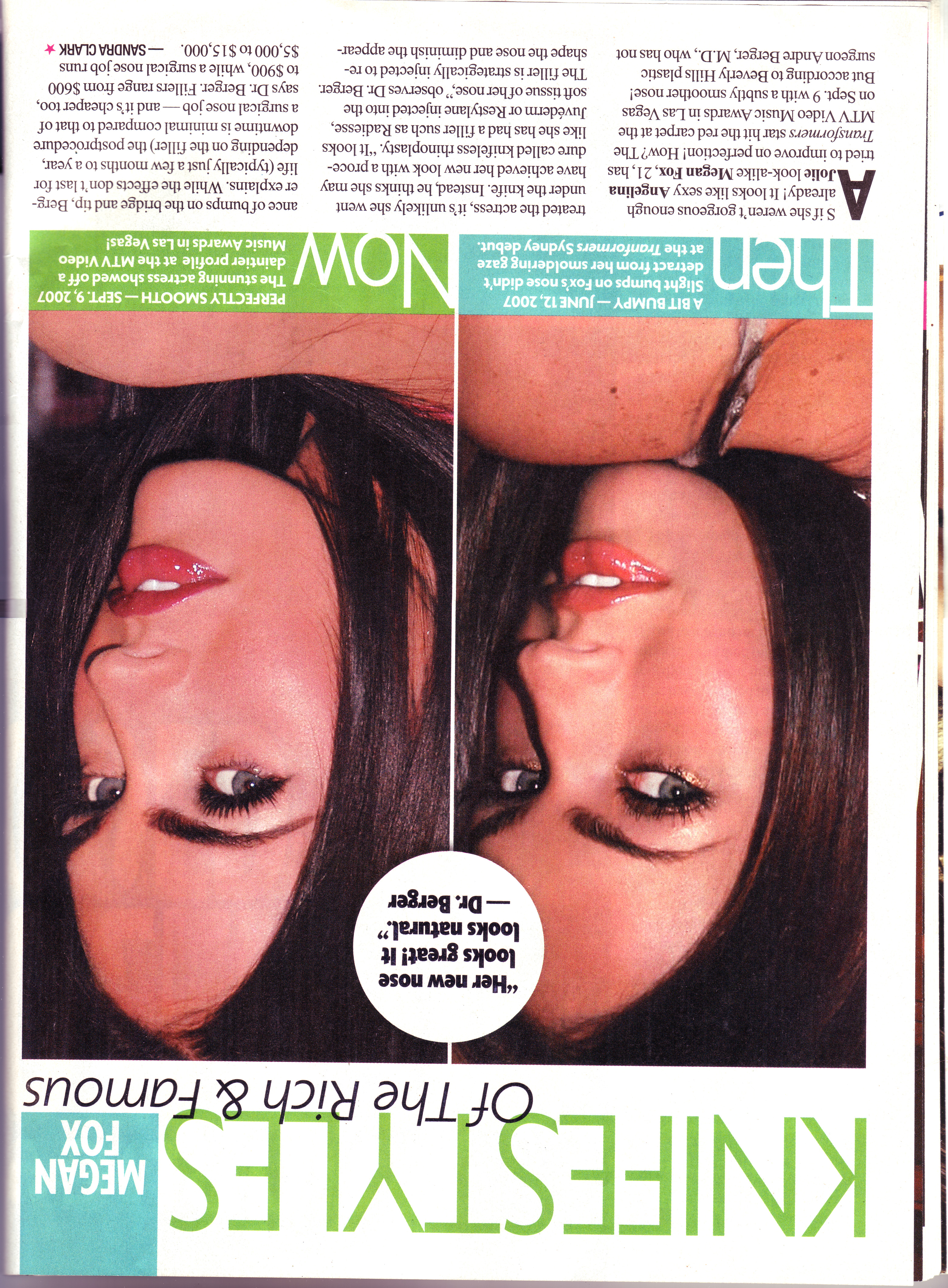 Ok, that sounds like a tabloid headline, but the more I look over Star Magazine, the more I’ve been struck by a sense of violence directed at women.
The starlets are constantly attacked for any extra weight, cellulite, bunions, ugly fingers or thick arms. It feels like open season. “Kill the Celebrity” is the name of the game.
One section called “Knifestyles” advocates mutilating women through plastic surgery. With the accompanying message, “You’re not good enough.”
In fact, Star uses the same devices that characterize domestic abusers: watching the victim’s every move, humiliation, stressing the negative rather than the positive aspects of the victim (who is supposedly adored), using “it’s her fault” to launch an attack, and transferring the abuser’s dissatisfaction with life and himself onto the victim.
After a while, she starts to blame herself.
Paparazzi hunt celebrities down and we all become cannibals of the spoils, savoring the flaws of “perfect” idols as we bring them down a peg.
But it’s not just about starlets. It’s not just their bodies that are under attack. Yours and mine are, too. If they don’t look good, we don’t either.
The depiction of women in gossip magazines represents the degradation, abuse and mutilation of women. We must recognize how damaging these portrayals are for all of us, women, girls, men and boys.
For we are all encouraged to scrutinize and vilify women for being less than perfect.
Popular Posts on BroadBlogs
Men Watch Porn, Women Read Romance. Why?
What Happens When You Beat A Sex Object?
Beautiful Women’s Hips Are Thinner Than Their Heads?
Share this:

Scrutinizing My Body Takes All My Time
On a typical day, you might see ads featuring a naked woman’s body tempting viewers to buy an electronic organizer, partially exposed women’s breasts being used to sell fishing line, and a woman’s rear—wearing only a thong—being used to pitch a new running shoe. Meanwhile, on every newsstand, impossibly slim (and digitally airbrushed) cover “girls” adorn a slew of magazines. With each image, you’re hit with a simple, subliminal message: Girls’ and women’s bodies are objects for others to visually consume.
So says Caroline Heldman, Assistant Professor of Politics at Occidental College, in a piece for Ms.
This notion of bodies for consumption leaves us constantly judging ourselves and others. How do we stack up? How do “they”?
Our friends declare someone too fat or too thin; sitcoms quip on body weight or shape; tabloids spot celebrities’ flaws; men bluster about big boobs; Howard Stern picks women apart and Rush Limbaugh insists feminism was established “to allow unattractive women easier access to the mainstream of society.” (Yes, really, Rush and Howard think they are in a position to make unkind remarks about other people’s appearance.)
All this leads women to “self-objectify” so that we see and judge ourselves through others’ eyes, and especially, the male gaze. Women live in “a state of double consciousness … a sense of always looking at oneself through the eyes of others,” says Heldman.
Self-objectifiers constantly “body monitor” – that is, think about how they look to the outside world. And this often leads to depression, lower self-esteem and diminished faith in their abilities.
Any surprise body monitoring distracts women from tasks at hand, whether math exams or throwing a softball? After all, girls have to split their attention between how they look and what they want their bodies to do.
Body monitoring also replaces the question “Who am I?” with “What image should I project?” It becomes difficult to imagine identities that are truly our own.
What to do? Heldman recommends avoiding fashion magazines, since just viewing those so-called “perfect” images makes women feel less attractive.
She also suggests we voice our concerns to companies and boycott their products.
Too often self-worth is based on unattainable body ideals. And with body image so closely tied to self-esteem, girls and women can end up pretty dissatisfied with themselves.
It wasn’t always so. There has been a dramatic increase in poor body image among women since the mid-20th century. Back then, a woman’s sense of self had revolved more around her talents, abilities and contributions. It was more about who she was than what she looked like. Maybe by shifting focus to who we really are we could more easily emerge out of ridiculous and superficial body consciousness.
Popular Posts on BroadBlogs
Lose Virginity, Lose Self-Esteem?
Harry Potter’s Hermione: Less Brainy, Brave. More Sexy
My Son Likes Girl-Things. Is He Gay?

 BroadBlogs