Category Archives: feminism
Boob: A Breast? Or a Fool?
The English language has more than 1000 words that sexually describe women or their body parts. Here are a few:
Babe, nymph, nymphomaniac, bimbo, fox, dog, beaver, freak, super freak, knockout, melons, tomatoes, whore, ho, dumb blond, shapely, pussy, boobs, hussy, slut, buxom, trim, troll, femme fatale, skank, goddess, jugs, bush, poontang, tart, loose, tramp, butch, bitch, Lolita, Betty, sex kitten, temptress, beast, promiscuous.
Sometimes neutral words take on a sexual meaning when they are applied to women. Call a man a professional and you’ll likely envision doctor or a lawyer. But say, “She’s a professional” and “prostitute” may be the first thing that comes to mind.
An author was asked to rename a book title before publication. “The Position of Women in Society” seemed too suggestive.
“It’s easy” sounds like a simple task. “He’s easy,” might denote an easy grader. But say, “she’s easy,” and you’ll likely hear “sexually promiscuous.”
One-time courtesy titles, or even high titles, can take on sexual meanings. “Madam” is a polite way of addressing a woman. She may be the female head of household. But she may also be the female head of a house of prostitution. Mistress – another term for the female head of house – is now associated with adultery. “Lady” is a polite title. But “lady of the evening” is not. Even the highest status a woman can gain, “Queen” takes on sexual connotations when applied to a gay man or a “drag queen.”
And notice how these words are demeaning as well as sexual (“gay” is beginning to overcome the stigma, but there’s a way to go). We could add drama queen and cootie queen to that mix.
Even the term boob, slang for a woman’s breast, is defined in the dictionary as, “a stupid or foolish person.” Odd that something so valued is also degraded. Is the appeal of boobs similar to the draw of a dumb blonde?
What difference does it all make?
In their work in anthropology, Edward Sapir and Benjamin Whorf learned that words affect how we see. The Hopi Indians had no words to distinguish among the past, present, and future. And they had a difficult time with those concepts. Skiers are more attuned than most to different kinds of snow: powder, packed powder, corn, ice, slush, for example. Or, we so often use male terms to describe humanity – man, mankind, brotherhood, fellowship – that when people are asked to think of a person, a man generally comes to mind.
Words dig deep into our unconscious psyches, directing how we see ourselves and others. When we constantly hear sexual and pejorative terms describing women, women come to be sexualized and demeaned in our minds.
The language we learn is neither the fault of the men or the women of our society, in so far as baby girls and baby boys both grow up immersed in these words. What’s important is how we use language once we “get it,” and once we get that it matters.
Georgia Platts
Related posts on BroadBlogs
“Cock” vs “Down There”
Sex: Who Gets Screwed?
Words: Sticks and Stones? Or Shaping How We See Ourselves?
Share this:

My Son Likes Girl-Things. Is He Gay?
Random Moms across America think they know: My son has got to be gay. He wears khakis today but wore a dress to school from age 4 to 6; he used to do ballet and still doesn’t like sports; in preschool he was all about playing princess but now is all about Pokemon; and, in spite of the clear gender divisions in third grade, he plays with both girls and boys. I mean, what straight boy is into that kinda freaky gender mash-up?

This mom knows better, and she goes on to remark that, actually, butch boys can grow up to be gay, and fem boys can grow up to be straight.
Interestingly, few moms worry that their little tomboys will grow up to be lesbians.
But this mom gets LOADS of advice on how to turn her son “boyish.” Take away the girly toys and clothes, and enroll him in sports!
So much worry about girly boys.
Yet what we think of as “girl stuff” turns out to be “boy stuff” in other times and places.
Boys shouldn’t wear pink? Years ago the country staged a great debate on whether pink or blue should designate girls or boys. Some advocated pink for boys – such a robust color! Blue is so dainty.
The Cabbage Patch craze of the last generation led a lot of boys to want dolls. One of my little boy cousins got one for Christmas. Today most people would call him a manly man, complete with wife and baby. (And G.I. Joe is a doll, too.)

Ancient Roman men wore skirts, though the one on the left is armored! (A likely relief to some macho men out there.) Other Roman men wore dresses (robes).


And we mustn’t forget men in tights, circa “Romeo and Juliet.”

Moving on to the court of the “Sun King,” Louis XIV, we find him wearing lots of lace, ruffles, curls, and color. And gracefully posed!


The American founding fathers had considerably less glitz, but they still wore more color, lace, ruffles, and curls than most men today would be caught dead in. They also hired instructors to help present a more graceful appearance. One of my male students asked, “Ok, but what did the manly men wear?” This is what they wore!

In more modern times, Scottish men can still be partial to skirts, though they call them kilts. Below are traditional and more recent versions of the garment.

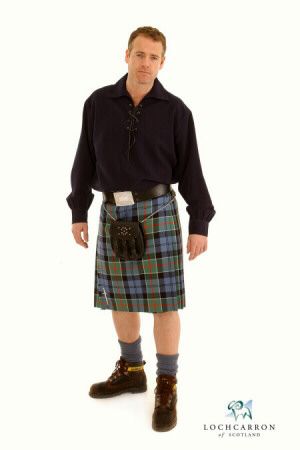
Judges, priests, and scholars also continue to wear “dresses” today.

Perhaps the most surprising expressions of manhood come from a culture entirely different from our own: the Wodaabe of Nigeria in Africa. There, men adorn themselves with makeup and jewelry. Because white eyes and teeth are part of the beauty ideal for men, they often roll their eyes and show their teeth to show off these features.

In our own time and place there’s Rod Stewart, who seems to be strongly hetero by all accounts. But check out these shots:


© Chris Walter
There’s a difference between sex and gender. Sex is biologically-based. It’s made up of our genes (xx for girls, xy for boys), hormones (testosterone, estrogen), anatomy (vagina, penis, breasts, etc.). But gender is all made up. Or what cultures make up to mark biological differences.
If clothing, makeup, jewelry and toys aren’t naturally “boy” or “girl” things, how can doing “boy” or “girl” things mark sexual orientation?
Popular Posts on BroadBlogs
Sex Objects Who Don’t Enjoy Sex
“Cock” vs “Down There”
Men Finding Fewer Women “Porn-Worthy”
Men: More Homophobic Than Women?
Share this:

Charlie Sheen: Celebrating a Bad-Boy Who Abuses Women
Charlie Sheen got fired. Until now he seemed to be rewarded more than punished for bad behavior, including a history of violence against women: He shot a fiancée in the arm, he hit a woman who wouldn’t have sex with him, he was arrested for beating a girlfriend, a porn star locked herself in a hotel bathroom as he went berserk, two of the women he married filed restraining orders against him after he issued death threats.
But right now I’m less concerned with Charlie’s behavior than with our own. Why did this abuse bring him greater celebrity than shame?
As Jezebel founder Anna Holmes pointed out in a New York Times piece, offense at abuse depends on the sort of women abused. Porn stars, prostitutes and suspected gold digging wives aren’t sympathetic.
But sometimes violence against women just doesn’t seem like a big deal. Eminem had a huge hit and huge accolades for “Love the Way You Lie,” which highlighted Rihanna singing “I like the way it hurts” as Eminem chanted, “It’s like I’m in flight, High of a love, Drunk from the hate,” while Megan Fox got beaten up in the accompanying video. The song garnered critical acclaim, including Grammy nominations for Song of the Year and Record of the Year. In fact, going into Grammy night, he led with ten nominations, including Album of the Year. No one seemed too bothered about eroticized abuse.
Oscar felt pretty hip awarding “It’s Hard Out Here For A Pimp” a few years back. Isn’t “owning,” degrading and beating women all part of the pimping life? But hey, it’s all good, as they say.
Or, Super Bowl audiences sat shocked when Justin Timberlake ripped off Janet Jackson’s bodice, revealing a bare nipple. Few cared that choreographed “slapping around” led to the grabbing and ripping. Abusing women is acceptable. But nudity is horrifying.
Then there’s Smack a Slut Week which runs October 3rd – 7th, and can be celebrated “anywhere you like, by, you guessed it, smackin’ sluts,” as The F-Bomb put it. Just a joke? One study found that men discriminated against women more after hearing sexist jokes.
Even the red hat from Devo’s “Whip It” video, depicting a man whipping the clothes off a female mannequin, is now a part of the Smithsonian collection. Accepted, mainstream stuff.
I won’t even get into the eroticized violence so often depicting women freshly killed in high fashion ads.
My first cue that Charlie had a sadistic streak was a news report that he alerted police to a “snuff” film in which a killing that followed sex looked a bit too real to him. Now, he seems to get off on harming women in real life.
Meanwhile, the rest of us stand by, barely noticing. Or celebrating Sheen’s behavior. He’s a bad boy. It’s a lot of fun, and no big deal.
Georgia Platts
Related Posts on BroadBlogs
Charlie Sheen: Winning. But Is He Happy?
Women Seeing Women as Sexier than Men
What Happens When You Beat A Sex Object?
Rape Epidemic in South Africa. Why?
Share this:

What Happens When “A Woman’s Place is in the Home”?
See anything odd in this argument about why rape should be illegal?
“Women’s power to withhold or grant sexual access is an important bargaining weapon… it fosters, and is in turn bolstered by, a masculine pride in the exclusive possession of the sexual object… whose value is enhanced by sole ownership.”
How about the lack of concern about women’s suffering from violence and violation? Nope; women are instead straightforwardly called sex objects that are owned by men.
Understanding the roots of this strange view brings me to a project sponsored by CARE, a poverty-fighting group who are discrediting “The Top 10 Myths about Women” for the 100th anniversary of International Women’s Day. To understand what went wrong with the above explanation on rape, it helps to consider this myth: A woman’s place is in the home.
What would happen if that wish actually came true?
If women are home, they’re missing elsewhere–among professors, researchers, law schools, courts, Congresses, media, business managers and religious hierarchies. And what happens when women are largely absent in the halls of power? Consider a few scattered examples:
* Turning first to the strange thesis on rape’s illegality, consider that the article was published in the 1952-53 Yale Law Journal, when the editorial board was 95 percent men, and lacking much female perspective. And, in the 1950s women’s psychology was not studied much because male researchers focused mostly on men.
* In the Old Testament (Judges 19:22-29) depraved men pound at a door, demanding a male guest be turned out to be raped. A concubine is sent out instead, to “use and do whatever you wish.” The woman is raped and abused throughout the night. At daybreak she staggers home, falls down and dies. No one seems too upset at her suffering. The concern back then was over defiled property (the concubine). Whether you take this story as historical fact, or simply as evidence of the writer’s bias, a male-dominant power structure is in play.
* In 2009 Arizona Senator John Kyle declared to an 83% male Senate that maternity leave needn’t be mandated since “I don’t need maternity care.” Well, if a man doesn’t need it, clearly it’s not important. You have to wonder if he’d be so brazen in a Congress that was half women.
* More recently, in the current 83.6% male House of Representatives, Rep. Bobby Franklin of Georgia introduced a bill to criminalize some miscarriages. Pennsylvania Rep. Joe Pitts feels hospitals should be able to refuse to terminate pregnancies even to save a mother’s life. Others want to slash support for international family planning and reproductive health care. Or as the New York Times summed it, a war on women is being waged.
* Soon after Justice Sandra Day O’Connor exited the Supreme Court, leaving an eight men and one woman jury, the ban on “partial birth” abortion was upheld. As Justice Ruth Bader Ginsberg, the sole remaining woman, noted, the ban saves no lives, but makes the procedure more dangerous for women.
We need women out in the world in places of power. Not surprisingly, women med students are pushing for abortion training at Bay Area universities (most prominently UC San Francisco and Stanford) so that women’s lives can be saved.
When women’s place is in the home, women are at the mercy of the patriarchy’s ways of seeing. And that is more than a little scary.
Georgia Platts
March is Women’s History Month
A version of this article was originally posted on the Ms. Magazine Blog on March 4, 2011
Popular Posts on BroadBlogs
Did Women Create Burqa Culture?
Cheerleader Ordered To Cheer Her Rapist, and Other Stories
Ways of Seeing: Ravaged or Ravishing?
Share this:

Sex Objects Who Don’t Enjoy Sex
Sexualizing women can have its perks in the bedroom, with breast fetishes and butt fetishes heightening men’s arousal.
But surprisingly, sexualizing women can have the opposite effect, harming both men’s and women’s enjoyment. And in many ways. Here’s one: self-objectification.
Drowning in “sexy women” images, men and women can both come to see women as the sexy half of the species. So what happens in bed? Because men aren’t seen as especially sexy (at least by comparison) men are focused on women and women can be focused on themselves.
Caroline Heldman, assistant professor at Occidental College, found that some women become preoccupied with how they look instead of the sexual experience. “One young woman I interviewed described sex as being an ‘out of body’ experience,” she said. “She viewed herself through the eyes of her lover, and, sometimes, through the imaginary lens of a camera shooting a porn film.”
Sounds a bit like Paris Hilton: “My boyfriends say I’m sexy but not sexual,” she mused. “Being ‘hot’ is a pose, an act, a tool, and entirely divorced from either physical pleasure or romantic love.”
Heldman feels that girls and women are learning to eroticize male sexual pleasure as though it were their own. She feels they need to explore their sexuality in more empowering and satisfying ways than this vicarious act.
Cultural theorist Jackson Katz has similar concerns. “Many young women are now engaged in sex acts with men that prioritize the man’s pleasure,” he reflected, “with little or no expectation of reciprocity.”
When having sex, these young women may be enjoying themselves, and how nice they look. They may gain a boost to self-esteem as they dwell on their “hotness.” But they’re not enjoying sex.
Popular Posts on BroadBlogs
Women Seeing Women as Sexier than Men
Women Learn the Breast Fetish, Too
Surprises in Indiana University Sex Survey
Share this:

Why Do The “Isms” That Affect Men Seem More Important?
“You’re never going to have this revolution happen unless there’s also a sexual revolution.”
That’s Bill Maher’s verdict on the push for Democracy in Egypt as he discussed the matter on his show, Real Time with Bill Maher.
Pro-feminist, Tavis Smiley, agreed that women need to be treated better. Yet he inserted a different spin: “When we have these conversations about how they treat women, as if we treat women better in our country, it demonizes Muslim men.”
The most well-meaning among us, men like Smiley, work hard to respect other cultures. Yet sometimes we need to discern whether powerful elements of a society are harming less powerful targets. And really, is pointing out a need for improvement “demonization”?
Mr. Smiley is a-okay in my book, and I appreciate his aim here. Yet there is plenty of room for change in cultures that (depending upon the country or province) stone women for being victims of rape, beat women for leaving home without a male relative, keep girls out of school, forbid women from driving, make divorce difficult for women but easy for men, remove battered women from shelters, and cut women’s genitals – leaving them in pain, crippled, or dead.
It’s a sad turn of events when early Islam did so much to improve women’s rights in the world. The Koran gave women the right to work, inherit and own property. Female infanticide and slavery were abolished. Women were given the right to consent to marry. Protections against abuse became instituted.
Today Islamic scholars like Dr. Jamal Badawi work to support women’s rights. Meanwhile, large majorities favor legal, political and professional freedoms for women in North Africa and many countries in the Middle East and the broader Muslim world, according to a 2007 Gallup poll. In fact, the Islamic culture of West Sumatra, Indonesia is one of the most peace-loving, egalitarian places on the planet.
Islam isn’t the problem. Neither are Muslim men.
Still, problems abound. Yet Smiley seems more concerned with ethnocentrism than sexism, given his desire to cut off conversation. Why do the “isms” that affect men seem more important? And did women have equal power to create the cultures that oppress them?
When ethnocentrism and sexism are at odds, which worries should prevail? Cultural relativism – don’t judge one culture from the perspective of another – is a good guide most of the time. But what if someone is being harmed? When people are killed for reasons other than self-defense, when they are crippled physically, emotionally, intellectually or spiritually, those circumstances must trump all others.
Must we worry more about offending those who create cultures that harm women than freeing women who are harmed by them?
Meanwhile, Islamic feminists complain that Western women can be too fearful of offending ethnic sensitivities to back their feminist sisters.
Now, is lecture the best way to handle this? Dialogue is better. Other cultures have perspectives that can benefit us, too. Perhaps we can learn from each other.
Love Tavis. But he insists we cannot criticize until we perfect ourselves. We’ll never be perfect. Still, we must fight oppression wherever it is found, here and there, to whatever degree we find it. Tolerating intolerance is not progressive.
Georgia Platts
Popular Posts on BroadBlogs
Early Islam’s Feminist Air
Did Women Create Burqa Culture?
Don’t Reject Your Culture, Even When It Mutilates You
Cultural Relativism: Must We Be Nazis to Criticize Them?
Share this:

Learning to Say No in 520 Languages

I’m Learning to Say No in 520 Languages
“How often do I hear my brain screaming NO as I smile and say yes? These random words are all “NO” in different languages. So I am learning to say no in 520 languages, most importantly mine, NO.”
Artist, Karen Gutfreund, works with unconventional materials: roof tar, bone, red food coloring, wax… Moving against standards and customs, is she saying NO even in the becoming and embodiment of her art?
She has good reason to go against the flow. We all do.
“Using hot political issues, I mix it up with text, pop culture images, stencils, and symbols to create works that are a combination of personal commentary, religious and moral teachings, political outrage and social observation,” she says. “Often the imagery and core meaning of the painting is very personal and emotionally gut-wrenching, so that not being able to discuss it verbally, I present it visually. Part humorous, part tragic.”
As she explains, the layering and mixed meanings echo and reveal the inner complexity of dreams, nightmares and emotions.
Her work strikes a chord with a piece I once read entitled, “Betrayed by the Angel”:
“I’m 25 years old. I’m alone in my apartment. I hear a knock. I open the door and see a face I don’t know. The man scares me, I don’t know why. My first impulse is to shut the door. But I stop myself: You can’t do something like that. It’s rude… He is inside. He slams the door shut himself and pushes me against the wall… Since he is being rude, it is okay for me to be rude back.”
Despite her revelation that rudeness can be good, it was too late. The young woman was raped.
Some feel queasy at self-defense seminars when told to gouge out an attacker’s eyes. “Could I do something less gruesome?” Advice from the expert: “He’s bigger than you. If you try something weaker he’ll overtake you and you’ll be raped or dead.”
I had it easier. But not really easy. He was a guy from church, and we were dating. At church we didn’t have double standards. Men and women were both told to stay pure. So inexperienced and naïve that when he touched me outside my clothes, but at “third base,” I froze in shock. Was he really doing that? I didn’t want to be rude. In guarding his feelings I paid a price, smacked with the label, “loose.”
Virginia Woolf speaks of the Angel in the House. Some scattered lines:
“You who come of a younger and happier generation may not have heard of her – you may not know what I mean by the Angel in the House… She was intensely sympathetic. She was immensely charming. She was utterly unselfish… She sacrificed herself daily… She preferred to sympathize always with the minds and wishes of others…
“I turned upon her and caught her by the throat. I did my best to kill her. My excuse, if I were to be had up in a court of law, would be that I acted in self-defense. Had I not killed her she would have killed me.”
This piece was originally shown at “CONTROL,” an exhibition of California women artists presented by The Women’s Caucus for Art at New York’s Ceres Gallery, February 1 – February 26th, 2011.
For more on Karen Gutfreund’s work go to her website.
Popular Posts on BroadBlogs
Spoon Fed Barbie
Cartoonish vs Authentic Sexuality
Sex: Who Gets Screwed?
Share this:

What Abusers and “Pro-Family” Conservatives Have in Common
Birth control sabotage has been revealed to be a common form of partner abuse. In a report released earlier this week by the National Domestic Violence Hotline, 25 percent of women callers to the hot line, who voluntarily answered questions about birth control and pressure to get pregnant in their relationships, reported some form of reproductive coercion.
The callers said their partners hid birth control pills or flushed them down the toilet. Some refused to wear condoms or poked holes in them. One woman’s partner became furious when she recently got her period.
The study’s authors state firmly that reproductive coercion is a form of abuse. Family Violence Prevention Fund president Esta Soler says, “While there is a cultural assumption that some women use pregnancy as a way to trap their partner in a relationship, this survey shows that men who are abusive will sabotage their partner’s birth control and pressure them to become pregnant as a way to trap or control their partner.”
And physical and emotional abuse go hand-in-hand with birth control sabotage: Another study on reproductive coercion found that one-third of women using reproductive health clinics (of five studied), whose partners were physically abusive, also said their partners had pressured or forced them into pregnancy, often hiding or destroying contraception.
This tactic should alarm feminists and anti-domestic-violence workers. It also suggests a revealing political analogy.
It seems these ostensibly “pro-family” men, who are busily destroying contraception in pursuit of children, have a lot in common with the “pro-family” (read: anti-reproductive rights) political agenda.
So why aren’t we willing to call the anti-choice agenda abusive, too?
The conservative political agenda is anti-women working outside the home, anti-abortion, anti-birth control, and once upon a time, anti-battered women’s shelters (the better to keep women inside the home and attached to intact nuclear families). Each of these stances, in some way, disempowers women.
It’s easy to see how restricting shelters keeps women under the thumb of abusive men: It’s a no brainer. If there’s no safe place to go, you’re trapped.
The same holds for denying women access to birth control or abortion. If you’re pregnant with this man’s child, you’re attached–you’re trapped, again, by an unwanted pregnancy.
And women who don’t work outside the home tend to have less say within it. Not to mention that a lack of income makes it hard to leave an abusive partner.
The “pro-family” political agenda may claim to uphold “traditional” American values, but for for many young men claiming to want “normal” nuclear families, pregnancy coercion is a form of abuse and control. What kind of “family values” are those?
Georgia Platts
This post originally appeared in the Ms. Magazine Blog, February 18, 2011
Related Posts on BroadBlogs
Are You Pro Life, Or Do You Just Want To Control Women?
Patriarchy’s Role in Shielding Pedophile Priests
Is Sexism Men’s Fault?
Share this:

The Constricting Bodice: Empowerment and Imprisonment?
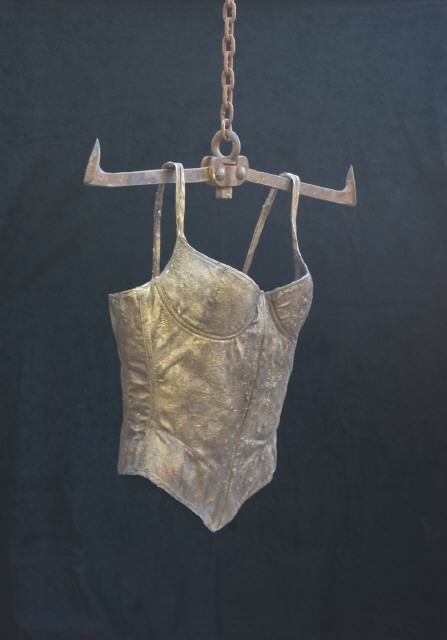
Bodice
— Angela Fortain
In her series “Overt Underthings” artist, Angela Fortain, considers a paradox: Distorting the body can both liberate and imprison, she says. Society dictates constraining fashions which, once dawned, create power over others.
Power over others?
By way of men’s desire, women’s envy.
The power to shape space as others turn in our direction.
Favors.
Lower status bowing to higher. Standing based on beauty – and what to make of that?
The power to gain love? Or sex? And must one undergo body-torture to attain either?
How might power become less available inside the constrained body?
Are the powers bestowed – or removed – substantive or superficial?
Finally, Fortain muses, “Separating the sensual object that once transformed the wearer into an object of sexuality allows us to examine the object, and our own desire.”
The power of objects… our own desire?
Fortain’s work provokes more questions than answers. As art should.
Georgia Platts
This piece was originally shown at “CONTROL,” an exhibition of California women artists presented by The Women’s Caucus for Art at New York’s Ceres Gallery, February 1 – February 26th, 2011.
For more on Angela Fortain’s work go to ARTslant.
Popular Posts on BroadBlogs
Spoon Fed Barbie (Part of the CONTROL series)
Men Aren’t Hard Wired To Find Breasts Attractive
Men Are Naturally Attracted To Unnatural Women
Surprises in Indiana University Sex Survey
Share this:

Men: More Homophobic Than Women?
 There is plenty of bad news on the gay/lesbian front. Suicides, gay-bashing. Just a few months ago a gubernatorial candidate maintained that “homosexuality is not an equally valid option” but felt women having sex with horses was hot. Historically, men have been more homophobic than women. But why?
It’s common to think of gay men as woman-like. Some act feminine, feminine stereotypes abound, and gay men do often perform sexually like women.
The very idea that men might be like, or act like, women is pretty threatening to manly men. But even more so when manhood feels insecure.
Men acting anywhere in the realm of womanhood collapses the great divide between male and female. Seeming more the same, male dominance and status are at risk.
Further, if gays and lesbians couple together no one can be the male head of home. Another blockage to male dominance.
But in the last four years the level of homophobia among men has dropped drastically, according to a Gallup poll taken a few months ago. Today men are no more homophobic than women. What happened?
Importantly, women’s status has risen. If women and men are equal, then men acting like women isn’t the big threat it had once been.
But women and men haven’t achieved full equality yet. So what else is going on?
New York Times columnist, Charles Blow called a couple of experts to get insight into the change in men’s attitudes. He talked with sociologist, Michael Kimmel, who studies men, and Ritch Savin-Williams, Cornell’s Chair of Human Development and an expert on same-sex attraction.
Dr. Kimmel notes that, “Men have gotten increasingly comfortable with the relative equality of ‘the other.’ The dire predictions for diversity have not only not come true, they’ve been proved to be other way.”
Additionally, as gays and lesbians come out of the closet people come to see that they are like the rest of us: our fathers and mothers, our sisters and brothers, our friends and coworkers. Who knew they were real people?
Most interestingly, “virulent homophobes are increasingly being exposed for engaging in homosexuality,” as Blow put it. Evangelical Ted Haggard and George Rekers of the Family Research Council have both been outed. Not long ago, anti-gay megachurch pastor Eddie Long was accused of coercing young men into sex. Some are starting to see that spouting homophobia can be a front for the gay man inside. (Is homophobia acting to decrease claims of homophobia?)
Despite continued gay bashing, things are looking up.
Related Posts on BroadBlogs
Homophobes Aroused by Gay Porn
Higher Suicide Rates in Conservative “Values Voters” States
Gay Marriage Helps Families

 BroadBlogs