Blog Archives
Woman, Not the Sum of Flawed Parts
By Linda Bakke
 Star Magazine. Full of faces covered by question marks, bodies sliced up. Women diminished to the details of their flaws, circled in bold. A dissection of celebrities’ body parts.
I was working as a receptionist at a hair salon when I discovered Star. I picked it up and paged through. It was awful. I could not put it down.
One article divulged a star’s “hairy secret,” detailing the frequency of her waxing regimen and suggesting her pubic area was overly hairy. A two page spread highlighted shameful “sausage fingers.” Another asked who had the worst toes.
It all oddly evoked the serial killers who keep articles – or worse, dismembered body parts – as trophies.
And what is the triumph here? A sensed superiority over the goddess’ faults as we lie in judgment?
And who can blame us? Their supposedly error-free bodies stress us out! Destroying them and their presumed perfection just might lift our spirits.
But maybe scrutinizing them only returns scrutiny to us, as the judgments tell us we must correct our own “blemishes,” whether buttocks, breasts, fingers or toes.
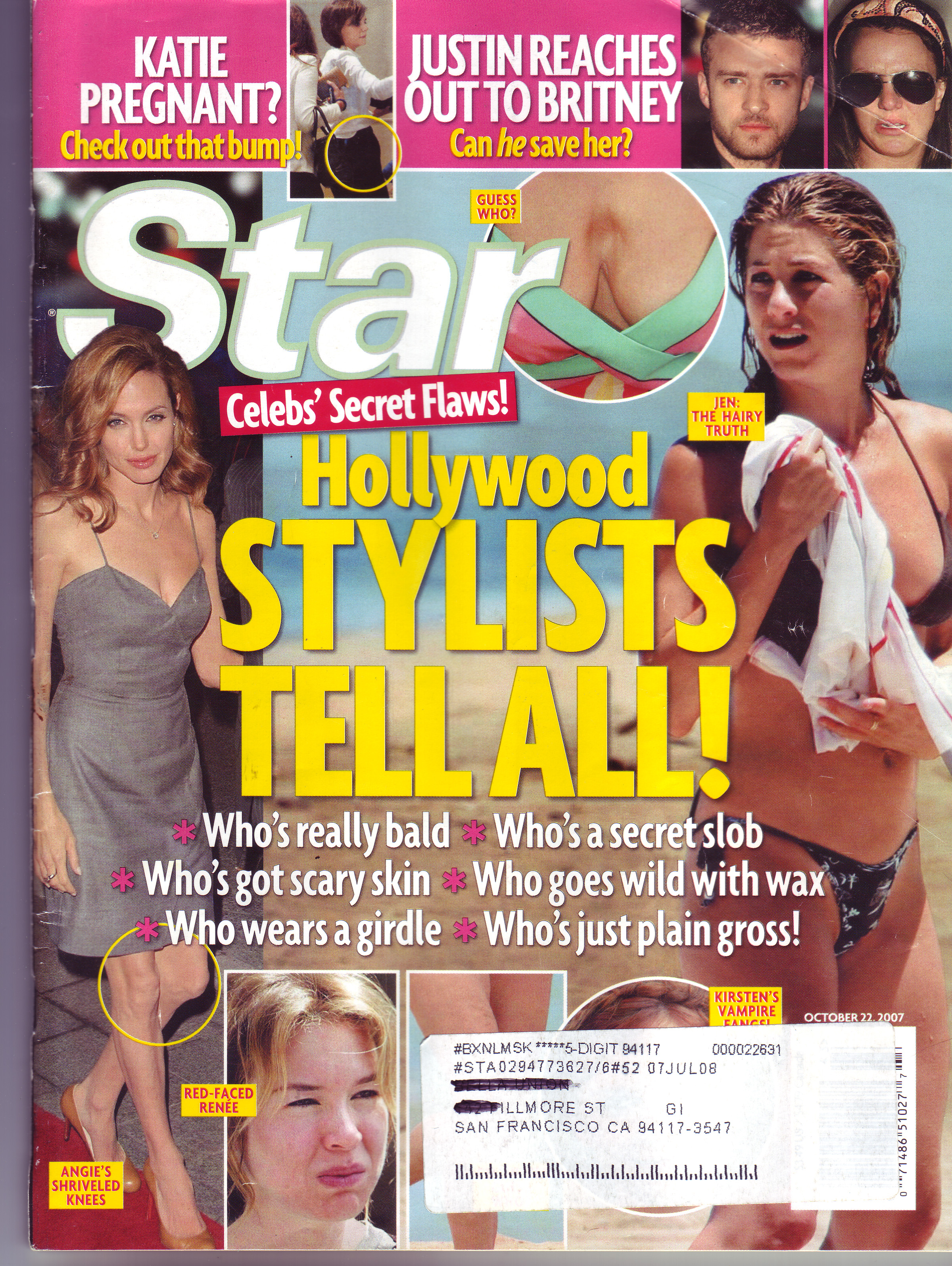 The message: women’s imperfections cannot be tolerated.
As we eat it up, we fail to see how we become victims, too, unconsciously nodding agreement that this treatment of women is acceptable.
While the pictures and text underline our preoccupation with facade over character, men’s bodily foibles are untouched by these tabloids. Who can imagine placing a man in such light?
Hopefully one day we will take on realistic and healthy expectations so that women will no longer be seen as the sum of flawed parts.
Popular Posts on BroadBlogs
Keep Your Boobs, Get Better Guys
How to Look Like a Victoria’s Secret Angel
Beautiful Women’s Hips Are Thinner Than Their Heads?
Share this:

You Are “Less Than”?
How could anyone ever tell you
you were anything less than beautiful?
How could anyone ever tell you
you were less than whole?
How could anyone fail to notice
that your loving is a miracle?
How deeply you’re connected to my soul.
The song “How Could Anyone,” has had a worldwide healing impact. The lyrics have touched AIDS orphans, cancer survivors, disabled teens, and women and girls redefining beauty.
These words by Libby Roderick have touched me, too.
I first heard them soon after I’d broken up with a boyfriend. This man had said nothing outright about my being “less than,” but sent heavy cues by his occasional gaping at women who took up all the space of his vision while I disappeared.
When I asked about it, he said, “Well, yeah, other women are more attractive than you.” And added, “There’s an archetypal image that men are just naturally drawn to.” Archetypal Playmate, that is.
Men are naturally drawn to something unnatural? Plastic-chested, unnaturally starving and airbrushed? The current ideal is actually both new and strange.
In his eyes I felt less than beautiful. And less than whole.
But this song made me reflect on whether I wasn’t whole or whether he simply had a partial view.
Just what is whole, really? What is beautiful?
False, synthetic, shallow?
Genuine, sincere, heartfelt, deep connection?
When we meet those who dwell on the surface, living with limited sight – whether ourselves or others – forgiveness begs. For blocked vision brings suffering to the seer.
And remember:
Every loving thought is true
Everything else is an appeal for healing or help
From Accept This Gift
It’s not that we’re not whole. But in obstructed vision, we aren’t entirely seen.
How Could Anyone http://www.libbyroderick.com/cd_new.html
Words and music by Libby Roderick c 1988
From the recordings “How Could Anyone” and “If You See a Dream”
Turtle Island Records Anchorage Alaska
www.libbyroderick.com libbyroderick@gmail.com
Popular Posts on BroadBlogs
Men Finding Fewer Women “Porn-Worthy”
Keep Your Boobs, Get Better Guys
Fatal Attraction: Relationship Killed By What Sparked It
Share this:

Does Sexual Objectification Lead to Bad Sex?
Turning women into sex objects heightens the erotic experience, right?
A growing body of research indicates the opposite: for women and, surprisingly, men.
A new longitudinal study out of Pennsylvania State found that when women lost their virginity, they lost self-esteem, too. Before they had sex, the body image of the women in the study steadily improved. But after a first sexual experience it dropped. Why? The study found that in bed women became self-conscious and critical of their bodies.
Tracy Clark-Flory over at Salon.com points out that this loss of self-esteem likely spells a loss of sexual pleasure. While women are supposedly enjoying sex, an awful lot of us are distracted, worrying that we don’t meet sex-object standards. Breasts are too small? Butt is too big? Cellulite, anyone?
Or as Clark-Flory puts it, “You think, ‘Do my breasts look OK from this angle’ instead of, ‘Wow, this position feels fantastic.’”
Even if you are proud of your body, self-scrutiny can distract from lovemaking. Caroline Heldman, assistant professor at Occidental College, writes that women who are hyper-aware of their appearance see sex as an ‘out of body’ experience, but not in a heavenly way. They view themselves through an imaginary camera lens, focusing on how they look in one position or another, as if they were porn stars. And their sexual pleasure suffers.
Heterosexual men should pause at this news. It’s likely they would enjoy themselves more if their partners were present and actively engaged, instead of dealing in distraction.
But objectification of women can also interfere more directly with straight men’s enjoyment of sex. Men who consume porn often say they come to objectify women in a way that has them expecting a particular body type, leaving them disappointed if their partner looks different from the images they’re used to.
“I prefer women with a C- or D-cup, full-figured but definitely not overweight. I don’t want some small spindly girl either,” a young man explained in Pamela Paul’s Pornified. “Briana Banks is the ultimate. She’s not only blonde, she’s got the right chest size.”
In Pornified, psychologist Gary Brooks explains that he is concerned that many of these men lose the ability to be aroused by their partner’s positive features, and try instead to “re-create the images from porn in their brain when they’re with another person in order to maintain their arousal.” Adds Mark Swartz, clinical director of the Masters and Johnson clinic in St. Louis:
You’re making love to your wife, but you’re picturing someone else. That’s not fair to the woman, and it’s miserable for the man.
Some men may think objectifying women is a harmless pleasure, but the Penn State study and others suggest it’s a buzzkill. Think this information could spur a movement to end objectification?
I originally wrote this piece for the Ms. Magazine Blog, where it appeared May 10, 2011
Popular Posts on BroadBlogs
Cartoonish vs Authentic Sexuality
Men Watch Porn, Women Read Romance. Why?
Women Want Emotionally Connected Sex. Why?
Share this:

Men Are Naturally Attracted To Unnatural Women
Ask a guy why he looks at porn and he’s likely to say that men are just naturally attracted to women. But the women in porn don’t look too natural.
Actually, women in fashion magazines and billboards don’t look too natural, either.
Women and men both learn to admire a feminine ideal that ends up frustrating both men and women.
Most women have to starve themselves to be ideally skinny. Many models are so thin that they have stopped menstruating. Isn’t the natural instinct to stay alive and well?
And how about fake breasts? If men are naturally drawn to breasts, why do so many women go under the knife and mutilate themselves so that men – and society – will find them attractive?
Then there’s the preference for blondes. Few women past puberty are true blondes. But unnaturally bleached hair is the top color of choice, both for men and for women who want to look beautiful. Well, at least peroxide doesn’t require enormous amounts of money or risk much bodily harm.
So models go through all their pain and suffering, but it’s not quite enough. Next, the malnourished, plastic-chested, bleached out images go to be photoshopped and airbrushed to look even more fake than they already are.
So women try in vain to match ridiculous notions of beauty. Then get depressed because nothing they do seems to work.
But the models don’t look like “themselves,” either!
At the same time, male students have told me that all this hurts them, too. “What’s wrong with me?” they wonder. “Why can’t I get women who look like THAT?”
Well, those “picture perfect” women don’t actually exist.
So women can never achieve the ideal. And men can never have the ideal woman.
Meanwhile, men are left feeling “naturally” attracted to something that isn’t natural.
Popular Posts on BroadBlogs
Men Finding Fewer Women “Porn-Worthy”
Men Aren’t Hard Wired To Find Breasts Attractive
Men Watch Porn, Women Read Romance. Why?
Share this:

Women Want Emotionally Connected Sex. Why?
 Women want emotionally connected sex.
Not all women, all the time, but University of Texas psychologists, Cindy Meston and David Buss interviewed over 1,000 women around the world for their book, Why Women Have Sex, and what did they find? Both women and men have sex because they are physically attracted, for pleasure, because they are in love, or just because they’re horny… the list goes on. But most women want emotionally bonded sex.
Why?
Conventional wisdom looks to evolutionary psychology which says that women are genetically driven to be more monogamous so that fathers will stick around and provide resources, helping children to survive. So perhaps women pass up casual sex with whomever in favor of the connected sex that would provide those good-for-baby resources.
Yet not all women are terribly monogamous. And in some cultures, none are. Women who belong to tightly-knit, interdependent tribal groups often have sex with many men, often outside their marriages or partnerships. In these places the entire tribe raises children so paternity is unimportant and women’s sexuality is not guarded. These sex-positive cultures produce women who are highly orgasmic and who greatly enjoy sex.
But when these societies are destroyed (as with the Cherokee and Iroquois) immersion into a sex-negative culture (for women) can quickly turn their sexuality around.
Today in the U.S. a sexually interested and active woman may be called a slut, whore, ho’, tramp, skank, nympho, hussy, tart, loose, bitch, promiscuous, and perhaps most tellingly, freak or super freak.
Women leaving the frat house Sunday morning may be chided for taking the “Walk of Shame” as frat boys returning from the dorms stroll the Walk of Fame.
Slang for our privates? “Cock” versus “down there.” Put another way, cocky versus unspeakable.
And who gets screwed, f’d, banged, nailed and rammed?
Meanwhile, women are the sex objects in our culture, with busts and butts ogled in word, picture, and x-ray vision, offering men a trove of sexual stimulus. What do women have to look at? Not much.
But as sex objects, women may also become more focused on how they look in bed (whether good or bad) than enjoying anything erotic.
Add to this the sexual violence that so frequently ends in lost sexual interest.
All of this leaves women less responsive, with a University of Chicago study finding 43% of women experiencing dysfunction.
Any wonder men are more interested in random acts of sex, while women are more inclined toward emotional bonding? In the arms of someone she loves a woman may feel free from slut-shaming. She may focus on intimacy and not how fat or thin she is. She is freed from worry about being screwed. And if she has difficulty achieving orgasm, she can still revel in her man’s love-filled attentions.
On top of this, women are more often taught that “sex is okay if you love him.”
Of course, women have varieties of social experiences and personalities, so despite the culture, some will certainly be up for sex with anonymous others.
The longing for bonded sex emerges from sources other than the horrors listed above. And certainly, many men want loving, connected relations, too. Justin Garcia, an evolutionary biologist at Binghamton University, observes that, “Having deep relationship with someone can be really magical and people all over the world experience that… (it) can really change someone’s life.” But for all the reasons listed above, sex-for-fun may not be so fun for a lot of women, which can leave other options out.
Related Posts on BroadBlogs
Men Watch Porn, Women Read Romance. Why?
Lose Virginity, Lose Self-Esteem?
Sex Objects Who Don’t Enjoy Sex
Why Hasn’t Open Marriage Caught On?
Share this:

Keep Your Boobs, Get Better Guys
 If I had I been more spiritually evolved, or more grounded at 22 when I got breast implants, I never would have gotten them. Yes I got lots of attention, sexual attention. And for awhile I enjoyed it. But as the saying goes, be careful what you wish for. It became apparent that the attention I received was not from quality people… Why did I mutilate my body to appease the tastes of SOME men? We were all duped by the media, the medical profession, our low self esteem. I am now ready to have these D cups removed.
That’s a comment a woman placed on a web site called “48 Reasons Not To Get A Boob Job.” The response followed the male author’s contention that:
If you want more male attention, implants may increase the quantity but only with a corresponding decrease in quality. You’ll probably get your biggest gains in approval among guys who are most prone to objectifying you.
Whether you see all this as good or bad depends on what you’re after. If you want all eyes on you, or random sex, fake boobs could do the trick.
So I’ll address this to those who want something else. Quality men for quality relationships.
Fake boobs seem to create an image of “sex object.” Consider this experience:
A woman asked me about implants last week and I told her about the risks. But I told her the things people don’t talk about, like not being able to buy every little cute top, how no one looks you in the eyes, how people think of you as a bimbo.
Sex may not be so fun, either. Men don’t see objects as having feelings, and feel little empathy in return. Women exist to fill their needs, as far as they’re concerned. In Pornified Pamela Paul talks of objectified sex lives as all about bodies and positions, and not about intimacy.
But the culture worships its fetish, leaving a young woman asking girlsaskguys.com the following question.
Are big boobs important to guys? Because as you can see from the photo, I have really small breasts and I have really low self-esteem because of it. Do guys only think a girl is hot by the size of her bra cuz if that’s true I am in big trouble.
Here’s what some guys thought about guys who judge women by bust size:
- If someone would not date you based solely upon the size of your breasts they would not be worth jack squat anyway.
- If any guy judges you differently because of your breast size, he doesn’t deserve you!
- I like girls more for how the face looks. Nice eyes, lips, smile, hair, eyelashes… Any guy getting with someone just because they have a nice rack doesn’t seem like it could be a stable relationship.
- Don’t worry about your boobs, period. We love you for who you are.
These are some higher quality men.
There’s only a two-inch difference between an A-cup and a C-cup. Or between a B-cup and a D-cup. Two inches! That is the measure by which a woman judges herself? Or the measure by which a man judges a woman? Please! Be glad to lose those guys!
Do you really want to be wanted for your boobs and not for you? Are these types of
men even worth bothering with?
And here’s some good advice:
I’m not busty, nor am I gorgeous, but when I was single, I had NO TROUBLE attracting plenty of great men. I have some hints for women who are interested in attracting men — they have NOTHING to do with your boobs!…. #3 Carry yourself well! Stand tall… #5 — Don’t apologize for your body…. If the man you’re with constantly makes you feel insecure, you don’t need a boob job – you need a new man!
Popular Posts on BroadBlogs
Anything Good About Being A Sex Object?
Sex Objects Who Don’t Enjoy Sex
Men Aren’t Hard Wired To Find Breasts Attractive
Share this:

Self-Esteem Falls with Rise in Power? Blame Beauty Ideals
Even as women’s power has increased over the last fifty years, self-esteem has too often diminished. Why? Blame unachievable beauty ideals.
Since the mid-twentieth century, the number of women and girls with poor body image has greatly risen. A big problem, since feminine self-worth has become closely tied to body image.
As Naomi Wolf explains in The Beauty Myth, women have more money and power than ever before but, “a secret ‘underlife’ poisons our freedom; infused with notions of beauty, it is a dark vein of self-hatred, physical obsessions, terror of aging and a dread of lost control… In fact, in terms of how we feel about ourselves physically, we may be worse off than our unliberated grandmothers.” Too bad her book, which was written twenty years ago, is not now obsolete.
Once upon a time, she says, the family was a productive unit so that a woman’s value lay in her work skills, economic shrewdness, physical strength, and fertility, with physical beauty playing a lesser, and less oppressive, role.
Before the industrial revolution – before photographs, photoshop, and plastic surgery – women did not feel pressured to live up to a mass-marketed ideal – one that is nearly impossible to achieve, leaving women frustrated and depressed, obsessed with their looks, and wondering what is wrong with them.
As the beauty myth creates a hierarchy pegging some better than others, I am reminded of a piece by Nick Kristof of the New York Times, entitled, “Equality, a True Soul Food.”
He cites evidence from two British epidemiologists who wrote a book called, The Spirit Level. Richard Wilkinson and Kate Pickett argue that “Gross inequality tears at the human psyche, creating anxiety, distrust and an array of mental and physical ailments,” with those at the bottom of unequal societies suffering from a range of pathologies.
The Spirit Level is concerned with economic disparity. But the theory fits with other
inequities. Beauty hierarchies leave too many women depressed with low self-esteem, eating disorders, competing to be plastic on reality TV, jealous, envious, and sometimes dying from anorexia or plastic surgery. Notably, the problem isn’t so much where you stand as where you think you do. Unfortunately, it’s common for women to place themselves at the bottom, and suffer.
Inequality undermines social trust and community life, and people feel stressed when they sit at the bottom of a pecking order. Kristof discerns that the toll of our inequality is a melancholy of the soul.
Why not celebrate the wonderful variety of figures and faces that women embody, instead?
Popular Posts on BroadBlogs
Men Are Naturally Attracted To Unnatural Women
The Constricting Bodice: Empowerment and Imprisonment?
Men Finding Fewer Women “Porn-Worthy”
Share this:

I Overate Because I Felt Guilty Eating
What if I just have a small slice of raspberry cheesecake? I was good today, I deserve it. Maybe a bigger slice would be okay if I eat celery later? They would cancel each other out, right? Or I could eat the cake while jogging in place?

These are the musings of a young woman’s mind in a Yoplait yogurt ad. (See ad here.) Sound familiar?
Does to me. Evokes the mantra that once ruled my twenty-something brain. Back then, food was both magic and evil. That’s a noxious combination, known to create obsessions and addictions.
A person who feels guilty about eating often overeats. They obsess about food. Food calls to them. Think you’ve had a little too much? Feel guilty! Now that you’ve sinned you might as well go all the way. Besides, a pint of Häagen-Dazs feels sooo good. At least while there is still some left in the container.
Works the same with alcohol. To the Irish, spirits magically change your mood. But overindulging brings shame and disgrace. Imbibed a bit too much? Might as well drink more and feel better. The Irish have fairly high levels of alcoholism. It’s different in places where alcohol is simply a part of dinner. A good wine is a dining must in France. And alcoholism is low.
But back to eating disorders. Some are more serious than mine. Jenni Schaefer survived both anorexia and bulimia. She told the Huffington Post that you start to divide foods into “good” and “bad” categories until they all seem bad. “I was shocked by how (the ad) really nailed it on the head,” she said. “That’s exactly what I thought every time I opened a refrigerator door.”
Experts worry that the ad’s message makes this sort of obsessive thinking seem completely normal, with some responding by eating too little, while others eat too much. To their credit, Yoplait pulled the piece once concerns surfaced.
I was lucky to eventually hear a different message. I was shocked to find a diet that denied the notion that food is bad. Maybe because the book, Eat to Win, was written for athletes with tennis champ, Martina Navratilova, a fan.
The notion that food is good and shouldn’t be an obsession had a profound effect on me. I highly recommend a healthy perspective on food that recognizes the need for nourishment and enjoyment.
Related Posts on BroadBlogs
I Can’t Believe I Ate A Whole Head Of Lettuce!
500 Calories + Pregnancy Hormones = Perfect Body
Beautiful Women’s Hips Are Thinner Than Their Heads?
Share this:

Grade School Lingerie
When I was ten years old plenty of my friends would wear “big girl lingerie” that they got from Abercrombie and the like. I felt pressured to constantly push to be sexier, or more desirable. At ten years old, who exactly am I trying to attract?
This comment (paraphrased) came in reaction to a piece I recently wrote called, “Cartoonish vs Authentic Sexuality.”
I found the remark a bit starling. At age ten I did not feel any pressure to be sexy. I was a kid! None of my little-girl friends seemed to have such notions, either.
Wondering who she was trying to attract, the young woman added, “I don’t think any of us really knew the answer to that, but it felt necessary all the same.” And then she asked what lay behind the focus on sexualizing young girls.
My first thoughts are that companies like Abercrombie are trying to get young kids to like their brand by appealing to the desire to feel “grown up.” Not to mention all the free
publicity they get from controversies surrounding their products.
But I’ve also noticed a broad trend toward sexualizing both girls and women that goes beyond what I had experienced at the age of ten, or even twenty.
In fact, not long ago I was flipping through TV channels looking for movies when I saw the 1988 film Crossing Delancy with Amy Irving (Steven Speilberg’s ex) and the 1986 film About Last Night with Demi Moore and Rob Lowe. And then I noticed that in these films – and several other romantic comedies of that period – the women were not dressed sexually. No body-hugging clothing. No revealing décolletage.
Why the change?
Naomi Wolf’s The Beauty Myth might help us out. Wolf points out that as women
have gained power they have also become more sexualized. She says it’s no accident.
Think about it. As women take on sex object status, they become objects. Objects aren’t quite human, leaving them at a lower rung on the ladder than men. Meanwhile, the ideal of huge breasts and skinny waists is near impossible to achieve, leading to poor self-esteem and an awful lot of time spent trying to fulfill this “requirement.” And if you’re busy focused on your looks, you’ll take your attention off more substantive things.
In sum: As women become more sexualized, even as they gain power they lose status by becoming objects. Even as women gain power, narrow notions of beauty leave them feeling worse about themselves as body image suffers. As women put tremendous time and energy into their looks, they have little time or energy left to become more empowered.
I personally feel that sexy is fine (and beyond the cartoonish narrow notions, please!), but that “sex object” isn’t. Sexy can be one part of a well-rounded woman’s life, while “sex object” sees women as being only about sex.
Women should not be seen as only sexy. Sexy should not be the primary source of self-worth. Sexy should not be the most important thing in the world.
And children should not be trained to see themselves as objects.
Georgia Platts
Popular Posts on BroadBlogs
Cartoonish vs Authentic Sexuality
Spoon Fed Barbie
Women Seeing Women as Sexier than Men
Share this:

Anything Good About Being A Sex Object?
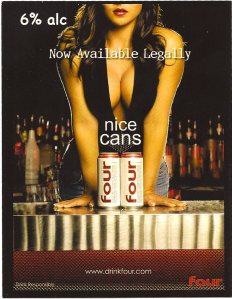 When I ask my students if they can think of anything good about being a sex object they think there must be something positive, since so many women put a lot of effort into being sexy, with some aspiring to “sex symbolness.” Here’s what they say:
- Sexy women get attention. They feel attractive and admired, so it’s a source of self-esteem.
- It’s nice to feel wanted and desired. It’s easier to attract mates or just get sex.
- It can be fun to feel sexy.
- Sex is a historic source of power for women. Sexiness can gain women resources, whether through marriage or getting men to do favors. It puts women in control over men.
Then I ask if there’s a downside. More comments:
- It can be uncomfortable being gawked at. You can feel like you’re only a sex object – and that’s all, like you’re not worth a lot.
- You can feel disrespected. Guys just want one thing. You get used.
- When women are seen as all about sex, and they don’t want to put out, they’re seen as bitches.
- You aren’t seen as intelligent. You aren’t taken seriously.
- Your personality disappears.
- It can feel inauthentic, feeling pressured from friends or society to look sexy.
- Sexual objectification leads to sex trafficking. Treating young women and girls like they are nothing but objects that exist to pleasure men. They have no lives. They’re all about sex and nothing else. And they’re not given an opportunity to be anything else.
But there are problems when you don’t meet sex-object standards, too:
- You feel like you’re constantly being judged, and not coming out well.
- You may starve. Or get implants and die (that does happen). You have false hope, and when you don’t meet the standard you lose self-esteem.
So much contradiction. Is there any way to get some of the positive upside without all the downside? I’ll admit to feeling the world would be a bit dull without any spice of sexiness.
How about distinguishing between sexy and sex object. And broadening our notion of what “sexy” means?
Objects are treated as little more than a means to others’ pleasure. They are not people with lives, goals, thoughts or emotions. It’s one-dimensional. A limited box. And who cares how you treat an object?
So if a woman does have – and is seen as having – a life, goals, emotions and intelligence, and sexiness is one part of all that, then she can be a full person – who is also sexy.
But still, can we move outside the narrow notions? Who’s sexy to me? Women and men who are classy, smart, talented, confident, and who make a difference in the world.
I nominate:
Nancy Pelosi, Thandie Newton, French politician Marie-Ségolène Royal, Helen Mirren, Angelina Jolie, Jackie O, Jennifer Lopez, Toni Morrison, Queen Rania of Jordan, Barbara Walters, Sandra Bullock, Zhang Ziyi, America Ferrera, Diane Sawyer, Jennifer Aniston, Queen Latifah, Gloria Steinem, Julia Roberts, and Maria Shriver.
And men? My list includes:
Ezra Klein, Benico del Torro, Ed Harris, New York Times columnist, Princeton professor and Nobel Laureate Paul Krugman, CNN anchor T.J. Holmes, Tom Brokaw, Brad Pitt, Barack Obama, Stephen Colbert, Gabriel Byrne, Japan’s former Prime Minister Koizumi Junichiro, JFK Jr., Antonio Banderas, Sidney Poitier, Javier Bardem, and White House corresspondent, Jake Tapper.
Yeah, sexiness can be fun and alluring, when moving outside narrow limits. But sex objects are just trapped.
Popular Posts on BroadBlogs
Men Are Naturally Attracted To Unnatural Women
The Constricting Bodice: Empowerment and Imprisonment?
What Happens When You Beat A Sex Object?

 BroadBlogs