Blog Archives
Sexual Objectification, What is it?

Cross-posted at Ms., Caroline Heldman’s Blog and Sociological Images
This is Part 1 of a four-part series on sexual objectification–what it is and how to respond to it.
The phrase “sexual objectification” has been around since the 1970s, but the phenomenon is more rampant than ever in popular culture–and we now know that it causes real harm.
What exactly is it, though? If objectification is the process of representing or treating a person like an object, then sexual objectification is the process of representing or treating a person like a sex object, one that serves another’s sexual pleasure.
How do we know sexual objectification when we see it? Building on the work of Nussbaum and Langton, I’ve devised the Sex Object Test (SOT) to measure the presence of sexual objectification in images. In it, I propose that sexual objectification is present if the answer to any of the following seven questions is “yes”:
1) Does the image show only part(s) of a sexualized person’s body?
Headless women, for example, make it easy to see them as only a body by erasing the individuality communicated through faces, eyes and eye contact:


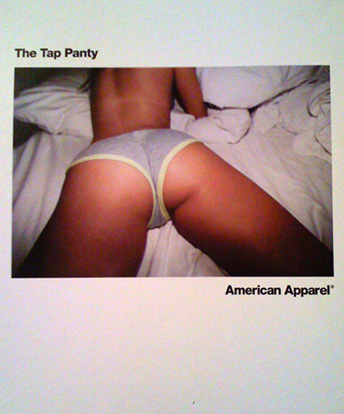
We achieve the same effect when showing women from behind, which adds another layer of sexual violability. American Apparel seems to be a culprit in this regard:

Covering up a woman’s face works well, too:


2) Does the image present a sexualized person as a stand-in for an object?
The breasts of the woman in this beer ad, for example, are conflated with the cans:
Likewise the woman in this fashion spread in Details, in which a woman becomes a table upon which things are perched. She is reduced to an inanimate object, a useful tool for the assumed heterosexual male viewer:

3) Does the image show sexualized persons as interchangeable?
Interchangeability is a common advertising theme that reinforces the idea that women, like objects, are fungible. And like objects, “more is better,” a market sentiment that erases the worth of individual women. The image below, advertising Mercedes-Benz, presents just part of a woman’s body (breasts) as interchangeable and additive:

This image of a set of Victoria’s Secret models, borrowed from a previous Sociological Images post, has a similar effect. Their hair and skin color varies slightly, but they are also presented as all of a kind:

4) Does the image affirm the idea of violating the bodily integrity of a sexualized person who can’t consent?
In this “spec” ad for Pepsi (not endorsed by the company), a boy is being given permission by the lifeguard to “save” an unconscious woman:

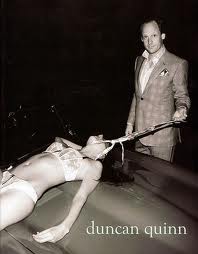
Likewise, this ad shows an incapacitated woman in a sexualized position with a male protagonist holding her on a leash. It glamorizes the possibility that he has attacked and subdued her:
5) Does the image suggest that sexual availability is the defining characteristic of the person?
This American Apparel ad, with the copy “now open,” sends the message that this woman is open for sex. She presumably can be had by anyone.

6) Does the image show a sexualized person as a commodity that can be bought and sold?
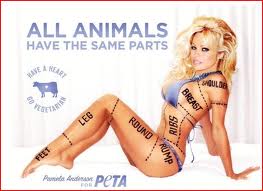
By definition, objects can be bought and sold, and some images portray women as everyday commodities. Conflating women with food is a common sub-category. This PETA ad, for example, shows Pamela Anderson’s sexualized body divided into pieces of meat:
And this album cover shows a woman being salted and eaten, along with a platter of chicken:

In the ad below for Red Tape shoes, women are literally for sale and consumption, “served chilled”:

7) Does the image treat a sexualized person’s body as a canvas?
In the two images below, women’s bodies are presented as a particular type of object: a canvas that is marked up or drawn upon.


The damage caused by widespread female objectification in popular culture is not just theoretical. We now have more than 10 years of research demonstrating that living in an objectifying society is highly toxic for girls and women. I’ll describe that research in Part 2 of this series.
Cross-posted at Ms., Caroline Heldman’s Blog and Sociological Images
Popular Posts on BroadBlogs
Anything Good About Being A Sex Object?
Sex Objects Who Don’t Enjoy Sex
Does Porn Objectify? Experts Disagree
Share this:

Woman, Not the Sum of Flawed Parts
![anistonpubis[1]](https://broadblogs.com/wp-content/uploads/2012/11/anistonpubis11.jpg) By Linda Bakke
By Linda Bakke
Star Magazine. Full of faces covered by question marks, bodies sliced up. Women diminished to the details of their flaws, circled in bold. A dissection of celebrities’ body parts.
I was working as a receptionist at a hair salon when I discovered Star. I picked it up and paged through. It was awful. I could not put it down.
One article divulged a star’s “hairy secret,” detailing the frequency of her waxing regimen and suggesting her pubic area was overly hairy. A two page spread highlighted shameful “sausage fingers.” Another asked who had the worst toes.
It all oddly evoked the serial killers who keep articles – or worse, dismembered body parts – as trophies.
And what is the triumph here? A sensed superiority over the goddess’ faults as we lie in judgment?
And who can blame us? Their supposedly error-free bodies stress us out! Destroying them and their presumed perfection just might lift our spirits.
But maybe scrutinizing them only returns scrutiny to us, as the judgments tell us we must correct our own “blemishes,” whether buttocks, breasts, fingers or toes.
The message: women’s imperfections cannot be tolerated.
As we eat it up, we fail to see how we become victims, too, unconsciously nodding agreement that this treatment of women is acceptable.
While the pictures and text underline our preoccupation with facade over character, men’s bodily foibles are untouched by these tabloids. Who can imagine placing a man in such light?
Hopefully one day we will take on realistic and healthy expectations so that women will no longer be seen as the sum of flawed parts.
Popular Posts on BroadBlogs
Keep Your Boobs, Get Better Guys
How to Look Like a Victoria’s Secret Angel
Beautiful Women’s Hips Are Thinner Than Their Heads?
Share this:

Overcoming Scars of Abuse
 Today I am reposting a story of one woman’s recovery (still in progress) from her traumatic ordeal of childhood sexual abuse. This story comes from HumanitysDarkerSide, and I hope it might help others.
Broadblogs wrote an article called Why We Have Sex based upon the findings of CM Meston and DM Buss at the Department of Psychology at the University of Texas. These two researchers wrote an article called Why Humans Have Sex in 2007. In their article Meston and Buss cite 237 reasons that students at UofT had listed as their reasons for having sex.
I commented on Georgia’s post and ended up being asked if I would like to write something about my own experiences and the effects of medication on myself.
One of the reasons being listed for having sex in Meston and Buss’ article is force. Sometimes sex isn’t a voluntary thing and in my case the force happened at a very early age and seriously messed up my head when it came to anything sexual. Well, not just that, as anyone who has run into PTSD will attest to.
PTSD, or post-traumatic stress syndrome is a strange thing. It is basically a severe reaction to trauma expressing itself in as varied manners as re-experiencing the original trauma(s) through flashbacks or nightmares, avoidance of stimuli associated with the trauma, and increased arousal—such as difficulty falling or staying asleep, anger, and hypervigilance.
In my case I experienced pretty severe nightmares and hypervigilance (and probably some anger). As I was 7 when the whole thing started, this was normal to me and I thought most people experienced life the way I did. Turns out they don’t. Some who get PTSD as adults remember life before and a state of non-PTSD. In some ways I would imagine that could be worse (although maybe not). Depends on the trauma and the psyche of the person struck down with it.
I would guess that most people would see me as a boring person with a weird sense of humor. It is that strange sense of humor that has carried me. After the awkward teens and early twenties, I came to realize that life was just one gigantic joke and the only defense was to laugh at it. Laughter has been my friend throughout my life, laughing at myself and the world and it has gotten me through some rough spots (my psyche).
Anyways, I got married and when I met my husband I was a virgin (well except for CSA that is). I’d seen some porn, read books with sexual content and talked to people. But, you know, people just don’t talk about sex and death – the two great taboos in life. I didn’t get that sex could even be pleasurable and was afraid during sex. I wanted it, got horny and all of that, but when it came to actually doing it, well.
Thankfully, my husband is the kindest, gentlest and most patient person on this planet and he worked with me and tried to make things good for me. But you know, there is only so much you can do on your own. Poor guy, living with a CSA survivor is not easy. No matter how optimistic a person is, having trouble with your sex life just hurts both parties.
I tried psycho-therapy. Hah, what a joke. Talking through the effects of PTSD as something that was supposed to help. Sometimes I wondered if I or my therapist was in need of help.
Then I found my psychiatrist – my voodoo queen – magician galore. Granted, it took years and years before I did find her, but this is my miracle person. We used three tools in getting acceptance of myself into my mind, heart and body. Cause you know, CSA people just don’t have a healthy view of themselves.
Tool one was cognitive therapy. Folks, this stuff actually works. It really does. What happens is a re-wiring of the way you think of yourself and the world. Yes, it is an ongoing process and some parts will probably have to be a life-project, but it works. I can now do this all by myself because I know how it works.
Tool two was EMDR. What the hell is EMDR, you ask. Before I tried it I put it in the same category as homeopathy. But it’s just a kind of hypnosis light. It should be tried with a therapist that knows what on earth they are doing and it does not work for everything. However, research in Holland and Germany shows that it is good with PTSD. Just do a search on Google for Dutch and German research on EMDR and you will have plenty of articles to choose from.
Tool three was medication. People, you know this, but it cannot be stated enough times. No new psychological medication without therapy. There are side-effects with every bleeding medical product out there and you might need help coping with them.
At first we tried beta-blockers. My god. The first time I tried them this super-tense feeling in my chest lessened and I fell asleep from sheer relief. I’d walked around being hyper-alert all of the time and that really isn’t good for you. My world changed, but tension around sex was still high. No wonder, as this was my major trigger.
Then a miracle happened. And I am serious about this. A major miracle happened. My psychiatrist suggested that I try something called venlafaxin – an efexor depot medication. Instead of being scared every time I had sex I was loving it. Sure, it had taken years for me to get there and my husband had had to endure my pain for a long time, but I have actually gotten to experience the joys of having sex. How cool is that? And we all know that my husband has been having the time of his life along with me.
Popular Posts on BroadBlogs
Past life
Making Violence Against Women Sexy
Real Men Don’t Beat, Rape Women
Share this:

Vibrators & Women’s Sexuality are Out of the Closet
 Vibrators, once steeped in shame and secrecy, are going mainstream. Does this mean women’s sexuality has thrown off the covers, too?
As a culture, we are of two minds.
Vibrators were once illegal in several states, including Texas, Mississippi, and Alabama, or found only in seedy sex shops. But as the New York Times reports, today they may be purchased at your neighborhood drug store. Out in the open, even Oprah has pitched the helpful tool. And who can forget the “Rabbit Pearl” popping up in Sex and the City?
And yet, they aren’t quite out of the closet.
As one seller described the problem, “I can sit with my 10-year-old daughter during prime-time TV and watch a commercial for Viagra,” she said, “but I can’t advertise our OhMiBod fan page within Facebook.” Nylon Magazine won’t run her ads and the Small Business Administration refused her loan application because vibrators are a “prurient” business.
Ambivalence over tools and meds that enhance women’s sexuality reflects the larger cultural view. On the one hand the media glamorizes women’s sexuality. And plenty of porn approvingly portrays women with voracious sexual appetites.
But porn is off-limits. And women are told “Keep your legs together,” as if open legs were an open invitation.
Male sexuality is something to brag about, but female sexuality is something to hide. Men are praised as players and pimps. Women are called sluts, whores, tramps, and skanks… What positive word applies to women who enjoy sexuality?
Slang for penis and vagina says a lot, especially “cock” and “down there.” Cock: Cocky, boastful, swaggering. “Down there”? Unspeakable. Shameful.
This all reminds me of Zestra’s difficulty getting ads on TV for a product that arouses women. TV networks, national cable stations, radio stations, and Web sites like Facebook and WebMD all resisted. Yet “An erection lasting more than four hours” is O.K.?
Is it any wonder that sex surveys find mixed experiences among women when it comes sexual pleasure?
Indiana University’s comprehensive survey found that while 91% of men had an orgasm the last time they had sex only 64% of women did. These numbers roughly reflect the percentage of men and women who say they enjoyed sex “extremely” or “quite a bit”: 66% of women and 83% of men. Only 58% of women in their 20s had “the big O” on their last occasion.
As I’ve recently posted, 30-40% of women report difficulty climaxing. Women who lose virginity are also likely to lose self esteem, largely because they’re so focused on how they look (bad, they apparently think) and so unfocused on the sexual experience. And one-third of women under 35 often feel sad, anxious, restless or irritable after sex, while 10 percent frequently feel sad after intercourse.
On the other hand, many women do enjoy sex a lot, and frequently orgasm.
Does all this reflect that ambivalence, with enjoyment perhaps affected by which message gets most drilled into a woman’s mind?
Women’s sexuality kept in shadow and suspicion has an effect. Time to come out of the closet!
Ms. Magazine cross-posted this May 16, 2011 I first posted this piece May 9, 2011.
Popular Posts on BroadBlogs
Women: Climax Less Likely in Relationship Sex
Men: Climax More Likely in Relationship Sex
Sex Lessons from Mom and Dad
Share this:

Women’s Rights: Distracting, Shiny Objects?
 With all the rightwing nuts running about, I must make a post mortem on the election and women’s rights. Which would be comical, if it weren’t scary. Ok, both.
Let’s start with Katherine Fenton, scolded for asking how the candidates would ensure equal pay for women in the second debate. All hell broke loose in Wingnut-Sphere where the “femanazi question” was deemed illegitimate and Fenton became the “Whore of Babylon” inciting “Twitter hate masturbation” as Amanda Marcotte over at Pandagon put it.
Nearly every Republican congress member knows better, having voted down the Lilly Ledbetter Fair Pay Act.
The loony right’s insensitivity to rape has been widely panned, but deserves a brief review. Representative John Koster cavalierly called it “The rape thing.” Mike Huckabee sees rape as an alternative baby delivery system and Paul Ryan minimizes rape by calling it a “method of conception.” In fact, Paul Ryan co-authored a bill with Todd Akin (victims of “legitimate rape” don’t get pregnant) to narrow the definition to “forcible rape.” Richard Mourdock found forced pregnancy through rape “a gift from God” and told folks to “get over it.”
Feminist, Caroline Heldman wondered how pregnancy from rape could be a gift from God if raped women can’t get pregnant?
Meanwhile, Republicans voted time and again against contraception and abortion (even to save a woman’s life) even though contraception prevents abortion.
And if women die because they can’t get the procedure legally and safely, who cares, says Mississippi State Rep. Bubba Carpenter:
They’re like, “Well, the poor pitiful women that can’t afford to go out of state are just going to start doing them at home with a coat hanger.” That’s what we’ve heard over and over and over. But hey–you have to have moral values.
Laws that lead to women’s deaths are moral?
In other news most of the GOP refused to protect all women in the U.S. from domestic violence.
And, they pushed to block cancer screenings and HIV testing for underprivileged women.
Women’s rights just aren’t important says Eric Fehrnstrom, senior campaign adviser for Mitt Romney. They’re just “shiny objects” that are used to distract voters from real issues as he explained to ABC’s George Stephanopoulos:
Mitt Romney is pro-life. He’ll govern as a pro-life president, but you’re going to see the Democrats use all sorts of shiny objects to distract people’s attention from the Obama performance on the economy.
First it’s women as objects. Now it’s women’s rights as objects.
These guys haven’t got a clue. And they lost, big time.
Popular Posts on BroadBlogs
Spilling Sperm Harms Unborn, Law Says
Rush’s War on Women is No Fluke
Why Do Right-Wingers Hate Sex?
Share this:

Raping, Shaming Girls to Impress Guys

Felicia Garcia
Young men at Piedmont High near San Francisco were caught “drafting” female schoolmates (unbeknownst to most of them) into a secret “Fantasy Slut League.” Upper classmen earned points for documenting their sexual exploits and used social pressure to manipulate the girls’ yearnings to feel attractive, included and popular. Sometimes they plied their targets with alcohol to impair judgment and control, that is, to commit rape.
Meanwhile, in the Stanton Island borough of New York, 15-year-old Felicia Garcia of Tottenville High had sex with four football players. The escapade was recorded and passed around the school as football players bragged about their conquest. Two of the ball players involved began tormenting her, and as news spread through the school, bullying spread, too.
One of Felicia’s friends told the New York Daily News,
Kids are saying she had sex with some guys from the football team at a party after the game. Later on, they wouldn’t leave her alone about it. They just kept bullying her and bullying her.
The young women of Piedmont High were left shamed and humiliated, and too many of them were sexually assaulted. Felicia killed herself on October 24 when she jumped in front of a Staten Island train as 200 students watched in horror.
You have to wonder why so many young men are willing to harm so many young women.
The answer likely revolves around guys trying to feel like men.
Michael Kimmel is an expert on men and masculinity who has studied “guys” at the cusp of manhood. He says that too often guys hurt themselves or others as they latch onto the more negative notions of manhood like aggression, violence, dominance and being tough.
Meanwhile, women are often objectified and seen as “things” that are all about sex. If they are things, and not people, you don’t have to worry about their feelings or their lives.
The young men at Piedmont High and Tottenville High were working to create a culture that painted men as aggressive and dominant, and women as silenced and humiliated victims who were made to feel lower in status… and who may even end up killing themselves.
Surely there are better ways to be a man.
Popular Posts on BroadBlogs
Yale Fraternity Chants “No Means Yes.” Men? Or Scaredy Cats?
Frats Invite Sluts, Bitches; Women Accept Degradation. Why?
It’s Ok To Be A Tomboy But Not A Sissy. Why?
Share this:

Playboy Bunnies Are Scary
 Would you like to be a Playboy Bunny this Halloween? The Bunny is a popular costume, and you may have some fun. But one real, live ex-Bunny paints a bleaker picture.
Lili Bee had once worked at the New York City Playboy Club. One day when a Bunny/Playmate emerged from the shower Lili was “struck by how absolutely human she looked.”
Curious about the Playmate’s spread, Lili flipped through the stacks of Playboys that sat in the Club’s employee lounge:
In front of me was sprawled virtual perfection, not a flaw in sight, her skin pore-less, tawny, with the texture of velvet. Her eyes were sparkling and bright. Her lips perfectly moist, parted ever so slightly to show off her perfect, non-rejecting smile.
Her body was portrayed in much the same way: All good features were highlighted to the extreme, and the less than perfect were ‘corrected,’ which is to say, rendered invisible.
Yes, the centerfolds were pretty. But so were her aunt, her boyfriend’s sister, and the woman who had handed her the New York Times that morning. In fact,
Most women were attractive if you could just see them outside of the narrow rules, and yet it seemed that Playboy had extolled some illusory woman as the absolute gold standard for perfection.
That presents a scary perspective for your average women. A fear that she can never live up to an ideal. She might undergo scary surgeries or diets to try to achieve that “perfection.” Or wear tortuous outfits to create an unreal shape. In fact, the Bunny costume is kind of scary.
In its shape-shifting, Lili’s outfit was painful and the boning left marks around her ribs. When feminist, Gloria Steinem, worked undercover as a Bunny, she had to wrap gauze around herself to keep the boning from rubbing her raw. And the stuffing the breasts sit on to make “anyone” look large-breasted was sweltering and tight. In fact, the costume was “so tight it would give a man cleavage,” Steinem recalled. Even the modified outfits that actresses wore for last year’s cancelled Playboy TV series were described as, “tight,” “constricting,” and, “Child, you cannot breathe.” All this pain to create the illusion of an “ideal” female figure that does not exist in reality.
Today Lili is leery of all that Playboy has created: Unattainable ideals that will hurt American women for the next 40 years, and counting…
So women can feel they don’t match up. And men can feel deprived, never finding the idealized perfection.
A little scary.
Popular Posts on BroadBlogs
Men Are Naturally Attracted To Unnatural Women
Miss Representation: Girls are Pretty, Boys Are Powerful
Beauty Tricks to Remove Your Power
Share this:

Why Men Objectify
 Some men wonder why they objectify women. So Jayson Gaddis asked men on his Facebook page why they thought they did, and then he wrote about it for The Good Men Project.
What is objectification? Jayson describes it as:
Staring, gawking, or checking out women and their bodies and body parts. Seeing them as objects instead of actual people, and thinking of them in a sexual way.
Why do they do it? Most blame “nature.” As one man exclaimed,
I love looking at women. They’re just amazing. It’s part of my biological make up to think that they’re beautiful.
Jayson believes biology plays a role since men are hardwired to look for mates and procreate. But he thinks cultural conditioning is involved, too. To paraphrase:
In men’s culture, it’s acceptable to objectify women. Men bond around it. And, it’s pervasive and all around us. Notice where men buy stuff, there are often photos of women present. I can barely go on any male-focused website now without being hit at some point by a tiny, physically attractive, disproportioned airbrushed woman looking at me.
Some men objectify because the “feel good” feeling acts like a drug or pick me up. Objectification can fill an empty place inside:
I’m stuck in the belief that that feminine essence is outside of myself. I’m alienated from the larger truth of my Completeness as a human being. That sexy, juicy, radiant paradise is not inside myself, therefore it’s an object I obsess about outside myself and I treat it like entertainment. This insight leads me to believe I haven’t spent enough time balancing the relationship with My (whole) Self.
Others want gratification without any real work or risk of rejection.
I objectify women cause it’s “safer.” I receive an immediate gratification, a thrill if you will, albeit superficial, it does keep me safe at least for a time from annihilation — from a treacherous road of intimacy and vulnerability — the risk of being really seen and connected with – or actually rejected!! Yes, that’s it — it’s an avoidance of rejection… Intimacy takes a lot of work, courage and commitment. Objectifying is an “easy” road out of the potential of rejections.
Maybe some men simply enjoy the sense of being with many women, polygamous, a way of living that doesn’t appear to be a possibility in our culture. One man says he likes to play with the fantasy and the illusion like he does with porn:
The most fun and exciting and ego gratifying times in my life have been when i have embraced it and danced with it and gave myself permission to play with the illusions, projections, feelings, etc.
Like this man, many say they seek approval or self-esteem. I’m not sure what that means. Might a man’s self worth rise when he imagines the women enjoying his attention?
Or, does self-esteem rise from gaining a sense of power over women? After all, they dressed and adorned themselves to please men – and thus, “him.”
Some talk of the power women have over men – making them melt and creating unrequited desire. But by objectifying women a man can feel superior. “He” is subject while “she” is an object that exists for his pleasure and purposes.
The fear of annihilation has been cited before, but one man describes it in a way that echoes this fear of female power. He seeks “to avoid the terror of annihilation — being reabsorbed back into the feminine.”
Whatever’s going on, Jayson suggests men consider how objectification is working for them and the women in their lives. For those who feel it’s not working, here’s how some have dealt with the matter:
What I’ve found works best for me so far is being a yes to everything in my own experience and in what’s happening AND at some point in my development simply realizing that objectification is not enough for me … I love appreciating and experiencing another human being for more than just her physical traits. What I prefer physically doesn’t in itself inspire me to want to connect with a woman, and doesn’t in itself have me feel attracted. The attraction and inspiration simply are there or not independent of how she looks.
Or this:
The answer for me was to stop trying to get this woman but use that energy to make myself the best possible me I could become. A me that now has confidence because I am self assured, self respecting, and full of self accepting unconditional love. Part of becoming that man means that I must accept and own the truth of my motives and be willing to see the motives of others. That is when I was finally able to let go of the fantasy and see this woman for who she really is inside.
My biggest life breakthrough and victory came as a result of that growth.
As a result, something incredible is happening to me now. Something wonderful has started growing in the void where my fantasy used to live. It’s a genuine curiosity and appreciation for all woman. Especially for all the women who actually live and display their authentic self and freely give their love to all as an expression of their femininity.
Or this,
Once I get connected to me again, I notice how I can appreciate a beautiful woman and I’m in my body, connected to my heart. It has a totally different quality. She feels it and I feel it.
By the way, objectification and desire are two different things. And men are rarely objectified. See these two articles:
For more on all this, go to The Good Men Project.
Related Posts on BroadBlogs
Anything Good About Being A Sex Object?
Being Sexual vs Looking Sexual
Does Porn Objectify? Experts Disagree
Share this:

Love My Body
 By Zhe Cheng
I step on the scale, glance at the digital 135 and sigh silently.
“Hi, listen,” my boyfriend’s words ring in my mind, “I want you to lose weight. Immediately!”
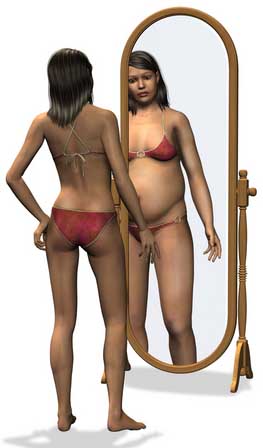
I know I am a bit bigger than most Asian girls, but I never thought I was “fat.” I do want to lose weight to “look good,” but it is just so hard. Now, this stupid man, who is 5’10 and 110 pounds, who thinks of himself as “fit and charming,” sees me as “overweight.”
And my mind wanders back to a girl who smiles sweetly and says, “If you were thin, you would be very pretty.” My lips smile back but my mind glares. I’d already thought I was beautiful.
Mother wants me to lose weight, too. She claims I haven’t because I’m not insistent.
Although I love my body, although I am a feminist, although I try to ignore the thin girls around me, I am shaped by my society. Sometimes I feel upset when I see my round belly. And I feel guilty when I eat too much.
But I worry about dieting. Courtney Martin, who wrote Perfect Girls, Starving Daughters, says that 25% of dieters develop eating disorders. One of those disorders is especially dangerous: 7.4% of anorexics die. Then she tells us about Janet who says, “Even after my friend had a ministroke from taking Ephedra, I sometimes wonder if I can search the Internet and find some on the black market.”
Why risk death to lose weight?
We watch TV and see slim heroines, we pick up magazines and see skinny models, and we learn that thin is hot. We accept what society wants, and deny ourselves.
We accept superficiality over the inner beauty of independence, wisdom, and achievement.
Men don’t face such strict standards or such close scrutiny. My father is a bit overweight, but no one judges him by his body. Yet men feel free to judge us.
Martin suggests a solution:
If a women of any size is able to stop her negative self-talk and accept herself, she may experience the world with a little peace of mind.
I see my body in the mirror. It is so perfect. I face my boyfriend and stare at him, “If I wanna lose weight, I would. But I just think it is so stupid to lose weight because my boyfriend thinks I’m fat.”
I say to him, “If you don’t like my body, then don’t even touch me!”
He stands there shocked, saying “sorry” with his eyes.
This was written by one of my students (who is perfect weight and perfectly beautiful) and posted with permission.
Popular Posts on BroadBlogs
How to Look Like a Victoria’s Secret Angel
500 Calories + Pregnancy Hormones = Perfect Body
Beautiful Women’s Hips Are Thinner Than Their Heads?
Share this:

Porn Fantasy Mistaken for Reality
 By Demon Ted
Does porn raise men’s expectations of how women should perform in bed? I believe it depends entirely on the man’s ability to distinguish between real life and fantasy.
True, you could try to recreate porn in real life. But then it’s not real. It’s acting. So you’re back to fantasy.
I think porn is great to enjoy. But men must realize what it is.
Unfortunately, a lot of men (and some women in regards to things like Twilight) get fantasy and reality mixed up. And that can harm relationships.
Take my girlfriend’s ex. He’s a nasty piece of work. Barely finished high school, can’t drive, no job. Literally sits at home all day. But because my girlfriend was young when she met him, he became a lot of “firsts.” And he made her think that things that weren’t healthy were.
She didn’t expect to ever get off on real sex, or that her significant other should even try. Early on she told me that she would be “totally down for a threesome” if I saw another girl I found attractive. She later recanted when I told her to never suggest anything that makes her uncomfortable or unhappy.
As we talked on she began blurting out a long list of things her ex did, sexually, that she asked me not to. The worst part was that after she had listed everything, she thought I was angry with her.
I was angry. Not because she had asked me not to do certain things, but because I realized what she had come to expect. I had thought she’d say something like, “I don’t feel comfortable with the lights on,” not, “Please don’t tell me I’m a dirty slut for enjoying your cock.”
I was upset that she had let someone treat her, for lack of better words, like trash. I had to explain that, even without her asking me not to do those things I would not have done them.
I saw that she had come to believe that she must do things she hated for a relationship to “work.”
Obviously we’ve talked about these things and she realizes that, yes, I do watch porn, but that porn is porn. I do not expect her to act like the girls in it, nor should anyone else.
My girlfriend is beautiful. She’s incredibly attractive just the way she is. And she’s most beautiful when she’s enjoying herself, sexually or otherwise.
This was written by one of my students who gave permission to post it under a pseudonym.
Popular Posts on BroadBlogs
Should Women Give Men The Porn-Star Experience?
Men, Women & Internet Porn
Sex Objects Who Don’t Enjoy Sex

 BroadBlogs