Blog Archives
Men Prefer Great Hair Over Big Breasts?
Sixty percent of men would rather date a woman with great hair than big breasts. Fabulous hair also topped low-cut blouses when it came to alluring men in bars. So says a recent survey reported in Glamour.
Do keep in mind that 40% chose breasts over hair. So if you’re well-endowed, not to worry.
Is this true? Some wonder. After all, Pantene commissioned the study.
The research has been picked up and widely reported. Here are a few comments from men on the topic.
- On my list of attributes I wanted, “hair longer than mine” ranked well above “a chest larger than mine.”
- The face/hair falls #1 on the thing my friends and I notice first about attractive ladies. It’s not that we ignore the other blessings bestowed upon a beautiful woman, but what’s above the neckline determines approachability and friendliness and gives a much better sense of the person than cleavage. I have no friends who discriminate based on cup size, and bras today can make Betty White’s breasts appear firm. (NOTE: Admittedly, I’m almost 40. So maybe we older dudes judge by different standards.)
- We would notice your curves first, ass, chest, legs and the way you stand. But your head will become our primary focus after that. Your face, your hair, your smile is what charm us. We really notice your hairstyle, especially if it’s a nice cut. It’s also a mirror of your personality, of how you can take care of yourself, it’s feminine and sexy.
The survey results make some sense. Keira Knightley and Paris Hilton have both landed on FHM’s “sexiest women” list. They both have great hair, but little cleavage. A past roommate of mine had gorgeous hair and face but very little “up top,” as they say, yet men went nuts for her.
Related research shows that men usually rank face over body in some circumstances too. Surprising? Given a choice between seeing a woman’s face or body, 75% of men preferred to see face for long-term relationships, compared with 51% who wanted to see body for a short fling.
Overall, I would call this good news. First, maintaining beautiful hair is not dangerous, unlike going under a knife for implants.
And, I appreciate the sense that face and hair reveal personality and give a sense of who the woman is, while cleavage does not. Men caring more about women as people than objects. Who knew?
Popular Posts on BroadBlogs
Men Aren’t Hard Wired To Find Breasts Attractive
Men Watch Porn, Women Read Romance. Why?
Keep Your Boobs, Get Better Guys
Share this:

Sex: From Casual Pleasures to Deep Connection. Readers Discuss
Below are comments on how women and men experience themselves, and how they think sex is best, based on earlier posts: “Are Women Naturally Monogamous?” and “Are Women Culturally Monogamous?” They’re edited for brevity and clarity. I’ve organized comments and added my own in italics. The comments typically revolve around the advantages of casual pleasures versus deep connection.
Polygamous women
- Divorced at age 33, I experienced a natural heightening of sexual interest and there were a number of men with whom I had sex during the next 7-8 years. I enjoyed it all tremendously and learned a lot about men and about myself. During that time, I met only one man I would have considered as a life partner. Now I realize that the relationship was great because the sex was great.
- If women were paid equally and had equal opportunity in the job market, I think that monogamy would be weakened. When I earned more than my husband, and could survive financially on my own, my sexual behavior changed as well.
- I seem to be different than the study (enjoying a variety of partners), but then so are most males I know (more monogamous).
Polygamous men
- Sex is so pleasurable. Why limit yourself from pleasure so long as everyone knows the ground rules – that this is about pleasure and not about commitment or love.
- Sex is magical. I would like to have sex with as many women as possible. But I always thought women experienced sex the same as I do. It hadn’t occurred to me that they might not.
Research suggests that women, on average, don’t enjoy sex as much as men do. U.S. women enjoy sex less than women in some cultures, but more than women in others. I’ll explore why later. The difference in enjoyment is not based on biology, but culture.
Jealousy and not loving equally
Women who are interested in polygamous sex can discover difficulties:
- As a lesbian I have a perspective that is completely woman oriented. I personally have had more than one lover at a time and found it difficult since I was always trying to explain why I was leaving to visit someone else. One always seems to love one more than the other.
Having sex because you’re expected to
- Here is my confession – two or three times I allowed myself to be picked up at a party or a bar. I am still so ashamed of those incidents. Remembering them makes me feel so dirty! I thought it was expected. You know – times were changing. Everybody did it. I now believe I let myself be used by men who were only after a little fun and had no serious intentions.
- I let myself be used by men who were only looking for fun… then I felt ashamed! Many women were brainwashed into believing they would enjoy it as much as men only to realize they were no more than a toilet bowl or conquest. I am sorry to disappoint but sex ain’t all it’s cracked up to be. Many may hide the shame and humiliation they feel by saying they liked it.
Women are punished for sex
Some women may feel pressured to have sex, but women are also punished when they have it, labeled “sluts”:
- The stigma attached to women likely keeps the number (of lovers they report) low
- (At least men) seem to have each others’ backs. Women don’t. They’re often quick to stab each other in the back.
Meeting social expectations: Men
- Men might be lying too since the cultural expectation for them seems to be quantity rather than quality.
- Men also have cultural expectations to live up to: amass notches on their belts.
- I wanted to have threesomes for the longest time. Then I realized it was largely about feeling left out of something I thought everyone else was doing.
Agreed. There are plenty of pressures on men, too. Women claim 5 lovers and men claim 12. Women must be underestimating and men exaggerating. The real number for both is likely in between: 8 or 9. Men also watch porn, think it’s an accurate portrayal of womens sexuality, and end up thinking they are missing out on a lot of action (that no one else is getting, either).
Meeting social expectations: Women and men
- I think you hit the nail on the head when you stated “Western women are much more monogamous than our Tahitian or American Indian sisters were before European contact.” I don’t think any of us are pre-wired to remain with one person all 80 plus years that we walk this earth. Man or woman. As humans we make that CHOICE to do so. What it comes down to is one having their own mind. Neither man nor woman should continue to be concerned with what current society dictates.
Women desiring depth, connection
- Women prefer depth, romance, quality in a relationship. They know that the closer one is in spirituality, emotions, the better the sex. Women need that depth to be fulfilled.
- A purely physical relationship requires little work. You don’t have to concern yourself with messy thoughts or feelings beyond the immediate moment. It’s shallow and one dimensional. Real relationship takes depth: looking at someone’s worth beyond pretty eyes, nice butt, and teeth.
- I have heard some women say they enjoy casual sex – but in 62 years I have heard far more say they haven’t enjoyed any sex let alone casual – meaningless sex. It’s intimacy we want! But I am still waiting for the rush of women who can honestly tell us about all the hot meaningless sex we have been missing! I’m all ears?
Men desiring depth, connection
A woman’s perspective
- I met both kinds of guys when I was dating. I met guys who seemed downright anxious to connect on a deeper level and guys who would lie in a NY minute if they thought it would get them into my pants faster.
A man’s perspective
- Our sexuality and the expression of it before and during (and after) marriage is, I am convinced, one of the more complicated aspects of what it means to be human. One could argue that God created men and women different sexually (in all the ways!) because to come together in meaningful intimacy (erotic or sexual) requires the development and expression of our deepest and highest virtues—sacrifice, humility, and kindness (even long-suffering at times!), and especially love. It is among the most meaningful and challenging dances we do.
And, don’t forget the men in men’s studies. Both Michael Kimmel and John Stoltenberg recommend men do sex from a place of love and commitment, and they say that is where they come from, themselves.
SOURCES: Comments from:
Blogs: BroadBlogs, BroadBlogs, and FreeMeNow
My Facebook site
Various lists responded either to the list, or to me via email
Student discussions
A version of this post was originally published August 23, 2010 as “Readers Discuss: Are Women Polygamous?”
Share this:

“Cock” vs “Down There”
When I ask students what they call a penis and a vagina in everyday words, two responses stand out: “cock” and “down there.”
The difference is telling. Cock: Cocky, proud, boastful, swaggering, self-satisfied. Image of a strutting cock, er, rooster.
But “down there”? Unspeakable. Embarrassing. Shameful.
Male sexuality is something to brag about, while female sexuality is something to hide.
The difference is reflected in Zestra’s difficulty getting ads on TV for a product that arouses women’s sexuality – while songs of “Viva Viagra” fill the airwaves.
The New York Times reports that TV networks, national cable stations, radio stations, and Web sites like Facebook and WebMD have all resisted airing ads for Zestra. Some agreed to broadcast ads in the early morning when most people are asleep. Others wanted disclaimers: “Not for people under 18.” Most felt that no amount of tweaking could make the ad suitable.
Many stations want to remove the words sex and arousal. Yet “An erection lasting more than four hours” is O.K.?
The manufacturer believes the resistance comes from our culture’s discomfort with women’s sexuality.
Meanwhile, normal processes of the vagina are shrouded in secrecy. Ads for one brand of sanitary napkins simply said, “Modess … Because.” Ok, that was the 70s. But even today women are embarrassed when tampons fall from their purses. Ever hear anyone say they had a “visit from Aunt Flow” when their period started?
Because female sexuality is deemed dirtier, more evil and more unspeakable, insulting slang for the vagina packs a bigger punch than slang for a penis.
Call a man a dick, and you’ve called him an idiot. Dictionary definition of dork: a whale’s penis. So a dork is a giant penis – an even bigger idiot.
But a cunt cuts deeper, moving into deeper disgrace.
Whether “down there” or “cunt,” it’s just degrees of shame.
We think that women will enjoy sex as much as men? In this atmosphere? It’s just the tip of the iceberg.
Georgia Platts
Popular Posts on BroadBlogs
Sex: Who Gets Screwed?
Men Have Higher Sex Drive. Why?
Surprises in Indiana University Sex Survey
A version of this article was originally posted on Sept. 30, 2010
Share this:

Women Want Casual Sex? Yes and No
 Women want casual sex as much as men, says one study. No they don’t, says another.
Which is it?
Maybe you’ve heard of this project: strangers approach students on college campuses and propose a one night stand or a short-term fling. Women almost always decline, but a lot of men accept.
Standard conclusion: evidence supports evolutionary psychology which claims women are picky, wanting faithful men with good genes, who will provide for their children. Men, on the other hand, will have sex with as many women as possible to better “spread their seed.”
But wait. A new study found that women were as likely to accept casual offers as men. So long as the possible partners were Brad Pitt or Johnny Depp.
Neither Brad nor Johnny propositioned real live research subjects. Rather, men and women were surveyed on a variety of scenarios.
Would you like to have sex if a stranger propositioned you in broad daylight? Survey says women find this set-up is no more appealing on paper than in the real life original study. Real or imagined, men were much more likely than women to accept.
What if fears of violence were removed? Women were asked if they’d like to have sex with their best male friend. Not really. Men were much more interested in sex with a female friend.
How about sexy men who seemed non-violent. Johnny Depp or Brad Pit? By all means, YES!!! Just as interested as men were in having sex with Angelina Jolie or Christy Brinkley.
Researchers queried on a variety of factors that might drive appeal or repulsion, including assumed sexual capability, status, warmth, faithfulness, likely gift-giving, or worries about danger, STDs or mental illness.
For women, nothing much affected their feelings other than worries about violence, or most especially, sexual capability.
For the most part, women said “no” to strangers and good friends because they didn’t think they’d enjoy sex with them very much. And they said yes to Johnny and Brad because they thought they would.
Still, another survey found that large numbers of women regretted one-night stands. While 80% of men had positive feelings, only 54% of women did. Displeased women felt used or worried about their reputations, while the men felt even more confident after these encounters. Lead researcher, Professor Anne Campbell of Durham University (UK) explained, “What the women seemed to object to was not the briefness of the encounter but the fact that the man did not seem to appreciate her.”
Others have found emotional connection to be extremely important to women. Women who respond to my blog constantly say they enjoy sex, but that it needs to be with someone they care about.
Maybe the truth lies somewhere in between. I need a strong emotional connection, myself. But I’d make an exception for Brad or Johnny.
Is my general preference due to evolutionary psychology? I doubt it. American Indians and Tahitians were promiscuous before European contact, so I don’t think monogamy’s in the genes.
In the western world women’s sexuality is repressed by negative messages from parents, friends, religious instructors, words like slut and whore, and worries about reputations. The threat of sexual violence can make sex seem fearful, while the act of sexual violence can make sex seem abhorrent. Since women are the sex objects, we don’t have sexy men to focus on. Instead we too often dwell on ourselves, distracted by how good or bad we look. All of this makes emotional connection an important component for many women.
My conclusion: Women are as biologically capable as men of wanting casual sex. But a lot of women want a lot more.
Popular Posts on BroadBlogs
Surprises in Indiana University Sex Survey
Men Have Higher Sex Drive. Why?
Orgasm: It’s All in the Mind
Women Learn the Breast Fetish, Too
Share this:

Charlie Sheen: Winning. But Is He Happy?
Charlie Sheen is obsessed with winning, as in, “The only thing I’m addicted to right now is winning…” “Just winning every second…” “Winning, anyone?…” “Duh, winning!”
What’s winning? To Charlie it’s sleeping with all the attractive women he can buy, and treating them anyway he wants. When he abuses women does “beating” carry a double entendre – batter and win?
Two trains of thought prevail on the source of happiness. One side advocates freedom. The other, deep bonds.
Charlie, the libertine, seeks the former. Devoid of moral or social restraint, he feels more deserving of freedom than others. After all, the libertine’s liberty comes through other’s bondage.
Winning. Conquering. Total liberty as burden heaps onto others.
While your classic libertine could indulge in rape, murder and mayhem without much thought for the victims (think Marquis de Sade), Charlie may actually experience some, uh, “concern for others” (quotes indicating irony) seeking to believe his victims enjoy it, too. A little narcissism can help with that: I’m feelin’ good, so you must, too.
When Andrea Canning asked in a 20/20 interview how he thought the women felt, Charlie explained, “I expose people to magic. I expose them to something they’re never otherwise going to get to see in their normal, boring lives.”
Let’s see, death threats, beatings, shooting, a rampage. Magic, indeed.
It helps when others are things – objects, sex objects – to be treated anyway you want. Yet as the “thing” becomes dehumanized, so does the dehumanizer.
Charlie Sheen: part libertine, part narcissist. Either way, it’s all about himself. Me, me, me without any real concern for you.
Yes, two perspectives prevail on the roots of happiness: freedom versus deep bonds. Social research suggests that deep connection is what actually creates bliss.
In fact, some see addiction as arising out of deficiencies in deep spiritual bonds, whether the craving is for drugs/alcohol, sex, or thrills. Sheen may be exhibiting each of these. Making us wonder how joyful he really is.
Some suspect Sheen is mentally ill. If former child star, Todd Bridges, is right there may be a connection between drugs and this illness. In a discussion on The View this week, Bridges said that stopping cocaine use led him into “cocaine psychosis,” which he believes Sheen may be experiencing now.
Of course, Charlie thinks he’s fine. He’s winning. And he repeats it so often that you have to wonder who he’s trying to convince.
What is happiness’ source? Deep connection? Total freedom? Treating others like objects to be used, abused and tossed away? Drug use?
Winning and happy? That depends on your pursuit.
Georgia Platts
Popular Posts on BroadBlogs
Charlie Sheen: Celebrating a Bad-Boy Who Abuses Women
Men Finding Fewer Women “Porn-Worthy”
Real Women Competing With Porn Stars
Sex Objects Who Don’t Enjoy Sex
Share this:

Boob: A Breast? Or a Fool?
The English language has more than 1000 words that sexually describe women or their body parts. Here are a few:
Babe, nymph, nymphomaniac, bimbo, fox, dog, beaver, freak, super freak, knockout, melons, tomatoes, whore, ho, dumb blond, shapely, pussy, boobs, hussy, slut, buxom, trim, troll, femme fatale, skank, goddess, jugs, bush, poontang, tart, loose, tramp, butch, bitch, Lolita, Betty, sex kitten, temptress, beast, promiscuous.
Sometimes neutral words take on a sexual meaning when they are applied to women. Call a man a professional and you’ll likely envision doctor or a lawyer. But say, “She’s a professional” and “prostitute” may be the first thing that comes to mind.
An author was asked to rename a book title before publication. “The Position of Women in Society” seemed too suggestive.
“It’s easy” sounds like a simple task. “He’s easy,” might denote an easy grader. But say, “she’s easy,” and you’ll likely hear “sexually promiscuous.”
One-time courtesy titles, or even high titles, can take on sexual meanings. “Madam” is a polite way of addressing a woman. She may be the female head of household. But she may also be the female head of a house of prostitution. Mistress – another term for the female head of house – is now associated with adultery. “Lady” is a polite title. But “lady of the evening” is not. Even the highest status a woman can gain, “Queen” takes on sexual connotations when applied to a gay man or a “drag queen.”
And notice how these words are demeaning as well as sexual (“gay” is beginning to overcome the stigma, but there’s a way to go). We could add drama queen and cootie queen to that mix.
Even the term boob, slang for a woman’s breast, is defined in the dictionary as, “a stupid or foolish person.” Odd that something so valued is also degraded. Is the appeal of boobs similar to the draw of a dumb blonde?
What difference does it all make?
In their work in anthropology, Edward Sapir and Benjamin Whorf learned that words affect how we see. The Hopi Indians had no words to distinguish among the past, present, and future. And they had a difficult time with those concepts. Skiers are more attuned than most to different kinds of snow: powder, packed powder, corn, ice, slush, for example. Or, we so often use male terms to describe humanity – man, mankind, brotherhood, fellowship – that when people are asked to think of a person, a man generally comes to mind.
Words dig deep into our unconscious psyches, directing how we see ourselves and others. When we constantly hear sexual and pejorative terms describing women, women come to be sexualized and demeaned in our minds.
The language we learn is neither the fault of the men or the women of our society, in so far as baby girls and baby boys both grow up immersed in these words. What’s important is how we use language once we “get it,” and once we get that it matters.
Georgia Platts
Related posts on BroadBlogs
“Cock” vs “Down There”
Sex: Who Gets Screwed?
Words: Sticks and Stones? Or Shaping How We See Ourselves?
Share this:

Sex Objects Who Don’t Enjoy Sex
Sexualizing women can have its perks in the bedroom, with breast fetishes and butt fetishes heightening men’s arousal.
But surprisingly, sexualizing women can have the opposite effect, harming both men’s and women’s enjoyment. And in many ways. Here’s one: self-objectification.
Drowning in “sexy women” images, men and women can both come to see women as the sexy half of the species. So what happens in bed? Because men aren’t seen as especially sexy (at least by comparison) men are focused on women and women can be focused on themselves.
Caroline Heldman, assistant professor at Occidental College, found that some women become preoccupied with how they look instead of the sexual experience. “One young woman I interviewed described sex as being an ‘out of body’ experience,” she said. “She viewed herself through the eyes of her lover, and, sometimes, through the imaginary lens of a camera shooting a porn film.”
Sounds a bit like Paris Hilton: “My boyfriends say I’m sexy but not sexual,” she mused. “Being ‘hot’ is a pose, an act, a tool, and entirely divorced from either physical pleasure or romantic love.”
Heldman feels that girls and women are learning to eroticize male sexual pleasure as though it were their own. She feels they need to explore their sexuality in more empowering and satisfying ways than this vicarious act.
Cultural theorist Jackson Katz has similar concerns. “Many young women are now engaged in sex acts with men that prioritize the man’s pleasure,” he reflected, “with little or no expectation of reciprocity.”
When having sex, these young women may be enjoying themselves, and how nice they look. They may gain a boost to self-esteem as they dwell on their “hotness.” But they’re not enjoying sex.
Popular Posts on BroadBlogs
Women Seeing Women as Sexier than Men
Women Learn the Breast Fetish, Too
Surprises in Indiana University Sex Survey
Share this:

Learning to Say No in 520 Languages

I’m Learning to Say No in 520 Languages
“How often do I hear my brain screaming NO as I smile and say yes? These random words are all “NO” in different languages. So I am learning to say no in 520 languages, most importantly mine, NO.”
Artist, Karen Gutfreund, works with unconventional materials: roof tar, bone, red food coloring, wax… Moving against standards and customs, is she saying NO even in the becoming and embodiment of her art?
She has good reason to go against the flow. We all do.
“Using hot political issues, I mix it up with text, pop culture images, stencils, and symbols to create works that are a combination of personal commentary, religious and moral teachings, political outrage and social observation,” she says. “Often the imagery and core meaning of the painting is very personal and emotionally gut-wrenching, so that not being able to discuss it verbally, I present it visually. Part humorous, part tragic.”
As she explains, the layering and mixed meanings echo and reveal the inner complexity of dreams, nightmares and emotions.
Her work strikes a chord with a piece I once read entitled, “Betrayed by the Angel”:
“I’m 25 years old. I’m alone in my apartment. I hear a knock. I open the door and see a face I don’t know. The man scares me, I don’t know why. My first impulse is to shut the door. But I stop myself: You can’t do something like that. It’s rude… He is inside. He slams the door shut himself and pushes me against the wall… Since he is being rude, it is okay for me to be rude back.”
Despite her revelation that rudeness can be good, it was too late. The young woman was raped.
Some feel queasy at self-defense seminars when told to gouge out an attacker’s eyes. “Could I do something less gruesome?” Advice from the expert: “He’s bigger than you. If you try something weaker he’ll overtake you and you’ll be raped or dead.”
I had it easier. But not really easy. He was a guy from church, and we were dating. At church we didn’t have double standards. Men and women were both told to stay pure. So inexperienced and naïve that when he touched me outside my clothes, but at “third base,” I froze in shock. Was he really doing that? I didn’t want to be rude. In guarding his feelings I paid a price, smacked with the label, “loose.”
Virginia Woolf speaks of the Angel in the House. Some scattered lines:
“You who come of a younger and happier generation may not have heard of her – you may not know what I mean by the Angel in the House… She was intensely sympathetic. She was immensely charming. She was utterly unselfish… She sacrificed herself daily… She preferred to sympathize always with the minds and wishes of others…
“I turned upon her and caught her by the throat. I did my best to kill her. My excuse, if I were to be had up in a court of law, would be that I acted in self-defense. Had I not killed her she would have killed me.”
This piece was originally shown at “CONTROL,” an exhibition of California women artists presented by The Women’s Caucus for Art at New York’s Ceres Gallery, February 1 – February 26th, 2011.
For more on Karen Gutfreund’s work go to her website.
Popular Posts on BroadBlogs
Spoon Fed Barbie
Cartoonish vs Authentic Sexuality
Sex: Who Gets Screwed?
Share this:

What Abusers and “Pro-Family” Conservatives Have in Common
Birth control sabotage has been revealed to be a common form of partner abuse. In a report released earlier this week by the National Domestic Violence Hotline, 25 percent of women callers to the hot line, who voluntarily answered questions about birth control and pressure to get pregnant in their relationships, reported some form of reproductive coercion.
The callers said their partners hid birth control pills or flushed them down the toilet. Some refused to wear condoms or poked holes in them. One woman’s partner became furious when she recently got her period.
The study’s authors state firmly that reproductive coercion is a form of abuse. Family Violence Prevention Fund president Esta Soler says, “While there is a cultural assumption that some women use pregnancy as a way to trap their partner in a relationship, this survey shows that men who are abusive will sabotage their partner’s birth control and pressure them to become pregnant as a way to trap or control their partner.”
And physical and emotional abuse go hand-in-hand with birth control sabotage: Another study on reproductive coercion found that one-third of women using reproductive health clinics (of five studied), whose partners were physically abusive, also said their partners had pressured or forced them into pregnancy, often hiding or destroying contraception.
This tactic should alarm feminists and anti-domestic-violence workers. It also suggests a revealing political analogy.
It seems these ostensibly “pro-family” men, who are busily destroying contraception in pursuit of children, have a lot in common with the “pro-family” (read: anti-reproductive rights) political agenda.
So why aren’t we willing to call the anti-choice agenda abusive, too?
The conservative political agenda is anti-women working outside the home, anti-abortion, anti-birth control, and once upon a time, anti-battered women’s shelters (the better to keep women inside the home and attached to intact nuclear families). Each of these stances, in some way, disempowers women.
It’s easy to see how restricting shelters keeps women under the thumb of abusive men: It’s a no brainer. If there’s no safe place to go, you’re trapped.
The same holds for denying women access to birth control or abortion. If you’re pregnant with this man’s child, you’re attached–you’re trapped, again, by an unwanted pregnancy.
And women who don’t work outside the home tend to have less say within it. Not to mention that a lack of income makes it hard to leave an abusive partner.
The “pro-family” political agenda may claim to uphold “traditional” American values, but for for many young men claiming to want “normal” nuclear families, pregnancy coercion is a form of abuse and control. What kind of “family values” are those?
Georgia Platts
This post originally appeared in the Ms. Magazine Blog, February 18, 2011
Related Posts on BroadBlogs
Are You Pro Life, Or Do You Just Want To Control Women?
Patriarchy’s Role in Shielding Pedophile Priests
Is Sexism Men’s Fault?
Share this:

The Constricting Bodice: Empowerment and Imprisonment?
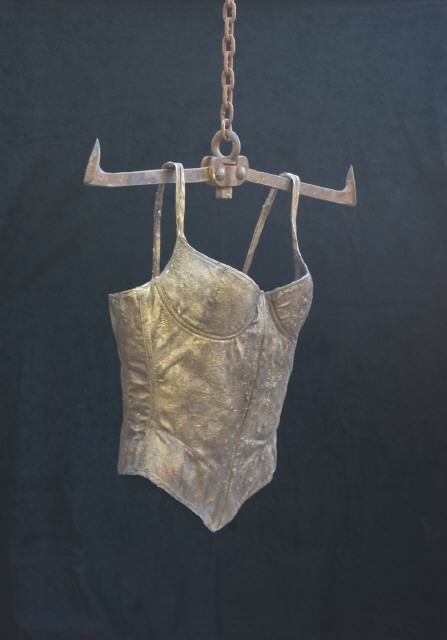
Bodice
— Angela Fortain
In her series “Overt Underthings” artist, Angela Fortain, considers a paradox: Distorting the body can both liberate and imprison, she says. Society dictates constraining fashions which, once dawned, create power over others.
Power over others?
By way of men’s desire, women’s envy.
The power to shape space as others turn in our direction.
Favors.
Lower status bowing to higher. Standing based on beauty – and what to make of that?
The power to gain love? Or sex? And must one undergo body-torture to attain either?
How might power become less available inside the constrained body?
Are the powers bestowed – or removed – substantive or superficial?
Finally, Fortain muses, “Separating the sensual object that once transformed the wearer into an object of sexuality allows us to examine the object, and our own desire.”
The power of objects… our own desire?
Fortain’s work provokes more questions than answers. As art should.
Georgia Platts
This piece was originally shown at “CONTROL,” an exhibition of California women artists presented by The Women’s Caucus for Art at New York’s Ceres Gallery, February 1 – February 26th, 2011.
For more on Angela Fortain’s work go to ARTslant.
Popular Posts on BroadBlogs
Spoon Fed Barbie (Part of the CONTROL series)
Men Aren’t Hard Wired To Find Breasts Attractive
Men Are Naturally Attracted To Unnatural Women
Surprises in Indiana University Sex Survey

 BroadBlogs