Blog Archives
Sex Sells — To Women?
 Sex sells, they say.
Last month’s Sports Illustrated swimsuit edition featured bikinied women and women whose nude bodies were painted to look like they were wearing bikinis. (Swimsuits are related to sports, get it?). The scantily clad ladies sell a lot of magazines.
Now SI wants to appeal to its female audience of 18 million. The ladies will get makeup tips. And after all the lovely swimsuit models, women readers may feel badly enough about themselves to want them – a common advertising trick.
But why no Beckham in the buff for us? We aren’t supposed to enjoy ogling sexy men? Instead, we are supposed to be sexy ourselves, so that men can enjoy ogling us?
But SI is hardly alone.
Cosmo, Glamour, Elle, et al., highlight sexy ladies, and at best, lowlight sexy men. In fact, Cosmo and Maxim look an awful lot alike.
But it’s not just magazines. Nearly nude women, but rarely men, draw our eyes to billboards peddling products. The camera hones in on women’s boobs and butts on TV and film. You don’t see much focus on men’s buns and chests.
Why are sexy women marketed to both men and women?
And why aren’t sexy men marketed to women?
Historically, men have controlled media and they put out what they find attractive. Then, flooded with pretty women, we all drink them in. They sink into our minds, and we unconsciously develop notions that that’s the way the world is and the only way things could be.
But the unsaid message is that women’s sexual needs aren’t primary. Men’s are. We are meant to be beautiful decorations for men. We are there to turn men on. Men need sexual pleasure, and we are the one’s to give it to them.
Not the reverse.
As a result, when men look at nearly-nude women, they love it. But when women look at nearly-nude men they can feel uncomfortable.
Shouldn’t women’s sexual pleasure be as important as men’s? And wouldn’t men and women both enjoy sex more if it were?
Popular Posts on BroadBlogs
Sex Objects Who Don’t Enjoy Sex
Men: Erotic Objects of Women’s Gaze
Men, Women React to Male/Female Nudity
Share this:

Outrage at Blaming Rapists, Not Women
 A proposal: “Blame the criminal, not the victim.” And there’s an uproar?
Last week rape survivor, Zerlina Maxwell, went on Fox’s “Hannity” to discuss rape and guns. But instead of saying women should drink less, dress modestly, arm themselves and learn self-defense, like she “should have,” she told Hannity:
I don’t think that we should be telling women anything. I think we should be telling men not to rape women and start the conversation there… If you train men not to grow up to become rapists, you prevent rape.
And all hell breaks loose. The Blaze calls her words “bizarre.” Blogs and tweets say she should get raped.
“Thanks for the feedback, Internet dopes. Why would anybody think that you need some sensitivity training?” responds Mary Elizabeth Williams at Salon.
Maxwell tells Salon that, “We need to teach (men) to see women as human beings and respect their bodily autonomy.” Williams points out that when you do, things change:
After Canada launched a “Don’t be that guy” consent awareness campaign in 2011, the sexual assault rate dropped for the first time in years — by 10 percent.
In fact, violence against women is much lower in non-patriarchal cultures that respect women. Both rape and battering were pretty much nonexistent among American Indians before Europeans arrived. Rape and battering have also dropped in the U.S. with a rise in feminism, according to Justice Bureau surveys of victims.
But why the rage when the focus of rape prevention turns from women to men?
Actually, the outrage hasn’t come from everywhere. It comes from right-wing groups — Fox News viewers and the like — who bolster the haves over the have-nots: typically whites, the rich, heteros and in this case, men, over everyone else.
Here, the matter relates to who is free and who is not. Do not even think about asking men to limit themselves. Women, on the other hand, should limit themselves: what they wear, what they drink, what time of day they leave the house… They must prepare themselves for defense against men who refuse to limit themselves. And continuing the right-wing rant, women must be stripped of freedom over their reproductive lives, entirely. No right to your own body in any way.
In this worldview even if rapists ACT, responsibility for the act must fall on the victim. Because men must be free, but women must not.
Popular Posts on BroadBlogs
Markets Must Be Free; Women Must Be Constrained
Cheerleader Ordered To Cheer Her Rapist, and Other Stories
11-Year-Old Blamed For Her Rape
Share this:

Women, Men Face Opposing Repressions
![hodgins-and-angela-in-jail[1]](https://broadblogs.com/wp-content/uploads/2013/03/hodgins-and-angela-in-jail1.jpg) Men and women are both repressed, but sometimes in opposing ways. Too many women feel emotionally open but sexually unresponsive, while too many men easily come even while their emotions lie submerged. Either way, when it comes to sex, they lose.
Men and women are both repressed, but sometimes in opposing ways. Too many women feel emotionally open but sexually unresponsive, while too many men easily come even while their emotions lie submerged. Either way, when it comes to sex, they lose.
But should we be surprised when (among other things) buddies push each other to have sex with lots of women who they feel nothing for. Successful “players” are celebrated for “scoring” with the ladies – who may be shamed for “giving it up.”
But as players have sex with women they don’t know and don’t care about, and whose reputations they may destroy, they must check their emotions. But checking emotions goes beyond the bedroom. Boys don’t cry, and shouldn’t express much else, either. When Norah Vincent passed as a man for 18 months, she missed feeling and expressing emotion.
Here’s one man’s response to a post I wrote called “Twilight vs Porn” which contrasts women’s emotionally charged erotica with men’s proclivity for body parts.
It took years for me to untangle the damaging messages I received as a man and to get underneath them to a more genuine understanding of what sex was. I, too, think male sexual modes are primarily culturally reinforced – and exclude men from the best sex within intimacy, leaving them with a series of shallow orgasms and striving egos.
A young woman named Valerie saw it from the other side. She complained about guys gaping at her body and manipulating her into popular porn positions. It’s cold, she says:
I don’t just want to become Body A. I want men to feel like they are with me, Valerie, a particular woman with a particular body and my own unique personality.
Surprisingly, advice to non-orgasmic women may have something in common with helpful advice for non-emotional men.
Sex therapist, Lonnie Barbach encourages women to explore their bodies — without trying to come (because trying to climax just leads to worry that they won’t and keeps them out of the erotic experience). Notice the subtleties of the sensations, she says, feel into them, let them grow.
A guy once told me that he’d had to do the reverse to experience connection. Orgasm was easy. He needed to notice emotional subtleties and center on those as a way to move beyond cold porn sex. And then he couldn’t believe how amazing sex could be — even though he’d thought it was awesome before.
Popular Posts on BroadBlogs
Men Watch Porn, Women Read Romance. Why?
Women Want Casual Sex? Yes and No
Guys Are Getting More Romantic
Share this:

Grooming Women for Battering

It’s not often – if ever – that you can witness a man grooming a woman to accept battering. We now have a visual record of how one man attempted it. And it may help to warn women away from potential abusers.
Sara Naomi Lewkowicz, a grad student at Ohio University, had planned to study the stigma of being an ex-convict. While at a local Corn Festival she spotted a tattoo-covered man who was gently cuddling a cute little girl. She approached and asked him and his girlfriend if she could photograph them over a period of time for her project, and they agreed.
Our photographer had met the couple only about a month after they’d gotten together. Two and a half months later she photographed Shane as he battered Maggie in their home. And she had already amassed a photographic record of how he had groomed her for the abuse. You can see the pictures here.
Batterers know that if they give in to their craving to beat their partners too soon the women will leave. So they have two immediate projects 1) push for quick involvement and 2) make her fall in love hard and fast so that she will stay after the beatings.
Shane’s charm offensive began while he was in prison, where he called Maggie every day. As soon as he was released they began dating and within weeks Maggie and her two kids, ages two and four, had moved in with him. A month later Shane got a huge neck tattoo which practically shouted MAGGIE. Any man who would get a tattoo like that must surely be both smitten and committed!
Abusers also keep score of emotional debts owed them (while ignoring those they owe). Altering his body for Maggie created a huge debt. As Amanda Marcotte put it,
“But I got a tattoo for you!” Translation: I altered my very body “for” you, and that is a massive debt that you can pretty much never pay, so you have to put up with my crap forever.
In more emotional blackmail Shane spent plenty of time complaining that Maggie paid more attention to her kids than to him.
Her four-year-old son, Kayden, took the brunt of his resentment even as he lavished attention on his cute two-year-old sister, Memphis. Maybe Shane thought he could release some of his abusive cravings on him while he repressed his desire to beat the boy’s mother. So keep in mind that batterers are often cruel to animals and children.
Batterers also try to isolate their victims, leaving them without help or support. So characteristically, Shane moved Maggie and her kids far away from family and friends within months of beginning their relationship. Moving everyone in with him may have also created a sense of “debt owed” and dependence on him.
But with a criminal record and facial tattoos Shane had difficulty finding work, so he couldn’t really afford to support the family. Abusers can come from any class but men who feel disempowered sometimes beat up their partners partly because it gives them a sense of empowerment in those moments when they are raging and pummeling a smaller, physically weaker person. And Shane’s difficulty finding work may have created a sense of powerlessness.
Once Maggie had fallen in love and was isolated and dependent, Shane only needed an excuse to beat her.
Jealousy works especially well for this trigger. The whirlwind courtship had already marked the relationship as passionate, and so administering a beating over jealous love promotes the storyline that he only did it because he loves her sooo much. And that makes her more likely to stay afterwards.
So Maggie and Shane went to a bar where Maggie became jealous over some flirtations and left. After a friend drove him home, Shane became enraged that Maggie had abandoned him. He then turned the jealous accusation around. Furious that one of his friends had flirted with Maggie, he claimed that she had betrayed him.
As they fought he told her to choose between getting beaten in the kitchen or going to the basement where they could talk privately (they were staying at a friend’s home).
Any police officer will tell you to never go to a second, more isolated location where something more brutal is likely to happen. Maggie was smart enough not to do that.
Hearing her mother’s screams, two-year-old Memphis ran to her mother’s side. Maybe because Shane had always been so sweet to Memphis, she felt she could protect her mom. So the little girl screamed, stomped her feet and finally put her body in between the two of them.
But the abuse didn’t end until a housemate called the police. Shane told the officers that he was just trying to keep Maggie from leaving the house with the children while she was drunk.
When that didn’t work he cried out, “Please, Maggie, I love you, don’t let them take me, tell them I didn’t do this,” apparently hoping that his “love” would persuade her to save him.
Often, it works. And it nearly did here as the officer had to coax the truth from Maggie and then talk her into signing a protection order and getting a medical exam.
“I don’t want to get him in trouble,” she wept.
“You aren’t getting him into trouble. He got himself into trouble,” the officer assured her. “You know, he’s not going to stop. They never stop. They usually stop when they kill you.”
What’s not typical is that Maggie left. She now lives in Alaska with her children’s father. Maybe she left because she had someplace to go. Maybe the publicity and the pictures made it difficult to deny the gravity of the abuse.
Most women stay, thinking that he will change. It usually takes months or even years of violent outbursts to see that it is about him and not about her, to see that he will not change, and to see that love is nowhere to be found.
When women decide to leave they should first call a domestic abuse hotline to make plans. And then go without warning. Because leaving is the most dangerous time.
800-799-SAFE (TDD: 800-787-3224)
SIGNS OF AN ABUSER
Keep in mind that not every batterer has all the signs. But here are some things to look out for:
Before an abuser starts physically assaulting his victim, he typically demonstrates his abusive tactics through certain behaviors. The following are five major warning signs and some common examples:
Charm
Abusers can be very charming. In the beginning, they may seem to be Prince Charming or a Knight in Shining Armor. He can be very engaging, thoughtful, considerate and charismatic. He may use that charm to gain very personal information about her. He will use that information later to his advantage.
For example; he will ask if she has ever been abused by anyone. If she says, “yes”, he will act outraged that anyone could treat a woman that way. Then when he becomes abusive, he will tell her no one will believe her because she said that before and it must be her fault or two people would not have hit her.
Another example; he may find out she experimented with drugs in her past. He will then threaten that if she tells anyone about the abuse he will report her as a drug abuser and she will lose her children. The threat to take away her children is one of the most common threats abusers use to maintain power and control over their victims.
Isolation
Abusers isolate their victims geographically and socially. Geographic isolation includes moving the victim from her friends, family and support system (often hundreds of miles); moving frequently in the same area and/or relocating to a rural area.
Social isolation usually begins with wanting the woman to spend time with him and not her family, friends or co-workers. He will then slowly isolate her from any person who is a support to her. He dictates whom she can talk to; he tells her she cannot have contact with her friends or family.
Jealousy
Jealousy is a tool abusers use to control the victim. He constantly accuses her of having affairs. If she goes to the grocery store, he accuses her of having an affair with the grocery clerk. If she goes to the bank, he accuses her of having an affair with the bank teller. Abusers routinely call their victims whores or sluts.
Emotional Abuse
The goal of emotional abuse is to destroy the victim’s self-esteem. He blames her for his violence, puts her down, calls her names and makes threats against her. Over time, she no longer believes she deserves to be treated with respect and she blames herself for his violence. For some survivors of domestic violence, the emotional abuse may be more difficult to heal from than the physical abuse.
Control
Abusers are very controlled and very controlling people. In time, the abuser will control every aspect of the victim’s life: where she goes, how she wears her hair, what clothes she wears, whom she talks to. He will control the money and access to money. Abusers are also very controlled people. While they appear to go into a rage or be out of control we know they are very much in control of their behavior.
The following are the reasons we know his behaviors are not about anger and rage:
- He does not batter other individuals – the boss who does not give him time off or the gas station attendant that spills gas down the side of his car. He waits until there are no witnesses and abuses the person he says he loves.
- If you ask an abused woman, “can he stop when the phone rings or the police come to the door?” She will say “yes”. Most often when the police show up, he is looking calm, cool and collected and she is the one who may look hysterical. If he were truly “out of control” he would not be able to stop himself when it is to his advantage to do so.
- The abuser very often escalates from pushing and shoving to hitting in places where the bruises and marks will not show. If he were “out of control” or “in a rage” he would not be able to direct or limit where his kicks or punches land.
Here are some more signs:
1. Jealousy of your time with co-workers, friends and family.
2. Controlling behavior. (Controls your comings and goings and your money.)
3. Isolation. (Cuts you off from all supportive resources such as telephone pals, colleagues at work and close family members.)
4. Blames others for his problems. (Unemployment, quarrels – everything is “your fault.”)
5. Hypersensitivity. (Easily upset by annoyances that are a part of daily life.)
6. Cruelty to animals or children.
7. “Playful” use of force in sex. (May start having sex with you when you are sleeping or demand sex when you are ill or tired.)
8. Verbal abuse.
9. Dr. Jekyll and Mr. Hyde personality. (Sudden mood swings and unpredictable behavior – one minute loving, the next minute angry and punitive.)
10. Past history of battering. (Has hit others but has a list of excuses for having been “pushed over the edge.”)
11. Threats of violence.
12. Breaking or striking objects.
13. Uses force during an argument.
Any woman who sees herself in this column should call the nearest women’s crisis line and tell someone what is happening. She will be provided with support and safety options.
Some women do not realize they are being abused until someone points it out to them. They have been made to believe that abusive treatment is what they deserve and that most women are treated this way. Women who see themselves in his should check out the nearest shelter and keep the phone number handy. They can also call the National Domestic Violence Hotline at 800-799-SAFE (TDD: 800-787-3224).
1. Controlling behavior: “I know what’s best for you” and “I know what you want (or need).”The reality is that no one knows what is best for another adult.
2. Blames others for his problems: “Look what you made me do” and “If you hadn’t done that, none of this would have happened.”
3. Use of force in sex and/or saying that sex was a “wifely duty.” There is no law requiring a woman to have sex if she doesn’t want to. Forced sex is called rape.
4. History of battering: Excuses include the classic, “If you hadn’t provoked me …”The truth is that he chose to hit, push, kick, slap or punch you. If he hit you once, he will hit you again.
5. Verbal abuse: If someone deliberately hurts your feelings by word or deed, it is abuse, even if it is as simple as “You look fat in that outfit.”
6. Threats of violence: Threats are almost always precursors to the deed. If he threatens you, leave him before he does it.
7. Use of force during an argument: Most women feel, as I did, that if they haven’t been hit, they have not been physically abused. Restraining someone is also physical abuse. Pushing and shoving are physical abuse.
Abuse and battery take a toll on one’s physical, emotional and spiritual energy. It is easy to say no. We say this word all the time. Unfortunately, we find it especially difficult to say no to those we love and those we fear.
Share this:

Are Girls Free to Make Love?
 In a recent episode of Girls, non-skinny and not classically beautiful, Hannah, has a short affair with a man who looks exactly like hunky Patrick Wilson. The response? He’s too hot for her!
As Fariha Roisin at Huffington Post put it:
Like, nobody who looks like that would a) Even think about sleeping with Hannah b) Then actually have the impertinence to enjoy it c) Then actually tell her she’s ‘beautiful.’ All he, realistically, would surely feel is remorse/self contempt, but hey sex is sex, right? Even bad sex, with a supposed undesirable.
Roisin then points out that when gender roles are reversed a similar outcry is absent.
- Katherine Heigl would go for Seth Rogen?
- The King of Queens gets the queen of Queens?
- Jon Cryer and Courtney Thorne Smith?
- Gorgeous porn stars with Ron Jeremy?
The list goes on but the outcry does not.
Maybe it’s about who has power over media and ideas – usually, men. And men like the idea of being able to get gorgeous girls even if they, themselves, aren’t so good-looking.
It’s not that men are bad. If women had more power than men it would probably be the reverse. (Lena Dunham gets a little power and look what happens to her character, Hannah. If I were producing, writing and starring in GIRLS I’d write in an affair with Patrick Wilson, too.)
This power over ideas may also affect whose body is shamed and whose is not. Men must be quite obese to garner body shame (if then) but women may be perfectly healthy and be thought too fat. And so Rush Limbaugh says feminism was created to allow unattractive women into mainstream society.
The double standard is reflected yet again as men may make love to many women without censor, but women may not.
In the end it is all about who is free and who is not — to love their bodies, to make love and to love. And it’s all tied to who makes the rules and who does not.
Popular Posts on BroadBlogs
You Are “Less Than”?
Does Sexual Objectification Lead to Bad Sex?
Celebs Less Weight-Conscious
Share this:

Women’s Sexuality Is Like Men’s?
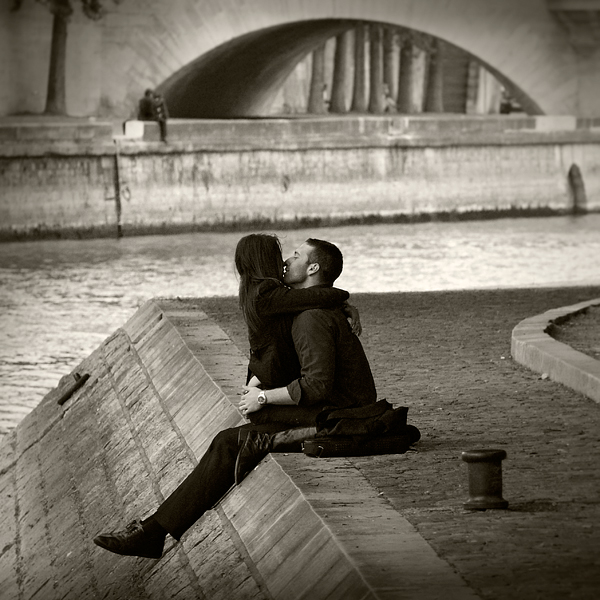 Women’s and men’s sexuality are pretty much the same, says Dan Slater in a recent New York Times piece.
He goes on to critique evolutionary psych, which says otherwise: Since women have a small number of eggs they best reproduce by putting great time and effort into each child – and by making sure a dependable dad sticks around to provide resources; hence, women are genetically primed for monogamy. But men are promiscuous because, with lots of sperm, they best reproduce by “spreading their seed,” willy-nilly.
But, says Slater, if kids need a dad to provide resources then “loving and leaving” their mothers is counterproductive. Plus, men can’t be promiscuous if women are monogamous. And, women in tribal societies enjoy many partners. I could go on.
Culture must not create differences in sexuality, either, he says, since men and women behave similarly.
For instance, women claim they want fewer partners than men. But when hooked up to a (fake) lie detector, women and men report the same number of actual partners.
Or, in speed dating women are pickier than men. But when the tables are turned with women approaching men, men become the more selective sex.
Finally, early research had found women — but not men — rejecting sex with both friends and strangers. But when that stranger was Johnny Depp, or when the friend was said to be good in bed, women were just as interested in casual sex as men. (No flesh and blood movie stars were involved in this study.)
So neither evolution nor cultural norms seem to be having an effect, leaving men and women just the same.
I agree that women’s sexuality is like men’s in its natural state. In many tribal societies it seems to be.
But can women be untouched by a culture that celebrates women’s bodies — or bodies that very few women actually have — while ignoring men’s? Or that applauds men’s sexuality while repressing their own? Is women’s sexuality untouched by a society that rapes so many?
We are bombarded by “sexy women” but not “sexy men” on billboards, in movies, on Dancing With The Stars… Even women’s everyday clothing shows off their curves while men stay covered up. Amanda Marcotte says “straight women don’t get nearly the provocation on a daily basis.”
No part of the male body is fetishized, either. Men stare at breasts and butts. What are we supposed to look at?
Meanwhile, the “perfect” images that our partners consume can make women feel bad about themselves — a libido killer as women become obsessed by their “flaws” in bed instead of enjoying sex.
The double standard is loosening but sexual women may still be called: slut, ho’, tramp, skank… the list goes on.
Sexual violence also takes a toll, leaving many women fearful or uninterested in sex.
All that has no effect?
Actually, in his evidence for similarity Slater leaves things out.
When it comes to casual sex, men are very interested in their lady friends. But women will only romp with those rumored to be great lovers. Otherwise, why bother?
On sex with strangers, only gorgeous celebs interest women. They seem safe (no reports of rape) and are mega-attractive, charismatic and sexy. Women expect they’ll be great in bed. Plus, sex with a star sounds heavenly, tantamount to intercourse with the gods — or rock gods. So nabbing a guy like that tells her something pretty great about herself.
Turning to speed dating, when things switch around maybe women begin to fear rejection and want to “win” now that the setup feels like a contest. Research in cognitive dissonance suggests that if you try to get someone to like you, you like them more.
Finally, most women say that ideally they would like just one or two partners, lifetime, but Slater thinks they’re lying since they admit to four real partners under duress of lie detection. With or without a lie detector I would say that I have had 5 partners in real life, but ideally I would like just one true love. And a lot of us women need a strong emotional connection to even get aroused.
Meanwhile, the eroticism women typically seek out – romance – is very different from the endless variety of women and their body parts that men more typically “procure” in porn.
While women’s natural sexuality is likely much like men’s, our differing experiences unfortunately pull us apart. And the root cause appears to be sexism, not nature.
Popular Posts on BroadBlogs
Lose Virginity, Lose Self-Esteem?
Women Want Casual Sex? Yes and No
Men Watch Porn, Women Read Romance. Why?
Share this:

Girls = Boys in Math
 In the US boys outperform girls in math. But we’re an outlier. As a Slate article describes it:
The only countries with a wider gap favoring boys are Colombia and Liechtenstein. Many Middle Eastern countries—notably Qatar, Jordan, and the U.A.E.—report a significant gender gap in favor of girls (though lower math scores overall). In Hong Kong, Singapore, and South Korea, the gender gap is miniscule, and the math scores are high. Shanghai registers no gender gap between boys and girls—together, they’re outperforming other teenagers across the globe.
Why is the US so different? Here, we see math as a male domain, and that explains a lot.
American girls have less confidence in their math skills than boys and so they take fewer math classes. But girls are also less likely to join the math, science or chess clubs, too. And all those clubs help strengthen math skills.
US boys also try harder because they think math will have a bigger impact on their lives. In Jordan girls are the ones who think that, and they do better.
And importantly, when people lack confidence their performance drops. College men and women got similar scores when they were told that men and women typically do equally well. But men did better when told that big gender differences were expected. Even taking a test in a room full of men dampens American women’s performance.
Meanwhile, Asian girls did better when they were told that ethnic differences affect math scores than when they were told that gender differences did.
Looks like boys aren’t better at math, we just think they are.
Popular Posts on BroadBlogs
Testosterone Damages Verbal Skill. Yet We Have Shakespeare
Learning to See Ourselves as Inferior
Prejudiced People Are Stupid
Share this:

Women Shouldn’t Be Alphas!
![Kristen-Stewart-Snow-White-Huntsman-armour[1]](https://broadblogs.com/wp-content/uploads/2012/06/kristen-stewart-snow-white-huntsman-armour1.jpg) I don’t want to publish reviews of films where women are alpha and men are beta. Where women are heroes and villains and men are just lesser versions or shadows of females.
I don’t want to publish reviews of films where women are alpha and men are beta. Where women are heroes and villains and men are just lesser versions or shadows of females.
Frank Parlato wrote that email soon after becoming editor of The Reporter.
The New York Times says it was Snow White and the Huntsman that set him off.
(It) struck Parlato as emblematic of “a Hollywood agenda of glorifying degenerate power women and promoting as natural the weakling, hyena-like men, cum eunuchs.”
He must not have seen the film.
Luckily, The Reporter is just a small weekly in upstate New York. But I’ve been thinking about this with the Oscars approaching.
Fortunately for Parlato, movies are mostly the way he likes them. But that’s not so fortunate for the rest of us.
Quick thought experiment: how would you experience yourself after watching popular Oscar-nominated films if gender roles were reversed?
- What if we watched President Mary Todd Lincoln fight to abolish slavery and save the union?
- What if CIA operative, Tonya Mendez, led the charge to liberate female diplomats from Tehran during the Iranian hostage crises in Argo?
- In Zero Dark Thirty a male CIA agent finds Osama bin Laden’s whereabouts. A highly-skilled female unit then finds and kills bin Laden.
- Our heroine explores spirituality and survives the good part of a year stranded on a lifeboat with a Bengal tiger named Rachel Parker in the Life of Pi.
- In Les Misérables ex-convict Janette Valjean undergoes redemption while pursued by police inspector, Monique Javer, who doubts the possibility of transformation.
- In Silver Linings Playbook bipolar Patricia leaves a mental health facility where she’d ended up after nearly beating her husband’s lover to death. Next thing you know, she’s fighting thugs at a Philadelphia Eagles game. In the end she enters a dance contest and gains love.
- Django Unchained follows Sally Django, a freed slave who crosses the United States with bounty hunter, Kate King, on a mission to rescue her husband from a cruel and charismatic plantation owner named Lenora Crawford.
If these were the movies would you experience yourself as a more powerful woman? More in control? More the main event? As a man would you feel more disempowered and marginal?
Plenty of things in our culture create the same psychology, such as “man” and “he” referring to us all. Or, “woman,” “she,” and “her” are consistently placed after “man,” “he,” and “him.” A wife takes her husband’s name. The list goes on. Living in a world where the power players in business, government, religion, the home and beyond are mostly men adds to the effect.
I grew up with a mother who’d grown up in a world where women were even more passively presented than they are today. She couldn’t change things, she thought. Others had to create a good place for her or she was out of luck. She felt powerless and depressed. That didn’t help me and that didn’t help my brother. (So yeah, males are harmed, too.)
Surely, balance would be better.
Related Posts on BroadBlogs
Women, We Are Men
Gender-Swapping Grammar Lessons
Frats Invite Sluts, Bitches; Women Accept Degradation. Why?
Share this:

Low Self-Esteem? Blame Beauty Myths
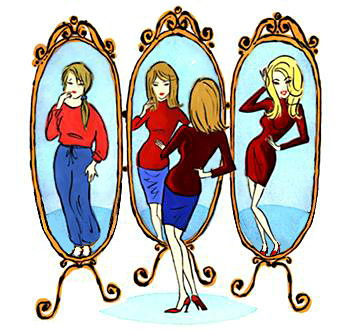 Even as women’s power has increased over the last fifty years, self-esteem has too often diminished. Why? Blame unachievable beauty ideals.
Since the mid-twentieth century, the number of women and girls with poor body image has greatly risen. A big problem, since feminine self-worth has become closely tied to body image.
As Naomi Wolf explains in The Beauty Myth, women have more money and power than ever before but, “a secret ‘underlife’ poisons our freedom; infused with notions of beauty, it is a dark vein of self-hatred, physical obsessions, terror of aging and a dread of lost control… In fact, in terms of how we feel about ourselves physically, we may be worse off than our unliberated grandmothers.” Too bad her book, which was written twenty years ago, is not now obsolete.
Once upon a time, she says, the family was a productive unit so that a woman’s value lay in her work skills, economic shrewdness, physical strength, and fertility, with physical beauty playing a lesser, and less oppressive, role.
Before the industrial revolution – before photographs, photoshop, and plastic surgery – women did not feel pressured to live up to a mass-marketed ideal – one that is nearly impossible to achieve, leaving women frustrated and depressed, obsessed with their looks, and wondering what is wrong with them.
As the beauty myth creates a hierarchy pegging some better than others, I am reminded of a book called The Spirit Level. British epidemiologists, Richard Wilkinson and Kate Pickett say “Gross inequality tears at the human psyche, creating anxiety, distrust and an array of mental and physical ailments,” with those at the bottom suffering a range of pathologies.
The Spirit Level is concerned with economic disparity. But the theory fits with other inequities. Beauty hierarchies leave too many women depressed with low self-esteem, eating disorders, competing to be plastic on reality TV, jealous, envious, and sometimes dying from anorexia or plastic surgery. Importantly, the problem isn’t so much where you stand as where you think you do. Unfortunately, it’s common for women to place themselves at the bottom, and suffer.
Why not celebrate the wonderful variety of figures and faces that women embody, instead?
Popular Posts on BroadBlogs
Men Are Naturally Attracted To Unnatural Women
The Constricting Bodice: Empowerment and Imprisonment?
Men Finding Fewer Women “Porn-Worthy”
Share this:

Stop Selling Girls
 Like most girls who end up in prostitution “Alissa” grew up in an abusive home. But at age 16 a deceptive Prince not-so-Charming came to her “rescue.” He told her she was attractive and that he’d like to be her boyfriend. Flattered, she accepted. Soon after, he prostituted her.
Alissa stayed with him, partly because she felt emotionally attached. Girls who have lived without love crave it and often take whatever they can get. Pimps know this and use it. But she also stayed because she feared his violence.
Nick Kristof told this story in the New York Times:
She was sold to johns seven days a week, 365 days a year. After a couple of years, she fled, but a pimp tracked her down and — with the women he controlled — beat and stomped Alissa, breaking her jaw and several ribs, she said. That led her to cooperate with the police.
Perhaps the strangest part of this story is that she was sold on Backpage.com, which is owned by Village Voice Media. Strange, since Village Voice is a well-known alternative journal whose aim is to speak truth to power. Yet Backpage makes up about 70% of prostitution advertising among similar Web sites. Most of the Backpage ads are legit, but the sex slavery that it promotes is troubling.
John Mailer, son of Village Voice co-founder Norman Mailer, has called for Backpage to shut down. As he put it:
The Village Voice was born out of the desire for an independent media voice for the people, a voice that had the freedom and authority to hold those who abuse power accountable for their actions… As my father’s son, knowing all of the hopes and dreams that went into the work of creating this particular paper, the Village Voice appears to have lost its way…
Pandora Young, now at Media BistroI, has also felt the pangs of conscience. For years she worked at the Village Voice-owned LA Weekly. She said:
I knew that I was being paid in some small part by blood money. And while I felt lousy about it, I did nothing beyond kvetching about the problem with fellow employees. I always cashed my paychecks, and I never gave a dime to help victims of sex trafficking.
Some defend Backpage’s right to free speech. And Village Voice says they work hard to make sure all ads are legit. But too much gets through.
The only reasonable argument I’ve heard to keep from shuttering Backpage is that it provides a tool for law enforcement to identify trafficking victims. But Kristof points out that:
Village Voice makes some effort to screen out ads placed by traffickers and to alert authorities to abuses, but neither law enforcement officials nor antitrafficking organizations are much impressed. As a result, pressure is growing on the company to drop escort ads.
Change.org has a petition to shut down Backpage. Weigh the pros and cons yourself. If you want Backpage shut down, sign the petition here.
“All that is necessary for the triumph of evil is that good [people] do nothing.”
– Edmund Burke.
Popular Posts on BroadBlogs
Trafficked Girl Shoots Pimp, Gets Life Sentence
In-laws Rip Off Girl’s Fingernails, But Who Cares?
Why Did Nancy Garrido Help Kidnap Jaycee Dugard?

 BroadBlogs