Category Archives: sexism
Is Sexism Men’s Fault?
![2009-01-13-0obama[1]](https://broadblogs.com/wp-content/uploads/2012/12/2009-01-13-0obama1.jpg?w=604) Is male dominance natural and normal? Did sex inequality arise as men’s brute strength cowed women into compliance? My students often think so, saying things like, “Men have always ruled,” as though it’s inevitable. Or, “Men are bigger and stronger so they can bully women into submission.”
Is male dominance natural and normal? Did sex inequality arise as men’s brute strength cowed women into compliance? My students often think so, saying things like, “Men have always ruled,” as though it’s inevitable. Or, “Men are bigger and stronger so they can bully women into submission.”
I guess we’ve made some progress since I don’t also hear the old argument that women are naturally dependent.
Most people don’t know that men haven’t always been in charge.
When Europeans first made contact with America Indians they were amazed – and appalled – at their equality.
Matrilocal, the husband took his place with his wife’s family after marriage. Matrilineal, relatives were traced through the female line. Property passed through women. Killing a woman brought a double penalty.
Europeans were aghast that native men needed to speak with their wives before taking action!
Men and women both had tribal councils. If the men voted to go to war and the women disagreed, the women could refuse to provide corn (their staple) leaving the men backing down.
Other egalitarian cultures include the Arapesh, the !Kung, and Tahitians (before European contact), to name a few. In fact, it appears that parity was not uncommon prior to agriculture.
Inequality seems to have arisen not because men purposely tried to hurt women and help themselves, but via some seemingly innocuous routes, 1) agriculture and 2) attempts to avoid inbreeding via trading, selling, and stealing women (who could have more children and make the tribes larger and stronger). I’ll discuss these dynamics in a later post.
But we know that gender inequality is not predestined. And men do not inevitably try to dominate women through brute force.
Today many men work for women’s equality, too.
And I’d like to thank them.
Popular Posts on BroadBlogs
Are Women Naturally Monogamous?
Cultural Relativism: Must We Be Nazis to Criticize Them?
Cheerleader Ordered To Cheer Her Rapist, and Other Stories
Share this:

Saying “No” in 520 Languages
I’m Learning to Say No in 520 Languages
How often do I hear my brain screaming NO as I smile and say yes? These random words are all “NO” in different languages. So I am learning to say no in 520 languages, most importantly mine, NO.

Artist, Karen Gutfreund, works with unconventional materials: roof tar, bone, red food coloring, wax… As she moves against standards and customs, is she saying NO even as she works as an artist?
She has good reason to go against the flow. We all do.
Her work strikes a chord with a piece I once read entitled, “Betrayed by the Angel”:
I’m 25 years old. I’m alone in my apartment. I hear a knock. I open the door and see a face I don’t know. The man scares me, I don’t know why. My first impulse is to shut the door. But I stop myself: You can’t do something like that. It’s rude… He is inside. He slams the door shut himself and pushes me against the wall… Since he is being rude, it is okay for me to be rude back.
Despite the young woman’s revelation that rudeness can be good, it was too late. She was raped.
Some feel queasy at self-defense seminars when told to gouge out an attacker’s eyes. “Could I do something less gruesome?” someone asks. Advice from the expert: “He’s bigger than you. If you try something weaker he’ll overtake you and you’ll be raped or dead.”
I had it easier. But not really easy. He was a guy from church, and we were dating. At church we didn’t have double standards. Men and women were both told to stay pure. I was so inexperienced and naïve that when he touched me outside my clothes, but at “third base,” I froze in shock. Was he really doing that? I didn’t want to be rude. In guarding his feelings I paid a price, smacked with the label, “loose.”
Virginia Woolf speaks of the Angel in the House. Some scattered lines:
You who come of a younger and happier generation may not have heard of her – you may not know what I mean by the Angel in the House… She was intensely sympathetic. She was immensely charming. She was utterly unselfish… She sacrificed herself daily… She preferred to sympathize always with the minds and wishes of others…
I turned upon her and caught her by the throat. I did my best to kill her. My excuse, if I were to be had up in a court of law, would be that I acted in self-defense. Had I not killed her she would have killed me.
This piece was originally shown at “CONTROL,” an exhibition of California women artists presented by The Women’s Caucus for Art at New York’s Ceres Gallery, February 1 – February 26th, 2011.
For more on Karen Gutfreund’s work go to her website.
Popular Posts on BroadBlogs
Spoon Fed Barbie
Cartoonish vs Authentic Sexuality
Sex: Who Gets Screwed?
Share this:

A Woman Slut-Shames, in Verse
![35u7yq[1]](https://broadblogs.com/wp-content/uploads/2012/12/35u7yq1.jpg?w=604) By Rebecca Gardner
By Rebecca Gardner
I’m always surprised at how women can foster sexism, themselves. I heard Nicki Minaj’s “Stupid Hoe” the other day and thought of the problem. She uses tough-girl guises, but she is far from modeling powerful womanhood.
The title, itself, says men may do as they please. Women may not.
Or how about these lines:
ice my wrists’ and I piss on bitches
you can suck my diz-nik,
if you take this jizz-ez.
Seeing through sexist eyes, she asserts that one woman might be superior to another, but she will never equal a man. And “piss(ing) on bitches” hardly promotes female solidarity or empowerment. The jab puts other women down just to raise Minaj up.
Meanwhile, she raps-idizes on male pleasure and the “diz-nik” as a symbol of male supremacy while the genitalia of “stupid hoes” fall short.
“Pretty bitches can only get in my posse”
In her video, Minaj wears several wigs, mostly blonde and coupled with big breasts, a big butt, and a fit body. She transforms herself into viewing pleasure – pleasure for men. And unless a woman is “beautiful,” she cannot be Minaj’s friend. She’s just a “stupid hoe.”
Beauty norms are unquestioned, eliminating room for individuality and self-expression while the camera pans from her butt to her bust, like that’s all she is, like that’s all sex is, and as if her power emerges only sexually.
And then she imprisons herself in a cage – not so powerful, after all. The camera flashes between images of her head and a leopard’s, creating a sense of Minaj as animal, sub-human.
“Stupid Hoe” cries out “hoe” nearly 50 times, and the n-word more than once. This sexist racism paints a clear picture: Minaj identifies with privileged white males.
Bitches play the back cause they know I’m the front man
Why does Minaj exalt white men — and herself — at black women’s expense?
She may have simply internalized racist and sexist norms so that these “isms” now live, unquestioned, in her head.
Or she shrewdly plays a game. She gains whatever power and status she can wrest from powerful men, while leaving a system that oppresses women intact. She gains even as she loses in this patriarchal bargain.
Underneath it all lies an illusion of power.
Popular Posts on BroadBlogs
Making Violence Against Women Sexy
What Do Top Model and Hard Core Porn Have in Common?
Virtually Attack Women, But No Nudity
Share this:

Sexual Objectification, The Harm
![Dolce-Gabbana-Ad-Sexist[1]](https://broadblogs.com/wp-content/uploads/2012/12/dolce-gabbana-ad-sexist1.jpg?w=300&h=224) By Caroline Heldman (Cross-posted at Ms. and Caroline Heldman’s Blog)
By Caroline Heldman (Cross-posted at Ms. and Caroline Heldman’s Blog)
This is the second part in a series about how girls and women can navigate a culture that treats them like sex objects. (Part 1 can be found here.)
Sexual objectification is nothing new, but this latest era is characterized by greater exposure to advertising and increased sexual explicitness in advertising [PDF], magazines, television shows, movies [PDF], video games, music videos, television news, and “reality” television.
In a culture with widespread sexual objectification, women (especially) tend to view themselves as objects of desire for others. This internalized sexual objectification has been linked to problems with mental health (clinical depression, “habitual body monitoring”), eating disorders, body shame, self-worth and life satisfaction, cognitive functioning, motor functioning, sexual dysfunction [PDF], access to leadership [PDF] and political efficacy [PDF]. Women of all ethnicities internalize objectification, as do men to a far lesser extent.
Beyond the internal effects, sexually objectified women are dehumanized by others and seen as less competent and less worthy of empathy by both men and women. Furthermore, exposure to images of sexually objectified women causes male viewers to be more tolerant of sexual harassment and rape myths (false notions about rape). Add to this the countless hours that some girls/women spend primping to garner heterosexual male attention, and the erasure of middle-aged and elderly women who have little value in a society that places women’s primary value on their sexualized bodies.

Theorists [PDF] have contributed to understanding the harm of objectification culture by pointing out the difference between sexy and sexual. If one thinks of the subject/object dichotomy that dominates Western culture, subjects act and objects are acted upon. Subjects are sexual, while objects are sexy.
Pop culture sells women and girls a hurtful fiction that their value lies in how sexy they appear to others; they learn at a very young age that their sexuality is for others. At the same time, sexuality is stigmatized in women but encouraged in men. We learn that men want and women want-to-be-wanted. The yardstick for women’s value (sexiness) automatically puts them in a subordinate societal position, regardless of how well they otherwise measure up. Perfectly sexy women are perfectly subordinate.
The documentary Miss Representation has received considerable mainstream attention, one indicator that the public is now recognizing the damaging effects of sexual objectification of women.
Widespread sexual objectification in U.S. popular culture creates a toxic environment for girls and women. The next two posts in this series provide ideas for navigating objectification culture in personally and politically meaningful ways.
Popular Posts on BroadBlogs
Sexual Objectification, What is it?
Nude Men Seem Less Intelligent
Objectification’s Role in a Suicide
Share this:

Religious Cruelties
![article-0-0D220DA8000005DC-480_468x503[1]](https://broadblogs.com/wp-content/uploads/2012/12/article-0-0d220da8000005dc-480_468x5031.jpg?w=279&h=300) Some wonder how morality can exist without religion. Yet too often religion submerges morality.
Some wonder how morality can exist without religion. Yet too often religion submerges morality.
I recently wrote about religious men seeking therapy to overcome same-sex attraction. But the “therapy,” itself, seemed evil as men were shocked, given drugs to create nausea, told to strip naked and touch themselves in front of a counselor, or were forced to beat their mothers’ effigies.
Not long ago an Irish woman died because her doctors would not perform an abortion:
Despite her rising pain, doctors refused her request for an abortion for three days because the fetus had a heartbeat. She died in the hospital from blood poisoning three days after the fetus died and was surgically removed.
Her husband was left asking,
When they knew the baby was not going to survive, why not think about the bigger life which was the mother, my wife Savita? And they didn’t.
In the not-so-distant past some devout Irish doctors broke their patients’ pelvises to prevent miscarriage. The painful operation often caused chronic back pain, incontinence, and crippling. As one woman explained,
It ruined my life. I have two titanium knees, a bad back and I think about it every day. It was 53 years ago… They were torturers. They didn’t care. I was a thing.
Another described the procedure:
I saw the hacksaw. He started cutting my bone and my blood spurted up like a fountain. [She remembers the doctor looking annoyed that he had gotten her blood on his glasses]. You’ll never get rid of [the pain] until you’re not living anymore.
Not long ago a Polish woman named Edyta died because each doctor she approached refused to treat her colon condition, fearing an operation might lead to miscarriage or abortion. She could have expected refusals had she lived in Italy, Hungary, or Croatia, too, because in each of these places doctors may refuse treatment on moral grounds. Apparently, letting a woman die is not a part of the moral compass. The fetus died, anyway.
In North African countries the clitoris or vulvas of young girls are routinely cut with dirty razors and parts are removed to deaden sexual sensitivity, “making them pure.” Some die of infection, many are crippled, and most live in pain.
In other places brothers kill sisters over any “sexual impropriety,” including marrying who you want, being alone with a boy, looking at a boy, or rape.
In Saudi Arabia girls in night clothes were once forced back into a burning building to die so as to protect men from their immodesty.
The religious Taliban ordered a girl’s nose and ears cut off when she ran away from her abusive in-laws.
And don’t forget the Inquisition, the Crusades and the witch hunts.
I could go on.
Really, how callus can your religious beliefs make you?
The Golden Rule must be hiding around here somewhere.
Popular Posts on BroadBlogs
Child Rape: Not As Bad As Contraception
God-Wrestling Nuns
Share this:

Murder-Suicide and Jock Culture
 In a murder-suicide Kansas City Chiefs linebacker, Jovan Belcher, shot and killed his 22-year-old girlfriend and then killed himself at the young age of 25. Their baby daughter, Zoey, is now motherless and fatherless.
In a recent New York Times piece, Frank Bruni pondered the effect of football culture on athletes and how it may have influenced the killings:
While it’s too soon to say whether Belcher himself was a victim of that culture, it’s worth noting that the known facts and emerging details of his story echo themes all too familiar in pro football over recent years: domestic violence, substance abuse, erratic behavior, gun possession, bullets fired, suicide.
Bruni considers this range of problems. I’ll look at how the culture harms relationships and buttresses hostility and violence against women.
When sociologist, Timothy Jon Curry, spent time hanging with athletes he found a “locker room culture” that demeaned women and celebrated violence against them.
Not all guys were the same. Some talked about women as real people and discussed their relationships, usually in quite tones with a best friend. But if someone overheard, they’d get slapped down. Because any “real man” knows that men should not be dependent on or vulnerable to women.
In a hushed conversation in one corner of the locker room a guy told his best friend, “I’ve got to talk to you about my girlfriend.”
But the others jibed him:
Yeah, tell us what she’s got.
Boy, you’re in trouble now.
You’ll have to leave our part of the room. This is where the men are.
More often guys talked boisterously – and often with hostility — about women as sex objects and conquests. All to enhance their hetero manly-men images.
Girlfriends were slammed. An assistant coach held up a picture of an obese woman that he called “Frank’s girlfriend.” Another sneered, “When she sits around the house, she really sits around the house.” Or, “She’s so ugly that her mother took her everywhere so she wouldn’t have to kiss her goodbye.”
Other times the guys seemed to celebrate rape:
Hey Pete, did you know Terry is a sexual dynamo? Well he said he was with two different girls in the same day and both girls were begging, and I emphasize begging, for him to stop.
Even moms were not immune:
She’s too young to be his mother!
Man, I’d hurt her if I got a hold of her.
I’d tear her up.
I’d break her hips.
Yeah, she was hot!
So here we have male bonding, men “being men,” men being different from women and in a way that controls and dominates them.
Curry says it all makes successful, loving, nurturing relationships difficult and supports violence against women. In fact, he says, there’s evidence that years of living in this sort of culture desensitizes guys to women’s rights and supports male supremacy.
And judging from one dead linebacker, his dead partner and orphaned daughter, that’s not good for anyone.
Popular Posts on BroadBlogs
What Happens When You Beat A Sex Object?
Making Relationship Violence Sexy
Real Men Don’t Beat, Rape Women: A Guy’s View
Share this:

11-Year-Old Blamed For Her Rape
![rapist-victim-blaming[1]](https://broadblogs.com/wp-content/uploads/2012/12/rapist-victim-blaming1.jpg?w=300&h=199) “It should not be this hard to get it through anybody’s head that an 11-year-old child who’s been repeatedly abused is not the problem.”
“It should not be this hard to get it through anybody’s head that an 11-year-old child who’s been repeatedly abused is not the problem.”
That’s Mary Elizabeth Williams over at Salon bemoaning that a young girl has been repeatedly blamed for a gang rape meted out by 20 boys and men.
The townspeople of Cleveland, Texas began the indictment, complaining that:
She dressed older than her age, wearing makeup and fashions more appropriate to a woman in her 20s. She would hang out with teenage boys at a playground.
The New York Times reporter who covered the case seemed to think the charge held merit, obediently recording the concerns.
Next, she was blamed in court.
As 20-year-old Jared Cruise stood trial his defense attorney, Steve Taylor, told the jury that she had never reported the rape to police. And that,
She had never shed a tear nor voiced a single complaint about her sexual encounters with any of the 20 males accused of assaulting her two years ago.
When he asked if she had been a “willing participant” she said, “Yes, sir.”
Actually, on her affidavit she said that the men had threatened to beat her if she did not do as she was told. That may have seemed to her like willing compliance.
Taylor then accused her of being, “Like the spider and the fly. Wasn’t she saying, ‘Come into my parlor, said the spider to the fly?’”
Her attorney retorted, “I wouldn’t call her a spider. I’d say she was just an 11-year-old girl.”
Taylor scolded, “I hope nothing like this ever happens to your two teenage sons.”
Because, as Williams points out,
Apparently those four months of sustained sexual abuse against a child are something that happened to Jared Len Cruise and 19 other guys.
The girl’s lawyer then played the rape video, saying, “Look at how proud [Cruise] is on that video as his buddies say ‘beat that ho.’”
“Beat that ho.” Yes, that sounds exactly like what a little eleven-year-old would tempt men to do to her.
Victim-blaming often works because so many blame girls and women for their assaults.
Too many believe that women take pleasure in rape even though it doesn’t involve foreplay or clitoral stimulation. And most women need emotional connection to enjoy sex. Since men get off on straight intercourse many think it’s great for women too.
Why didn’t she report the assault to police? She may have felt ashamed or not known that she could. She may have feared the men’s further retribution. Abused kids often feel powerless and unsure what to do. And how do we know that she never cried?
Last week Cruise was convicted of assault. I guess the jury didn’t believe that an 11-year-old “wanted it.”
But if she’d been older, would he still have been convicted?
Related Posts on BroadBlogs
Community Bullies Rape Victim
Cheerleader Ordered To Cheer Her Rapist, and Other Stories
12-Year-Olds Wanted Rape, Judge Says
Share this:

Sexual Objectification, What is it?

Cross-posted at Ms., Caroline Heldman’s Blog and Sociological Images
This is Part 1 of a four-part series on sexual objectification–what it is and how to respond to it.
The phrase “sexual objectification” has been around since the 1970s, but the phenomenon is more rampant than ever in popular culture–and we now know that it causes real harm.
What exactly is it, though? If objectification is the process of representing or treating a person like an object, then sexual objectification is the process of representing or treating a person like a sex object, one that serves another’s sexual pleasure.
How do we know sexual objectification when we see it? Building on the work of Nussbaum and Langton, I’ve devised the Sex Object Test (SOT) to measure the presence of sexual objectification in images. In it, I propose that sexual objectification is present if the answer to any of the following seven questions is “yes”:
1) Does the image show only part(s) of a sexualized person’s body?
Headless women, for example, make it easy to see them as only a body by erasing the individuality communicated through faces, eyes and eye contact:


We achieve the same effect when showing women from behind, which adds another layer of sexual violability. American Apparel seems to be a culprit in this regard:


Covering up a woman’s face works well, too:


2) Does the image present a sexualized person as a stand-in for an object?
The breasts of the woman in this beer ad, for example, are conflated with the cans:
Likewise the woman in this fashion spread in Details, in which a woman becomes a table upon which things are perched. She is reduced to an inanimate object, a useful tool for the assumed heterosexual male viewer:

3) Does the image show sexualized persons as interchangeable?
Interchangeability is a common advertising theme that reinforces the idea that women, like objects, are fungible. And like objects, “more is better,” a market sentiment that erases the worth of individual women. The image below, advertising Mercedes-Benz, presents just part of a woman’s body (breasts) as interchangeable and additive:

This image of a set of Victoria’s Secret models, borrowed from a previous Sociological Images post, has a similar effect. Their hair and skin color varies slightly, but they are also presented as all of a kind:

4) Does the image affirm the idea of violating the bodily integrity of a sexualized person who can’t consent?
In this “spec” ad for Pepsi (not endorsed by the company), a boy is being given permission by the lifeguard to “save” an unconscious woman:

Likewise, this ad shows an incapacitated woman in a sexualized position with a male protagonist holding her on a leash. It glamorizes the possibility that he has attacked and subdued her:
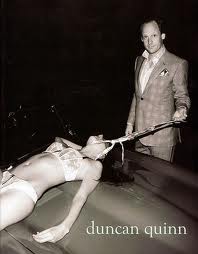
5) Does the image suggest that sexual availability is the defining characteristic of the person?
This American Apparel ad, with the copy “now open,” sends the message that this woman is open for sex. She presumably can be had by anyone.

6) Does the image show a sexualized person as a commodity that can be bought and sold?
By definition, objects can be bought and sold, and some images portray women as everyday commodities. Conflating women with food is a common sub-category. This PETA ad, for example, shows Pamela Anderson’s sexualized body divided into pieces of meat:

And this album cover shows a woman being salted and eaten, along with a platter of chicken:

In the ad below for Red Tape shoes, women are literally for sale and consumption, “served chilled”:

7) Does the image treat a sexualized person’s body as a canvas?
In the two images below, women’s bodies are presented as a particular type of object: a canvas that is marked up or drawn upon.


The damage caused by widespread female objectification in popular culture is not just theoretical. We now have more than 10 years of research demonstrating that living in an objectifying society is highly toxic for girls and women. I’ll describe that research in Part 2 of this series.
Cross-posted at Ms., Caroline Heldman’s Blog and Sociological Images
Popular Posts on BroadBlogs
Anything Good About Being A Sex Object?
Sex Objects Who Don’t Enjoy Sex
Does Porn Objectify? Experts Disagree
Share this:

Woman, Not the Sum of Flawed Parts
![anistonpubis[1]](https://broadblogs.com/wp-content/uploads/2012/11/anistonpubis11.jpg) By Linda Bakke
By Linda Bakke
Star Magazine. Full of faces covered by question marks, bodies sliced up. Women diminished to the details of their flaws, circled in bold. A dissection of celebrities’ body parts.
I was working as a receptionist at a hair salon when I discovered Star. I picked it up and paged through. It was awful. I could not put it down.
One article divulged a star’s “hairy secret,” detailing the frequency of her waxing regimen and suggesting her pubic area was overly hairy. A two page spread highlighted shameful “sausage fingers.” Another asked who had the worst toes.
It all oddly evoked the serial killers who keep articles – or worse, dismembered body parts – as trophies.
And what is the triumph here? A sensed superiority over the goddess’ faults as we lie in judgment?
And who can blame us? Their supposedly error-free bodies stress us out! Destroying them and their presumed perfection just might lift our spirits.
But maybe scrutinizing them only returns scrutiny to us, as the judgments tell us we must correct our own “blemishes,” whether buttocks, breasts, fingers or toes.
The message: women’s imperfections cannot be tolerated.
As we eat it up, we fail to see how we become victims, too, unconsciously nodding agreement that this treatment of women is acceptable.
While the pictures and text underline our preoccupation with facade over character, men’s bodily foibles are untouched by these tabloids. Who can imagine placing a man in such light?
Hopefully one day we will take on realistic and healthy expectations so that women will no longer be seen as the sum of flawed parts.
Popular Posts on BroadBlogs
Keep Your Boobs, Get Better Guys
How to Look Like a Victoria’s Secret Angel
Beautiful Women’s Hips Are Thinner Than Their Heads?
Share this:

Overcoming Scars of Abuse
 Today I am reposting a story of one woman’s recovery (still in progress) from her traumatic ordeal of childhood sexual abuse. This story comes from HumanitysDarkerSide, and I hope it might help others.
Broadblogs wrote an article called Why We Have Sex based upon the findings of CM Meston and DM Buss at the Department of Psychology at the University of Texas. These two researchers wrote an article called Why Humans Have Sex in 2007. In their article Meston and Buss cite 237 reasons that students at UofT had listed as their reasons for having sex.
I commented on Georgia’s post and ended up being asked if I would like to write something about my own experiences and the effects of medication on myself.
One of the reasons being listed for having sex in Meston and Buss’ article is force. Sometimes sex isn’t a voluntary thing and in my case the force happened at a very early age and seriously messed up my head when it came to anything sexual. Well, not just that, as anyone who has run into PTSD will attest to.
PTSD, or post-traumatic stress syndrome is a strange thing. It is basically a severe reaction to trauma expressing itself in as varied manners as re-experiencing the original trauma(s) through flashbacks or nightmares, avoidance of stimuli associated with the trauma, and increased arousal—such as difficulty falling or staying asleep, anger, and hypervigilance.
In my case I experienced pretty severe nightmares and hypervigilance (and probably some anger). As I was 7 when the whole thing started, this was normal to me and I thought most people experienced life the way I did. Turns out they don’t. Some who get PTSD as adults remember life before and a state of non-PTSD. In some ways I would imagine that could be worse (although maybe not). Depends on the trauma and the psyche of the person struck down with it.
I would guess that most people would see me as a boring person with a weird sense of humor. It is that strange sense of humor that has carried me. After the awkward teens and early twenties, I came to realize that life was just one gigantic joke and the only defense was to laugh at it. Laughter has been my friend throughout my life, laughing at myself and the world and it has gotten me through some rough spots (my psyche).
Anyways, I got married and when I met my husband I was a virgin (well except for CSA that is). I’d seen some porn, read books with sexual content and talked to people. But, you know, people just don’t talk about sex and death – the two great taboos in life. I didn’t get that sex could even be pleasurable and was afraid during sex. I wanted it, got horny and all of that, but when it came to actually doing it, well.
Thankfully, my husband is the kindest, gentlest and most patient person on this planet and he worked with me and tried to make things good for me. But you know, there is only so much you can do on your own. Poor guy, living with a CSA survivor is not easy. No matter how optimistic a person is, having trouble with your sex life just hurts both parties.
I tried psycho-therapy. Hah, what a joke. Talking through the effects of PTSD as something that was supposed to help. Sometimes I wondered if I or my therapist was in need of help.
Then I found my psychiatrist – my voodoo queen – magician galore. Granted, it took years and years before I did find her, but this is my miracle person. We used three tools in getting acceptance of myself into my mind, heart and body. Cause you know, CSA people just don’t have a healthy view of themselves.
Tool one was cognitive therapy. Folks, this stuff actually works. It really does. What happens is a re-wiring of the way you think of yourself and the world. Yes, it is an ongoing process and some parts will probably have to be a life-project, but it works. I can now do this all by myself because I know how it works.
Tool two was EMDR. What the hell is EMDR, you ask. Before I tried it I put it in the same category as homeopathy. But it’s just a kind of hypnosis light. It should be tried with a therapist that knows what on earth they are doing and it does not work for everything. However, research in Holland and Germany shows that it is good with PTSD. Just do a search on Google for Dutch and German research on EMDR and you will have plenty of articles to choose from.
Tool three was medication. People, you know this, but it cannot be stated enough times. No new psychological medication without therapy. There are side-effects with every bleeding medical product out there and you might need help coping with them.
At first we tried beta-blockers. My god. The first time I tried them this super-tense feeling in my chest lessened and I fell asleep from sheer relief. I’d walked around being hyper-alert all of the time and that really isn’t good for you. My world changed, but tension around sex was still high. No wonder, as this was my major trigger.
Then a miracle happened. And I am serious about this. A major miracle happened. My psychiatrist suggested that I try something called venlafaxin – an efexor depot medication. Instead of being scared every time I had sex I was loving it. Sure, it had taken years for me to get there and my husband had had to endure my pain for a long time, but I have actually gotten to experience the joys of having sex. How cool is that? And we all know that my husband has been having the time of his life along with me.
Popular Posts on BroadBlogs
Past life
Making Violence Against Women Sexy
Real Men Don’t Beat, Rape Women

 BroadBlogs