Blog Archives
Miss Representation: How I Look Is What Matters

Girls get the message early on that the most important thing is how they look. Too often their self-worth depends upon it.
Miss Representation premiered last week on Oprah Winfrey’s OWN network, seeking to combat that unfortunate reality. The film opens our eyes to all that creates the message. And offers change.
From the time they’re small, little girls are told they’re pretty – or notice that they’re not told that. They receive gifts of play makeup and vanity sets. They watch endless repeats of Disney princesses on DVD, buy beautiful princess dolls, and then graduate to Barbie or Bratz. All of whom have extensive wardrobes. It’s all about being pretty. Meanwhile, girls and women are bombarded with media images of impossibly beautiful women who are photoshopped up the wazoo, modeling what they’re supposed to look like.
Who’s popular in middle school and high school? Pretty girls. By the time they’re in college young women are under relentless pressure to be hot, as if that’s the most important thing in the world.
Media creates consciousness, but women don’t have much control over media. As Miss Representation tells us, women hold only 3% of the clout positions in publishing, advertising, telecommunications, and entertainment. And women comprise only 16% of producers, writers, directors and editors.
And so women come to see themselves through men’s eyes.
Meanwhile, media makes its money through advertising. And advertising works by making people feel bad about themselves so that they’ll buy products to “help.” But if the feminine ideal is impossible to achieve, women can buy an endless stream of products and still feel eternally insecure.
Jennifer Siebel Newsom, Miss Representation’s writer-director, makes this observation:
When youth are engaging in cutting and other forms of self-injury, when 65% of American women have eating disorders, when depression rates have doubled in the past ten years, when plastic surgery has tripled in the past decade amongst youth in particular; when you look at that you think Something is wrong. This is not healthy.
Fashion magazines are especially harmful. Girls and women who read them have worse body images than those who don’t. But women aren’t the only ones affected. Just looking at those “perfect” models can leave men finding real women less attractive, too.
So women and men who compare women to unattainable ideals both end up dissatisfied and estranged from each other.
Too many women sit in their inadequate, one-dimensional corners opposite too many men who do the same thing.
And no one is better off.
Popular Posts on BroadBlogs
Grade School Lingerie
500 Calories + Pregnancy Hormones = Perfect Body
Women Want Good Sex, Men Want Cuddling
Share this:

Man as Object: Reversing the Gaze

Della Calfee. Ass Like That
“Men act and women appear. Men look at women. Women watch themselves being looked at,” art critic John Berger famously observed.
Now some feminist artists are turning the tables in the exhibit, Man as Object: Reversing the Gaze:
With a gallery filled with men stripped naked this body of work exposes women’s cheeky, provocative and sometimes shocking commentaries on the opposite sex (which) may make the viewer squirm a little. But that is precisely the point.
The exhibit reveals sundry masculinities from female/feminist/
transgender perspectives, moving from sensuous rear views of the male buttocks to gender-bending to daughters gazing at fathers. Featured artists include Juana Alicia, Nancy Buchanan, Guerrilla Girls on Tour!, Lynn Hershmann, Jill O’Bryan, ORLAN, Carolee Schneemann, Sylvia Sleigh, Annie Sprinkle, Elizabeth Stephens, May Wilson, and Melissa Wolf.
Man as object strikes a pose, buttocks pushed out, offered to us as bedroom eyes shoot a backward glance. Men flex in awkward positions, or bend gracefully into compliant cants. Some men turn submissively into tables.
Others lie down. Natural enough, yet rarely seen in art. Too sensually passive… waiting… vulnerable… or “on the bottom” for mainstream viewing?
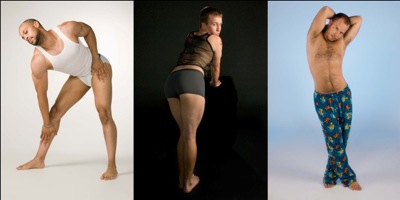
Karen Zack, Man As Object
The visions can come across as “gay.” Since sexual pose is so often meant for the male gaze, on some unconscious level we may see it all through male eyes. And that is jarring, too.
The camera pleasurably zooms in on erotic man-parts. Images of male autoeroticism and penises abound, including a piece called “Where’s His Head?” that depicts a giant phallus-man fondling his much smaller man-phallus. Indeed! And when Pinocchio tells a lie, it’s not his nose that grows. More like a woody that “lasts more than four hours.” Actual penises are rarely displayed, apparently unable to live up to what Richard Dyer called “the mystique implied by the phallus.”
The exhibit includes a lenticular postcard (turn it one way and it’s a woman, turn the other and it’s a man) that juxtaposes Courbet’s “Origin of the World” with a close-up vagina shot versus ORLAN’s “Origin of War” with a penis close-up.
At times men are objectified in one-dimensional, controlling and demeaning ways. But sex-positive feminist photographer Shiloh McCabe explores the other side, working to ensure that her gaze does not consume or dominate. She takes a wide view, seeing those who are usually not. Her subjects help create their own representation so they can retain their power. “I’m not here to objectify or harm; I’m here to nurture and document,” she explains.

Laura Hartford. Graham Reclining
Man as object, Rubenesque, reclining, bathing, cooking, lounging, washing up before bed. Man as Madonna and Child, patriarchal man, veiled man, man as cowboy bunny, trans man. Blonde man in short shorts. Bodybuilder, Founding Father. Homeless man. Nude and vulnerable. Empowered. Bound and submissive. Striking a pose. Objectified.
So much to gaze at. And so much to see.
“In the past it was totally taboo for women to gaze upon the male, yet it was appropriate and common in the reverse,” observes artist Marian Yap. “Do you think that things are changing?”
Good question. This exhibit pushes us out of our taken for granted ways of seeing to explore that path.
Check out a video on the exhibit here.
Man as Object: Reversing the Gaze. Opening Friday, November 4th at SOMArts Cultural Center in San Francisco and running through the end of November. The show will travel to the Kinsey Institute Gallery, Bloomington, IN and will open April 13, 2012 through the end of June.
This exhibition was created by The Women’s Caucus for Art – the founding organization promoting feminist art and art as activism since 1972.
For more information click here.
Ms. Magazine reposted this piece on their blog October 28, 2011
Popular Posts on BroadBlogs
Does Sexual Objectification Lead to Bad Sex?
Men, Women React to Male/Female Nudity
Anything Good About Being A Sex Object?
Share this:

Why Do Women Fight Against Their Own Interests?
Growing up Mormon, it seemed women fought against their own interests all the time. In the 70’s my Mormon piano teacher spent an hour post-lesson talking to my mom about stopping feminists from setting up battered women’s shelters!
Other Mormon women followed orders to pack a lunch, get on a bus, and vote everything down at women’s conferences, hoping to keep the Equal Rights Amendment from passing.
Today women are still not allowed priesthood, but few seem disturbed.
And it’s not just Mormons.
Over a century ago some women ridiculed and ostracized suffragettes who sought the vote.
Even today sororities receive invitations addressed to “bitches and sluts” and accept
the invite – and the degradation.
Outside the U.S., Egyptian women defend men who murder their lovers because the women “must have done something to deserve it.”
Until recently, Saudi women couldn’t vote. They still can’t drive a car. Some have said they like it that way.
In North Africa and parts of the Middle East women cut girls’ genitals to preserve virginity until marriage. The girls may end up crippled or living in pain. Many die.
Women aren’t the only ones who accept second-class status. “Uncle Tom” brands African-Americans who accept threads of racist society. “Untouchables” accept their lot within the Hindu caste system. And Karl Marx coined the term “false consciousness” to describe workers who accept low wages and poor working conditions.
Why do underprivileged people so often accept limitations?
In a nut shell, it’s all they know, and as such, the world’s ways seem natural, normal and “right.”
Basically, society ends up in our own minds through a little process called internalization.
We are born without many thoughts in our heads. The world seems chaotic. But we must cope. So unconsciously we notice patterns and start classifying things. Reducing a complex world to simple categories leads to oversimplification and stereotyping. “Men are leaders in business, politics, and priesthood. Women stay home with kids or work outside the home as nurses, teachers, and secretaries.”
The stronger the pattern, the stronger the stereotype. Few thought to think outside the box in 1950’s America. Diversity (e.g., coming into contact with other cultures) can offer expanded vision.
Some do move out of “normal” ways of seeing: Susan B. Anthony, Elizabeth Cady Stanton and Gloria Steinem, for instance. These leaders have often had unusual lives that help to remove the blinders.
But if people believe God wants things “the old way,” minds quickly close. Yes, add God to the brew (our ways are God’s ways) and you’ve got a strong tonic.
Other processes specific to sexism add to women’s acceptance of inferior status, like eroticized male dominance and women’s close relationships to men, but I’ll save that discussion for a later post.
So women acquiesce.
Some will call this victim-blaming: blaming the oppressed for their compliance. But you can’t blame someone for doing something that’s unconscious. It all becomes so taken-for-granted that few realize there are other ways of seeing and being.
In the Mormon church I see some improvement. When visiting my mom’s congregation the bishop said they were raising money for a battered women’s shelter. I have also heard “unequal relationships” cited as a primary cause of family disintegration. Though, the “Proclamation on the Family” diminishes that sentiment. “Men and women are equal, but men are the head”? I guess some are still more equal than others.
Change will only come when we take off our taken-for-granted blinders to see the light.
I originally wrote this piece for Feminist Mormon Housewives
Popular Posts on BroadBlogs
Why Do The “Isms” That Affect Men Seem More Important?
Men Are Naturally Attracted To Unnatural Women
Why Hasn’t Open Marriage Caught On?
Share this:

Better My Daughter Die Than Signal “Sex is Ok”
If adolescent girls are given the HPV vaccine to guard against cervical cancer, will they be more likely to have sex? Some worry they will, and are pushing to keep girls from getting
vaccinated.
I’ve never understood the concern.
I suspect few girls or women think much about the sex/cancer relationship. So how would inoculation make sexual activity more likely? “Oh, now I won’t get cancer, so I’ll have sex!” Who cares about STDs or pregnancy (which is what girls are much more likely to worry about).
Maybe parents fear that signing a consent form is tantamount to giving their okay to adolescent sex. All the more reason to allow girls to get vaccinated without parental consent.
And besides, a girl could end up getting cancer from HPV without ever having consensual sex outside marriage. She could be raped, or her husband could have an affair and transmit the disease to her in that way.
Still, it’s been a huge fuss in the conservative ranks. But why do so many conservatives feel that girls’ and women’s lives are not worth saving?
Right now, political fights revolve around limiting girls’ or women’s access to: the HPV vaccine, cancer screenings, tests for STDs — including H.I.V., nutrition programs for women and children, and Topeka, Kansas recently decriminalized domestic violence, saying they couldn’t afford it. Most recently the House passed HR 358, the “protect life” but kill women act, under which hospitals could refuse to perform emergency abortions even when a woman’s life is threatened by her pregnancy.
But back to the HPV controversy. Why would some parents risk their daughter’s death to send a signal about sex?
And is sex really so bad?
Popular Posts on BroadBlogs
Why Some Guys Want to Screw You
Sex Drive: How Men and Women Match Up
Why Is the Right-Wing Attacking Women?
Share this:

Apple® and Eve’s Choice

Ever wonder about the Apple icon? The apple with a bite taken from it?
Once upon a time, the story goes, a woman named Eve took a bite from an apple that brought the fall of humanity.
Or did something else happen? Here’s the story:
Adam and Eve lived in the paradisiacal Garden of Eden. God told them they could eat from all the trees except the Tree of Knowledge of Good and Evil. Eat this fruit, and surely die. But one day a snake told Eve: Die? You will not die. If you eat this fruit you will become wise like God, knowing good from evil. Desiring wisdom, Eve took the fruit and ate, and gave some to her husband, who also ate. Upon discovering the breach, God cast Adam and Eve out of their lovely garden and into a harsh world.
Hence, the Fall.
There are other ways of understanding this story.
The story can be seen as a metaphor of human life. Children are born into a state of innocence, with all their needs attended to. Life is cushy. Others make their decisions. But then they reach “the terrible two’s” when they begin to rebel and think for themselves. Disobedience sounds bad. But what happens to a person who just does what they’re told all of their lives? Or who never struggles with anything?
And is greater wisdom, knowing good from evil, a bad thing?
If Adam and Eve had stayed in the garden forever, certainly things would have been pleasant. But would they have grown? Would they have gained any wisdom? Life would have gone on as it always had. Always staying the same.
In choosing this icon Steve Jobs, who placed his headquarters at the corner of Technology and Liberal Arts, knew the power of a symbol. He also had ways of seeing that others lack.
Apple’s early logo slapped a rainbow on the very archetype of human fallenness and failure – the bitten fruit – and turned it into a sign of promise and progress.
In Steve Jobs’ commencement speech at Stanford he talked about the power of failure — how you learn from it.
There is no progress when we stay static. When we are afraid to fail. When we fail to think. And when we avoid struggle.
Choose wisdom. Choose growth. Choose, the bitten apple seems to say.
Popular Posts on BroadBlogs
Vibrators and Women’s Sexuality: Out of the Closet?
Don’t Reject Your Culture, Even When It Mutilates You
Fatal Attraction: Relationship Killed By What Sparked It
Share this:

Men, Women React to Male/Female Nudity
By Lisa Wade @ Sociological Images
We’ve all heard the truism “sex sells.”
But whose sex is sold? And to who?
If it was simply that sex sold,
…we’d see men and women equally sexually objectified in popular culture. Instead, we see, primarily, women sold to (presumably heterosexual) men. So what are we selling, exactly, if not “sex”?
What is really being sold is men’s (presumably heterosexual) sexual subjectivity: the experience of being a person in the world who was presented with images that were for his titillation. Women do not live in the world this way. They are not exposed everyday to images that legitimize their lust; instead, the images teach women that they are the object of that lust.
In light of this, Sociologist Beth Eck did a series of interviews attempting to tap into what it felt like for men and women to look at male and female nudes. Her findings were pretty fascinating.
First, she asked men and women to look at naked images of women, including this one of Cindy Crawford:

Women viewing images of female nudes almost inevitably compared themselves to the figure and felt inadequate. Said one women:
…the portrayal of these thin models and I just get depressed… I’m very hard on myself, wanting to be that way.
Women ended up feeling bad whether the model conformed to conventional norms of attractiveness or not. When looking at a heavy set woman, they often responded like this:
I am disgusted by it because she is fat, but I’m also… I need to lose about 10 pounds.
I don’t necessarily find her body that attractive… Her stomach looks like mine.
Men, in contrast, clearly felt pandered to as holders of a heterosexual male gaze. They knew that the image was for them and offered praise (for a job well done) or criticism (for failure to live up to their expectations). About Crawford they said:
Personally I think she is attractive.
I like that.
Both men and women, then, knew exactly how to respond to female nudes: women had internalized their object status (women as sex object-things) and men had internalized their subject status (men were people looking at sexy objects).
Eck then showed them male nudes, including this one of Sylvester Stallone:
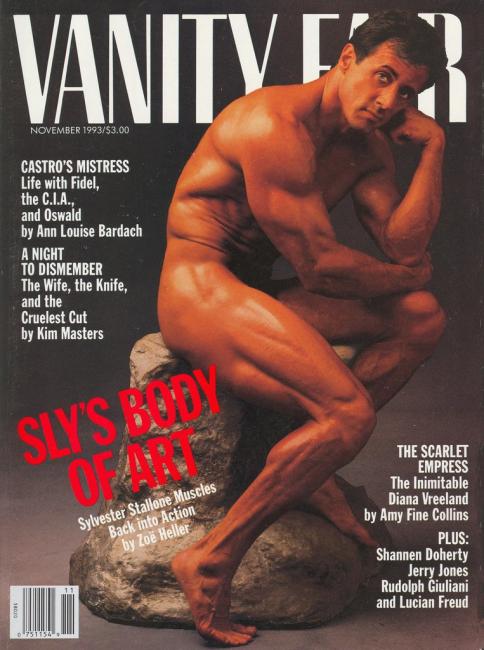
Interestingly, both men and women felt uncomfortable looking at male nudes.
Men responded by either expressing extreme disinterest, re-asserting their heterosexuality, or both. They did not compare themselves to the male nudes (like women did with female nudes), except to say that they were both male and, therefore, there was “nothing to see.” Meanwhile, because men have been trained to be a lustful sexual subject, seeing male nudity tended to raise the specter of homosexuality. They couldn’t see the bodies as anything but sexual objects for them to gaze upon.
In contrast, the specter of homosexuality didn’t arise for women when they looked at female nudes because they weren’t used to being positioned as lustful. Eck explains:
When women view the seductive pose of the female nude, they do not believe she is ‘coming on to’ them. They know she is there to arouse men. Thus, they do not have to work at rejecting an unwanted advance. It is not for them.
Many women also did not feel lustful when looking at male nudes and those that did often experienced lust mixed with guilt or shame. Eck suggests that this may be, in part, a reaction to taking on the active, consuming, masculine role, something they’re not supposed to do.
Summarizing responses to the male nudes, she writes:
Men, over and over again, reject the seductive advance [of a male nude]. While some women welcome the advance, most feel a combination of shame, guilt, or repulsion in interacting with the image…
This is what it means to live in a world in which desire is structured by a gendered sexual subject/object binary. That is, men are taught to be subjects who see women as objects, and women are taught to be objects. It’s not just “out there,” it’s “in us” too.
This piece was originally posted in Sociological Images. A slightly edited version is
reprinted here with permission.
Popular Posts on BroadBlogs
Men: Erotic Objects of Women’s Gaze
Grade School Lingerie
I Can’t Believe I Ate A Whole Head Of Lettuce!
Share this:

Dear Facebook: Rape Is No Joke
by Angi Becker Stevens @ The Ms Magazine Blog
According to Facebook’s terms of service, users are not permitted to post content that is hateful, threatening or incites violence. But it appears that, in the minds of the Facebook powers-that-be, pages that encourage rape don’t violate that rule.
For two months now, Facebook users have been campaigning for the site to take down several “rape joke” pages. The titles of these pages include such gems as “Riding your girlfriend softly, cause you don’t want to wake her up” and “You know she’s playing hard to get when you’re chasing her down an alleyway.” Hundreds of Facebook users have reported the pages as Terms of Service violations, and a petition at Change.org (see below) demanding their removal has received over 130,000 signatures. But Facebook has yet to take action. Dozens of pages advocating rape or violence against women remain on the site, many with tens of thousands of fans.
The defenders of these pages say that we need to lighten up. Learn to take a joke. Feminists are, once again, being humorless. We are making mountains out of molehills when we become outraged by such trivial things as pro-rape Facebook pages.
According to statistics, 17.4 percent of women in the U.S. have survived a completed or attempted rape, and that figure would likely be higher if victims were not so often silent about their experiences. Yet we are not supposed to question what it means for us, as women, to live in a culture that dehumanizes us with acts of sexual assault (the vast majority of which are committed by men we know personally) and then dehumanizes us further by pointing and laughing at our victimization, belittling trauma with crude humor. This is the definition of rape culture: a society that upholds the conditions for sexual violence against women and treats this violence as an unchangeable norm.
Anyone who claims that a rape joke is just a joke does not understand how rape culture works. Just as racist jokes can only be found funny within a culture of racism, rape jokes could not exist outside of a culture of rape. When our society allows men to believe that having sex with a sleeping woman is not rape; that having sex with a girlfriend or previous sexual partner is never rape; that having sex with someone who is too intoxicated to consent or object is not rape; men are taught to feel entitled to these acts (and women are taught to accept them in silence). When our culture is casually permissive of sexual assault, it inevitably perpetuates more sexual assault.
It would be absurd, of course, to suggest that anyone goes out and commits assault as a direct reaction to a Facebook page. But in reducing sexual violence to nothing more than a joke, they reflect and perpetuate the idea that women are objects to be used for the sexual satisfaction of men. Countless seemingly small things work together to uphold that kind of pervasive misogyny.
It would be naïve to imagine that the removal of these pages will in and of itself end rape culture. But that doesn’t mean the appropriate response is to simply accept them. Daunting as the task may be, the only way to end rape culture is to confront it.
Facebook is certainly not responsible for the prevalence of sexual assault in our society. But those in a position of power at Facebook are responsible for the choice they make to either condone or condemn the use of sexual assault as humor. Silence, as the saying goes, is acceptance. And Facebook’s refusal to take sexual violence seriously is exactly the kind of complicit silence that rape culture thrives on.
To sign change.org’s petition, click here.
This piece originally appeared on the Ms. Magazine Blog
Popular Posts on BroadBlogs
Dad Imprisons, Rapes Daughters, Mere Sex Objects
Words: Sticks and Stones? Or Shaping How We See Ourselves?
Grade School Lingerie
Share this:

If Gays Can Marry Can I Marry My Dog?
When will people understand that tradition is just a stumbling block in the pursuit of progressive thinking? My dog and I are very much in love. She has been my friend, protector and lover for eight years. I firmly believe that we are both deserving of a legal domestic partnership, too. If the gay/lesbian community can be granted such a thing, then why can’t we? Heck, I’d be willing to bet that there would be less uproar over me kissing my dog on the front page.
This was an actual letter written by Joe Freeman and published in the San Jose Mercury News on May 21, 2008, on the cusp of gay marriage becoming legal in California, and amidst visions of husbands kissing husbands and wives kissing wives.
While some feared immanent bestiality, others worried that if gays could marry, next thing you know, adults would be marrying kids. It’s all the same, right?
At the very least, what about consent?
An adult man can give consent to marry another man. An adult woman can give consent to marry another woman. But children are too young to fully understand what they would be getting into by agreeing to marriage — if they were asked their opinion at all. Children cannot give consent. Neither can dogs or cats or birds or lizards or cows… Bestiality and child marriage are nothing like gay marriage. Funny that ol’ Joe couldn’t make the distinction.
Joe is also worried about going beyond tradition, or traditional morality that is based in religion. But after all the atrocities committed in the name of religion, whether the Crusades or 9/11 or cutting women’s genitals from their bodies (female genital mutilation), I don’t find religion to be the best guide to ethics.
So religious morality can seem hardly moral at all, and too often the opposite.
Better to base morality on whether someone is being harmed.
I can see how homophobia hurts people. Gay bashing harms victims. Homophobia inflicts emotional suffering, sometimes so severe that gays and lesbians take their lives. At the least self-worth can greatly suffer. But those who bash also lose their humanity.
When parents can’t get married, children cannot visit a sick parent in the hospital, they can lose out on social security or inheritance if a parent dies, they aren’t guaranteed child support if parents separate. These kids miss out on the support and stability that other kids take for granted.
On the other hand, I don’t see how homosexuality harms anyone.
We would all be better off extending love instead of hate and contempt.
October is LGBT History Month.
Popular Posts on BroadBlogs
Higher Suicide Rates in Conservative “Values Voters” States
Gay Marriage Protects Marriage
Gay Marriage Helps Families
,
Share this:

Women, Objects of Desire (Even for Women?)
As women have become increasingly sexually objectified, even straight women were more aroused by a nude woman than by a nude man in one study, when measuring blood flow to the vagina, researchers found.
Is this true? A student of mine wondered. And do the rules of religion collide with sexuality? My student, named Laurelle, garnered a peek at both matters with a simple focus on threesomes.
Laurelle surveyed her friends, family, and coworkers, and had a friend post questions on his forum. Twenty-five women and twenty-five men of varying ages, races, and religious perspectives responded to these questions:
Would you like to do a threesome with two women? With two men? What religion do you belong to? What’s your sexual orientation?
It’s not a scientific study, but I found the results interesting, and with permission I’m sharing her findings.
Eight percent of the men and sixteen percent of the women were bisexual. The rest were straight. No gays or lesbians, which surprised her. (When I survey my students I sometimes receive far more “bi” responses than gay or lesbian, as well. Also surprises me.)
Now, on to the first survey question. Let’s start with men. Not because they are numero uno, but because the women’s answers are perhaps more surprising.
Does belonging to an anti-gay religion make men less inclined toward threesomes? No. While 72% of the men said they’d enjoy a ménage à trois with two women, the number rose to 78% of men belonging to a religion that disapproves of homosexuality. Are they ignoring their religious tenants? Or do they think lesbians don’t count? None of the men – even those who were bi – were interested in sex with two men. Interesting.
Laurelle found it refreshing that twenty eight percent of the guys just wanted one partner. (Better than the 90-plus percent she’d expected would crave threesomes.)
How about women? Those who belonged to an anti-gay religion were less likely than men to want threesomes. But then, women were less likely to want them, overall. Forty percent of the women were interested in trying a threesome involving two women, while only sixteen percent were interested in two men. Yet forty-eight percent of those belonging to a religion that disapproves homosexuality were up for such trysts.
Laurelle’s sample showed a higher interest in threesomes than a survey that I have yet to
post. Her sample comes from family, friends and coworkers, while mine comes from women’s psych and women’s studies students. Maybe she runs with a more experimental crowd.
Still, interesting that these straight women were more interested in sex with two women than two men. And that bi men felt the same way.
The results lend support to the notion that women are seen more sexually than men even among straight women and bi men (at least when they’re in the role of a sex-object casual hookup). Biology? More likely culture.
From the time girls are small they are bombarded with sexualized images of women, but encounter relatively few such images of men. Any wonder, then, that even hetero women can end up seeing women as sexier than men? Some call if female sexual alienation. When we live in a world that is more controlled by men than by women, on some level we all end up seeing the world through male eyes.
Popular Posts on BroadBlogs
Women Seeing Women as Sexier than Men
Women Learn the Breast Fetish, Too
Men: Erotic Objects of Women’s Gaze
Share this:

Saudi Women Can Vote. West, Middle East Can Learn From Each Other
Saudi women got the right to vote and run in municipal elections this week. It’s a big step forward.
There are limitations. It’s hard to run for office when you can’t drive or show your face. Some fear political stalling. And men could keep their wives and daughters from voting. But the women are optimistic. Let’s hope for the best.
Interestingly, only about five years ago George W. Bush sent Karen Hughes to Saudi Arabia to express her hope that one day Saudi women would be able to vote and drive. She was surprised when many said they didn’t want to do either.
Past relations between Western and Middle Eastern feminists have sometimes been strained with Western feminists lecturing Middle Eastern women, and Middle Eastern women rejecting what they see as Western arrogance.
Yet the road to women’s rights presents plenty of opportunity for all of us to learn from one another.
There is plenty that Westerners could have, and may have, learned from our Arabian sisters and brothers in the early years of Islam. When we were in the Dark Ages.
Back in the 7th century the Koran gave women the right to work, own property and inherit, and provided protections from domestic violence. Women were also granted the right to give their consent to marry.
But lately Arab women have been taking some cues from us. Both the Arab Spring and Saudi women’s suffrage were inspired by Western democracies.
And perhaps now it is time for us to learn from them, again. The Arab Spring has inspired many Americans who wonder at our current state of democracy which is marked by legalized bribery (large campaign contributions) that make important matters like environmental sustainability and economic renewal political impossibilities.
Too often Western women think they have nothing to learn from their Middle Eastern sisters, while Middle Eastern women reject Western notions out of hand.
Perhaps we would do better to have dialogue and learn from each other.
Popular Posts on BroadBlogs
Early Islam’s Feminist Air
It’s Ok To Be A Tomboy But Not A Sissy. Why?
Baby Named “Storm.” Sex Unknown

 BroadBlogs