Blog Archives
Why Is There A War On Women?
 Conservatives insist there is no war on women. They must be willfully ignorant to miss the signs.
In recent years the extreme right has voted against the Lilly Ledbetter Fair Pay Act, they have refused to protect all women in the U.S. from domestic violence, they have pushed to block cancer screenings and HIV testing for poor women, they have voted against contraception and abortion that could save women’s lives. Five states now require women seeking abortions to endure ultrasounds, which might require intrusive, vaginal probes. Some have made light of rape, narrowing the definition to “forcible” rape (what’s nonforcible rape?) or, as Amanda Marcotte at RH Reality Check points out:
Showing their true colors has been a theme of anti-choicers this campaign season, from Todd Akin’s “legitimate rape” comment to Huckabee’s extolling the virtues of rape as a baby delivery system to Paul Ryan minimizing rape by calling it a “method of conception”… They don’t really think rape is a big deal—it’s not like raping uterus vessels is the same as violating people, right?
But what’s behind the war? Here’s one idea: sexist men fear that independent women won’t need them.
Marcotte points out that attempts to control women swell whenever women become more independent. She may have a point. We’ve seen increasing attempts to use government to control women as we become more independent. And the same thing occurs in relationships when some men destroy contraception, hoping their wives or girlfriends will get pregnant and become more dependent.
And the same men who work to limit women’s control over their bodies say things like this, from Rep. Allen West of Florida:
And all of these women that have been neutering American men and bringing us to the point of this incredible weakness. Let them know that we are not going to have our men become subservient.
Or Rush Limbaugh:
The average size of a penis is roughly 10 percent smaller than it was 50 years ago. And the researchers say air pollution is why. Air pollution, global warming, has been shown to negatively impact penis size, say Italian researchers.
I don’t buy this. I think it’s feminism.
Well then, men had better get their control over women back, and soon!
Marcotte sums it up:
Hostility to abortion rights and contraception access is about gender anxiety. It’s about this strange fear that unless women are forced into a subservient, dependent position to men, women will not want anything to do with men. Anti-choicers are reacting to a paranoid belief that if women are totally free to choose our own paths, we won’t choose to have men on our journeys. It’s yet further proof that misogyny has an element of man-hating to it, because the misogynist believes that men are not capable of being true friends and partners to women.
Looks like feminists have a higher opinion of men than these sexist men do, themselves.
Popular Posts on BroadBlogs
What Abusers and “Pro-Family” Conservatives Have in Common
Why Is the Right-Wing Attacking Women?
Government Takeover of Our Bodies
Share this:

What’s Wrong With Hooking Up?
 By Lisa Wade
Crossposted from Ms. and Sociological Images
Hanna Rosin, senior editor at The Atlantic and author of The End of Men, has written a piece about hook-up culture on and off college campuses for the September issue of her magazine. Given that I’ve done some research on hook-up culture, here are my two cents: Rosin isn’t wrong to argue that the culture offers women sexual opportunities and independence, but she mischaracterizes the objections to hook-up culture and draws too rosy a conclusion.
Those who wring their hands and “lament” hook-up culture, Rosin contends, do so because they think women are giving it up too easily, a practice that will inevitably leave them heartbroken. She writes:
[Critics of hook up culture pine] for an earlier time, when fathers protected ‘innocent’ girls from ‘punks’ and predators, and when girls understood it was their role to also protect themselves.
If this is the problem, the answer is less sex and more (sexless?) relationships. But, Rosin rightly argues, this wrongly stereotypes women as fragile flowers whose self-esteem lies between their legs. It also romanticizes relationships. Drawing on the fantastic research of sociologists Laura Hamilton and Elizabeth A. Armstrong, she explains that young women often find serious relationships with men to be distracting; staying single (and hooking up for fun) is one way to protect their own educational and career paths.
All this is true and so, Rosin concludes, hook-up culture is “an engine of female progress—one being harnessed and driven by women themselves.”
Well, not exactly. Yes, women get to choose to have sex with men casually and many do. And some women truly enjoy hook-up culture, while others who like it less still learn a lot about themselves and feel grateful for the experiences. I make this argument with my colleague, Caroline Heldman, in Hooking Up and Opting Out: Negotiating Sex in the First Year of College [PDF].
But what young women don’t control is the context in which they have sex. The problem with hook-up culture is not casual sex, nor is it the fact that some women are choosing it; it’s the sexism that encourages men to treat women like pawns and requires women to be just as cunning and manipulative if they want to be in the game; it’s the relentless pressure to be hot that makes some women feel like shit all the time and the rest feel like shit some of the time; it’s the heterosexism that marginalizes and excludes true experimentation with same-sex desire; and it’s the intolerance towards people who would rather be in relationships or practice abstinence (considered boring, pathetic or weird by many advocates of hook-up culture, including, perhaps, Rosin).
Fundamentally, what’s wrong with hook-up culture is the antagonistic, competitive and malevolent attitude towards one’s sexual partners. College students largely aren’t experimenting with sexuality nicely. Hook ups aren’t, on the whole, mutually satisfying, strongly consensual, experimental affairs during which both partners express concern for the others’ pleasure. They’re repetitive, awkward and confusing sexual encounters in which men have orgasms more than twice as often as women:

The problem with hook-up culture, then, is not that people are friends with benefits. It’s that they’re not. As one of my students concluded about one of her hook-up partners: “You could have labeled it friends with benefits … without the friendship, maybe?”
Hook-up culture is an “engine of female progress” only if we take for granted that our destination is a caricature of male sexuality, one in which sex is a game with a winner and a loser. But do we really want sex to be competitive? Is “keep[ing] pace with the boys,” as Rosin puts it, really what liberation looks like? I think we can do better.
Crossposted from Ms. Magazine and Sociological Images
Popular Posts on BroadBlogs
Women Want Casual Sex? Yes and No
Women Want Emotionally Connected Sex. Why?
Are Women Naturally Monogamous?
Share this:

Toys Create Gender
 By Jessica Garriga
I work at a toy store. There’s a girl’s side and a boy’s side. The girl’s side is suffocated with pink and purple — with a small section of black and pink for the ‘rebellious’ little girl. This side stocks Barbies, Brats, Maxie dolls, baby dolls, stuffed animals, kitchen and food sets, cleaning sets, accessories, make up kits, pretend hair kits and real beauty products that are child safe.
Some girls hate pink and refuse to buy it. I can understand why. It has nothing to do with the color, really, but that is seems like the only color they are allowed.
The boy’s side has lots of colors – except pink. This side has video games, legos, super hero action figures and masks, toy swords and super hero themed weapons, Nerf guns, sport equipment and balls, army toys and weapons, battle ships, musical instruments, board games and chess. Boy toys celebrate violence and being tough. Even the boxes they come in are drawn with explosive effects.
Science themed toys have only pictures of boys — unless they’re painted pink or purple. A guitar aimed at boys is dark blue and painted with flames. The girl guitar is pink with flowers. Legos for girls are in pink and purple boxes with nice ‘friendship’ themed characters and sets. The action, city, and car themed Legos are for boys.
Parents are funny.
One father insisted the Nerf guns he bought were not for his daughter, but for her male friend. When I told him I did not care if his daughter played with Nerf guns and told him I’d played with them, myself, he insisted the toys were not for his daughter and seemed offended by my playing with Nerf guns.
Another dad wanted a pink science kit with princesses on them. With none available, he settled on a pink princess electric piano.
A mom refused to buy Elmo or music themed toys unless they enforced the socialization she wished to impose on her daughter.
And parents seem to avoid bringing their sons anywhere near the girls’ side. Do they fear their sons might like the baby dolls or the pink makeup sets and don’t want to risk it? One dad told me he only lets his three year old son go to the boy’s side because he likes the pink baby dolls, so dad wants to avoid them.
Toy segregation has consequences. As Katrin Bennhold at the New York Times explained:
Male and female stereotypes are established early: It is not hard to see a connection between girls playing with dolls and boys playing with cars, and the widespread segregation of labor markets into “female” and “male” professions. (Lower-paid, lower-status) nurses, primary school teachers and caregivers of most kinds are overwhelmingly female. Engineers, computer scientists and mechanics tend to be male.
Maybe parents believe that gender is biological and that their children won’t like toys that don’t “fit” the sex. But they’re unwittingly (or wittingly) creating gender through the toys they choose – with a lot of help from society and toy stores.
Popular Posts on BroadBlogs
Baby Named “Storm.” Sex Unknown
My Son Likes Girl-Things. Is He Gay?
It’s Ok To Be A Tomboy But Not A Sissy. Why?
Share this:

Men Guarding My Purity
 By Anonymous
Why do some men want to control women’s “purity”?
I was reading about Tara Conner, Miss USA 2006, who was almost stripped of her crown due to:
substance abuse, failing to make Miss USA promotional appearances, chafing at other obligations and nonstop nightclubbing at Big Apple hot spots.
Being dismissed for substance abuse and failing to make obligations, I get. But nonstop nightclubbing? What’s the problem?
Donald Trump, the pageant’s co-owner, eventually came to her rescue, granting her a second chance.
Later, he gave her permission to pose in Playboy.
I read about Tara in The Purity Myth: How America’s Obsession with Virginity Is Hurting Young Women by Jessica Valenti. She points out that when Trump determined that Tara could keep her crown despite a fast life, and when he determined that she could appear in Playboy, her immodest ways were not the problem. The problem was that Tara was in charge of herself, instead of Trump being in charge of Tara. Some men just want to be in charge of women’s purity.
Even today men may flaunt their sexuality and make “conquests.” Yet women must still be restrained, and are called ho’s and sluts when they aren’t.
And while there is no argument about whether men should be able to use a little blue pill to enjoy sex, various conservative, male-led legislatures find The Pill morally repugnant.
It comes as no surprise to me that young women can grow to be ashamed, and at times even afraid of sexuality.
I, admittedly, have been a victim of the power of negative connotations of virginity, or the lack thereof. Maybe because I come from a more conservative, Latina background I was hit harder than other girls who were raised in America. But after the first time I had sex I drowned myself in guilt and shame. I doubted everything that had just happened. I thought,
This wasn’t supposed to happen that way; I shouldn’t have done it with him; I won’t be able to marry in a white dress anymore; I wonder what he thinks of me now; the whole school is going to find out…
As these phrases filled my head, there was another thought that would not leave me peace: “My parents are going to think I’m worthless.” The worry was so intense that for several months I literally put my head down when having any sort of conversation with them.
I eventually realized that it wasn’t them setting the “standard of virginity,” but the society they grew up in.
Although my mother and I are of different generations, we share the same experience of oppression when it comes to our sexuality. Only she had it worse. Her teenage years were so squeamish that the word sex was frowned upon even between doctor and patient. I, fortunately, have more tools to overcome the repression.
Why do some men want to regulate a woman’s every move, disciplining her if she gets “out of line”?
I don’t know the answer to that. But it feels oppressive. And I don’t think that celebrating sexual males while shaming females helps anyone.
This post was written by one of my students, who asked to remain anonymous.
Popular Posts on BroadBlogs
Lose Virginity, Lose Self-Esteem?
Sex and the Walk of Shame
Surprises in Indiana University Sex Survey
Share this:

What If Women Ran Rap?
 By Rebecca Fierros
If women ran hip hop
the beats and rhymes would be just as dope,
but there would never be a bad vibe when you
walked into the place
That’s what Anay de Leon says. Because right now bad vibes are all too easy to feel if you’re a woman in the middle of a rap.
Or as Bridget Grey declares:
Now unless I’m dreaming I could have swore,
right after you called me a “bitch” you called someone else a whore,
and at this point I’m trying to process a few things…
What were the original words to that song?
and you want me to do what with my thong?
And I’m trippin’ cause nobody is acting like anything is wrong.
Testosterone-fueled hip hop is the air that we breathe. We groove to the put downs. ‘Cause we see women the way men see us. It’s okay. It’s cool. We might grasp – for a second – a spiteful riff aimed at us. And then press “repeat.”
de Leon says:
If women ran hip hop
there would never be shootings
cuz there would be onsite conflict mediators
to help you work through all that negativity &
hostility
If women ran hip hop
men would be relieved because it’s so draining
to keep up that front of toughness & power &
control 24-7
And the men look so cool as women crawl at their feet, to be taken and left. Tough men don’t need a woman ‘cause they can always get another. Women are bereft
… and disposable.
Women in rap materialize hyper-sexualized because “sex sells.” Strong women rappers — Salt-n-Pepa, Roxanne Shante, Queen Latifa, MC Lyte — know it ain’t what you look like, it’s how you spit (rhyme).
If women ran rap, says de Leon,
& females would dress sexy if we wanted to
celebrate our bodies
but it wouldn’t be that important because
everyone would be paying attention to our minds,
anyway
In my own vision:
If women ran hip hop
the verses would flow perfectly
and they’d make you think better of yourself as a woman.
Women would have a voice and speak for themselves
and speak about what we want without the approval of a man.
No ho’s or bitches here because we wouldn’t be brainwashed
into thinking that any women was one, or that it’s okay to be one.
Women would be uplifted and not degraded.
Men and women would respect themselves and each other.
No one would need to feel superior.
So no one would look down on another
because of some clichéd version of who we think they are.
Rebecca Fierros is a student of mine who wrote this piece and gave permission to post it.
Popular Posts on BroadBlogs
Eminem Makes Sexism Seem Sexy – And That’s A Problem
Words: Sticks and Stones? Or Shaping How We See Ourselves?
“Bitches and Dudes,” a.k.a. “Women and Men” on College Campuses
Share this:

Spoon-Fed Barbie

Spoon Fed Barbie
Surface appearances can be deceiving, says artist, Yvonne Escalante.
“From the day we are born, our behavior and tastes are controlled by the social status quo. Little girls are fed an idealized image. Barbie has been deconstructed and reassembled for even easier consumption.”
As a first generation American, Escalante’s father had stressed American identity over cultural ties. Today, her work explores the conflict she feels, caught in the kaleidoscope of identity, gender roles, and societal norms.
Here’s what her art says to me.
Like most little girls, I grew up spoon-fed on Barbie. But not just Barbie. She was an emblem of all that mass media, friends and schoolmates, told me to be. A good shopper. Paired with Ken. Skinny and curvy all at once. The emblem of perfect womanhood, where body defines us.
Oddly, all this spoon feeding can lead to a dearth of feeding of any sort. I’ve gone through phases of not eating like I should, hoping to look like what turn out to be phony photoshopped images that don’t even resemble the starving models who posed for the pics.
What did I know?
Of course, skinny isn’t enough. We must be buxom, too. Which leads to unnecessary, and sometimes life-threatening, surgeries in pursuit of Barbie breasts. At least that’s what happens when boobs define us, creating our worth. For too many women and men, surface is all.
When women are told they must acquire surreal measurements, and when obtaining them is the source of self-worth, the pursuit takes unending time and energy.
Obsessed with diet and exercise, women can become distracted from the rest of life; so much so that (as Naomi Wolf can tell you) advances of the women’s movement wane. Frantic pursuit of the perfect body removes agitation for power of greater substance.
Hence, the pacifier. Here, called “Sucker.”
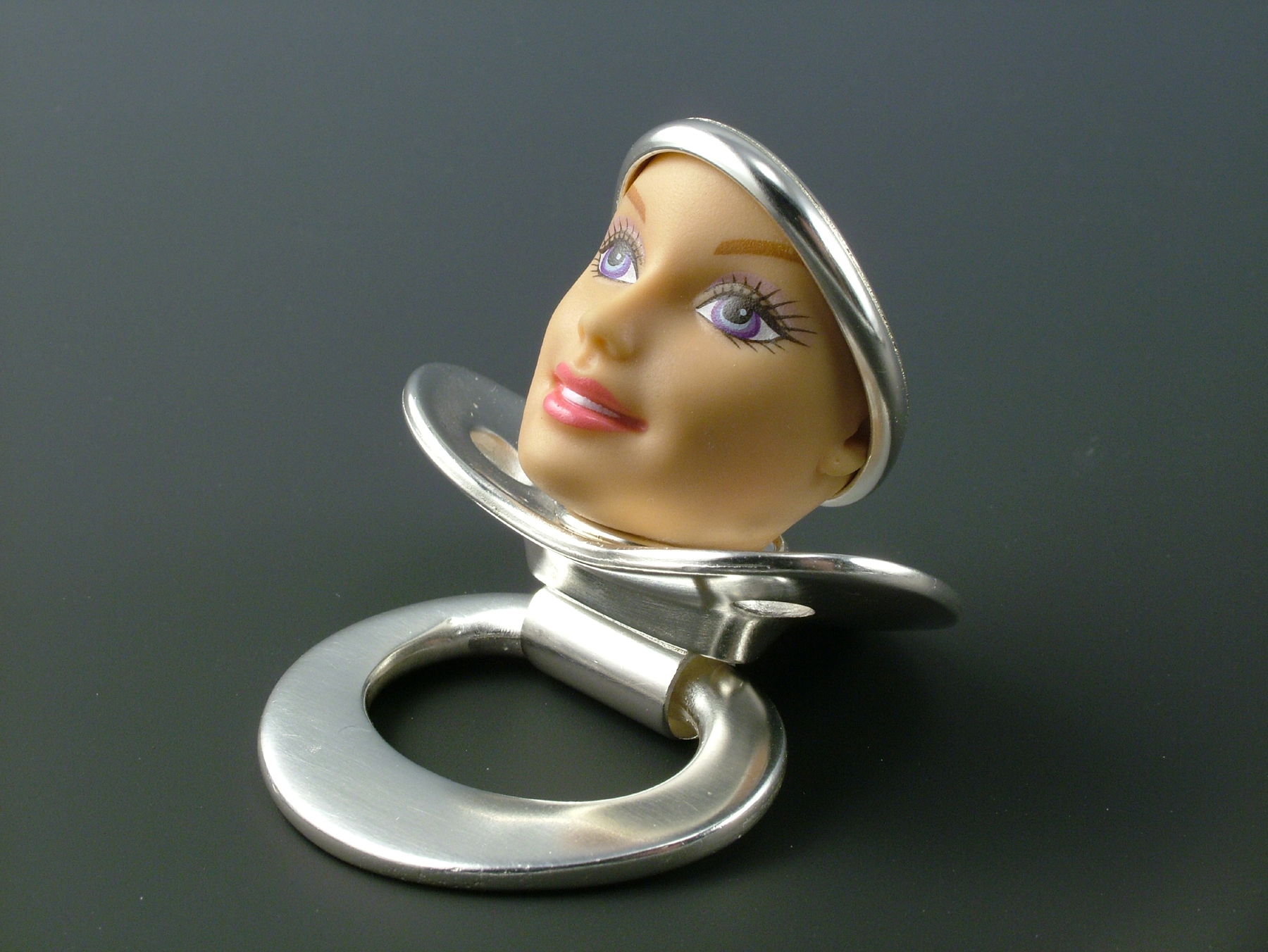
For more on Yvonne Escalante’s work go to ARTslant.
Popular Posts on BroadBlogs
The Constricting Bodice: Empowerment and Imprisonment?
Men Finding Fewer Women “Porn-Worthy”
Men Are Naturally Attracted To Unnatural Women
Share this:

Women, We Are Men
 Women, we are a part of the brotherhood of mankind. We are man. We are men.
Sounds odder than usual when you put it that way. Yet women can still be expected to live with the notion that we are “men” in our daily lives.
Man, mankind, brotherhood, fellowship. The generic “he,” as in Will Rogers declaration, “I never met a man I didn’t like.” With women it’s a different story?
The egalitarian Unitarian congregation I attend calls itself a “fellowship.” I heard women called men during William and Kate’s nuptials (yep, I watched the royal wedding). And four years ago when Hillary was running as the first serious woman candidate, I found it strange when she stated in a campaign speech, “Kitchen table issues … are ones the next president can actually do something about if he actually cares about it.” He? She thought Obama would win?
Some say it’s just generic. No one interprets all this as meaning men, in particular.
But how does this sound:
Problems arise when a player runs onto the field and his cleats catch the Astroturf and she falls on her face.
My husband asked, “Who are they talking about, a man or a woman?” Anyone still think “he/his/him” are understood as gender-neutral?
When I was a kid I heard that dogs were man’s best friend, and wondered why men like dogs so much.
Turns out, this manner of speaking has psychological effects.
Drake University sociologists asked college students to bring in pictures to illustrate chapters in a textbook. One group was given titles like “Culture,” “Family,” and “Urban Life.” The other group’s titles included, “Urban Man,” “Political Man,” and “Social Man.” Two thirds of those asked for “man” titles brought in male-only pictures. But only half of the students assigned generic labels did.
Another study found that men and women who used more male pronouns in their term papers drew more male than female images when asked to draw pictures illustrating sentences.
Even women’s interest in job positions is affected by male terms. So “mailman” has been changed to “mail carrier.”
With all the “he/him/his” and “man/mankind/brotherhood” still bandied about is it any wonder that when a group of students were asked to think of a typical person, most thought of a male?
As a result, men are seen as people, but women are seen as women.
And that creates all sorts of other effects. Medical and other research are more often geared toward men because they are people. Women are only half the population – a little more than half, actually! On the human scale, women fall a bit lower, and it becomes easier to see them as objects or property. (Or sex objects.)
And that affects how women are treated and what they will accept. More on all that later.
The way to break out of this problem is to consciously see what is currently below consciousness – and make change, including gender-inclusive language.
Related Posts on BroadBlogs
Words: Sticks and Stones? Or Shaping How We See Ourselves?
Boob: A Breast? Or a Fool? “
Bitches and Dudes,” a.k.a. “Women and Men” on College Campuses
Share this:

Tangled Up in Femininity
 If femininity came naturally, women wouldn’t need to tie themselves up in knots.
Some can barely walk in spiked heels that hurt. Some relentlessly guard against short skirts offering a quick flash. Some shift their weight around in corset-like contraptions. Others rearrange their faces, breasts and thighs under the knife.
Many squirm into a one-size-fits-all prescription that a husband and children will be 100% fulfilling.
Or, how about twisting yourself into Howcast’s rules for free drinks at a bar?
- Dress sexy, but not slutty, or you’re asking for it. How do you know if you’ve crossed the line? Well, if any men act inappropriately toward you, you must have shown too much boob. Better luck next time!
- Buy yourself one drink right off the bat, so it looks like you’re an independent-minded woman who isn’t trying to get free shit in return for being pretty. I mean, you are doing that, but you don’t want to make it obvious. Men might be turned off if the gendered exchange were made explicit.
In other words, don’t be who you are, be as you are expected, and walk a fine line on top of egg shells.
It all reminds me of a scene from “Brave,” as Natalie Wilson over at Ms. describes it:
Brave also offers a funny take on gender as performance when the very prim and proper Elinor is transformed into a hulking bear with a decidedly non-feminine body. Despite her new furry form, Elinor still “performs” femininity, prancing and posing and doing her best to have “good manners” with her unwieldy claws as she eats berries and fish.
So many of us jam ourselves into straightjackets. But why?
This is the “patriarchal bargain” that Lisa Wade, over at Sociological Images, calls a choice to accept roles that disadvantage women in exchange for whatever power they can wrest from the system. They gain advantages but leave the system intact.
And in fact, Howcast (mockingly?) instructs women to do just that:
Don’t ever stop to question a system that tells women that trading on our appearance, faking interest in people, excluding friends from social outings because they might be annoying to random men you’ve never met, and being manipulative are all totally empowering and socially-acceptable ways to behave as long as ladies get a fairly low-cost item for free in return for our efforts.
Yes. Never question the system.
Because the free drinks are so worth it.
Popular Posts on BroadBlogs
500 Calories + Pregnancy Hormones = Perfect Body
Beautiful Women’s Hips Are Thinner Than Their Heads?
Harry Potter’s Hermione: Less Brainy, Brave. More Sexy
Share this:

Government Takeover of Our Bodies
 Obama supporters want to relinquish individual choice. Romney supporters stand upon the principles of individual freedom.
- Republicans want to erase a woman’s right to choose. They seek to deny abortion even in cases of rape, incest, or when a woman’s life or health are at risk. Beware who you vote for! It concerns the well-being of your mothers, sisters, wives, daughters and granddaughters.

Those sentiments come from two letters to the editor, which appeared one after the other.
Which side is for freedom?
Really, it’s a question of whose freedom is at stake.
Paul Ryan loves liberty, he says. But not women’s.
Ryan wants to prevent women from even controlling their own bodies. He backed a “personhood” bill which would have prevented women from using many forms of birth control. Miscarriage could have become grounds for criminal investigation. And abortion would have been banned even for victims of rape and incest. Ryan voted for the Blunt Amendment, which would have given employers control over a woman’s access to contraception. And he co-authored a bill with Todd Akin (victims of “legitimate rape” don’t get pregnant) to narrow the definition of rape to “forcible rape.”
What is non-forcible rape, anyway?
Paul Ryan doesn’t want freedom for women. He wants a government takeover of our bodies.
But he does want freedom for the One Percent. In fact, he seeks to reduce Social Security and Medicare benefits for the middle class in order to give many in the One Percent a 1% tax rate. They will then have the freedom to buy more big homes and big cars and big boats and big vacations. Some Wall Streeters buy gold-filled hamburgers so that they can literally shit gold.
But will Ryan’s budget bring more freedom to the middle-class? The New York Times reported that focus groups found the plan so cruel that they “simply refused to believe any politician would do such a thing.”
Does greater liberty arise when some can no longer afford both food and medicine? Or when they are ill and can’t get medical care? Or when they die? The hungry, sick, and dead don’t have a lot of freedom.
The Hunger Games comes to mind as the rich have their fun while the hungry poor die.
Paul Ryan believes in freedom. For the powerful and privileged. But he’s not so keen on freedom for the rest of us.
Popular Posts on BroadBlogs
Markets Must Be Free; Women Must Be Constrained
Spilling Sperm Harms Unborn, Law Says
Rush’s War on Women is No Fluke
Share this:

Battered and Bruised is Beautiful?
 By Catherine Scott @ Ms. Magazine Blog
Treating women like dirt is hardly a new tactic for the fashion industry, with its long history of objectifying the female body, idealizing physically impossible beauty types and glamorizing violence against women. Bulgaria-based 12 magazine, however, has hit a new low with an inexplicable photo spread in its latest issue titled, “Victim of Beauty” [TRIGGER WARNING].
The six images are all close-up portraits of young, attractive white models sporting various gruesome injuries: one boasts a black eye, another a slit throat and a third sports a split lip and a bruised neck. Scrolling through this montage of burns, bruises and gashes, it’s easy to forget you’re looking at a “fashion” photo shoot; the images more closely resemble police files of horrendous domestic violence.
Were the magazine spread a deliberate attempt to raise awareness and generate conversation about our society’s failure to prevent and punish widespread violence against women, it might be possible to salvage an argument in its favor. But the spread contains no words or explanations to contextualize it, plus editors-in-chief Huben Hubenov and Slav Anastasov have actually gone on record arguing the photos can be interpreted as “beautiful”:
We believe that images such as ours can be seen from various angles, and we think that exactly that is what is beautiful about fashion and photography in general – that anybody can understand it their own way, and fill it with their own meaning. Where some see a brutal wound, others see a skilful (sic) work of an artist, or an exquisite face of a beautiful girl.
With these blithe words, Hubenov and Anastasov have not just admitted to cheapening violence against women but to actively eroticizing it as well.
We’re so accustomed to seeing the female body stripped, arranged in demeaning poses and digitally manipulated in fashion shoots that few even question what scantily clad, emaciated women have to do with selling a clothes. But the descent into sexualizing violence against women to hawk a few magazines is a truly dangerous trend. In Bulgaria, 12 magazine’s country of origin, one in four women suffers violence at the hands of a male partner. Its neighbors Turkey and Serbia have even worse rates of domestic violence (40 and 54.2 percent of women, respectively). Yet magazine editors think we need to look beyond the injuries and start seeing “beauty” in a maimed female face?
Hubenov and Anstasov do scramble to state that they “do NOT support violence of ANY kind, and this is NOT a shoot glamorizing or encouraging or supporting violence against women.”
But being part of an industry which refuses to take responsibility for constantly spewing out misogynistic images, they would say that, wouldn’t they?
Reposted with Permission from the Ms. Magazine Blog
Popular Posts on BroadBlogs
Making Violence Against Women Sexy
What Do Top Model and Hard Core Porn Have in Common?
What Happens When You Beat A Sex Object?

 BroadBlogs