Blog Archives
Men, Women not from Mars, Venus
 Men and women aren’t so different, after all.
They have similar levels of interest in sex with multiple partners, willingness to have sex outside of a relationship, closeness with a best friend and interest in science, for instance.
What a surprise!
Harry Reis, a psychology professor at the University of Rochester, and Bobbi Carothers, a senior data analyst at Washington University used their own and others’ research to study the characteristics of 13,301 men and women.
They looked at a range of things like physical strength, sexual attitudes, empathy, science inclination, extroversion, relationship interdependence, intimacy, mate selection criteria and personality traits in an attempt to find out which characteristics could reliably predict whether someone was male or female.
Turns out, women and men are much more alike than different.
And even differences may not be biologically based. Stereotypes tend to create social patterns. Boys are told “boys don’t cry,” so they end up repressing their emotions. Or, they get kudos for acting tough. So they are more likely to grow up to be tough guys. Girls, on the other hand, are free to cry and show weakness, and so they are more likely to do both. That’s a social pattern, not a biological one.
But even with socialization, you still get a continuum of behavior. Some guys are sweet and some girls are tough.
The researchers found that the biggest differences were physical, with men being taller and physically stronger. But psychologically, there’s a lot of overlap.
Below, you can find graphs of physical strength and assertiveness. Men are a bit more assertive, but take a look at the overlap.

A variety of other traits show a pattern similar to the bottom graph, like desire for non-committed sex (so much for evolutionary psychology), fear of success, levels of empathy, and how much feeling men and women have for their friends.
Amanda Marcotte points out that,
What’s remarkable about all this is not that men and women have so much in common but that these commonalities persist despite relentless gender policing that usually involves quite a bit of shame.
Men face ridicule if they’re perceived as having female-like levels of empathy and concern for their friends, and yet, according to the study, they overcome it. Women are routinely told there’s something wrong with them if they have “masculine” attitudes towards sex and men are emasculated if they aren’t horny all the time or if they desire intimacy alongside their sexual adventures, and yet both genders tend to have a mix of adventurousness and tenderness when it comes to sex.
Good to know that the humanity within usually wins out.
Simplistic frameworks like the pop psychology book, Men are from Mars, Women are from Venus can even be harmful in some ways. In relationships, says Reis,
When something goes wrong between partners, people often blame the other partner’s gender immediately. Having gender stereotypes hinders people from looking at their partner as an individual. (Yet) gay and lesbian couples have much the same problems relating to each other that heterosexual couples do. Clearly, it’s not so much sex, but human character that causes difficulties.
Rigid frames can also discourage people from pursuing goals that they think are for the other sex.
If men aren’t really from Mars, nor women from Venus, that gives us all a whole lot of freedom.
Popular Posts on BroadBlogs
Guys Just Wanna Have Relationships?
Hookup Culture
Surprises in Indiana University Sex Survey
Share this:

Marcella Learns Sexual Bliss is Shameful Sin
 With no sex ed, a squeamish mom and friends who laugh at her naïveté, Marcella grew curiouser and curiouser about her body and its changes.
She seemed to have a secret cavern right inside her body… but where did it end? Exploring, she felt tingles and ripplings … the body’s song… Ohhh, she can’t wait to go to bed each night. And then one night they come,
bigger, and harder and… oh, enormous wind-torn gusts of feeling that… rumbling! …
No part of her felt the same after…
She thought sometimes that what she’d done was wrong, that she shouldn’t do it again, that maybe it was like sinning. But how could it be? … All bliss, and calm, like floating out on soft warm waters afterward, with heavenly music coursing in her ears. God must surely approve.
One day her mom hands her a book called So You’re Growing Up. A chapter entitled “Peeping Through the Keyhole” talks of masturbation. She’s not sure what that word means but by the time she’s done reading she knows it’s bad.
Eventually she learns exactly what the sin of masturbation is. This pleasure, which had once seemed a gift of God, turns out to be evil and perilous.
Desperately, she tries to stop. She just can’t disappoint God and go against her Christian values. She doesn’t want to go to Hell. But as she fights the urge she gets even more obsessed… and guilty and shameful… and more obsessed.
She seeks help from the Minister who brought her to God. And he sexually assaults her.
Seeking sanctity, she wanders into an empty church and eventually finds her way to the church kitchen and its drawer full of knives. If only she could cut off her hands… no, that wouldn’t be enough, she would need to cut off her arms… or just off herself, entirely.
What will happen to Marcella?
Marcella is a coming of age tale written by Marilyn June Coffey, an award-winning poet and author. The ground-breaking novel will be republished this year, 40 years after making literary history as the first English work of fiction to use female autoeroticism as a main theme. I had a chance to interview her. The discussion below was first posted in Ms.
What inspired you to write Marcella?
My psychoanalyst. He asked me, “But have you ever tried to commit suicide?” And I remembered descending to the church basement (as Marcella does), selecting a knife, and sawing at my wrists. That memory provoked the novel.
How did you expect Marcella would be received when you wrote the book in 1973? Were there any surprises?
I thought God might send down a lightning bolt and kill me. But He didn’t.
The biggest surprise was the strong support from feminists. They lauded my controversial novel. Ms. published the menstruation chapter as “Falling Off the Roof.” Gloria Steinem hailed Marcella as “an important part of the truth telling by and for women,” and Alix Kates Shulman praised the book in her New York Times Book Review.
What sort of effect do you think your book has had?
Varied. From a refusal to read it to “Thank you for telling my story.”
What kind of response do you expect for the republication?
Lisa Pelto of Concierge, my specialist in marketing, suggested that we offer Marcella to a Young Adult audience. This surprised me, since in 1973, my audience consisted of adults. Then I considered the sophistication of today’s young adult reader compared to her counterpart forty years ago. I’m sure that today’s young reader is so much more savvy about sexual matters that my book wouldn’t shock her. So I think my audience for Marcella will broaden.
I understand that in 1989 you attempted a public reading which was eventually canceled after public outcry. Since you are once again planning a public reading, I’m wondering how the response has been different and why you think that is.
I think the response to this year’s reading is largely different because of place. Omaha, Nebraska, is a sophisticated city that supports the arts and wouldn’t attempt to ban our marathon reading.
But in 1989, I had agreed to read a marathon in Orleans, Nebraska, population 400 in my home county of 4,000. I love my roots, but sophisticated they are not. My Orleans reading was initially accepted, but when word spread about its descriptions of mas -tur – ba – tion, a brouhaha erupted.
How do you see reactions to your book and to public readings as relating to today’s war on women by the extreme right?
I am appalled by the attacks on women’s rights by the extreme right. I thought we’d settled all that decades ago. I have three recurring elements in Marcella, her Christianity, her masturbation, and her love of music. I expect the first two might give the extreme right reason to dislike my novel.
I’ve heard you describe Marcella as being sexually addicted. What do you think caused that? Do you feel her desire for nightly masturbation was addictive, or did the addiction come more after she began feeling guilty about it?
In my experience, sexual addiction is the result of trauma. Two things traumatized her, her belief that masturbation was sinful and Big Jim’s unexpected sexual attraction to her.
Do you see parallels to Marcella’s pedophile Minister and to pedophile priests of today, and public reaction?
A pedophile is a pedophile whether in Marcella’s day or now. But today children are taught to speak out about behavior that makes them uncomfortable. That has caused, as you know, a tremendous outcry against pedophilia.
However, Marcella thought that the sexual experience with the minister she trusted was her fault, not Big Jim’s. Who could she speak to? No one.
What sorts of letters have you received from those who have read your book – or from those who haven’t?
The Internet has coached us to expect many responses from readers, as I experienced with the recent publication of my Mail-Order Kid: An Orphan Train Rider’s Story and with A JoLt of CoFFeY, my blog. But I received very few letters in response to Marcella. They were laudatory.
The response I valued most was from a woman who saw me in an art gallery. When she read my name tag, she cried out, “Oh, are you the Marilyn Coffey who wrote Marcella?”
Ah, fame! Fleeting but delectable.
Coffey’s new collection of tart poetry from the sixties, Pricksongs, will also be published in 2013. It will include her Pushcart Prize winning poem, “Pricksong.”
Her most recently published book is an adult biography, Mail-Order Kid: An Orphan Train Rider’s Story. It’s a best seller on Amazon and the recipient of The National Orphan Train Complex’s Special President’s Award.
Popular Posts on BroadBlogs
Sex Lessons from Mom and Dad
Sex and the Walk of Shame
Better My Daughter Die Than Signal “Sex is Ok”
Share this:

Women Shouldn’t Be Alphas!
![Kristen-Stewart-Snow-White-Huntsman-armour[1]](https://broadblogs.com/wp-content/uploads/2012/06/kristen-stewart-snow-white-huntsman-armour1.jpg) I don’t want to publish reviews of films where women are alpha and men are beta. Where women are heroes and villains and men are just lesser versions or shadows of females.
I don’t want to publish reviews of films where women are alpha and men are beta. Where women are heroes and villains and men are just lesser versions or shadows of females.
Frank Parlato wrote that email soon after becoming editor of The Reporter.
The New York Times says it was Snow White and the Huntsman that set him off.
(It) struck Parlato as emblematic of “a Hollywood agenda of glorifying degenerate power women and promoting as natural the weakling, hyena-like men, cum eunuchs.”
He must not have seen the film.
Luckily, The Reporter is just a small weekly in upstate New York. But I’ve been thinking about this with the Oscars approaching.
Fortunately for Parlato, movies are mostly the way he likes them. But that’s not so fortunate for the rest of us.
Quick thought experiment: how would you experience yourself after watching popular Oscar-nominated films if gender roles were reversed?
- What if we watched President Mary Todd Lincoln fight to abolish slavery and save the union?
- What if CIA operative, Tonya Mendez, led the charge to liberate female diplomats from Tehran during the Iranian hostage crises in Argo?
- In Zero Dark Thirty a male CIA agent finds Osama bin Laden’s whereabouts. A highly-skilled female unit then finds and kills bin Laden.
- Our heroine explores spirituality and survives the good part of a year stranded on a lifeboat with a Bengal tiger named Rachel Parker in the Life of Pi.
- In Les Misérables ex-convict Janette Valjean undergoes redemption while pursued by police inspector, Monique Javer, who doubts the possibility of transformation.
- In Silver Linings Playbook bipolar Patricia leaves a mental health facility where she’d ended up after nearly beating her husband’s lover to death. Next thing you know, she’s fighting thugs at a Philadelphia Eagles game. In the end she enters a dance contest and gains love.
- Django Unchained follows Sally Django, a freed slave who crosses the United States with bounty hunter, Kate King, on a mission to rescue her husband from a cruel and charismatic plantation owner named Lenora Crawford.
If these were the movies would you experience yourself as a more powerful woman? More in control? More the main event? As a man would you feel more disempowered and marginal?
Plenty of things in our culture create the same psychology, such as “man” and “he” referring to us all. Or, “woman,” “she,” and “her” are consistently placed after “man,” “he,” and “him.” A wife takes her husband’s name. The list goes on. Living in a world where the power players in business, government, religion, the home and beyond are mostly men adds to the effect.
I grew up with a mother who’d grown up in a world where women were even more passively presented than they are today. She couldn’t change things, she thought. Others had to create a good place for her or she was out of luck. She felt powerless and depressed. That didn’t help me and that didn’t help my brother. (So yeah, males are harmed, too.)
Surely, balance would be better.
Related Posts on BroadBlogs
Women, We Are Men
Gender-Swapping Grammar Lessons
Frats Invite Sluts, Bitches; Women Accept Degradation. Why?
Share this:

Low Self-Esteem? Blame Beauty Myths
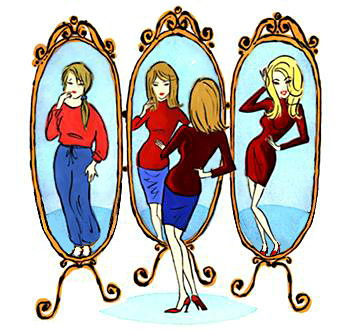 Even as women’s power has increased over the last fifty years, self-esteem has too often diminished. Why? Blame unachievable beauty ideals.
Since the mid-twentieth century, the number of women and girls with poor body image has greatly risen. A big problem, since feminine self-worth has become closely tied to body image.
As Naomi Wolf explains in The Beauty Myth, women have more money and power than ever before but, “a secret ‘underlife’ poisons our freedom; infused with notions of beauty, it is a dark vein of self-hatred, physical obsessions, terror of aging and a dread of lost control… In fact, in terms of how we feel about ourselves physically, we may be worse off than our unliberated grandmothers.” Too bad her book, which was written twenty years ago, is not now obsolete.
Once upon a time, she says, the family was a productive unit so that a woman’s value lay in her work skills, economic shrewdness, physical strength, and fertility, with physical beauty playing a lesser, and less oppressive, role.
Before the industrial revolution – before photographs, photoshop, and plastic surgery – women did not feel pressured to live up to a mass-marketed ideal – one that is nearly impossible to achieve, leaving women frustrated and depressed, obsessed with their looks, and wondering what is wrong with them.
As the beauty myth creates a hierarchy pegging some better than others, I am reminded of a book called The Spirit Level. British epidemiologists, Richard Wilkinson and Kate Pickett say “Gross inequality tears at the human psyche, creating anxiety, distrust and an array of mental and physical ailments,” with those at the bottom suffering a range of pathologies.
The Spirit Level is concerned with economic disparity. But the theory fits with other inequities. Beauty hierarchies leave too many women depressed with low self-esteem, eating disorders, competing to be plastic on reality TV, jealous, envious, and sometimes dying from anorexia or plastic surgery. Importantly, the problem isn’t so much where you stand as where you think you do. Unfortunately, it’s common for women to place themselves at the bottom, and suffer.
Why not celebrate the wonderful variety of figures and faces that women embody, instead?
Popular Posts on BroadBlogs
Men Are Naturally Attracted To Unnatural Women
The Constricting Bodice: Empowerment and Imprisonment?
Men Finding Fewer Women “Porn-Worthy”
Share this:

Stop Selling Girls
 Like most girls who end up in prostitution “Alissa” grew up in an abusive home. But at age 16 a deceptive Prince not-so-Charming came to her “rescue.” He told her she was attractive and that he’d like to be her boyfriend. Flattered, she accepted. Soon after, he prostituted her.
Alissa stayed with him, partly because she felt emotionally attached. Girls who have lived without love crave it and often take whatever they can get. Pimps know this and use it. But she also stayed because she feared his violence.
Nick Kristof told this story in the New York Times:
She was sold to johns seven days a week, 365 days a year. After a couple of years, she fled, but a pimp tracked her down and — with the women he controlled — beat and stomped Alissa, breaking her jaw and several ribs, she said. That led her to cooperate with the police.
Perhaps the strangest part of this story is that she was sold on Backpage.com, which is owned by Village Voice Media. Strange, since Village Voice is a well-known alternative journal whose aim is to speak truth to power. Yet Backpage makes up about 70% of prostitution advertising among similar Web sites. Most of the Backpage ads are legit, but the sex slavery that it promotes is troubling.
John Mailer, son of Village Voice co-founder Norman Mailer, has called for Backpage to shut down. As he put it:
The Village Voice was born out of the desire for an independent media voice for the people, a voice that had the freedom and authority to hold those who abuse power accountable for their actions… As my father’s son, knowing all of the hopes and dreams that went into the work of creating this particular paper, the Village Voice appears to have lost its way…
Pandora Young, now at Media BistroI, has also felt the pangs of conscience. For years she worked at the Village Voice-owned LA Weekly. She said:
I knew that I was being paid in some small part by blood money. And while I felt lousy about it, I did nothing beyond kvetching about the problem with fellow employees. I always cashed my paychecks, and I never gave a dime to help victims of sex trafficking.
Some defend Backpage’s right to free speech. And Village Voice says they work hard to make sure all ads are legit. But too much gets through.
The only reasonable argument I’ve heard to keep from shuttering Backpage is that it provides a tool for law enforcement to identify trafficking victims. But Kristof points out that:
Village Voice makes some effort to screen out ads placed by traffickers and to alert authorities to abuses, but neither law enforcement officials nor antitrafficking organizations are much impressed. As a result, pressure is growing on the company to drop escort ads.
Change.org has a petition to shut down Backpage. Weigh the pros and cons yourself. If you want Backpage shut down, sign the petition here.
“All that is necessary for the triumph of evil is that good [people] do nothing.”
– Edmund Burke.
Popular Posts on BroadBlogs
Trafficked Girl Shoots Pimp, Gets Life Sentence
In-laws Rip Off Girl’s Fingernails, But Who Cares?
Why Did Nancy Garrido Help Kidnap Jaycee Dugard?
Share this:

4 Daily Rituals to Stop Objectification

Objectification causes women a lot of harm says Caroline Heldman, a professor who specializes in gender at Occidental College:
In a culture with widespread sexual objectification, women (especially) tend to view themselves as objects of desire for others. This internalized sexual objectification has been linked to problems with mental health (clinical depression, “habitual body monitoring”), eating disorders, body shame,self-worth and life satisfaction, cognitive functioning, motor functioning, sexual dysfunction [PDF],access to leadership [PDF] and political efficacy [PDF]. Women of all ethnicities internalize objectification, as do men to a far lesser extent.
Beyond the internal effects, sexually objectified women are dehumanized by others and seen as less competent and less worthy of empathy by both men and women.
Furthermore, exposure to images of sexually objectified women causes male viewers to be more tolerant of sexual harassment and rape myths. Add to this the countless hours that some girls/women spend primping to garner heterosexual male attention, and the erasure of middle-aged and elderly women who have little value in a society that places women’s primary value on their sexualized bodies.
In a new post she discusses what women can do to navigate a culture that treats them like sex objects. (See Part 1, Part 2.) This is the third of a four-part series.
Sexual Objectification: Daily Rituals to Stop
There are four damaging daily rituals of objectification culture we can immediately stop engaging in to improve our health.
1) Stop seeking random male attention.
Most women were taught that heterosexual male attention is our Holy Grail before we were even conscious of being conscious, and its hard to reject this system of validation. But we must. We give our power away a thousand times a day when we engage in habitual body monitoring so we can be visually pleasing to others. The ways in which we seek attention for our bodies varies by sexuality, race, ethnicity and ability, but the goal too often is to attract the male gaze.
Heterosexual male attention is actually pretty easy to give up, when you think about it. First, we seek it mostly from strangers we will never see again, so it doesn’t mean anything in the grand scheme of life. Who cares what the man in the car next to you thinks of your profile? You’ll probably never see him again. Secondly, men in U.S. culture are raised to objectify women as a matter of course, so an approving gaze doesn’t mean you’re unique or special. Thirdly, male validation through the gaze alone doesn’t provide anything tangible; it’s fleeting and meaningless. Lastly, men are terrible validators of physical appearance, because so many are duped by make-up, hair coloring and styling, surgical alterations, etc. If I want an objective evaluation of how I look, a heterosexual male stranger is one of the least reliable sources on the subject.
Suggested activity: When a man catcalls you, respond with an extended laugh and declare, “I don’t exist for you!” Be prepared for a verbally violent reaction as you are challenging his power as the Great Validator. Your gazer likely won’t even know why he becomes angry, since he’s simply following the societal script that you’ve interrupted.
2) Stop consuming damaging media.
 That includes fashion, “beauty” and celebrity magazines, along with sexist television programs, movies and music. Beauty magazines, in particular, give us very detailed instructions on how to hate ourselves, and most of usfeel bad about our bodies immediately after reading. Similar effects are found with televisionand music video viewing. If we avoid this media, we undercut the$80 billion a year Beauty-Industrial Complex that peddles dissatisfaction to sell products we really don’t need.
Suggested activity: Print out sheets that say something subversive about beauty culture, like “This magazine will make you hate your body,” and stealthily put them in front of beauty magazines at your local supermarket or corner store.
3) Stop playing the tapes.
Many of us girls and women play internal tapes on loop for most of our waking hours, constantly criticizing the way we look and chiding ourselves for not being properly pleasing in what we say and do. Like a smoker taking a drag first thing in the morning, many of us are addicted to this self-hatred, inspecting our bodies first thing as we hop out of bed to see what sleep has done to our waistline. Self-deprecating tapes like these cause my female students to speak up less in class. They cause some women to act stupid when they’re not, in order to appear submissive and therefore less threatening. These tapes are the primary way we sustain our body hatred.
Stopping the body-hatred tapes is no easy task, but keep in mind that we would be highly offended if someone else said the insulting things to us that we say to ourselves. These tapes aren’t constructive, and they don’t change anything in the physical world. They are just a mental drain.
Suggested activity: Sit with your legs sprawled and the fat popping out wherever. Walk with a wide stride and some swagger. Eat in public in a decidedly non-ladylike fashion. Burp and fart without apology. Adjust your breasts when necessary. Unapologetically take up space.
4) Stop competing with other women.
 Unwritten rules require us to compete with other women for our own self-esteem. The game is simple: The prize is male attention, which we perceive as finite, so when other girls/women get attention from men we lose. This game causes many of us to reflexively see other women as natural competitors, and we feel bad when we encounter women who garner more male attention than we do. We walk into parties and see where we fit in the “pretty girl pecking order.” We secretly feel happy when our female friends gain weight. We criticize other women’s hair and clothing. We flirt with other women’s boyfriends to get attention, even if we’re not romantically interested in them.
Suggested activity: When you see a woman who triggers competitiveness, practice active love instead. Smile at her. Go out of your way to talk to her. Do whatever you can to dispel the notion that female competition is the natural order. If you see a woman who appears to embrace the male attention game, recognize the pressure that produces this and go out of your way to accept and love her.
Cross-posted at Ms. and on Caroline Heldman’s blog
Popular Posts on BroadBlogs
Sexual Objectification, What is it?
Sexual Objectification, The Harm
Why Men Objectify
Share this:

Burning Wives
 By Hanna Ingraham
Rhuksana’s husband threw acid on her face and then her sister-in-law lit her on fire. Shortly after, one of her children got sick and she was forced to move back in with them because she couldn’t afford to feed her kids.
Zakia was divorcing her husband and just leaving the courthouse when he found her and threw acid on her. She is now disfigured and has lost an eye.
I learned about Rhuksana and Zakia in the documentary “Saving Face” which tells of the many Pakistani women who are victims of these attacks — about 100 cases each year. Women who consider themselves “the living dead.”
A patriarchy that devalues women appears to be the culprit.
Men who feel disgraced or embarrassed because of an argument over the dishes, or discarded advances, or who hold a generalized hatred of women, lash out. If women don’t do what men want, they deserve it.
These men want to ruin the women’s lives. And they succeed.
Agonizing acid burns through skin and fuses it together, making it difficult to eat or breathe. It blinds and kills. Women who survive become ashamed of their bodies and are ostracized. They are emotionally wrecked from being burned alive by their own husbands.
Abuse is rife in Pakistan with 65% of men saying they were abused as children and about half now say they abuse their wives. Through generations the men become diseased with a lust to harm women.
For years Pakistani women had not fought back because they had no voice. They may have believed that this was life and there was no other way. But recently the scales are falling from their eyes and the women are seeing possibilities and working to end the abuse. The government is listening and passing bills to protect them.
Here we see the cycle of abuse and how it can be broken. We see women once disempowered and blind to the possibility of change gaining both sight and muscle.
I’m inspired!
Popular Posts on BroadBlogs
In-laws Rip Off Girl’s Fingernails, But Who Cares?
Whipping a Daughter. Good Dad? Bad Dad?
Real Men Don’t Beat, Rape Women
Share this:

Celebs Less Weight-Conscious
 Female celebrities are obsessing less about their weight. Will that body acceptance free the rest of us to accept ourselves?
Voluptuous celebs include Christina Hendricks of “Mad Men,” Kat Dennings, a star of “2 Broke Girls,” Christina Aguilera from “The Voice,” Emmy winner Melissa McCarthy of “Mike & Molly,” Mindy Kaling of “The Mindy Project,” Rebel Wilson, who won a hunky guy in “Bachelorette,” and Lena Dunham, writer-director-producer-star of “Girls.”
Even the modeling industry has branched out with Real Beauty ads and Cosmo featuring a “plus-size” model at size 12 instead of the usual size 0.
Maybe the biggest surprise was Lady Gaga whose oversized personality materialized in bodily form last year. As Alessandra Stanley at the New York Times put it:
Gaining weight is the most outrageous stunt Lady Gaga has pulled to date. Instead of wearing raw animal flesh at a public event this summer, she wore her own — the one metamorphosis that even Madonna wouldn’t dare undertake.
But I’m also struck by Lena Dunham who as “Hannah” unselfconsciously runs about in her undies – if she wears anything at all – while eating assorted goodies. It’s remarkable. No body shame or food shame.
Of course, Ms. Dunham and Ms. Kaling have more power to break rules because they have created, produced and written their own shows, as a Times piece points out.
Interesting how power can free you, considering the body torture women have historically undergone to show off their husbands’ success — as the men sit comfortably by. At one point women wore constricting corsets so people could see that their husbands were wealthy enough to support a spouse who didn’t need to work – and couldn’t in that straight jacket. Tiny bound feet once served the same end in China. In parts of West Africa today women are force fed into obesity to demonstrate their husbands’ financial ability to over-feed them. And then the poor copy the rich and end up in even worse straits.
Women the world over internalize beauty norms that harm them.
Some suspect the ideals are put in place with the aim of harming them: make women obedient and so distracted by their looks that they have no time for anything else, like gaining political power. As Naomi Wolf suggested in her bestseller, The Beauty Myth:
A culture fixated on female thinness is not an obsession about female beauty, it is an obsession about female obedience. Dieting is the most potent political sedative in women’s history: a quietly mad population is a tractable one.
So it’s interesting that when Dunham’s character Hannah is asked about her flabby tummy she responds:
No, I have not tried a lot to lose weight. Because I decided I was going to have some other concerns in my life.
You know, so the real Lena Dunham could become the writer, director, producer and star of “Girls.”
Maybe we should all have greater concerns in our lives than how slim we can be.
Popular Posts on BroadBlogs
Beauty Tricks to Remove Your Power
Miss Representation: Girls are Pretty, Boys Are Powerful
Scrutinizing My Body Takes All My Time
Share this:

Racism: Genetic or Learned?
 Evolutionary psychology says racism is in our genes — a genetic adaptation that helps groups survive by favoring themselves over others. Skin color cues us in to who’s “in” and who’s “out.” (Yet the most prosperous areas of the world are those that cooperate and trade with each other?)
When I explain the theory, my students are appalled. (Though they readily accept evolutionary psych when it comes to explaining supposed sex differences.)
I once wrote a comment questioning evolutionary psychology on Slate and got the following response:
And what about all of those studies on doctors that found they treat patients differently because of race? What about those studies that show that we show preference to people wearing the same color of shirts as us?
Then shouldn’t children prefer parents who have their same hair/eye color? Not in my case. My mom has brown eyes and very light skin like me and my dad has green eyes and darker skin. Yet as a child I preferred him because mom was the disciplinarian.
And doctors could treat patients differently because they learn prejudice and not because they are genetically programmed to discriminate.
You also have to wonder why so many brown-haired, brown-eyed people have a preference for blonde, blue-eyed looks if our genes cause us to prefer our own type. But then, we’re all bombarded with messages that teach us that blue eyes and blond hair are best, at least on women.
Relatedly, about half of the Black people who take Harvard’s test of unconscious prejudice show a preference for Whites. If evolutionary psychology is right, shouldn’t they have a preference for Blacks? But again, Black Americans (just like the rest of us) are barraged with unfortunate messages that White is prettier, smarter, and less criminal.
Meanwhile, some people show “no preference” for either race when they take Harvard’s “implicit” test of unconscious bias.
Or consider the most recent presidential elections. The younger a person was, the more likely she or he cast a ballot for Barack Obama. Was there a mass genetic mutation that caused younger voters to be less racist? Or has society changed enough through the years that young people have simply learned less racism?
Evolutionary psychology says racism is in our genes. Looks more like it’s learned.
You inherited you grandmother’s eyes. Did you inherit her racism, as well?
February is Black History Month
Related Posts on BroadBlogs
Are Women Naturally Monogamous?
Black Isn’t Beautiful Claims Evolutionary Psychologist
Women Want Casual Sex? Yes and No
Share this:

Rapists Get Child Custody?
I would learn firsthand that in the vast majority of states — 31 — men who father through rape are able to assert the same custody and visitation rights to their children that other fathers enjoy.
That’s Shauna Prewitt. In her final year of college she became the victim of a horrifying rape. Nine months later she gave birth to a beautiful baby girl. She chose to keep and raise her because her daughter was,
so much more than her beginnings. I blissfully believed that after I finally had decided to give birth to and to raise my daughter, life would be all roses and endless days at the playground.
I was wrong again.
Nearly 1/3 of women who conceive by rape choose to keep and raise their children. Like Shauna, they probably don’t realize that their rapist will be given visitation rights and end up in their lives forever.
As if the violent rape weren’t bad enough now she must be constantly reminded of it as she is forced into contact with the child’s father.
That may be just why the men seek custody. Rapists enjoy power and intimidation and can now create dread and fear through a lifetime. Or, as Shauna sees it:
It is not surprising that a man who cruelly degrades a woman would also seek to torture her in an even more agonizing way, by seeking access to her child.
A rape victim may, alternatively, sacrifice her need for justice by dropping the charges in a bargain to gain sole custody of the child.
Apparently, the court’s concern is that the man may not have raped the woman. But in this “he said/she said,” why does he win? Especially since rapists tend to have a controlling nature and a violent streak, risking child endangerment.
When I look at which causes greater harm, a man denied custody or a woman forever tormented and a child at risk for abuse, I wonder why the man’s rights trump the woman’s and the child’s.
Probably because every society is ruled from the perspective of the powerful. In this case, men. Those making the law are looking at things more from the man’s perspective than from the perspective of where the greater harm occurs.
It’s all reminiscent of a newly proposed bill “aimed at throwing rape victims in jail if they refuse to honor their rapist’s right to control their body by carrying his child,” as Amanda Marcotte put it.
That’s right. Rep. Cathrynn Brown of New Mexico wants a bill banning abortion for rape victims because it “tampers with evidence.” Sounds phony since pregnancies may occur without rape and rape can occur without pregnancy. Wonder how much money one of her constituents contributed to get that bill proposed?
At best this ban sees through the eyes of the powerful instead of the powerless.
At worst it is misogynistic, an excuse to hurt a woman even more than she has already been harmed by rape.
When it comes to justice sometimes it’s a world turned upside-down.
Popular Posts on BroadBlogs
Community Bullies Rape Victim
If She Was Drunk, Did She Rape Herself?
Mind of a Rapist: Trying to Bridge a Gap between a Small Self and a Big Man

 BroadBlogs