Blog Archives
Women Seeing Women as Sexier than Men
 Girls are so inundated with sexualized images of women that they learn to see women as sexier than men. Women come to see women through male eyes?
In the bedroom, this can make women’s sexuality a bit convoluted, which I’ll discuss later.
But consider my students:
“Women’s bodies are just naturally sexier than men’s,” my class tells me when I ask why women are portrayed as sex objects.
In this belief, my students are not alone.
A few years back Lisa Kudrow, of Friends fame, told Jay Leno that female nudity is displayed more in movies because, “Who wants to look at a guy?”
Hugh Hefner thinks women are natural sex objects, “If women weren’t sex objects, there wouldn’t be another generation.”
I’ve talked before about how the breast fetish is not natural, but is learned by both men and women. But how do we all learn that women are sexier than men in ways that go beyond the fetish?
Growing up, girls are bombarded with visions of women as sexy, with skin selectively hidden and revealed, the camera focused on those intriguingly concealed parts.
When I was little my mom took me to the Ice Capades. After noticing that the women were half dressed while the men were fully clothed, I asked why. Mom told me that women just have better legs.
Do they? One warm summer day an adult from my church youth group commented, “It’s too bad the guys have the best legs.” (Thanks!) But what is our cultural ideal? Longer, leaner. Young men typically have longer legs, and they don’t have the extra layer of fat that women do. So most young men’s legs come closer to our ideal. Yet we say women have better legs? When I think about it, I actually think men have pretty nice looking legs. But nothing and no one directs our attention to them.
On Dancing With The Stars, women are half-dressed and men are fully-clothed. During an advertisement, the camera lingers on women’s breasts and legs in a Victoria’s Secret display. Next, a commercial for shoes focuses on women’s behinds: See this Rebook ad for EasyTone. Try to imagine the same focus on men’s butts (which actually are pretty attractive)!
Watch a football game and see big, fully-dressed, aggressive guys playing on the field, while scantily clad cheerleaders show off their stuff from the sidelines. In the Bikini Open men sport golf wear while women dawn bikinis. When does Sports Illustrated most focus on women? In the swimsuit edition.
Through it all, the camera gazes at women’s body parts, but not men’s. Telling us what’s important to notice. What’s sexy and what’s not.
Men’s bodies are rarely sexualized outside infrequent underwear ads.
Historically, men have had control of media, and they’ve portrayed what they see as sexy.
Bombarded with these images, girls come to see women as sexier than men. As I’ve said before, when I tell my class that I find a Playboy pinup sexier than a Playgirl pinup, women’s heads nod in agreement.
Meanwhile, when women answer surveys about what they find sexy they say “men.” But when they are wired up, blood flow to the vagina is stronger when viewing an image of a nude woman than a nude man – conscious responses and bodily responses not agreeing.
Oddly, and yet logically, women come to see women through male eyes.
So women come to see themselves as the sexy half of the species. Being sexy has some advantages. It can just be fun, it’s easier to attract mates (consider the success of women versus men in singles bars), and sexiness is a source of power.
But there’s a downside, too, including the narrow construct that leaves so many women feeling they exist outside the “sexy” box, with a drop in self esteem kicking in.
Taken to extreme, some women can become sex objects, taking an unhealthy one-dimensional focus on themselves, feeling that how they look is all that matters. And some men may see them as objects whose sole purpose is to be used for their pleasure.
It ain’t so great to be, or be seen, as mere object.
Popular Posts on BroadBlogs
Sex Objects Who Don’t Enjoy Sex
Men Have Higher Sex Drive. Why?
Women Learn the Breast Fetish, Too
Originally posted on January 10, 2011by BroadBlogs
Share this:

Beastly Breasts. Patriarchy? Or Blasphemy?
 In honor of women’s history month I talked with Brock Neilson, a feminist artist who wonders if he might sometimes unconsciously support patriarchy.
Or, is he blasphemous instead?
BB: It’s very easy for anyone, including feminists, to unconsciously see and think in patriarchal ways, at least some of the time, since we’re all immersed in the system. You wonder if you sometimes unconsciously support patriarchy in your art. How so?
BN: This past year a lot of my art has been about someone – or something — that has enormous or strange looking breasts. These images are what I’d imagine a drunken fraternity or a 12-year-old boy drawing.
I imagine that these kinds of perversions are part of the package with which males are endowed in society, and I feel a responsibility to address that somehow.
Sometimes I might want the breasts to look uncomfortably disfigured or I might want the  viewer to feel a kind of confusion about the body they are seeing. The breasts could also be more humane when they are not perfectly shaped or as easily sexualized, but I worry that I might be reinforcing patriarchy by not allowing something as commonly fetishized as breasts — or the person or entity to which the breasts belong — to just exist without having to be ugly, or strange, or beautiful, or symbolic. However, this concern is unavoidable as these images are being filtered through my nonobjective brain and hands.
The ultimate goal of feminism is to not have to be the mother, the champion goddess, the victim, or even a female or a male in order to have credibility and dignity. It is the hope that everyone could simply be who they want to be without having to force ourselves into degrading positions.
That said, I think it’s important to express these positions — or distortions — of power and powerlessness (and the variations between). My art is preoccupied with the slots we pop people into: the corporate leader, the androgynous, the porn victim, the violent athlete, the disabled or disfigured. I find that I’m often exploring possibilities for a better world by regurgitating things that are offensive to me.
BB: How might your work be blasphemous instead, working against patriarchy?
BN: There’s been a big focus among popular male artists to make big objects and paintings that can be bought and sold — similar to a Wall Street investment. This approach to art is problematic. I have been decorating a lot of brown paper in my work because it’s cheap and accessible. Being a male who is involved in decorating materials that require a kind of gentleness can be a blasphemous act.
I remember overhearing a mother years ago who was telling her five year old son not to smell flowers because she was afraid that this would make him look “gay.” I was so taken back that this innocent behavior — a child smelling flowers — was already perceived as inferior. My work, however crude it may be, is concerned with a hope of reclaiming this kind of sensitivity.
Tawnie Silva, an artist I discovered this last summer, made a beautiful inflatable sculpture of a quirky four-eyed girl with a rainbow coming out of her head. It’s made of fragile plastic bags, but Tawnie Silva’s body is brawny and masculine. It is especially sacrilegious to commercial gender ideals when men make things that are sweet and delicate. Both women and men need to protect and make space for vulnerable things in others and in themselves. This is an important way that we can expand and break dangerous gender stereotypes.
Related Posts on BroadBlogs
Man as Object: Reversing the Gaze
The Constricting Bodice: Empowerment and Imprisonment?
Spoon Fed Barbie
Share this:

What Gossip Magazines & Abusers Have In Common
By Linda Bakke
Star Magazine promotes violence against women.
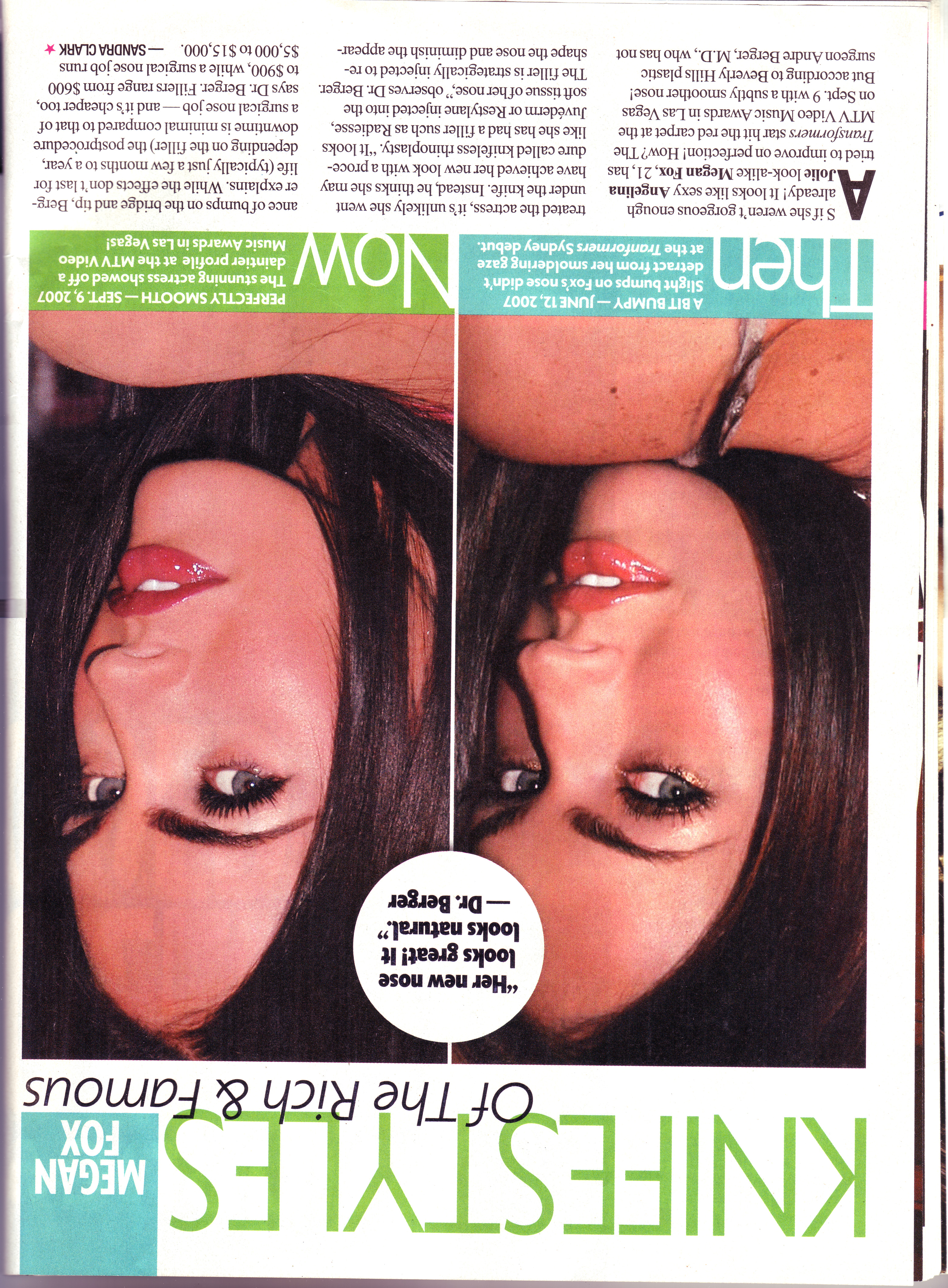 Ok, that sounds like a tabloid headline, but the more I look over Star Magazine, the more I’ve been struck by a sense of violence directed at women.
The starlets are constantly attacked for any extra weight, cellulite, bunions, ugly fingers or thick arms. It feels like open season. “Kill the Celebrity” is the name of the game.
One section called “Knifestyles” advocates mutilating women through plastic surgery. With the accompanying message, “You’re not good enough.”
In fact, Star uses the same devices that characterize domestic abusers: watching the victim’s every move, humiliation, stressing the negative rather than the positive aspects of the victim (who is supposedly adored), using “it’s her fault” to launch an attack, and transferring the abuser’s dissatisfaction with life and himself onto the victim.
After a while, she starts to blame herself.
Paparazzi hunt celebrities down and we all become cannibals of the spoils, savoring the flaws of “perfect” idols as we bring them down a peg.
But it’s not just about starlets. It’s not just their bodies that are under attack. Yours and mine are, too. If they don’t look good, we don’t either.
The depiction of women in gossip magazines represents the degradation, abuse and mutilation of women. We must recognize how damaging these portrayals are for all of us, women, girls, men and boys.
For we are all encouraged to scrutinize and vilify women for being less than perfect.
Popular Posts on BroadBlogs
Men Watch Porn, Women Read Romance. Why?
What Happens When You Beat A Sex Object?
Beautiful Women’s Hips Are Thinner Than Their Heads?
Share this:

Should We Ban “Slut” and “Ho”?
by Janell Hobson @ Ms. Magazine
I must commend Sandra Fluke, like so many others have already done, for rightly condemning “shock jock” Rush Limbaugh’s efforts in silencing women who dare to speak publicly about sexual politics by calling them “sluts.” The furor over Limbaugh’s slut-shaming tactics, however, seems to underlie a different anxiety that is more than just outrage over such blatant misogyny.
Rush Limbaugh is a bigot, a misogynist and a homophobe. His recent “slut” comments are right up there with his usual hate speech, and I distinctly remember him uttering the word “ho” to describe the black woman accuser behind the infamous Duke lacrosse case before that same case got dismissed.
What had impressed me back then was when I heard a white woman who called into his radio show and, without knowing much about the case or how it would unravel a year later, lambasted Limbaugh for using such an epithet to describe a woman. It was clear that Limbaugh was genuinely stunned that a white “conservative” woman didn’t rely on racial divides, or class and political “respectability” rules, to distinguish herself from a black sex worker. She understood that the “ho” label applied to all women, even if it was used to only apply to black women, and she did not let Limbaugh get away with it.
I also distinctly remember Don Imus’s “nappyheaded ho” comment and the furor over that, thus proving that while many are outraged over “slut” we’ve also been inundated with “ho” language–from radio shock jocks recently undermining Whitney Houston’s legacy with the dismissive “crack ho” label to popular presidential campaign posters back in 2008 championing Obama over Hillary Clinton with the slogan “Bros Before Hos.”
In many ways, the public furor over Limbaugh’s slut-shaming of Fluke demonstrates that, once again, women will not let him get away with it. But it bothers me that so many of our responses–from #boycottrushlimbaugh Twitter trends to President Obama calling Fluke to show his support–are based on the premise that to be called a “slut” is inherently to be shamed. It bothers me that, despite all the efforts of the sexual revolution and women’s liberation–which have enabled women to avoid the stigma of having sex outside of marriage, having children outside of marriage or having sex beyond the confines of heterosexuality–that some hate-monger can just say, “You’re a slut” and a public meltdown ensues.
This suggests that women’s sexual egos are still fragile, but in a woman-hating society this should come as no surprise. In a sexually evolved world in which a woman proudly proclaims her enjoyment of sex, of kink, of polyamory, or even basic monogamy, the sex-positive woman should be able to respond to the “you’re a slut” woman-hater a number of ways:
- The flippant response: “How quaint of you. That’s so 50 years ago!”
- The defiant response: “Power to sluts and sex goddesses everywhere! Woo hoo!”
- The vulgar response: “Eat me!”
However, we do not live in a sexually evolved society, so to deliver any of these responses is to hint that you’re not quite the respectable lady so many of us work so hard at being. To do so is to invite suggestions that we just might be the “slut” those guys over there say we are, and that fear of sexual labels keeps us in line, or puts us on the defensive, with the retort “I’m not a slut!”
That Limbaugh–an admitted drug addict, bigot and proud chauvinist–responded to the furor not by apologizing (which would be like a Ku Klux Klan member apologizing for being racist) but by digging in his heels and suggesting that Fluke and other women who want contraceptives covered by health insurance should subject themselves to online porn, only proves that men like him are shameless in what they’re doing. But of course they can be: No matter what sexual misconduct men engage in–whether they are busted in prostitution rings or in child molestation cases–they never get slut-shamed.
Middle-aged Catholic priests and football coaches have institutions that cover up their bad behavior, but under-aged girls such as Amber Cole can be videotaped in sex acts and become YouTube sensations and Twitter trends, slut-shamed by the general public–as if any of the shamers have a moral leg to stand on while trafficking in child pornography.
This is the climate in which we live, where male privilege runs rampant and women are still on the defensive. And where “slut” will maintain its power over us as long as rape and other forms of sexual violence go unpunished, as long as our reproductive rights are undermined and as long as our reproductive health options are limited (the very issue that forced Fluke to speak out in the first place). Moreover, “ho” will maintain its power as long as we insist on racial and class hierarchies among women.
Isn’t Limbaugh’s slut-shaming based on the same sentiment that provoked a Toronto police officer last year to tell women not to “dress like sluts” to avoid being raped, thus igniting the worldwide SlutWalk protests in response? And isn’t the ensuing debate among feminists over this activist strategy indicative of our fear of the word “slut”?
As I suggested in a previous post, the SlutWalk has provided an ample opportunity for women to confront words like “slut” and “ho” head on and divest them of their power. If we really think these words can’t be reclaimed, and rappers like Nicki Minaj are wasting their time, then perhaps it’s time we get down to business and ban “slut” and “ho” from our lexicon, the way the N-word is now taboo.
Of course that won’t change the hate in the hearts of some, but we can mobilize that hate toward a counter-narrative for a new political movement.
This piece originally appeared in the Ms. Magazine Blog and is reposted with permission.
Popular Posts on BroadBlogs
“Whore”: The W-word?
“Cock” vs “Down There”
Women Want Casual Sex? Yes and No
Share this:

Scrutinizing My Body Takes All My Time
On a typical day, you might see ads featuring a naked woman’s body tempting viewers to buy an electronic organizer, partially exposed women’s breasts being used to sell fishing line, and a woman’s rear—wearing only a thong—being used to pitch a new running shoe. Meanwhile, on every newsstand, impossibly slim (and digitally airbrushed) cover “girls” adorn a slew of magazines. With each image, you’re hit with a simple, subliminal message: Girls’ and women’s bodies are objects for others to visually consume.
So says Caroline Heldman, Assistant Professor of Politics at Occidental College, in a piece for Ms.
This notion of bodies for consumption leaves us constantly judging ourselves and others. How do we stack up? How do “they”?
Our friends declare someone too fat or too thin; sitcoms quip on body weight or shape; tabloids spot celebrities’ flaws; men bluster about big boobs; Howard Stern picks women apart and Rush Limbaugh insists feminism was established “to allow unattractive women easier access to the mainstream of society.” (Yes, really, Rush and Howard think they are in a position to make unkind remarks about other people’s appearance.)
All this leads women to “self-objectify” so that we see and judge ourselves through others’ eyes, and especially, the male gaze. Women live in “a state of double consciousness … a sense of always looking at oneself through the eyes of others,” says Heldman.
Self-objectifiers constantly “body monitor” – that is, think about how they look to the outside world. And this often leads to depression, lower self-esteem and diminished faith in their abilities.
Any surprise body monitoring distracts women from tasks at hand, whether math exams or throwing a softball? After all, girls have to split their attention between how they look and what they want their bodies to do.
Body monitoring also replaces the question “Who am I?” with “What image should I project?” It becomes difficult to imagine identities that are truly our own.
What to do? Heldman recommends avoiding fashion magazines, since just viewing those so-called “perfect” images makes women feel less attractive.
She also suggests we voice our concerns to companies and boycott their products.
Too often self-worth is based on unattainable body ideals. And with body image so closely tied to self-esteem, girls and women can end up pretty dissatisfied with themselves.
It wasn’t always so. There has been a dramatic increase in poor body image among women since the mid-20th century. Back then, a woman’s sense of self had revolved more around her talents, abilities and contributions. It was more about who she was than what she looked like. Maybe by shifting focus to who we really are we could more easily emerge out of ridiculous and superficial body consciousness.
Popular Posts on BroadBlogs
Lose Virginity, Lose Self-Esteem?
Harry Potter’s Hermione: Less Brainy, Brave. More Sexy
My Son Likes Girl-Things. Is He Gay?
Share this:

Am I Ugly? Girls Ask YouTube
 A girl, age twelve or thirteen, posts a video on YouTube, asking:
I just wanted to make a random video seeing if I was like, ugly or not? Because a lot of people call me ugly and I think I am ugly … and fat. People say I’m ugly. So … tell me — am I?
The video was posted in December and has gotten over 3.4 million views and 92,000 comments. Many “tweens” (ages 11-13) have followed suit.
The girls repeatedly challenge the viewer to, “Go ahead, judge me, I don’t care what you think.” Of course, they wouldn’t have gone to the trouble if they didn’t care.
Why do they care? Because how others see us shapes how we see ourselves. Our solitary “subjective” notions about who we are morph into “objective” fact when others agree that, “That’s who you are.” And so we trumpet our successes and squelch nasty rumors because both are made more real by others’ seeing. Doesn’t have to be this way, but often is.
Come early adolescence, girls begin to grapple with who they are – looks becoming a primary source of identity, worth and status. Unfortunately, many of the “Am I Ugly?” girls seem depressed and lacking self-esteem.
Some YouTube commenters declare the girls “beautiful.” A few offer advice: “Get bangs.” Others tell them to get off the internet and do their homework.
But YouTube is not the place to gain affirmation. Too many insecure cowards anonymously hurl insults: “My vote: UGLIER THAN A DEMON” or “F*ck off whore wannabe” or “Just the fact that u did this video makes u ugly. But u were ugly already.” Twelve-year-olds aren’t mature enough to deal with misogynistic trolls who put them down in hopes of lifting their own sorry selves.
But the whole focus on looks faces the matter wrongly. As one commenter put it, “You’re not ugly, society is.”
Another summed it up nicely:
We place too much value on the way we look and too little on who we are. I could be the least attractive person on earth but I’m a good person and I have a good heart and I think that those things matter a million times more than being pretty or ugly. While I know that I’m not Ugly, I still believe that I have more to offer the world than just how I look. I wish that this was the message that young girls were getting. They need better role models, they need people to reinforce how smart they are and how talented they are vs. how pretty they look.
Popular Posts on BroadBlogs
Hit the Least Attractive Woman with an Egg
Bridalplasty: Competing to be Plastic on Reality TV
Grade School Lingerie
Share this:

Why Do Right-Wingers Hate Sex?
Why do right-wingers hate sex? And why don’t they want the rest of us to get any? Okay, not all of them. Newt Gingrich, for instance, seems to be a fan. But what he likes isn’t something he’d necessarily want anyone else to do.
Rick Santorum is the reigning sex-hating champ – unless it leads to procreation, of course. He once warned that Satan was using sensuality to attack America and he disagrees with the Supreme Court decision to allow birth control. As columnist Maureen Dowd explains,
(Santorum) believes that America’s soul wounds include men and women having sex for reasons other than procreation, people involved in same-sex relationships, women using contraception… (He feels) contraception is “not O.K. It’s a license to do things in a sexual realm that is counter to how things are supposed to be.”
Actually, those who lack contraception but don’t want pregnancy could still do anal and oral. Or, men could simply ejaculate on woman’s faces. So a lack of contraception may only encourage sodomy and other “perversities.”
And then there’s Santorum spokesperson, Foster Friess, who insists:
Back in my day, they used Bayer Aspirin for contraception. The gals put it between their knees.
Or, conservative columnist Ross Douthat helpfully explains, “Monogamy, not chemicals or latex, is the main line of defense against unwanted pregnancies.”
So if a married couple only want two kids, how often should they have sex sans chemicals or latex?
Or how about this guy who responded to a post I wrote saying women should be able to follow their conscience on birth control, and not be bullied by Catholic Bishops:
Where’s the discussion of men’s responsibility to do what they can to control their own passions? Are men just dogs who cannot control themselves?
And does all this repression make the right-wing sex drive reemerge in creepy ways? One bill sought to force women seeking abortions to undergo ultrasounds via vaginal probe. Democratic Delegate Lionell Spruill says this is tantamount to rape: inserting objects into vaginas without consent. Women’s advocates say the procedure is meant to shame women, which is similar to a motive of rapists: degrade the victim.
But why so anti-sex?
Are these just church-going folk who’ve been warned against sexuality their whole lives?
Some worry uncontrolled passions will harm the social fabric: children bearing children… unwanted babies. But that’s what contraception is for. As conservative columnist David Brooks admits, despite more sexually liberal attitudes, teen pregnancy rates are down, abortion is down, and crime is down. “There are problems with the social fabric,” he says, “but they no longer have to do with the sexual revolution.”
Others think right-wingers simply cling to clarity and order, and crave control (a common bent among extreme conservatives). And indeed, some may feel a sense of power in controlling women’s bodies. They may gain a sense of control by reigning in the flesh and wild sexuality of themselves and others. And, they can gain a sense of clarity and structure by seeing women and men as different, each in their separate spheres with men on top and women below, barefoot, pregnant, and obeying men.
Popular Posts on BroadBlogs
Markets Must Be Free; Women Must Be Constrained
Should Organized Religion Have More Rights Than Women?
Modesty Objectifies Women Says Nude Egyptian
Share this:

Gender-Swapping Grammar Lessons
A Chrome app called Jailbreak the Patriarchy switches gendered words and makes for an eye-opening experience. Check out. I’ve spiced it up by changing gendered names, etc., too to get a better feel for how the world would look if gender switched.
I Kissed A Boy (And I Liked It)” (male singer, of course)
I kissed a boy and I liked it,
the taste of his cherry chapstick.
I kissed a boy just to try it,
I hope my girlfriend don’t mind it.
It felt so wrong,
it felt so right.
Don’t mean I’m in love tonight.
I kissed a boy and I liked it.
Or how about this headline:
Women Fall For Facebook Scams More Than Men (especially when confronted by a scantily clad male “friend”)
Or, Gina Carey gender swapped book blurbs on her blog. Here’s a sample:
THE COLOR PURPLE: Chucky is a poor black man whose letters tell the story of 20 years of his life, beginning at age 14 when he is being abused and raped by his mother and attempting to protect his brother from the same fate, and continuing over the course of his marriage to “Ma’am,” a brutal woman who terrorizes him.
PRIDE AND PREJUDICE: It is a truth universally acknowledged, that a single woman in possession of a good fortune must be in want of a husband.
LITTLE MEN: Meet the March brothers: the talented sissy Joe, the beautiful Mark, the frail Bobby, and the spoiled Timmy, as they pass through the years between boyhood and manhood. A lively portrait of growing up in the 19th century with lasting vitality and enduring charm.
LOLITO: Hannah Humbert is a middle-aged, fastidious college professor. She also likes little boys. And none more so than Lolito, who she’ll do anything to possess. Is she in love or insane? A silver-tongued poet or a pervert? A tortured soul or a monster? Or is she all of these?
LOVE IN THE TIME OF CHOLERA: …As Florentina Ariza rises in her business career she whiles away the years in 622 affairs–yet she reserves her heart for Fermino.
Jezebel also did a little gender-swapping on some mainstream media. Here’s a Times article on evangelical Christianity in Africa:
Traditionally, Kassena-Nankana men are not involved in everyday decision making, even about household matters. But the born-again men were forming committees, making speeches and organizing outings, fund-raisers and other activities. Tradition in Kassena-Nankana also forbids men to communicate with ancestors and other spiritual beings; only women can do that. But the Christian men were speaking directly to Jesus about their problems. She was, many of them may have felt, the first woman ever to listen.
And from Cosmo’s “The Hottest Things to Do During Halftime”:
Whether you’re a legit fan or just enjoy watching jacked girls run around in skin-tight pants, we’re psyched for football season. And to make this Sunday’s big game a little more fun, we asked women to tell us what they’d love a man to do at halftime. No surprise here — their answers all involved sex, nachos, and you in practically nothing.
Her Halftime Fantasy: “That he’ll sit next to me in a jersey and matching panties.”
And what if you need to read something on the web exactly as it was written? Why you can simply hit a key that will Jailbreak the Patriarchy to return to the world as we know it.
Popular Posts on BroadBlogs
My Son Likes Girl-Things. Is He Gay?
It’s Ok To Be A Tomboy But Not A Sissy. Why?
Man as Object: Reversing the Gaze
Share this:

Sex: Who Gets Screwed?
One day I asked my class to think of slang words for sex. I got the following list:
Screw, f-, bang, nail, ram, smash, smack that, beat those, cut, boning, git-in-em-guts, get some trim, get some grip, do it, get some pussy, nasty time, make love.
I don’t know about you, but I only want to do one of those things.
Most of this list suggests a good deal of violence. And who gets screwed, rammed, nailed, cut, boned, banged, smacked, beaten, and f’d, anyway?
Really, it isn’t pretty.
The music I grew up on offered the B-52’s singing “Bang, bang, bang (on the door baby),” David Bowie intoning, “Wham, bam, thank you ma’am,” and the Tubes celebrating the raw tuna of a sushi girl. A nice piece of meat.
A DJ interrupts to suggest, “Could you trim that thing?”
It all sounds so appealing.
And we wonder why women indicate less sexual interest than men on surveys. But these words are only a small tip of that iceberg.
Popular Posts on BroadBlogs
Does Sexual Objectification Lead to Bad Sex?
Men, Women React to Male/Female Nudity
Men Are Naturally Attracted To Unnatural Women
Share this:

How Does Racism Hurt Racists? The Case of Emmett Till
How does racism hurt racists? In many ways, actually. Here’s one:
The case of Emmett Till.
In 1955 this 14-year-old African-American left Chicago to visit his cousin in Mississippi.
One day his cousin dared him to flirt with a white woman. Accepting, he whistled at a woman who was working at a grocery counter, and called her “baby.”
Later that night the woman’s husband and his half-brother hunted Emmett down, kidnapped him, and the torture began. They cut off one of his ears, gouged out an eye, and put a bullet through his head before throwing him into a river.
The men were arrested. At the trial witnesses placed them at the site where Emmett was tortured, and the two men admitted the kidnapping.
But they faced a jury of white men in a Mississippi courtroom. After deliberating for less than an hour, they acquitted the case. One juror told a reporter, “If we hadn’t stopped to drink a pop, it wouldn’t have took that long.”
We easily see how racism hurt the young minority in this case. But how did it also hurt the white people who were involved?
When one person can torture another, with no conscience or concern, and when others dismiss the behavior, we see that racism dehumanizes its target, but it also dehumanizes the racist.
February is Black History Month
Popular Posts on BroadBlogs
Think You’re Not Racist?
Learning to See Ourselves as Inferior
Black Isn’t Beautiful Claims Evolutionary Psychologist

 BroadBlogs