Category Archives: sexism
Rapists Echo “Blurred Lines” Lyrics
 by Sezin Koehler (Originally published at Ms.)
TRIGGER WARNING: Graphic descriptions of sexual assault.
Robin Thicke’s summer hit “Blurred Lines” addresses what he considers to be sounds like a grey area between consensual sex and assault. The images in this post place the song into a real-life context. They are from Project Unbreakable, an online photo essay exhibit, and feature women and men holding signs with sentences that their rapist said before, during or after their assault. Let’s begin going through the lyrics:
I know you want it.
Thicke sings “I know you want it,” a phrase that many sexual assault survivors report their rapists saying to justify their actions, as demonstrated over and over in the Project Unbreakable testimonials. Read the rest of this entry
Share this:

Men Who Wear Frocks
Some guys wear dresses. Why?

“Vivienne”
“Vivienne” is what one cross-dressing man calls himself when he’s in drag. Vivienne also blogs on her cross-dressing experience over at BluestockingBlue, where she seeks to understand why she does it.
Before delving into Vivienne’s musings, let’s do a little Transvestite 101.
First, you might be surprised to learn that most cross-dressers, a.k.a. transvestites, are straight men.
Straight men?
While biological males who are transgendered or transsexual don’t see themselves as men, transvestites do. They are men who are trying to express something of the feminine within, which is so often submerged. And, cross-dressing often holds a sexual appeal for them.
That appeal helps explain why they’re usually straight. These guys are turned-on by women, and for them, dressing like one can be arousing.
Now back to Vivienne, who wrote a four-part series on a documentary called “Why Men Wear Frocks.” The film was produced by British artist, and tranny, Grayson Perry. To read more, start with Part 1 on her site.
Share this:

How To Suppress A Woman’s Desire
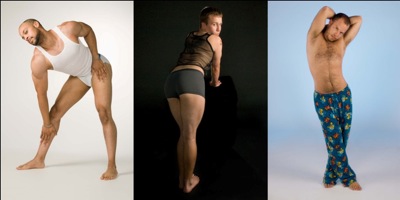
Man As Object, Karen Zack
Women typically have lower sexual desire and drive than men in our society, according to both sex surveys and statistics on sexual dysfunction. Our culture may be largely to blame. Consider this:
We are bombarded by “sexy women” but not “sexy men”
Whether on billboards, TV ads, Dancing With The Stars, Olympic ice skating, or professional football, women are half-dressed and men are fully-clothed. The camera hones in on women’s breasts and butts and ignores men. Sure, we are seeing more hot men these days thanks to Taylor Lautner and Ryan Gosling. But People’s “Sexiest Men” typically portrays gorgeous faces, loose T-shirts and few bods. Even the clothing that women and men walk around in show off women’s bodies and, more often, hide men’s
Share this:

Flaunting It: Damned if Do, Don’t
Dear girls,
Last night, as we sometimes do, our family sat around the dining table and looked through the summer’s social media photos.
We have teenage sons, and so naturally there are quite a few pictures of you lovely ladies to wade through. Wow – you sure took a bunch of selfies in your skimpy pj’s this summer!
I get it – you’re in your room, so you’re heading to bed, right? But then I can’t help but notice the red carpet pose, the extra-arched back, and the sultry pout. What’s up? None of these positions is one I naturally assume before sleep.
That post doesn’t reflect who you are at all! We think you are lovely and interesting, and usually very smart. But, we had to cringe and wonder what you were trying to do?
Girls, if you think you’ve made an on-line mistake (we all do), RUN to your accounts and take down the selfies that makes it too easy for friends to see you in only one dimension.
You are growing into a real beauty, inside and out.
Act like her, speak like her, post like her.

Those are a few lines lifted from a Given Breath blog post that went viral. To read the whole thing, unedited and intact, go here.
Kyoto Redbird responded, focusing less on the girls’ behavior than on our society’s messages. To see her full response, unedited and intact, go here.
Kyoto Redbird is a college-educated 20-something who finds navigating around a contradictory — and too often hostile — view of women difficult and frustrating.
Share this:

When Playboy Pushes Consent It’s Cool
 You’ve probably heard about Playboy’s new and revised Top 10 Party Commandments for the ultimate guide to a consensual good time.
Because without consent, “party times are under serious threat” by rape:
A good college party is all about everyone having a good time. Consent is all about everyone having a good time. Rape is only a good time if you’re a rapist. And f— those people.
You’ve probably also heard that these revised commandments are a hoax unleashed by college feminists.
Share this:

My Boyfriend, the Objectifier
![playboy-bunny-manual-main[1]](https://broadblogs.com/wp-content/uploads/2013/09/playboy-bunny-manual-main1.jpg) When I first heard feminists complain about sexual objectification I didn’t get it. Why didn’t they want women to be sexy?
When I first heard feminists complain about sexual objectification I didn’t get it. Why didn’t they want women to be sexy?
Turns out, I didn’t understand what objectification was.
Put simply, it is about seeing someone as nothing but an object – one that is sexual in nature – that exists for someone else’s pleasure. Objects don’t have feelings, thoughts or life goals, so you needn’t worry about hurting them.
So I finally got it intellectually. But I didn’t fully get how it played out until I met “Mike” (that’s what I’ll call him). And years later saw Mike’s way of seeing in a Ms. Magazine article discussing objectifying ads.
Share this:

A Law Against Girls Riding Bikes?
 Ten-year-old Wadjda yearned to ride a bike so that she could race a neighbor boy. But Saudi law forbade it.
The girl is actually a fictional character from the film, “Wadjda.” But she likely represents plenty of real Saudi girls. They may not yearn for bicycles, especially, but they may have other forbidden dreams.
Six months after “Wadjda” premiered, Saudi law declared bicycling legal for girls and women. But the continuing restrictions reveal why it was ever banned.
Share this:

Turning Indian Girls Into Boys
 Indian parents are paying to have their daughters turned into sons through sex-change operations that cost about 145,000 rupees ($3,200). Up to 300 girls have been surgically turned into boys in one city.
The procedure involves fashioning a penis from the little girls’ female organs. Afterwards they are injected with male hormones, which they will need to take throughout their lives. The procedure will leave these children impotent and infertile in adulthood. No sons or daughters for them.
The Madhya Pradesh government is investigating.
Share this:

Scrutinizing My Body Takes All My Time
On a typical day, you might see ads featuring a naked woman’s body tempting viewers to buy an electronic organizer, partially exposed women’s breasts being used to sell fishing line, and a woman’s rear—wearing only a thong—being used to pitch a new running shoe. Meanwhile, on every newsstand, impossibly slim (and digitally airbrushed) cover “girls” adorn a slew of magazines. With each image, you’re hit with a simple, subliminal message: Girls’ and women’s bodies are objects for others to visually consume.

So says Caroline Heldman, Assistant Professor of Politics at Occidental College, in a piece for Ms.
This notion of bodies for consumption leaves us constantly judging ourselves and others. How do we stack up? How do “they”?
Our friends declare someone too fat or too thin, sitcoms quip on body weight or shape, tabloids spot celebrities’ flaws, men bluster about big boobs, Howard Stern picks women apart while Rush Limbaugh insists feminism was established “to allow unattractive women easier access to the mainstream of society.” (Yes, really, Rush and Howard think they are in a position to make unkind remarks about other people’s appearance.)
All this leads women to “self-objectify” so that we see and judge ourselves through others’ eyes, and especially, the male gaze. Women live in “a state of double consciousness … a sense of always looking at oneself through the eyes of others,” says Heldman.
Share this:

Gender-Swapping Grammar Lessons
 A Chrome app called Jailbreak the Patriarchy switches gendered words and makes for an eye-opening experience.
This app has inspired me to go a little further to see how the world looks when gender changes. So I’ve spiced it up by changing gendered names, etc., too.
“I Kissed A Boy (And I Liked It)” (male singer, of course)
I kissed a boy and I liked it,
the taste of his cherry chapstick.
I kissed a boy just to try it,
I hope my girlfriend don’t mind it.
It felt so wrong,
it felt so right.
Don’t mean I’m in love tonight.
I kissed a boy and I liked it.
Or how about this headline:

 BroadBlogs