Category Archives: psychology
Making Violence Against Women Sexy
 What happens when you beat a sex object? Or hang her? Or rape her? Or hogtie and torture her?
Pop culture is filled with images of women as objects. It’s also filled with images of women as abused objects. But then, the two go hand in hand: Objects have no feelings to empathize with, no lives of their own to interrupt or worry about. They can exist just for sadistic pleasure.
Oddly, I’m not seeking to shame anyone who gets aroused by these images. People tend to unconsciously absorb their culture like a sponge – we all do. Even my women’s studies students and the feminist blogs I read register a taste for this stuff. No surprise that so many find it sexy, our society is so filled with these images.
At the same time, I’m not dismissing the issue. Whether you want to participate or fight it, at least have eyes open and look at the downside.
When I was a little girl I got a children’s book from the library. In one story a woman was punished: She was stripped, placed in a kettle-like contraption with spikes to poke her, and driven through the town in humiliation. That’s my first memory of sexualized abuse.
My second encounter was flipping TV stations as a child, and seeing a man throw a woman over his knee to spank her. Apparently, if I’d flipped through a magazine I could have seen an ad with the same image.

When I got older the Rolling Stones promoted their “Black and Blue” album with a picture of a woman bound and bruised.

At the movies women are killed – in sexy bras and panties – in popular horror flicks. In tamer fare, Scarlett started out resisting Rhett, but ended up enjoying a night of passion as “no” turned to “yes.” In the soaps, Luke raped Laura and they fell in love.

Devo’s “Whip It” showed a man whipping the clothes off a mannequin. The red hat from this video is now in the Smithsonian.
In magazines and billboards we are bombarded with ads depicting violence against women.

Romance novels and erotic tales tell stories of women who are abducted and raped and who fall in love with their captors. Mainstream movies like 9-1/2 Weeks and The Secretary depict women enjoying abuse at their lovers’ hands. Justine Timberlake slapped Janet Jackson around at the Super Bowl before ripping off her bodice. Megan Fox got beat up in a popular video that you can view over and over again. In the background Eminem mouths “I’m in flight high of a love drunk from the hate,” to which Rihanna replies, “I like the way it hurts.” And then there’s the porn world full of “no’s” turning to “yes.” Or “no” remaining “no,” but that’s sexy, too.
 On a feminist website, one woman described the joys of being a sex slave avatar to a dominant man in the virtual world of “Second Life.” Another explained the appeal with the help of a poor understanding of evolutionary psychology: Through evolution, she explained, women have come to want male domination in their relationships.
That’s not really what evolutionary psych says (and I have issues with that field, anyway). How would craving your own abuse be adaptive? Pain is meant to warn us to stop doing something. Women’s genes don’t crave poor treatment. If they did, we’d find eroticized violence in every culture, but we don’t. Egalitarian societies like those of the American Indian (before contact with patriarchy) did not sexualize abused women.
Here are two big problems with eroticizing male dominance and women’s pain: First, women and men can both come to crave the abuse of women in real life. Second, when we make male dominance seem sexy, we become more accepting of male dominance.
Originally posted on January 12, 2011 by BroadBlogs
Popular Posts on BroadBlogs
Anything Good About Being A Sex Object?
Frats Invite Sluts, Bitches; Women Accept Degradation. Why?
Orgasm: It’s All in the Mind
Share this:

Women Seeing Women as Sexier than Men
 Girls are so inundated with sexualized images of women that they learn to see women as sexier than men. Women come to see women through male eyes?
In the bedroom, this can make women’s sexuality a bit convoluted, which I’ll discuss later.
But consider my students:
“Women’s bodies are just naturally sexier than men’s,” my class tells me when I ask why women are portrayed as sex objects.
In this belief, my students are not alone.
A few years back Lisa Kudrow, of Friends fame, told Jay Leno that female nudity is displayed more in movies because, “Who wants to look at a guy?”
Hugh Hefner thinks women are natural sex objects, “If women weren’t sex objects, there wouldn’t be another generation.”
I’ve talked before about how the breast fetish is not natural, but is learned by both men and women. But how do we all learn that women are sexier than men in ways that go beyond the fetish?
Growing up, girls are bombarded with visions of women as sexy, with skin selectively hidden and revealed, the camera focused on those intriguingly concealed parts.
When I was little my mom took me to the Ice Capades. After noticing that the women were half dressed while the men were fully clothed, I asked why. Mom told me that women just have better legs.
Do they? One warm summer day an adult from my church youth group commented, “It’s too bad the guys have the best legs.” (Thanks!) But what is our cultural ideal? Longer, leaner. Young men typically have longer legs, and they don’t have the extra layer of fat that women do. So most young men’s legs come closer to our ideal. Yet we say women have better legs? When I think about it, I actually think men have pretty nice looking legs. But nothing and no one directs our attention to them.
On Dancing With The Stars, women are half-dressed and men are fully-clothed. During an advertisement, the camera lingers on women’s breasts and legs in a Victoria’s Secret display. Next, a commercial for shoes focuses on women’s behinds: See this Rebook ad for EasyTone. Try to imagine the same focus on men’s butts (which actually are pretty attractive)!
Watch a football game and see big, fully-dressed, aggressive guys playing on the field, while scantily clad cheerleaders show off their stuff from the sidelines. In the Bikini Open men sport golf wear while women dawn bikinis. When does Sports Illustrated most focus on women? In the swimsuit edition.
Through it all, the camera gazes at women’s body parts, but not men’s. Telling us what’s important to notice. What’s sexy and what’s not.
Men’s bodies are rarely sexualized outside infrequent underwear ads.
Historically, men have had control of media, and they’ve portrayed what they see as sexy.
Bombarded with these images, girls come to see women as sexier than men. As I’ve said before, when I tell my class that I find a Playboy pinup sexier than a Playgirl pinup, women’s heads nod in agreement.
Meanwhile, when women answer surveys about what they find sexy they say “men.” But when they are wired up, blood flow to the vagina is stronger when viewing an image of a nude woman than a nude man – conscious responses and bodily responses not agreeing.
Oddly, and yet logically, women come to see women through male eyes.
So women come to see themselves as the sexy half of the species. Being sexy has some advantages. It can just be fun, it’s easier to attract mates (consider the success of women versus men in singles bars), and sexiness is a source of power.
But there’s a downside, too, including the narrow construct that leaves so many women feeling they exist outside the “sexy” box, with a drop in self esteem kicking in.
Taken to extreme, some women can become sex objects, taking an unhealthy one-dimensional focus on themselves, feeling that how they look is all that matters. And some men may see them as objects whose sole purpose is to be used for their pleasure.
It ain’t so great to be, or be seen, as mere object.
Popular Posts on BroadBlogs
Sex Objects Who Don’t Enjoy Sex
Men Have Higher Sex Drive. Why?
Women Learn the Breast Fetish, Too
Originally posted on January 10, 2011by BroadBlogs
Share this:

I Didn’t Want To Be Pretty
By Victoria King
Man clothes, dark, heavy makeup, scarcely a trace of femininity: that was me in high school. I hated the notion that girls had to be pretty and were valued only for their looks. I wanted people to appreciate me for being fun, funny and a good debater.
I felt like women made themselves out to be pretty idiots because they were naturally shallow and stupid.
And envious. I hated the competition between females, so I looked as weird as possible hoping no one would see me as a threat.
Men don’t see attractive males as threats. They’re high-fived for getting women – the more the better. I wanted sisterhood, but was really more interested in having “brotherhood.”
It was a strange place to be, looking down on females as a female, and not wanting people to care whether I was pretty or not.
Yet part of me wanted very badly to be pretty. I believed I was hideous.
Despite a wholehearted attempt to free myself from incessant judgments on my appearance, I developed severe issues with self-image and self-esteem.
I saw myself being sidelined because of how I looked. I began to resent working that much harder to keep myself relevant and earn respect when other girls just stood there looking pretty. I felt trapped by society, my body and my inability to change myself or anything around me.
And so I fell into disordered eating in a desperate attempt to gain control over something. It didn’t work.
I began searching for answers. I wanted to know why women’s beauty seemed to be the only thing that mattered. I wanted to know why deep pain is associated with the beauty that is supposed to be a blessing.
The film, America the Beautiful offered a clue. The film tells how businesses make money when women feel dissatisfied with the way they look. If women weren’t satisfied, they wouldn’t spend money to make themselves “better.” I saw how we are manipulated.
As I studied more I began to see what it means to live in a patriarchy. It had never occurred to me that denigrating women’s appearance and capabilities could be a reaction to women’s gain of rights and power. If women have equal rights, you can still defeat their souls by draining their self-worth as they strive to live up to impossible standards.
The revelation was freeing. I didn’t have to accept impossible standards. I even stopped seeing anorexic models as attractive.
Now I feel that “pretty” is neither something to be obsessed over nor obsessively avoided. And I don’t think “attractive” comes in only one form. And that is freeing.
Popular Posts on BroadBlogs
Am I Ugly? Girls Ask YouTube
Keep Your Boobs, Get Better Guys
I Can’t Believe I Ate A Whole Head Of Lettuce!
Share this:

Women Make Men Dumber?
 “Talking to an attractive woman really can make a man lose his mind,” says The Telegraph. “Men get dumber just thinking women are nearby,” adds The Globe & Mail. And the more attractive she is, the dumber he gets.
Actually men may make women dumber, too. I’ll get to that in a moment.
Dutch researchers asked 71 straight male and female college students to perform a series of cognitive tests. Some were told they would be monitored by an unseen person. Others interacted with real live people.
When women were involved, seen or not, men’s performance dropped. But the presence of men had no effect on women’s functioning.
Why the difference? Lead researcher, Sanne Nauts, speculates that the men were preoccupied with how to impress the women – or how to make a good impression should they meet. And that distracted them from the task at hand.
While the researchers turned to evolutionary psychology to suggest that men get distracted because they pursue, while women wait and choose, I might note that while men are biologically more oriented toward pursuing sex (they have more testosterone, twice as much of their brain is devoted to sex, and their brain more quickly activates to pursue sex), in our culture men are also expected to take the lead. All this leaves them more distracted when given an opportunity to make that first move.
Interestingly, the study arose after one of the researchers was so struck by an attractive woman that he couldn’t remember his address when she asked where he lived. Apparently he was trying too hard to make a good impression.
But men may make women dumber, too. Once a woman is alerted to the fact that an attractive man might be interested in her, a woman may become flustered, distracted by the work of trying to look good.
Most people get distracted when they’re trying to look good. And that, unfortunately, can make us flub up. Sad but true: wanting to make a good impression can leave us looking like dimwits.
Popular Posts on BroadBlogs
Women Want Casual Sex? Yes and No
Women Want Good Sex, Men Want Cuddling
Sex Drive: How Men and Women Match Up
Share this:

Are Blondes as Picky as the Men Who Prefer Them?
 I’m still regarded a libidinous lad by a lot of (especially buxom blonde) ladies, so this muscular, boyishly handsome 5’8 black 58-year-old ALMOST ALWAYS ogles well-endowed women because I’m proud to be considered an aging lad!!!! How ’bout it, girls?
That’s one of the more colorful comments I’ve received (slightly edited to include all the vital stats he’s provided over time).
“Lusty” (part of his moniker) has voiced his buxom blonde penchant on numerous occasions, so I asked:
“Do you think Buxom Blondes are as picky as you?”
“Well, maybe,” he responded. “But as long as I can remember, I’ve been captivated by bosomy women — white, black, Latina, etc. — but buxom blondes are my faves.”
Little wonder, since they are regularly presented as the most prized by our society — though the preference has been moving toward “racially ambiguous” (meaning you can’t tell what race the woman is). Still, most starlets today embody Lusty’s preference.
Sooo many men desire buxom blondes and think they’re “the best.” But if BB’s are similarly restricted in their preferences (and why not, when they’ve got so much to choose from) then few men would seem to stand a chance. It just doesn’t seem to occur to a lot of men that snobbery can run both ways, leaving them out of the running, too.
I suspect that narrow notions of beauty benefit few (mostly corporations that sell products by making people feel bad about themselves).
But when only some are esteemed, everyone else ends up feeling deprived and frustrated. Women, because they don’t fit the narrow notions, and men, because they can’t have the limited number of women who do.
Meanwhile fabulous people, who may be a much better match, and who could please us more, end up out in the cold.
And that leaves too many lonely and lacking deep satisfaction.
Instead of running about like lemmings, led around by society’s dictates, why not find beauty in the varieties of women and men around us? And in the men and women we are actually with?
Popular Posts on BroadBlogs
Men Are Naturally Attracted To Unnatural Women
Self-Esteem Falls with Rise in Power? Blame Beauty Ideals|
Does Sexual Objectification Lead to Bad Sex?
Share this:

Prejudiced People Are Stupid
Prejudiced people are stupid. That’s not me pre-judging. That’s science.
An article published in the Journal of Psychological Science, and reported in Live Science says children who have low IQs tend to become prejudiced adults who are drawn to socially conservative beliefs that – in turn – encourage prejudice, adherence to hierarchy and authority, and promote resistance to change.
The researchers suggest that low intelligence makes it difficult to grasp the complexity of the world, which could explain the appeal of oversimplifications like, “Poor people are lazy.”
But you also have to wonder if the appeal of prejudice comes partly from a desire to feel like you are better (and smarter?) than someone.
John Dean wrote a book (which he had begun writing with Barry Goldwater just before Goldwater died) called Conservatives Without Conscience. These two conservatives presented a list of characteristics that are common among right-wing authoritarian “followers” (as opposed to “leaders”). The traits seem to fall into two categories: those that would appeal to the less intelligent and those that are just mean. Right-wing authoritarian “leader” traits fell almost entirely into the “mean” category.
Examples of beliefs and behaviors that fit well with not thinking too hard include: conventional, submissive to authority, highly religious (follow God’s authority), prejudiced, narrow-minded, inconsistent and contradictory (“Get your government hands off my Medicare!”) and having little self-awareness.
The “mean” list includes these traits: prejudiced, aggressive on behalf of authority, dogmatic, mean-spirited, intolerant, bullying, and highly self-righteous. All suggest a desire to feel bigger and stronger than someone else — as in overcompensating for insecurities?
Ahhh, that was fun for a liberal like me who gets so annoyed by both right-wingers and prejudiced people.
But there is a crimp in the analysis. First, the researchers recognize, not all liberals are brilliant, nor are all conservatives dense. We’re talking averages here. Certainly there are smart conservatives, including John Dean and Barry Goldwater. Also, the less intelligent are drawn to social and not fiscal conservatism.
And of course, extremists on the left and the right may both be simplistic. As the authors admit:
A study of left-wing liberals with stereotypically naïve views like “every kid is a genius in his or her own way,” might find that people who hold these attitudes are also less bright. In other words, it might not be a particular ideology that is linked to stupidity, but extremist, over-simplified views in general.
The main advantage of this research is finding clues to decreasing fear and hatred. For instance, many anti-prejudice programs ask people to see things from others’ perspectives, but that might be too hard for those with low IQ. And since prejudice is more emotionally than intellectually rooted, it’s probably better to change feelings instead of thoughts.
Who knows, perhaps the fear of appearing dimwitted will itself advance the cause against fear and hatred.
Popular Posts on BroadBlogs
Think You’re Not Racist?
Mind of a Rapist: Trying to Bridge a Gap between a Small Self and a Big Man
Do Kids Bully from Low Self-Esteem? Or Because they’re Popular? No and No
Share this:

What Gossip Magazines & Abusers Have In Common
By Linda Bakke
Star Magazine promotes violence against women.
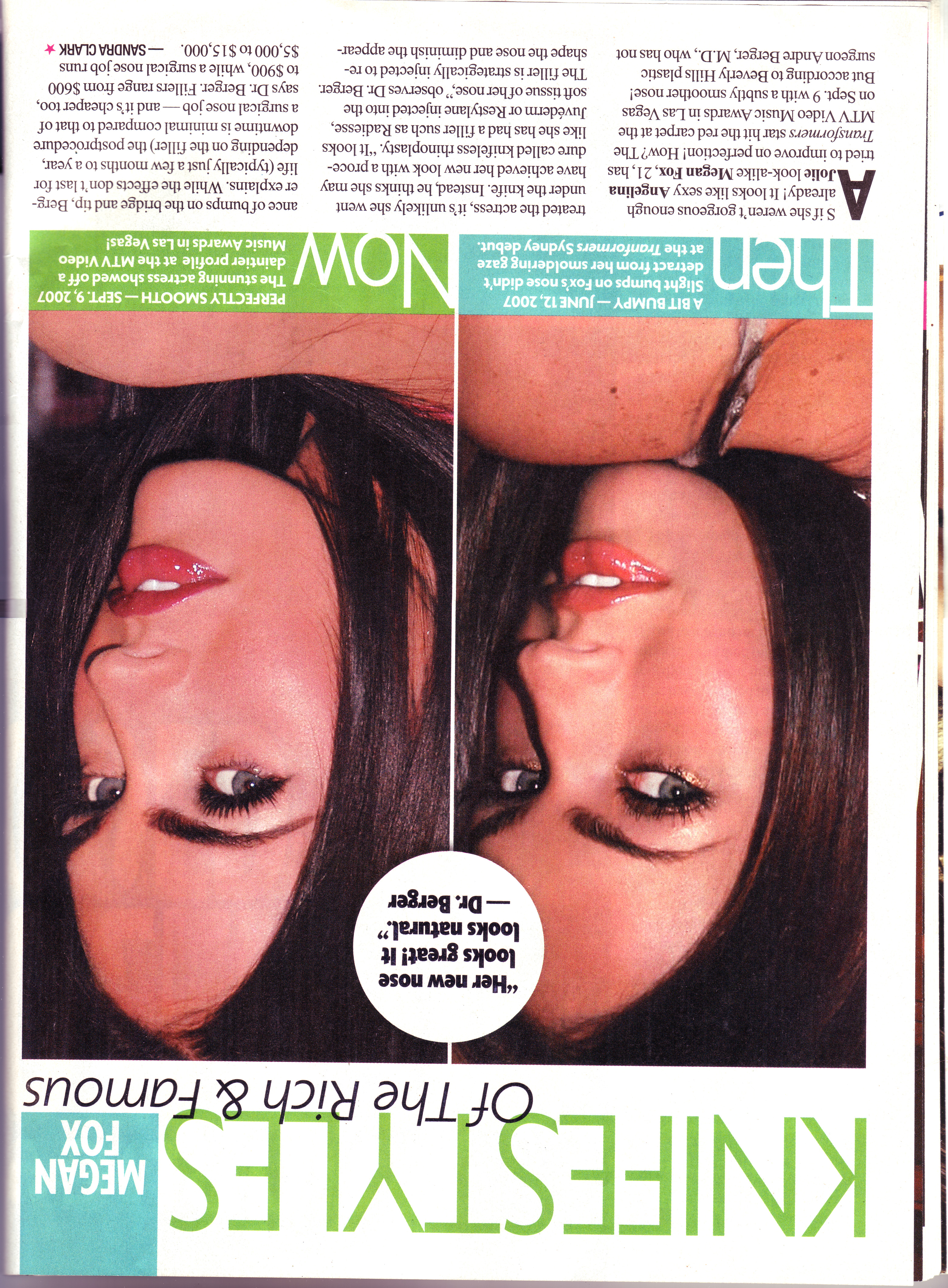 Ok, that sounds like a tabloid headline, but the more I look over Star Magazine, the more I’ve been struck by a sense of violence directed at women.
The starlets are constantly attacked for any extra weight, cellulite, bunions, ugly fingers or thick arms. It feels like open season. “Kill the Celebrity” is the name of the game.
One section called “Knifestyles” advocates mutilating women through plastic surgery. With the accompanying message, “You’re not good enough.”
In fact, Star uses the same devices that characterize domestic abusers: watching the victim’s every move, humiliation, stressing the negative rather than the positive aspects of the victim (who is supposedly adored), using “it’s her fault” to launch an attack, and transferring the abuser’s dissatisfaction with life and himself onto the victim.
After a while, she starts to blame herself.
Paparazzi hunt celebrities down and we all become cannibals of the spoils, savoring the flaws of “perfect” idols as we bring them down a peg.
But it’s not just about starlets. It’s not just their bodies that are under attack. Yours and mine are, too. If they don’t look good, we don’t either.
The depiction of women in gossip magazines represents the degradation, abuse and mutilation of women. We must recognize how damaging these portrayals are for all of us, women, girls, men and boys.
For we are all encouraged to scrutinize and vilify women for being less than perfect.
Popular Posts on BroadBlogs
Men Watch Porn, Women Read Romance. Why?
What Happens When You Beat A Sex Object?
Beautiful Women’s Hips Are Thinner Than Their Heads?
Share this:

Wanting “X” from Sex, but Doing “Y”
 Most people say they want pleasure and closeness from sex. But they don’t act like it.
Instead, they’re preoccupied with how they look, what their partner is thinking, how they’re performing, and what is “normal”
That’s what Dr. Marty Klein, a Certified Sex Therapist and sociologist, says in his book, “Sexual Intelligence: What We Really Want From Sex and How to Get It.”
Perhaps because of fashion magazines, or porn, or because we see “good sex” as the sex of our 20s, we conclude that great sex is looking like 20-year-old “perfectly” built porn stars, and doing what 20-year-old “perfectly” built porn stars do.
And that leaves most women feeling insecure about their bodies (since most women are insecure about their bodies): “Am I too fat? Are my breasts too small, too lopsided, too droopy? Do I have cellulite?” instead of having close, pleasurable sex.
Which naturally leads to: “Is my partner thinking I’m too big, too small…? Is he thinking about someone else?” Again, worries — not good sex.
Most men don’t yet expect to look like Ryan Reynolds. But they may worry about penis size. And they may notice that neither they nor their partners look like porn stars. Or, they may worry about performance or wish their bodies would do what they did years ago. And wish their ladies would act like porn stars. Or they may imagine porn stars instead of really being with their ladies. Distractions. Not good sex.
Too often, new positions or techniques are prescribed to perk things up. But Klein says the key is mind, not matter. Who can have great sex with all the distractions? You’ve got to clear out the baggage first.
A bit of advice:
First, embrace your body as it is – how it looks, what it can do. That frees you up to be present. As Klein points out, “You’d be foolish to craft a definition of sexy or manly or womanly that excludes you” (or your partner). He adds:
It is possible to detach how you look from how you feel and see that sexiness is not a product of what your body looks like from the outside, that sexiness is a product of how you feel on the inside… From there it’s a question of a person tuning into what do I have to offer somebody else sexually, and what do I have to offer myself sexually?
And let go of worries about what’s ‘normal,’ he says, because that takes us out of authenticity. Move “from ‘sex has to validate me’ to ‘I validate my sexuality.’”
The focus, according to Klein, should be on creating lasting physical and emotional connection with your partner. Don’t overburden genitalia with too much responsibility for making sex enjoyable. Media portray orgasm as the most important thing, he says, “But focusing on those few seconds misses most of what sex offers.” Instead, feeling good with your partner is the big payoff.
Popular Posts on BroadBlogs
Does Sexual Objectification Lead to Bad Sex?
Being Sexual vs Looking Sexual
Cartoonish vs Authentic Sexuality
Share this:

Should We Ban “Slut” and “Ho”?
by Janell Hobson @ Ms. Magazine
I must commend Sandra Fluke, like so many others have already done, for rightly condemning “shock jock” Rush Limbaugh’s efforts in silencing women who dare to speak publicly about sexual politics by calling them “sluts.” The furor over Limbaugh’s slut-shaming tactics, however, seems to underlie a different anxiety that is more than just outrage over such blatant misogyny.
Rush Limbaugh is a bigot, a misogynist and a homophobe. His recent “slut” comments are right up there with his usual hate speech, and I distinctly remember him uttering the word “ho” to describe the black woman accuser behind the infamous Duke lacrosse case before that same case got dismissed.
What had impressed me back then was when I heard a white woman who called into his radio show and, without knowing much about the case or how it would unravel a year later, lambasted Limbaugh for using such an epithet to describe a woman. It was clear that Limbaugh was genuinely stunned that a white “conservative” woman didn’t rely on racial divides, or class and political “respectability” rules, to distinguish herself from a black sex worker. She understood that the “ho” label applied to all women, even if it was used to only apply to black women, and she did not let Limbaugh get away with it.
I also distinctly remember Don Imus’s “nappyheaded ho” comment and the furor over that, thus proving that while many are outraged over “slut” we’ve also been inundated with “ho” language–from radio shock jocks recently undermining Whitney Houston’s legacy with the dismissive “crack ho” label to popular presidential campaign posters back in 2008 championing Obama over Hillary Clinton with the slogan “Bros Before Hos.”
In many ways, the public furor over Limbaugh’s slut-shaming of Fluke demonstrates that, once again, women will not let him get away with it. But it bothers me that so many of our responses–from #boycottrushlimbaugh Twitter trends to President Obama calling Fluke to show his support–are based on the premise that to be called a “slut” is inherently to be shamed. It bothers me that, despite all the efforts of the sexual revolution and women’s liberation–which have enabled women to avoid the stigma of having sex outside of marriage, having children outside of marriage or having sex beyond the confines of heterosexuality–that some hate-monger can just say, “You’re a slut” and a public meltdown ensues.
This suggests that women’s sexual egos are still fragile, but in a woman-hating society this should come as no surprise. In a sexually evolved world in which a woman proudly proclaims her enjoyment of sex, of kink, of polyamory, or even basic monogamy, the sex-positive woman should be able to respond to the “you’re a slut” woman-hater a number of ways:
- The flippant response: “How quaint of you. That’s so 50 years ago!”
- The defiant response: “Power to sluts and sex goddesses everywhere! Woo hoo!”
- The vulgar response: “Eat me!”
However, we do not live in a sexually evolved society, so to deliver any of these responses is to hint that you’re not quite the respectable lady so many of us work so hard at being. To do so is to invite suggestions that we just might be the “slut” those guys over there say we are, and that fear of sexual labels keeps us in line, or puts us on the defensive, with the retort “I’m not a slut!”
That Limbaugh–an admitted drug addict, bigot and proud chauvinist–responded to the furor not by apologizing (which would be like a Ku Klux Klan member apologizing for being racist) but by digging in his heels and suggesting that Fluke and other women who want contraceptives covered by health insurance should subject themselves to online porn, only proves that men like him are shameless in what they’re doing. But of course they can be: No matter what sexual misconduct men engage in–whether they are busted in prostitution rings or in child molestation cases–they never get slut-shamed.
Middle-aged Catholic priests and football coaches have institutions that cover up their bad behavior, but under-aged girls such as Amber Cole can be videotaped in sex acts and become YouTube sensations and Twitter trends, slut-shamed by the general public–as if any of the shamers have a moral leg to stand on while trafficking in child pornography.
This is the climate in which we live, where male privilege runs rampant and women are still on the defensive. And where “slut” will maintain its power over us as long as rape and other forms of sexual violence go unpunished, as long as our reproductive rights are undermined and as long as our reproductive health options are limited (the very issue that forced Fluke to speak out in the first place). Moreover, “ho” will maintain its power as long as we insist on racial and class hierarchies among women.
Isn’t Limbaugh’s slut-shaming based on the same sentiment that provoked a Toronto police officer last year to tell women not to “dress like sluts” to avoid being raped, thus igniting the worldwide SlutWalk protests in response? And isn’t the ensuing debate among feminists over this activist strategy indicative of our fear of the word “slut”?
As I suggested in a previous post, the SlutWalk has provided an ample opportunity for women to confront words like “slut” and “ho” head on and divest them of their power. If we really think these words can’t be reclaimed, and rappers like Nicki Minaj are wasting their time, then perhaps it’s time we get down to business and ban “slut” and “ho” from our lexicon, the way the N-word is now taboo.
Of course that won’t change the hate in the hearts of some, but we can mobilize that hate toward a counter-narrative for a new political movement.
This piece originally appeared in the Ms. Magazine Blog and is reposted with permission.
Popular Posts on BroadBlogs
“Whore”: The W-word?
“Cock” vs “Down There”
Women Want Casual Sex? Yes and No
Share this:

Scrutinizing My Body Takes All My Time
On a typical day, you might see ads featuring a naked woman’s body tempting viewers to buy an electronic organizer, partially exposed women’s breasts being used to sell fishing line, and a woman’s rear—wearing only a thong—being used to pitch a new running shoe. Meanwhile, on every newsstand, impossibly slim (and digitally airbrushed) cover “girls” adorn a slew of magazines. With each image, you’re hit with a simple, subliminal message: Girls’ and women’s bodies are objects for others to visually consume.
So says Caroline Heldman, Assistant Professor of Politics at Occidental College, in a piece for Ms.
This notion of bodies for consumption leaves us constantly judging ourselves and others. How do we stack up? How do “they”?
Our friends declare someone too fat or too thin; sitcoms quip on body weight or shape; tabloids spot celebrities’ flaws; men bluster about big boobs; Howard Stern picks women apart and Rush Limbaugh insists feminism was established “to allow unattractive women easier access to the mainstream of society.” (Yes, really, Rush and Howard think they are in a position to make unkind remarks about other people’s appearance.)
All this leads women to “self-objectify” so that we see and judge ourselves through others’ eyes, and especially, the male gaze. Women live in “a state of double consciousness … a sense of always looking at oneself through the eyes of others,” says Heldman.
Self-objectifiers constantly “body monitor” – that is, think about how they look to the outside world. And this often leads to depression, lower self-esteem and diminished faith in their abilities.
Any surprise body monitoring distracts women from tasks at hand, whether math exams or throwing a softball? After all, girls have to split their attention between how they look and what they want their bodies to do.
Body monitoring also replaces the question “Who am I?” with “What image should I project?” It becomes difficult to imagine identities that are truly our own.
What to do? Heldman recommends avoiding fashion magazines, since just viewing those so-called “perfect” images makes women feel less attractive.
She also suggests we voice our concerns to companies and boycott their products.
Too often self-worth is based on unattainable body ideals. And with body image so closely tied to self-esteem, girls and women can end up pretty dissatisfied with themselves.
It wasn’t always so. There has been a dramatic increase in poor body image among women since the mid-20th century. Back then, a woman’s sense of self had revolved more around her talents, abilities and contributions. It was more about who she was than what she looked like. Maybe by shifting focus to who we really are we could more easily emerge out of ridiculous and superficial body consciousness.
Popular Posts on BroadBlogs
Lose Virginity, Lose Self-Esteem?
Harry Potter’s Hermione: Less Brainy, Brave. More Sexy
My Son Likes Girl-Things. Is He Gay?

 BroadBlogs