Blog Archives
Grade School Lingerie
When I was ten years old plenty of my friends would wear “big girl lingerie” that they got from Abercrombie and the like. I felt pressured to constantly push to be sexier, or more desirable. At ten years old, who exactly am I trying to attract?
This comment (paraphrased) came in reaction to a piece I recently wrote called, “Cartoonish vs Authentic Sexuality.”
I found the remark a bit starling. At age ten I did not feel any pressure to be sexy. I was a kid! None of my little-girl friends seemed to have such notions, either.
Wondering who she was trying to attract, the young woman added, “I don’t think any of us really knew the answer to that, but it felt necessary all the same.” And then she asked what lay behind the focus on sexualizing young girls.
My first thoughts are that companies like Abercrombie are trying to get young kids to like their brand by appealing to the desire to feel “grown up.” Not to mention all the free
publicity they get from controversies surrounding their products.
But I’ve also noticed a broad trend toward sexualizing both girls and women that goes beyond what I had experienced at the age of ten, or even twenty.
In fact, not long ago I was flipping through TV channels looking for movies when I saw the 1988 film Crossing Delancy with Amy Irving (Steven Speilberg’s ex) and the 1986 film About Last Night with Demi Moore and Rob Lowe. And then I noticed that in these films – and several other romantic comedies of that period – the women were not dressed sexually. No body-hugging clothing. No revealing décolletage.
Why the change?
Naomi Wolf’s The Beauty Myth might help us out. Wolf points out that as women
have gained power they have also become more sexualized. She says it’s no accident.
Think about it. As women take on sex object status, they become objects. Objects aren’t quite human, leaving them at a lower rung on the ladder than men. Meanwhile, the ideal of huge breasts and skinny waists is near impossible to achieve, leading to poor self-esteem and an awful lot of time spent trying to fulfill this “requirement.” And if you’re busy focused on your looks, you’ll take your attention off more substantive things.
In sum: As women become more sexualized, even as they gain power they lose status by becoming objects. Even as women gain power, narrow notions of beauty leave them feeling worse about themselves as body image suffers. As women put tremendous time and energy into their looks, they have little time or energy left to become more empowered.
I personally feel that sexy is fine (and beyond the cartoonish narrow notions, please!), but that “sex object” isn’t. Sexy can be one part of a well-rounded woman’s life, while “sex object” sees women as being only about sex.
Women should not be seen as only sexy. Sexy should not be the primary source of self-worth. Sexy should not be the most important thing in the world.
And children should not be trained to see themselves as objects.
Georgia Platts
Popular Posts on BroadBlogs
Cartoonish vs Authentic Sexuality
Spoon Fed Barbie
Women Seeing Women as Sexier than Men
Share this:

Black Isn’t Beautiful Claims Evolutionary Psychologist
 Somalian-born supermodel, Iman
Evolutionary psychologist, Satoshi Kanazawa, claims Black women are less attractive than others. It’s apparently such good science that Psychology Today posted his piece on their website. Maybe not. They quickly took it down and recently apologized.
Hmmmm. Thinking about Black women, there’s
Somalian-born supermodel, Iman or Sudan-born supermodel, Alek Wek. And then
there’s Halle Berry, Naomi Campbell, Tyra Banks, Thandie Newton, Beyonce, Janet
Jackson, Lisa Bonet, Jada Pinket Smith… Beautiful Melia Obama fits right in
with these folks.

Lupita Nyong’o
A few years back FX had a reality show called “Black. White.” in which a White family’s coloring and features were changed to Black, while a Black family’s coloring and features were changed to White. I thought the White girl looked great Black.
 Black. White.
Really, we need to take evolutionary psychology with a grain of salt. Some research from this field may have some basis. But much carries cultural bias. Indeed, as Tami Winfrey Harris over at Ms. points out, others have demonstrated Kanazawa’s bad methodology and his taste for fashioning racism, sexism and conservatism as science. As much of evolutionary psychology is prone to do, I might add.
 Supermodel, Alek Wek
That said, as Harris eloquently observers:
All women bear the burden of the European beauty standard and the fact that, as women, our value as human beings is too often defined by how closely we fit the
standard—how close we are to being white, blond, blue-eyed, thin, with long, straight hair, and a keen nose and lips. Narrow standards of beauty are oppressive to all but a few, but it is Black women as a whole who are held up as the opposite of the ideal.
 Ethiopian woman
On Harris’ point, people do tend to prefer the features and fashions of powerful groups, but the bias is about power, not innate beauty. Just a couple examples:
When prosperous and influential Chinese families bound the feet of their daughters to signal wealth (what woman could work with bound, dysfunctional feet?) small feet came to be seen as beautiful. Unfortunately, poor Chinese soon imitated the fashion in pursuit of this excruciating “beauty.”
Or, when tanned skin indicated outdoor, poorly-paid, physical labor, Americans avoided the sun. But when Coco Chanel came back deeply tanned after vacationing in St. Tropez, her sun-kissed skin – now linked to wealth and privilege – appeared beautiful.
 Sudanese woman
Blacks do have less power than other ethnic groups due to intense prejudice which was created to support their enslavement and the discrimination that followed. (It’s easier to feel okay about enslaving someone if they’re not quite seen as people.) Due to a history of educational and occupational discrimination, it has been more difficult for the Black community to gain and pass on wealth.
And yet, looking at all the women on this page all I can say is black is truly beautiful.
Lupita Nyong’o on Black as Beautiful here.
More beautiful black women here:
Related Posts on BroadBlogs
(racism)
How Does Racism Hurt Racists? The Case of Emmett Till
“Why I Left the KKK”: One Man’s Revelation
(Evolutionary Psych)
Women Want Casual Sex? Yes and No
Are Women Naturally Monogamous?
Share this:

Surprises in Indiana University Sex Survey
 Researchers at Indiana University have completed the most comprehensive sex survey since 1994. It yielded some surprising results:
- Young women were more likely than young men to report having had sex in the last year
- Young women are increasingly likely to report masturbating
- 85% of men report that their partner had an orgasm the last time they had sex; but only 64% of women said they had reached orgasm. Hmmmmm
- Men were more likely to reach orgasm if they were in a relationship than with a casual sex partner
Share this:

Baby Named “Storm.” Sex Unknown
Kathy Witterick and David Stocker of Toronto have chosen not to announce their new baby’s sex, at least for now, as “a tribute to freedom and choice in place of limitation.” The parents would like to give the baby, named Storm, the freedom to choose or discover who she or he wants to be.

Other than their two sons, a close friend, and the two midwives who helped deliver the baby, no one knows the sex.
Because kids are bombarded by so many messages from society, the Witterick-Stocker’s are hoping to knock off a couple million of them, at least for a while.
If they want to treat their baby gender-neutral, Kathy and David will need to keep guard, themselves, because gender creation begins even before birth.
Typically, parents begin to develop ideas about what their child will grow up to be like as soon as ultrasound reveals the sex. Once they hear, “It’s a boy” dad gets visions of playing ball and coaching his son in little league. Or mom imagines playing dollies with her daughter or dreams of her future wedding gown.
Once they’re born, parents perceive boys as being strong and alert, while little girls seem delicate and pretty.
Parents treat sons rougher. Dad grabs Teddy Bear and threatens, “Teddy’s going to get you!” But tucking his daughter in at night, he’ll bring Teddy in for comfort and good dreams.
I’ve found myself mimicking these gender notions. When I was learning about all this in grad school, I agreed to babysit my two-year-old nephew. I’d roar at him. And for some reason I thought it might be fun to take a beach ball (it was very light!) and bang him on the head with it (but just once!). As soon as I did, I realized I would never do that to my little niece. She would be too delicate.
Parents even talk to their daughters more, and use a wider variety of emotion words. They use more questions, numbers, and action verbs with sons.
Girls are kept closer, and helped more. Boys are given more latitude and expected to help themselves, with just a little aid from mom and dad.
Meanwhile boys’ toys, like blocks, develop spatial skills while footballs and baseballs build muscles and a sense of competition. Girls’ dolls encourage nurture while tea parties hone social skills. Barbie teaches girls all about beauty, fashion, and the importance of dating Ken.
As kids watch cartoons they learn that boys are more active and aggressive, and are more likely the main character. There are a few exceptions, like Powerpuff Girls. Sailor Moon is another girl character who is active, fighting crime. Yet she’s an oddly sexy fourteen-year-old.
Hard to know whether the parents, brothers and friend’s knowledge of Storm’s sex might have some effect. And unfortunately, parents are rarely aware of how much they do treat their children in gender specific ways.
If little Storm gets any whiff of his/her sex, s/he’s likely to be highly influenced by the outside world: TV, billboards, other kids…
A lot of people are upset by all this. Maybe you are, too. But I’d like to know what’s wrong with trying to keep limitations away from a child so that s/he can become who s/he is with fewer restrictions.
Related Posts on BroadBlogs
It’s Ok To Be A Tomboy But Not A Sissy. Why?
My Son Likes Girl-Things. Is He Gay?
Frats Invite Sluts, Bitches; Women Accept Degradation. Why?
Share this:

Anything Good About Being A Sex Object?
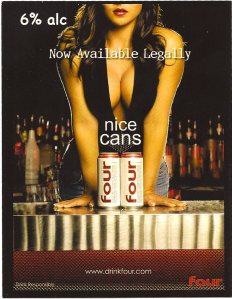 When I ask my students if they can think of anything good about being a sex object they think there must be something positive, since so many women put a lot of effort into being sexy, with some aspiring to “sex symbolness.” Here’s what they say:
- Sexy women get attention. They feel attractive and admired, so it’s a source of self-esteem.
- It’s nice to feel wanted and desired. It’s easier to attract mates or just get sex.
- It can be fun to feel sexy.
- Sex is a historic source of power for women. Sexiness can gain women resources, whether through marriage or getting men to do favors. It puts women in control over men.
Then I ask if there’s a downside. More comments:
- It can be uncomfortable being gawked at. You can feel like you’re only a sex object – and that’s all, like you’re not worth a lot.
- You can feel disrespected. Guys just want one thing. You get used.
- When women are seen as all about sex, and they don’t want to put out, they’re seen as bitches.
- You aren’t seen as intelligent. You aren’t taken seriously.
- Your personality disappears.
- It can feel inauthentic, feeling pressured from friends or society to look sexy.
- Sexual objectification leads to sex trafficking. Treating young women and girls like they are nothing but objects that exist to pleasure men. They have no lives. They’re all about sex and nothing else. And they’re not given an opportunity to be anything else.
But there are problems when you don’t meet sex-object standards, too:
- You feel like you’re constantly being judged, and not coming out well.
- You may starve. Or get implants and die (that does happen). You have false hope, and when you don’t meet the standard you lose self-esteem.
So much contradiction. Is there any way to get some of the positive upside without all the downside? I’ll admit to feeling the world would be a bit dull without any spice of sexiness.
How about distinguishing between sexy and sex object. And broadening our notion of what “sexy” means?
Objects are treated as little more than a means to others’ pleasure. They are not people with lives, goals, thoughts or emotions. It’s one-dimensional. A limited box. And who cares how you treat an object?
So if a woman does have – and is seen as having – a life, goals, emotions and intelligence, and sexiness is one part of all that, then she can be a full person – who is also sexy.
But still, can we move outside the narrow notions? Who’s sexy to me? Women and men who are classy, smart, talented, confident, and who make a difference in the world.
I nominate:
Nancy Pelosi, Thandie Newton, French politician Marie-Ségolène Royal, Helen Mirren, Angelina Jolie, Jackie O, Jennifer Lopez, Toni Morrison, Queen Rania of Jordan, Barbara Walters, Sandra Bullock, Zhang Ziyi, America Ferrera, Diane Sawyer, Jennifer Aniston, Queen Latifah, Gloria Steinem, Julia Roberts, and Maria Shriver.
And men? My list includes:
Ezra Klein, Benico del Torro, Ed Harris, New York Times columnist, Princeton professor and Nobel Laureate Paul Krugman, CNN anchor T.J. Holmes, Tom Brokaw, Brad Pitt, Barack Obama, Stephen Colbert, Gabriel Byrne, Japan’s former Prime Minister Koizumi Junichiro, JFK Jr., Antonio Banderas, Sidney Poitier, Javier Bardem, and White House corresspondent, Jake Tapper.
Yeah, sexiness can be fun and alluring, when moving outside narrow limits. But sex objects are just trapped.
Popular Posts on BroadBlogs
Men Are Naturally Attracted To Unnatural Women
The Constricting Bodice: Empowerment and Imprisonment?
What Happens When You Beat A Sex Object?
Share this:

I Can’t Believe I Ate A Whole Head Of Lettuce!
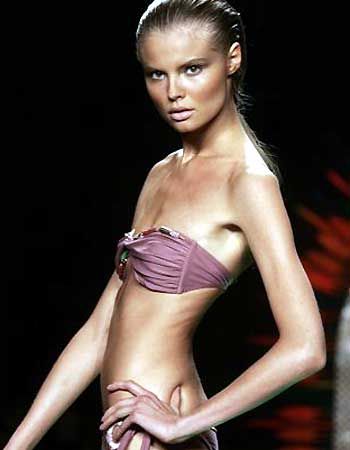 Once upon a time I wanted to look like a cover girl, despite whatever feminist consciousness I may have had.
It had not occurred to me that that wasn’t a possibility. It’s what my culture said I was supposed to look like. What I needed to look like to be truly valued.
Full of contradictions, I began my supermodel project. But in a healthy sort of way, I told myself. Wasn’t going to starve. No anorexia or bulimia for me.
I later came to see that I did end up with an eating disorder.
I became obsessed with food. How much had I eaten that day? Constantly counting calories. My worth depended upon how well I had eaten.
At times I swung between overeating and starving. Very little starving – I wasn’t good at it.
I next developed an exercise obsession. You can’t get too much exercise, right? After developing a knee injury from jogging, I tried Nordic Track. Another knee injury. Next, I began walking three miles a day at a brisk pace. Yet another knee injury. Apparently, you can rub your cartilage too much from over-exercise and lack of rest. My physical therapist told me to start biking instead – and don’t overdo it! No more than four days a week, and no hills.
After all the food and exercise mania, I still looked nothing like a supermodel. One day standing in line at a grocery store I picked up People Magazine and read a story on how supermodels did it. I finally understood why I didn’t look like them, and never would.
Kim Alexis had tried every fad diet and at one point starved herself for four days straight.
Carol Alt went on a fruit-only diet. Later, she drank eight cups of coffee a day, and ate salad for dinner.
Andie Macdowell said many models took drugs to deal with the stress of starving.
What struck me most was when Kim Alexis said,
When I first started out, I was rooming in a New York City hotel with (supermodel) Kelly Emberg. One night I came home, and I was eating only a head of lettuce for dinner. Kelly walked in and said, “You’re eating a whole head of lettuce? How could you?” I cried and said, “But it’s all I’ve had all day. It’s not even 50 calories!”
To which I say, “Are you freaking kidding me?!” That big “cheat” would be insane dieting in my book. In anyone’s book, one would hope.
That’s when my hopes for supermodel slim were dashed.
Yes, I had been insane. But not that insane.
And it’s not just me. It’s society. What kind of crazy culture says women must feel guilty about eating nothing but a head of lettuce to “look good”?
So I determined to gain my mental and physical health back. I’ve had ups and downs, but so far so good.
Georgia Platts
Related Posts on BroadBlogs
How to Look Like a Victoria’s Secret Angel
Beautiful Women’s Hips Are Thinner Than Their Heads?
Spoon Fed Barbie
Share this:

Making Relationship Violence Sexy
The blogosphere was abuzz last week with talk of TV’s Gossip Girl where antihero, Chuck Bass, humiliated ex-girlfriend, Blair Waldorf, by tattling on her sexual past in front of her new boyfriend’s mother. He followed up by telling Blair she couldn’t be with anyone else because, “You’re mine.” Enraged, he wrestled her onto a sofa before hurling his fist through a window, a shard of glass cutting Blair’s face.
A reporter from E! Entertainment called the cut, “the most perfect, beautiful, dainty injury.”
Are Chuck’s violence and controlling ways meant to be seen as “perfect” and “beautiful,” as well, set within the passion of unrequited love?
As the story goes along, it appears that Blair isn’t the one who’s hurt. Chuck is. He loves Blair too much for his own good, according to the show’s producers and this week’s episode.
Unfortunately, sexualized violence is hardly a new story. Popular romance novels are commonly called “bodice rippers.” The hero fears his love of the heroine and the vulnerability his affection might bring. He must stay strong and resist, in part by treating the object of his desire poorly. Finally he gives in in a torrent of ripped clothing.
In these stories the heroine reforms the rouge and wins in the end.
What message do young women get while watching abusive lovers in Gossip Girl or reading romance? That a lover’s harm exposes his love? That she will ultimately transform him? That it’s all so romantic? That it’s all so normal?
Maybe. Along these lines it’s interesting that one-third of abused women expect to marry their abuser. Why? First, they take the jealous rage as a sign of deep love and passion. Second, they believe that marriage will end his abuse-causing insecurity. Yet after marriage, violence escalates.
Signs of an abusive lover include controlling behavior, pushing for quick involvement, persistent jealousy (especially jealousy that leads to verbal or physical attacks), constantly checking up, isolation (cutting off family and friends), blaming others for his problems, insulting yet easily insulted, unrealistic expectations (you must be perfect and meet his every need), and rigid gender roles.
Should you choose to leave an abuser, contact a shelter or hotline to form a plan of action. Do not tell the abuser you plan to leave, as this is the most dangerous time. Knowing he’s lost control, he may seek to take ultimate control: your life. The National Domestic Violence Hotline is 800 799-7233.
Helping friends who are in abusive relationships can be difficult, for victims are often in denial about how bad the situation is, or about their ability to leave. Experts say that it helps if friends “continually counter with messages like ‘It’s not you. You didn’t cause this. This is not a normal relationship.’”
One battered woman who eventually left credited her friends, saying, “They saw the signs from the beginning. They would tell me I would go missing and my picture would end up on a milk carton. Over time, it slowly sank in.”
Of course, it might be a good idea to stop romanticizing and normalizing violent relationships in the first place.
Georgia Platts
Related Posts on BroadBlogs
Women Seeing Women as Sexier than Men
What Happens When You Beat A Sex Object?
Rape Epidemic in South Africa. Why?
Share this:

Vibrators and Women’s Sexuality: Out of the Closet?
Vibrators, once steeped in shame and secrecy, are going mainstream. Does this mean women’s sexuality has thrown off the covers, too?
As a culture, we are of two minds.
Vibrators were once illegal in several states, including Texas, Mississippi, and Alabama, or found only in seedy sex shops. But as the New York Times reports, today they may be purchased at your neighborhood drug store. Out in the open, even Oprah has pitched the helpful tool. And who can forget the “Rabbit Pearl” popping up in Sex and the City?
And yet, they aren’t quite out of the closet.
As one seller described the problem, “I can sit with my 10-year-old daughter during prime-time TV and watch a commercial for Viagra,” she said, “but I can’t advertise our OhMiBod fan page within Facebook.” Nylon Magazine won’t run her ads and the Small Business Administration refused her loan application because vibrators are a “prurient” business.
Ambivalence over tools and meds that enhance women’s sexuality reflects the larger cultural view. On the one hand the media glamorizes women’s sexuality. And plenty of porn approvingly portrays women with voracious sexual appetites.
But porn is off-limits. And women are told “Keep your legs together,” as if open legs were an open invitation.
Male sexuality is something to brag about, but female sexuality is something to hide. Men are praised as players and pimps. Women are called sluts, whores, tramps, and skanks… What positive word applies to women who enjoy sexuality?
Slang for penis and vagina says a lot, especially “cock” and “down there.” Cock: Cocky, boastful, swaggering. “Down there”? Unspeakable. Shameful.
This all reminds me of Zestra’s difficulty getting ads on TV for a product that arouses women. TV networks, national cable stations, radio stations, and Web sites like Facebook and WebMD all resisted. Yet “An erection lasting more than four hours” is O.K.?
Is it any wonder that sex surveys find mixed experiences among women when it comes sexual pleasure?
Indiana University’s comprehensive survey found that while 91% of men had an orgasm the last time they had sex only 64% of women did. These numbers roughly reflect the percentage of men and women who say they enjoyed sex “extremely” or “quite a bit”: 66% of women and 83% of men. Only 58% of women in their 20s had “the big O” on their last occasion.
As I’ve recently posted, 30-40% of women report difficulty climaxing. Women who lose virginity are also likely to lose self esteem, largely because they’re so focused on how they look (bad, they apparently think) and so unfocused on the sexual experience. And one-third of women under 35 often feel sad, anxious, restless or irritable after sex, while 10 percent frequently feel sad after intercourse.
On the other hand, many women do enjoy sex a lot, and frequently orgasm.
Does all this reflect that ambivalence, with enjoyment perhaps affected by which message gets most drilled into a woman’s mind?
Women’s sexuality kept in shadow and suspicion has an effect. Time to come out of the closet!
Georgia Platts
Ms. Magazine cross-posted this on their blog May 16, 2011.
Popular Posts on BroadBlogs
Women: Climax Less Likely in Relationship Sex
Men: Climax More Likely in Relationship Sex
Sex Lessons from Mom and Dad
Share this:

“Mankind”: Placing Men Foremost in our Minds
Women, we are a part of the brotherhood of mankind. We are man. We are men.
Sounds odder than usual when you put it that way. Yet women can still be expected to live with the notion that we are “men” in our daily lives.
Man, mankind, brotherhood, fellowship. The generic “he,” as in Will Rogers declaration, “I never met a man I didn’t like.” With women it’s a different story?
I heard women called men during William and Kate’s nuptials (yep, I watched the royal wedding). The egalitarian Unitarian congregation I attend calls itself a “fellowship.” And I found it especially strange when Hillary Rodham Clinton stated in a campaign speech, “Kitchen table issues … are ones the next president can actually do something about if he actually cares about it.” He? She had little expectation of winning?
Some say it’s just generic. No one interprets all this as meaning men, in particular.
But how does this sound: “Problems arise when a player runs onto the field and his cleats catch the Astroturf and she falls on her face.” My husband asked, “Who are they talking about, a man or a woman?” Anyone still think “he/his/him” are understood as gender-neutral?
When I was a kid I heard that dogs were man’s best friend, and wondered why men like dogs so much.
Turns out, this manner of speaking has psychological effects.
Drake University sociologists asked college students to bring in pictures to illustrate chapters in a textbook. One group was given titles like “Culture,” “Family,” and “Urban Life.” The other group’s titles included, “Urban Man,” “Political Man,” and “Social Man.” Two thirds of those asked for “man” titles brought in male-only pictures. But only half of the students assigned generic labels did.
Another study found that men and women who used more male pronouns in their term papers drew more male than female images when asked to draw pictures illustrating sentences.
Even women’s interest in job positions is affected by male terms. So “mailman” has been changed to “mail carrier.”
With all the “he/him/his” and “man/mankind/brotherhood” still bandied about is it any wonder that when a group of students were asked to think of a typical person, most thought of a male?
As a result, men are seen as people, but women are seen as women.
That has all sorts of other effects, in turn. Medical and other research are more often geared toward men because they are people. Women are only half the population – a little more than half, actually! On the human scale, women fall a bit lower, and it becomes easier to see them as objects or property. (Or sex objects. Language will strike again when we’ll look at the difference in how women and men are portrayed sexually.)
And that affects how women are treated and what they will accept. More on all that later.
The way to break out of this problem is to consciously see what is currently below consciousness – and make change, including gender-inclusive language.
Georgia Platts
Related Posts on BroadBlogs
Words: Sticks and Stones? Or Shaping How We See Ourselves?
Boob: A Breast? Or a Fool?
“Bitches and Dudes,” a.k.a. “Women and Men” on College Campuses
Share this:

Cartoonish vs Authentic Sexuality
 “I believe we should afford our daughters and ourselves a right to our own authentic sexuality,” to paraphrase psychoanalyst and author Joyce McFadden. “Not the cartoonish MTV kind, but the kind where we respect ourselves enough to listen to what our bodies and hearts feel is right for us.”
What is authentic sexuality? In a recent post I suggested it is neither shameful nor a crutch for powerlessness or low self-esteem. But what else?
Young women are flooded with images screaming “sexy is” which can feel foreign or unpleasant. Or the market offers limited choice. Some have a hard time finding anything they feel comfortable wearing because sexy is all that’s offered.
Cartoonish sexuality is all about surface. It’s about plastic and peroxide, feeling famished and wearing clothing – or even implants – that don’t quite fit.
Actor Gabriel Olds tells a story about a woman he met at a party who blurted out, “By the way, these fake boobs are so not me.” He asked why she’d gotten them. A former boyfriend had awoken her one morning with the romantic proposition, “Hey, you ever think about getting better tits?” So she bought D-cups. He left her soon after. Eventually, she got the implants removed because they had never felt like “her.”
I asked my students how they imagined cartoonish sexuality. They saw it as a freakish figure not found in nature: Huge boobs combined with small waist and hips, big lips, bleached blond hair. Also, how society sees sexy – not what comes from inside. Artificial and superficial.
Taking it further, how cartoonish are seven-year-olds wearing Abercrombie and Finch padded bras or ten-year-olds in thongs? (Do parents actually buy these or does Abercrombie just stock them knowing they’ll bring plenty of free publicity?)
And authentic sexuality? When it came to looks, my students described it as natural, appreciating a range of sizes and body types, including your own. Light makeup (or none), a real smile, good personality, a sense of humor and confidence. Who you really are. I’ve got some pretty wise students.
Let’s turn to what inauthentic sexuality feels like. Having sex out of feeling pressured from friends or boyfriends. Having sex because it seems like the “right time,” but not because you want to.
Experiencing sexuality through the male gaze is not authentic, either. Women too often focus on how they look instead of how they feel in the bedroom. They are observing (and often criticizing) but not experiencing.
Inauthentic sexuality involves unhappily acting like porn stars for your partner’s pleasure, but not your own. (If you’re both enjoying it, that’s different). Some do things they don’t like just to keep the guy. One woman called these experiences “harrowing.”
We can all take a page from our ancient sex-positive Tahitian sisters who were not objectified in the way Western women are today, who learned the beauty of sexuality, and who did not act only for others. Of course, we live in a complex world so our sexuality must be conscientious. We must protect ourselves and others from sexually transmitted diseases. We must take care not to bring lives into the world when we are not ready for the responsibility.
Here’s what one commenter on Part I of this series wrote.
Personally, I’m constantly questioning myself when I get dressed; am I choosing this outfit for attention or simply because I genuinely like it? I try to embrace my sexuality and my femininity and dress/act in a way that’s natural for me. I don’t like playing games or feeling like I have to put on a show for others… Perhaps one small step towards liberation is dressing and acting for oneself rather than for others.
Georgia Platts
Related Posts on BroadBlogs
“Dressing Like Prostitutes”? Authentic Sexuality?
Men Are Naturally Attracted To Unnatural Women
Beautiful Women’s Hips Are Thinner Than Their Heads?

 BroadBlogs