Blog Archives
Is Beauty A Worthy Goal?
 Last week I wrote about 14-year-old Nadia Ilse, who had gotten plastic surgery to stop kids from bullying her. Her ears were pinned back and her nose and chin shortened.
Over at The Nation Jessica Valenti wondered whether beauty is a worthy goal in the first place. At best, beauty is a short-term solution. And not much of a solution at that, if the sole focus is a one-dimensionality that keeps us shallow.
Plus, Valenti says,
We create a trap where anything that makes a girl feel better about her appearance, no matter how harmful, is a reasonable solution. (How many times has plastic surgery been preceded by an “I’m doing it for me!” explanation?)
Throughout history women have been convinced they must have various physical characteristics or accessories that harm their health: tiny waists, small feet, high heels, girdles, corsets, boob jobs…
All at the expense of extreme discomfort, scrunched vital organs, pulmonary disease, varicose veins, a lack of vital nutrients, crippled feet and knees, deadened erotic sensation, a block to cancer detection, death…
It’s all made worse by calling variation from beauty norms a “deformity” – just to make a buck. Doctors have told some of my students that they needed corrective surgery for their breasts. And that’s how Nadia’s doctor described her “need” for an operation:
She wasn’t picked to have her surgery because she was bullied. She was picked because of her deformities.
No wonder Valenti groaned,
This is our culture now: teen girls thinking that the slightest perceived imperfection—any deviation from what they see in magazines—is tantamount to deformity and in need of surgical correction.
… We should tell girls the truth: “Beautiful” is bullshit, a standard created to make women into good consumers, too busy wallowing in self-loathing to notice that we’re second class citizens.
And in fact, being called ugly can be useful. Jessica was teased before she grew into her face, as she put it. But,
In a lot of ways I’m glad I was considered unattractive as a kid—there is an upside to ugly. I developed a sharp sense of humor, a defense against the taunts. I thought more deeply about how good and bad people can be. I started writing. I found feminism.
Some who commented on my first Nadia post had similar experiences:
I was teased relentlessly when I was her age for my big ears, flat chest, and the amount of body hair that I had. Today I am grateful for a mother who didn’t care that I was being bullied for such superficial things and did not allow me to make permanent changes to my body to escape bullying. Eventually I grew into my body and in the meantime, while it was painful, I found people who didn’t give a shit about those things, and now most days I feel completely comfortable in my body and my own unique beauty.
Some come to understand that the tauting isn’t about them but about the taunter.
I suffered bullying when I was a kid, and I discovered that people who do this kind of thing usually are trying to move attention from them; they usually have self-esteem problems.
Instead of agreeing that beauty is worth having, Valenti suggests we should be warning that a culture that demands as much is toxic.
Or, as another commenter suggested, maybe we can expand our notions:
I used to have a pretty narrow definition of beauty until at age 15 I started drawing the faces of the people I saw around me, often on the city bus on the way home from school. That is when I began to see a new world of beauty everywhere I looked.
Popular Posts on BroadBlogs
Beauty Tricks to Remove Your Power
Am I Ugly? Girls Ask YouTube
The Plump Beauty Ideal: Exotic Dancers in 1890
Share this:

Getting Plastic Surgery to Stop Bullying
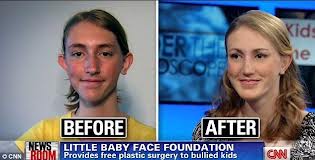 Fourteen-year-old Nadia Ilse got plastic surgery on her ears, nose and chin so kids would stop bullying her. She told Good Morning America:
I felt horrible. I felt like I was like dirt. They said that I have the biggest ears that they’ve ever seen. They called me ‘Dumbo,’ ‘elephant ears.’
Over time the bullying escalated. School became a nightmare, and she got so she couldn’t bear to look at herself in a mirror as she began to believe the slurs.
All this raises questions.
Like how the world seems to think that beauty – a plastic, superficial part of us — means something real. Like how moving a few millimeters of skin, bone and cartilage here and there makes all the difference. A few tweaks and kids go from bullying to accepting. And Nadia goes from crying herself to sleep and having suicidal thoughts to just going about her day.
Why do so many of us see the world in such superficialities?
I would like to ask the bullies if they would judge a person unworthy on such flimsy grounds if they were the ones whose ears were a bit large.
What if there is a God who purposefully creates people who go against beauty norms? What are we supposed to get out of that? Are we to develop empathy and compassion? Are we supposed to move away from the surface and superficial to see what really matters? Should we learn about what is real and what is ridiculous?
And should we really care what ridiculous people think?
Gore Vidal once said:
Don’t care about what others think of you. What matters is what you think of them.
Popular Posts on BroadBlogs
You Are “Less Than”?
Best Not To Be Popular In High School
Boys on the Bus Grasping at Fake Power
Share this:

Give Those Girls A Donut…Please!

Taken alone, the VS models seem almost normal.
In comparison, like scarecrows.Oddly, they look like two different species, almost :}
Those are my friends’ verdicts on the “Victoria’s Secret: Love My Body” campaign as it faced off against its nemesis, “Dove: Real Beauty.”
Real beauty wins in my book.
In fact, I’ve long thought that VS models look a bit like aliens. The ones from “Close Encounters,” as the beings first come into skinny focus. (Hmm, close encounters — almost like a Freudian slip with the demand: look like this and have a close encounter!)
But skeletal is an acquired taste. If acquired at all. Unfortunately many do, complete with the glamorized “anorexic chic” look. Some girls do all they can to avoid eating in hopes of becoming “beautiful.”
Scary, when nourishment becomes the enemy.
Shows how far we can stray from evolutionary psych notions that we are attracted to healthy people.
Some choose not to promote the problem. Kylie Bisutti had beaten out 10,000 hopefuls in a Victoria’s Secret Model Search, and then quit. In part out of her Christian beliefs and in part because of a conversation she had with her 8-year-old cousin.
I was doing my makeup in the mirror one day and she was watching me. She looked at me and was like, ‘You know, I think I want to stop eating so I can look like you.’
It just broke my heart because she looks up to me and I didn’t want to be that type of person that she thought she had to be to be beautiful. Thousands of girls think that being beautiful is an outer issue and really it’s a heart issue.
Luckily, many men actually prefer women who are well-nourished. One man commented on the VS/Dove face-off, saying:
The women below look much prettier. I am skeptical as to whether the women in the first picture actually love their bodies, or themselves.
And I have to agree with another friend who said, “Give those girls a donut…please!”
Popular Posts on BroadBlogs
How to Look Like a Victoria’s Secret Angel
Beautiful Women’s Hips Are Thinner Than Their Heads?
I Can’t Believe I Ate A Whole Head Of Lettuce!
Share this:

Men Find Fewer Women “Porn-Worthy”
 Feminist, Andrea Dworkin, had feared that easy access to internet porn would turbocharge women’s objectification and turn men into wild, raping beasts. But it looks like internet porn too often has the opposite effect, deadening male libido in relation to real women, with men who over-consume finding fewer women “porn-worthy.”
This is what author, Naomi Wolf, noticed when students talked about their sex lives during her speaking tours of college campuses.
Others have made similar findings.
Pamela Paul interviewed over one hundred people, mostly men, in her research for Pornified, and found that porn-worthiness was a common concern among those who over-indulged.
One young man talked of his change in perspective.
My standards changed. Women who are otherwise good looking but aren’t as overtly sexy as the women in porn don’t appeal to me as much anymore. I find that I look more for women who have the attributes I see in porn. I want bigger breasts, longer hair, curvier bodies in general.
I find that when I’m out at a party or bar I catch myself sizing up women. I would say to myself, wait a second. This isn’t a supermarket. You shouldn’t treat her like she’s some piece of meat. Don’t pass her up just because her boobs aren’t that big.
Paul went on to cite a 2004 Elle-MSNBC.com poll which found that one in 10 men admitted he had become more critical of his partner’s body with exposure to porn.
Meanwhile, 51% of Americans believe that pornography raises men’s expectations of how women should look.
Many of the college women Wolf spoke to complained that they couldn’t compete, and they knew it.
Men, she said, learn about sex from porn but find that it is not helpful in teaching them how to relate to real women. She ended with this observation:
Mostly, when I ask about loneliness, a deep, sad silence descends on audiences of young men and young women alike. They know they are lonely together, even when conjoined, and that this imagery is a big part of that loneliness. What they don’t know is how to get out, how to find each other again erotically, face-to-face.
Popular Posts on BroadBlogs
Real Women Competing With Porn Stars
Men Are Naturally Attracted To Unnatural Women
Men Aren’t Hard Wired To Find Breasts Attractive
Share this:

What If Women Went Topless?
 Unprecedented East Coast heat has prompted Moira Johnston to go topless in New York. Why drown in a hot, puddley bra when you can rip off your top, as so many men do when temperatures rise?
Moira also wants to raise awareness that, “It’s legal for woman to be topless anywhere a guy can be without a shirt since 1992 here in New York State.”
Jamie Peck gave it a try and found the only objectors were those worried about children, which she ponders:
Personally, I think that viewing a bare breast as inherently sexual and hence corrupting of innocence is silly; I’d much rather my hypothetical kid see women of all shapes enjoying the outdoors and being comfortable with their bodies than, say, two fully clothed people dry humping on a bench.
Plenty of men would love this, and judging from the crowd Moira attracts, many do.
But what would happen if women did go topless? All of them, in mass, for a long time?
Men would probably be disappointed as the breast fetish faded away. After all, it doesn’t exist in places where women walk around topless all the time, like tribal societies. And it withered in Europe and Australia in the 80s when breasts were bared in magazine and TV ads, and on billboards, and where women went topless on the beach.
The woman who reported this piece for Stuff appears to be Australian, and she can relate:
Why do we still treat bare breasts as such objects of scandal?
I must admit it’s always puzzled me. Growing up, as I did, in the ’80s, my template for adult womanhood was that it was perfectly natural – nay, expected – to whip ’em out in summer.
We’d turn up to the beach, three or four families or so, stake out a spot, and then the mums and aunts and friends would roll their one-pieces down and pour on the Reef. Consequently my approach to beachgoing is similarly au naturel.
So freeing. And some feminists recommend this breast baring to de-objectify them.
On the downside, women would probably still be judged, and some might feel pressured to uncover when they’d rather not — the inverse of some Arab women who feel pressured to cover when they’d rather not.
Still, women from once-topless societies aren’t expected to have such huge breasts today, saving money and potentially dangerous, unnecessary surgeries. As an ex-pat now living Portugal reveals:
My wife, who teaches at a local university, had an interesting conversation with one of her students. He’s a cosmetic surgeon, one of the very few in southern Portugal who does breast augmentations.
“I’m curious,” said my wife. “What size do most women ask for when they have an augmentation?”
“In Portugal? A B-cup,” he replied.
“A B-cup? That’s all? I’d have thought women who were paying for larger breasts would want something a little more…sizeable.”
“No, a B-cup is the average here, and in Europe. But if you go to the United States, it’s a different story.”
“What do American women ask for?”
“A D-cup,” he said. “The difference between Europe and the US is two cup sizes.”
Interesting to see the law of unintended (or intended) consequences in action.
Popular Posts on BroadBlogs
Men Aren’t Hard Wired To Find Breasts Attractive
Women Learn the Breast Fetish, Too
Women Seeing Women as Sexier than Men
Share this:

Women Gazing At Men
 Lately I’ve been asking why women don’t get so excited by naked men, why women are often uncomfortable with male nudity on stage and screen or in print, and why these nude men can seem “gay” to the women who gaze at them.
Elizabeth Hall Magill has been asking the same questions over at Yo Mama. And she’s wondering how women can better appreciate the male form, without objectifying them. Here’s an excerpt from one of her posts.
So—where does that leave a woman’s gaze?
Neither here nor there.
And yet, we have eyes. We gaze. And we like what we see.
As I pondered this issue, I realized something: perhaps men posing sexually seem homosexual not only because we are used to the male gaze. Perhaps it is also because we are used to the female pose. And here we encounter a difference between media (artful or otherwise) and life: real sexiness is rarely posed. It just happens. But in “sexy” pictures of women, the women are aware of the gaze and arranging themselves for it. So, when a man does the same thing, we read him as feminized. And when a man strips for a woman, he can be seen as “performing” something generally feminine, and therefore we define it as insincere, the object of a joke. Not true eroticism.
In one of my favorite essays of all time, Looking at Women, Scott Russell Sanders says:
When I return to the street with the ancient legacy of longing coiled in my DNA, and the residues from a thousand generations of patriarchs silting my brain, I encounter women whose presence strikes me like a slap of wind in the face. I must prepare a gaze that is worthy of their splendor.
This is how I feel about men. And I bet I’m not the only one.
We’re all conditioned to ignore the fact that women feel this way about men. How many times a week do you think a man checks out his wife as she reaches into the refrigerator to get something from that bottom drawer, or reaches high above her head for a rarely-used dish? How many times a week does he check out the women walking by him on the sidewalk, riding a bike in the gym, or sitting in the next office? Magazines love to make little pie charts telling us about how often the male brain does these things. I’ve never seen a pie chart telling me how often the female brain does similar things.
And yet.
Men get things from the refrigerator or the top shelf, and often look damn good doing it. They walk on the sidewalk, ride bikes, and work right next to us, looking good all the while. And women notice.
What we need is more women noticing themselves as they notice men. Thinking about how they feel when the tide of desire leaves and returns, leaves and returns. And owning that tide.
And then we need women talking about it—not giggling, not blushing, not encouraging men to mock the idea of their own desirability. Somebody ought to talk about it so often and so loudly that a pie chart becomes inevitable, cause we just know women are thinking about sex so dang much that we better measure it.
After that, we need female photographers and directors, tons of them, taking pictures of and telling stories about men being men. Holding babies in the middle of the night, shirtless and vulnerable and full of fatherly love and strength. Squatting in the middle of a road, looking at a rock (clothed, as squatting naked in the middle of the road is unnatural and possibly unsafe). Running on treadmills, making copies in the office while wearing snazzy ties, washing the dirt off their hands after a day working outside, laughing with their friends, kicking a tire and making dinner and coming home at the end of a long day. We need to see men being men through the eyes of women, not men posing as the objects of female desire. And we should see them in all their shapes and colors—in all their splendor.
You know what I think?
I think men would totally get being sexy in this way, and I think they would love it. They wouldn’t feel like objects, they wouldn’t feel feminized, they wouldn’t pose or feel goofy. They’d be themselves, and they’d be damn glad that the women they’ve been checking out all this time are checking them right back.
Which means the female gaze would no longer be marginalized, masculinized, or mocked. It would be honest, and it would be powerful—as powerful as desire itself.
Popular Posts on BroadBlogs
Men: Erotic Objects of Women’s Gaze
Man as Object: Reversing the Gaze
Does Porn Objectify? Experts Disagree
Share this:

Real Photos for Real Girls in Seventeen Magazine

17 magazine real girl cover girl
Few young women have good body image. The trouble starts early, thanks to Photoshopped pics in magazines like Seventeen — or even grown-up fare like Cosmo, or your typical billboard — all creating impossible standards that even models cannot achieve.
This is especially a problem for young women who are just beginning to develop a sense of themselves, and whose self-esteem is too often based on their looks.
Even Penelope Cruz knows the agony, having felt insecure as a young woman. Angry now, she says:
I would close down all those teenage magazines that encourage young girls to diet. Who says that to be pretty you have to be thin? Some people look better thin and some don’t. There is almost a standard being created where only thin is acceptable. The influence of those magazines on girls as young as 13 is horrific.
Consequently, too many young women starve or go under the knife in anxious attempts to feel good about themselves. But you can’t compete with Photoshop.
Fourteen-year-old Julie Bluhm knows this. She knows that girls her age are not all slim with glowing skin and shiny hair. And she tired of her friends’ endless rants about their “imperfections.”
And so she began an online petition on Change.org asking Seventeen to use at least one unretouched spread in each issue.
In her “David meets Goliath” moment Julie won – at least a few points. After collecting more than 84,000 signatures, Seventeen published an eight-point “Body Peace Treaty” promising to “celebrate every kind of beauty,” and pledging not to retouch girls’ bodies or faces, instead showing “real girls as they really are.”
Julie won a battle, but necessarily the war. As Ms. points out:
The letter overtly confirms that Seventeen will continue to retouch photos. And (the editor) still claims that Seventeen “never has never will” alter its models’ bodies–a statement that contradicts the very accusation Bluhm (and her 85,000 supporters) made with her petition.
At the least, Julie has gotten a conversation going that has clued many young women into knowing that things are not always what they seem, and learning that they need not strive to meet the nutty body ideals sent down by the gods of media — and the money to be made by offering helpful “fixes” after making women feel bad about themselves.
Goal one has been achieved: be empowered, don’t just take it.
Now we must work on goal two: critiquing looks as the major source of self-esteem.
Popular Posts on BroadBlogs
Men Are Naturally Attracted To Unnatural Women
Beautiful Women’s Hips Are Thinner Than Their Heads?
Scrutinizing My Body Takes All My Time
Share this:

The Constricting Bodice as Empowerment and Imprisonment?

Angela Fortain, Bodice
“The bodice, the corset and the bra can be instruments of empowerment, or torture.”
– Angela Fortain
In her series “Overt Underthings” artist, Angela Fortain, considers a paradox: Distorting the body can both liberate and imprison, she says. Society dictates constraining fashions which, once dawned, create power over others.
Power over others?
By way of men’s desire, women’s envy.
The power to shape space as others turn in our direction.
Favors.
Lower status bowing to higher. Standing based on beauty – and what to make of that?
The power to gain love? Or sex? And must one undergo body-torture to attain either?
How might power become less available inside the constrained body?
Are the powers bestowed – or removed – substantive or superficial?
Finally, Fortain muses, “Separating the sensual object that once transformed the wearer into an object of sexuality allows us to examine the object, and our own desire.”
The power of objects… our own desire?
Fortain’s work provokes more questions than answers. As art should.
For more on Angela Fortain’s work go to ARTslant.
Popular Posts on BroadBlogs
Spoon Fed Barbie
Men Are Naturally Attracted To Unnatural Women
Surprises in Indiana University Sex Survey
Share this:

Sex Objects Who Don’t Enjoy Sex
Sexualizing women can have its perks in the bedroom, with breast fetishes and butt fetishes heightening men’s arousal.
But surprisingly, sexualizing women can have the opposite effect, harming both men’s and women’s enjoyment. And in many ways. Here’s one: self-objectification.
Drowning in “sexy women” images, men and women can both come to see women as the sexy half of the species. So what happens in bed? Because men aren’t seen as especially sexy (at least by comparison) men are focused on women and women can be focused on themselves.
Caroline Heldman, assistant professor at Occidental College, found that some women become preoccupied with how they look instead of the sexual experience. “One young woman I interviewed described sex as being an ‘out of body’ experience,” she said. “She viewed herself through the eyes of her lover, and, sometimes, through the imaginary lens of a camera shooting a porn film.”
Sounds a bit like Paris Hilton: “My boyfriends say I’m sexy but not sexual,” she mused. “Being ‘hot’ is a pose, an act, a tool, and entirely divorced from either physical pleasure or romantic love.”
Heldman feels that girls and women are learning to eroticize male sexual pleasure as though it were their own. She feels they need to explore their sexuality in more empowering and satisfying ways than this vicarious act.
Cultural theorist Jackson Katz has similar concerns. “Many young women are now engaged in sex acts with men that prioritize the man’s pleasure,” he reflects, “with little or no expectation of reciprocity.”
When having sex, these young women may be enjoying themselves, and how great they look. They may gain a boost to self-esteem as they dwell on their “hotness.” But they’re not enjoying sex.
Popular Posts on BroadBlogs
Women Seeing Women as Sexier than Men
Women Learn the Breast Fetish, Too
Surprises in Indiana University Sex Survey
Share this:

Do Wrinkle Creams Work? Who Cares?
 Women in their early 20’s are now buying anti-aging potions. Used to be, the serums were sold to middle-aged women and older. But why start so late when there is money to be made?
Of course, “It’s hard to know if a wrinkle cream is working when there are no lines yet to erase,” Christina Brinkley of the Wall Street Journal points out.
But that’s an advantage to the sellers. No evidence that their products don’t work. Good thing for them, since they probably don’t.
Much of the medical establishment says anti-aging potions are ineffective. Consumer Reports has tested several and agrees:
After six weeks of use, the effectiveness of even the best products was limited and varied from subject to subject. When we did see wrinkle reductions they were at best slight.
Even the best performers reduced the average depth of wrinkles by less than 10%, the magnitude of change that was, alas, barely visible to the naked eye.
According to the National Institute on Aging we should be skeptical:
Despite claims about pills or treatments that lead to endless youth, no treatments have been proven to slow or reverse the aging process.
Instead, the Institute offers this advice on aging well: eat healthily, exercise regularly, don’t smoke, and of course, protect your skin from the sun.
We are a world that worships youth. But age was once valued when it was harder to survive and when a long past meant great wisdom and great skill. But now it’s ordinary to live long, higher education can give us more knowledge than our parents, and technology mass-produces high quality work.
Baba Cooper wrote a piece on becoming old women. Old age shouldn’t be feared, she says. It should be a final ripening, a meaningful summation, a last chance for risks and pleasures.
There are different ways of seeing. Does age erase our beauty? Or does it show off the laugh lines of our happiness? And might the wisdom we have gained be more worthy, worthwhile and fulfilling than the outer shell that contains it?
Popular Posts on BroadBlogs
Does Sexual Objectification Lead to Bad Sex?
Scrutinizing My Body Takes All My Time
Keep Your Boobs, Get Better Guys

 BroadBlogs