Category Archives: sex and sexuality
The Brain on Love vs Lust
![The-Notebook-movie-poster-McAdams-Gosling[1]](https://broadblogs.com/wp-content/uploads/2012/11/the-notebook-movie-poster-mcadams-gosling11.jpg?w=300&h=232) Is it love? Or lust?
Is it love? Or lust?
Scientists compared the brains of those who looked at erotica or at their significant other. Turns out love and lust are connected, but show up differently in the brain.
The brain on lust lights up the striatum region that is aroused by pleasures like “food, orgasms, or getting stoned, eating a whole bag of Funyuns, and sprinkling crumbs all over the couch just to mess with your OCD roommate,” as Doug Barry, at Jezebel put it.
Love also shows up in the striatum, but triggers the section that associates things with pleasure or reward. As the beloved continually gives pleasure she becomes the reward, herself. In this way, feelings of sexual desire turn into love.
The lover actually becomes an addictive habit. In fact, love lights up the same part of the brain as drug addiction as we become hooked on our lover.
Rutgers anthropologist, Helen Fisher, calls romantic love a stronger craving than sex, pointing out that people who don’t get sex don’t kill themselves. She says love is “a motivation system, it’s a drive, it’s part of the reward system of the brain,” a need that compels us toward a specific partner in pursuit of “life’s greatest prize.”
Habits and addictions both get bad raps, and often should. But here they’re not so bad as love is the bonding mechanism of relationship. Love activates the need to defend the interests of our children or lover, says study researcher Jim Pfaus. In a complex society like ours, this creates greater family and social stability.
Luckily, these habits of the heart are a good thing.
Popular Posts on BroadBlogs
Passionate Love: Like a Drug, or Mental Illness
Passion + Intimacy + Commitment = Consummate Love
Who Falls In Love Faster? Men or Women?
Share this:

Guys Just Wanna Have Relationships?
 “All men cheat.” “He can’t keep it in his pants.” “Men only talk about beer, sex and sports.”
That’s Lisa Hickey over at The Good Men Project reciting stereotypes about the supposed sex-craved male. But stereotypes aren’t reality, she says. And she’s got backup from Wake Forest psychology professor, Andrew P. Smiler who recently wrote a book called, “Challenging Casanova: Beyond the Stereotype of the Promiscuous Young Male.”
Smiler says it’s no wonder we think men are all about casual sex. Stereotypes abound and play out in pop culture. Walking through TV history we’ve got: Read the rest of this entry
Share this:

Sexual Objectification, What is it?

Cross-posted at Ms., Caroline Heldman’s Blog and Sociological Images
This is Part 1 of a four-part series on sexual objectification–what it is and how to respond to it.
The phrase “sexual objectification” has been around since the 1970s, but the phenomenon is more rampant than ever in popular culture–and we now know that it causes real harm.
What exactly is it, though? If objectification is the process of representing or treating a person like an object, then sexual objectification is the process of representing or treating a person like a sex object, one that serves another’s sexual pleasure.
How do we know sexual objectification when we see it? Building on the work of Nussbaum and Langton, I’ve devised the Sex Object Test (SOT) to measure the presence of sexual objectification in images. In it, I propose that sexual objectification is present if the answer to any of the following seven questions is “yes”:
1) Does the image show only part(s) of a sexualized person’s body?
Headless women, for example, make it easy to see them as only a body by erasing the individuality communicated through faces, eyes and eye contact:


We achieve the same effect when showing women from behind, which adds another layer of sexual violability. American Apparel seems to be a culprit in this regard:

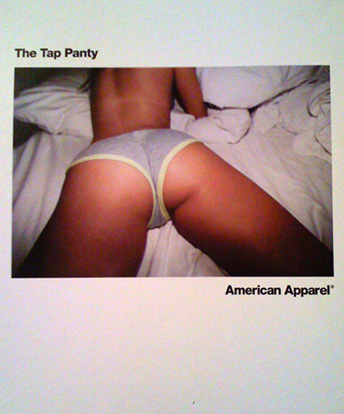
Covering up a woman’s face works well, too:


2) Does the image present a sexualized person as a stand-in for an object?
The breasts of the woman in this beer ad, for example, are conflated with the cans:
Likewise the woman in this fashion spread in Details, in which a woman becomes a table upon which things are perched. She is reduced to an inanimate object, a useful tool for the assumed heterosexual male viewer:

3) Does the image show sexualized persons as interchangeable?
Interchangeability is a common advertising theme that reinforces the idea that women, like objects, are fungible. And like objects, “more is better,” a market sentiment that erases the worth of individual women. The image below, advertising Mercedes-Benz, presents just part of a woman’s body (breasts) as interchangeable and additive:

This image of a set of Victoria’s Secret models, borrowed from a previous Sociological Images post, has a similar effect. Their hair and skin color varies slightly, but they are also presented as all of a kind:

4) Does the image affirm the idea of violating the bodily integrity of a sexualized person who can’t consent?
In this “spec” ad for Pepsi (not endorsed by the company), a boy is being given permission by the lifeguard to “save” an unconscious woman:

Likewise, this ad shows an incapacitated woman in a sexualized position with a male protagonist holding her on a leash. It glamorizes the possibility that he has attacked and subdued her:
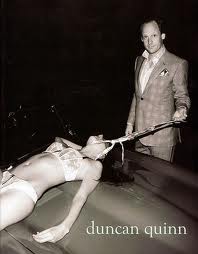
5) Does the image suggest that sexual availability is the defining characteristic of the person?
This American Apparel ad, with the copy “now open,” sends the message that this woman is open for sex. She presumably can be had by anyone.

6) Does the image show a sexualized person as a commodity that can be bought and sold?
By definition, objects can be bought and sold, and some images portray women as everyday commodities. Conflating women with food is a common sub-category. This PETA ad, for example, shows Pamela Anderson’s sexualized body divided into pieces of meat:
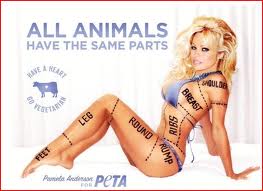
And this album cover shows a woman being salted and eaten, along with a platter of chicken:

In the ad below for Red Tape shoes, women are literally for sale and consumption, “served chilled”:

7) Does the image treat a sexualized person’s body as a canvas?
In the two images below, women’s bodies are presented as a particular type of object: a canvas that is marked up or drawn upon.


The damage caused by widespread female objectification in popular culture is not just theoretical. We now have more than 10 years of research demonstrating that living in an objectifying society is highly toxic for girls and women. I’ll describe that research in Part 2 of this series.
Cross-posted at Ms., Caroline Heldman’s Blog and Sociological Images
Popular Posts on BroadBlogs
Anything Good About Being A Sex Object?
Sex Objects Who Don’t Enjoy Sex
Does Porn Objectify? Experts Disagree
Share this:

Twilight vs. Porn
![10886003_det[1]](https://broadblogs.com/wp-content/uploads/2012/11/10886003_det12.jpg) Women often worry that porn raises men’s expectations about what their bodies should look like and what they should do in bed. And why does he want to have virtual sex with those other women, anyway? So women can end up feeling like they’re not enough or not good enough.
Women often worry that porn raises men’s expectations about what their bodies should look like and what they should do in bed. And why does he want to have virtual sex with those other women, anyway? So women can end up feeling like they’re not enough or not good enough.
Men may worry that Twilight raises women’s expectations for a “one true love” that is deep and intense with a man who only has eyes for her. Who can meet to such standards?!
Men craving sex with lots of women and women wanting sex with one true love. Funny how the visions are so often at odds with each other.
In fact, the appeal of Twilight for young girls may be the opposite of porn. Porn is all about getting sex. But as Edward yearns for Bella — yet avoids intimacy for fear of killing her in vampire bloodlust — Twilight is more like abstinence porn. Sex without sex. As a writer for Psychology Today put it:
Let’s get back to the sex, or lack of it, which is what hooks girls on the first volume: female readers love that Edward sleeps beside Bella and apparently only wants to kiss her neck.
So in Twilight girls can imagine safe crushes on boys who love them, while avoiding all the complex, confusing and scary adult realities of sex.
But it’s not just naïve girls who fall for Twilight. So do their older sisters and moms. But while their male partners are turned on by hard-core porn’s over-the-top fireworks, Twilight is all about the subtlest sex. Here’s how a blogger at Huffington Post described it. Twilight is all about the:
building of sexual tension. So much so that when Edward brushes Bella’s arm, you can almost feel him brushing yours… They get to really know each other, their passion is allowed to build, we revel in the innocence, the time it used to take to truly build a relationship. Do you remember how amazing your first true kiss was?
A Salon blogger continues:
Instead of relying on tight shots of penetration, these books get their sexual spark from extreme emotional close-ups. The ‘money shot’ in these novels typically isn’t a geyser of bodily fluids but rather a declaration of love, or a man on bended knee.
I was struck by the male/female difference when I heard Meryl Streep and director, David Frankel discuss their movie “Hope Springs.” Frankel said the movie’s themes were universal because, “Who thinks they’re having enough sex?” But Meryl Streep suggested the nuances behind the desire:
If my team were here – women – they’d say it’s not necessarily sex, it’s what sex pulls from you… brings you to. It’s connectedness, it’s intimacy, it’s being known, it’s being seen, it’s being felt, it’s being wanted. The whole thing… But yes, you can reduce it to that part.
For many women, a guy can do the exact same moves and it can feel like nothing if you don’t feel emotionally connected to him, and it can be off the charts amazing when you do.
I suspect the female/male difference is due more to nurture than nature, but it’s a pretty strong pattern. Fortunately, not all men and women fit these molds. Some girls do just wanna have the fun of porn sex and some guys do seek consummate love. Or, what’s wanted may change with context.
But too often, like star-crossed lovers whose pairing is “thwarted by a malign star,” it’s an unfortunate trick of nature – or society — that men and women so often sexually connect at cross purposes.
Popular Posts on BroadBlogs
Men Watch Porn, Women Read Romance. Why?
Women Want Casual Sex? Yes and No
Guys Are Getting More Romantic
Share this:

Overcoming Scars of Abuse
 Today I am reposting a story of one woman’s recovery (still in progress) from her traumatic ordeal of childhood sexual abuse. This story comes from HumanitysDarkerSide, and I hope it might help others.
Broadblogs wrote an article called Why We Have Sex based upon the findings of CM Meston and DM Buss at the Department of Psychology at the University of Texas. These two researchers wrote an article called Why Humans Have Sex in 2007. In their article Meston and Buss cite 237 reasons that students at UofT had listed as their reasons for having sex.
I commented on Georgia’s post and ended up being asked if I would like to write something about my own experiences and the effects of medication on myself.
One of the reasons being listed for having sex in Meston and Buss’ article is force. Sometimes sex isn’t a voluntary thing and in my case the force happened at a very early age and seriously messed up my head when it came to anything sexual. Well, not just that, as anyone who has run into PTSD will attest to.
PTSD, or post-traumatic stress syndrome is a strange thing. It is basically a severe reaction to trauma expressing itself in as varied manners as re-experiencing the original trauma(s) through flashbacks or nightmares, avoidance of stimuli associated with the trauma, and increased arousal—such as difficulty falling or staying asleep, anger, and hypervigilance.
In my case I experienced pretty severe nightmares and hypervigilance (and probably some anger). As I was 7 when the whole thing started, this was normal to me and I thought most people experienced life the way I did. Turns out they don’t. Some who get PTSD as adults remember life before and a state of non-PTSD. In some ways I would imagine that could be worse (although maybe not). Depends on the trauma and the psyche of the person struck down with it.
I would guess that most people would see me as a boring person with a weird sense of humor. It is that strange sense of humor that has carried me. After the awkward teens and early twenties, I came to realize that life was just one gigantic joke and the only defense was to laugh at it. Laughter has been my friend throughout my life, laughing at myself and the world and it has gotten me through some rough spots (my psyche).
Anyways, I got married and when I met my husband I was a virgin (well except for CSA that is). I’d seen some porn, read books with sexual content and talked to people. But, you know, people just don’t talk about sex and death – the two great taboos in life. I didn’t get that sex could even be pleasurable and was afraid during sex. I wanted it, got horny and all of that, but when it came to actually doing it, well.
Thankfully, my husband is the kindest, gentlest and most patient person on this planet and he worked with me and tried to make things good for me. But you know, there is only so much you can do on your own. Poor guy, living with a CSA survivor is not easy. No matter how optimistic a person is, having trouble with your sex life just hurts both parties.
I tried psycho-therapy. Hah, what a joke. Talking through the effects of PTSD as something that was supposed to help. Sometimes I wondered if I or my therapist was in need of help.
Then I found my psychiatrist – my voodoo queen – magician galore. Granted, it took years and years before I did find her, but this is my miracle person. We used three tools in getting acceptance of myself into my mind, heart and body. Cause you know, CSA people just don’t have a healthy view of themselves.
Tool one was cognitive therapy. Folks, this stuff actually works. It really does. What happens is a re-wiring of the way you think of yourself and the world. Yes, it is an ongoing process and some parts will probably have to be a life-project, but it works. I can now do this all by myself because I know how it works.
Tool two was EMDR. What the hell is EMDR, you ask. Before I tried it I put it in the same category as homeopathy. But it’s just a kind of hypnosis light. It should be tried with a therapist that knows what on earth they are doing and it does not work for everything. However, research in Holland and Germany shows that it is good with PTSD. Just do a search on Google for Dutch and German research on EMDR and you will have plenty of articles to choose from.
Tool three was medication. People, you know this, but it cannot be stated enough times. No new psychological medication without therapy. There are side-effects with every bleeding medical product out there and you might need help coping with them.
At first we tried beta-blockers. My god. The first time I tried them this super-tense feeling in my chest lessened and I fell asleep from sheer relief. I’d walked around being hyper-alert all of the time and that really isn’t good for you. My world changed, but tension around sex was still high. No wonder, as this was my major trigger.
Then a miracle happened. And I am serious about this. A major miracle happened. My psychiatrist suggested that I try something called venlafaxin – an efexor depot medication. Instead of being scared every time I had sex I was loving it. Sure, it had taken years for me to get there and my husband had had to endure my pain for a long time, but I have actually gotten to experience the joys of having sex. How cool is that? And we all know that my husband has been having the time of his life along with me.
Popular Posts on BroadBlogs
Past life
Making Violence Against Women Sexy
Real Men Don’t Beat, Rape Women
Share this:

What Women Want: Twilight
 A lot of men take my women’s psych course because they want to know what women want.
Maybe they should watch Twilight instead.
A woman I know of named Tracie Lamb was surprised that her daughters were more engrossed in Twilight than in their Hawaiian vacation. She knew the book series had soldover 100 million copies and that the films have made about a billion dollars. Curious, she started reading and became absorbed, herself. Wondering about the book’s allure, she made a record of what made her “tingle” and amassed a cornucopia of “invaluable information for the opposite sex.”
Here are her musings from a piece called, “Wanna Know What Women Want?”
Women want to captivate the men they love as Edward is captivated by Bella. He gazes at her. He watches her sleep. A sexy waitress flirts with him, but he only has eyes for his love:
She smiled at him again. “You have a nice evening.” He didn’t look away from me as he thanked her.
Later he tells her, “You’re not like anyone I’ve ever known. You fascinate me.”
Edward also listens to Bella, and he wants to know everything about her.
He seemed engrossed in our conversation… He says, “I want to know what you’re thinking – everything.”
Edward is completely devoted, telling Bella that, “You are my life now… I will always want you forever… You’re like my own personal brand of heroin.” (Well, love has been described as being like a drug.)
And instead of being on a quest to satisfy his sexual hunger he seeks to control it because he wants to protect Bella. (He fears he will drain her blood with his vampire instinct unless he controls himself.) That may make him sexy-safe for girls who are just discovering their sexuality, but his desire to protect, generally, is itself a strong draw. He’s not just strong, but his strength is directed at aiding his love. He’s always there for her. And she is more important than his own self and his own wants.
Now mind you, women may want to take care of themselves and their men, but they also like a man who takes care of them and who makes them feel safe and secure. So it goes both ways.
Edward’s brand of love may not appeal to every woman, but it sure appeals to a lot of them.
Tracie concludes with these words:
When a man looks at a woman, he sees the woman. When a woman looks at a man, she sees herself reflected in his eyes. What’s important is not how you look to her, but how you look at her and how you look out for her. It’s how you make her feel: fascinating, cherished, protected.
Next week: Twilight vs. Porn
Popular Posts on BroadBlogs
Hookup Culture
Pleasuring A Woman
Surprises in Indiana University Sex Survey
Share this:

Vibrators & Women’s Sexuality are Out of the Closet
 Vibrators, once steeped in shame and secrecy, are going mainstream. Does this mean women’s sexuality has thrown off the covers, too?
As a culture, we are of two minds.
Vibrators were once illegal in several states, including Texas, Mississippi, and Alabama, or found only in seedy sex shops. But as the New York Times reports, today they may be purchased at your neighborhood drug store. Out in the open, even Oprah has pitched the helpful tool. And who can forget the “Rabbit Pearl” popping up in Sex and the City?
And yet, they aren’t quite out of the closet.
As one seller described the problem, “I can sit with my 10-year-old daughter during prime-time TV and watch a commercial for Viagra,” she said, “but I can’t advertise our OhMiBod fan page within Facebook.” Nylon Magazine won’t run her ads and the Small Business Administration refused her loan application because vibrators are a “prurient” business.
Ambivalence over tools and meds that enhance women’s sexuality reflects the larger cultural view. On the one hand the media glamorizes women’s sexuality. And plenty of porn approvingly portrays women with voracious sexual appetites.
But porn is off-limits. And women are told “Keep your legs together,” as if open legs were an open invitation.
Male sexuality is something to brag about, but female sexuality is something to hide. Men are praised as players and pimps. Women are called sluts, whores, tramps, and skanks… What positive word applies to women who enjoy sexuality?
Slang for penis and vagina says a lot, especially “cock” and “down there.” Cock: Cocky, boastful, swaggering. “Down there”? Unspeakable. Shameful.
This all reminds me of Zestra’s difficulty getting ads on TV for a product that arouses women. TV networks, national cable stations, radio stations, and Web sites like Facebook and WebMD all resisted. Yet “An erection lasting more than four hours” is O.K.?
Is it any wonder that sex surveys find mixed experiences among women when it comes sexual pleasure?
Indiana University’s comprehensive survey found that while 91% of men had an orgasm the last time they had sex only 64% of women did. These numbers roughly reflect the percentage of men and women who say they enjoyed sex “extremely” or “quite a bit”: 66% of women and 83% of men. Only 58% of women in their 20s had “the big O” on their last occasion.
As I’ve recently posted, 30-40% of women report difficulty climaxing. Women who lose virginity are also likely to lose self esteem, largely because they’re so focused on how they look (bad, they apparently think) and so unfocused on the sexual experience. And one-third of women under 35 often feel sad, anxious, restless or irritable after sex, while 10 percent frequently feel sad after intercourse.
On the other hand, many women do enjoy sex a lot, and frequently orgasm.
Does all this reflect that ambivalence, with enjoyment perhaps affected by which message gets most drilled into a woman’s mind?
Women’s sexuality kept in shadow and suspicion has an effect. Time to come out of the closet!
Ms. Magazine cross-posted this May 16, 2011 I first posted this piece May 9, 2011.
Popular Posts on BroadBlogs
Women: Climax Less Likely in Relationship Sex
Men: Climax More Likely in Relationship Sex
Sex Lessons from Mom and Dad
Share this:

Why We Have Sex
 Psychologists Cindy Meston and David Buss of the University of Texas, Austin, asked nearly 2,000 people why they had sex and assembled a list of 237 reasons.
Strangely, a few had sex “to get rid of a headache.” It’s No. 173. Aren’t headaches an excuse to avoid sex?
Other reasons include exercise, revenge, a sense of duty, adventure, an ego boost, desiring a gift, drunkenness, to keep warm, so my partner won’t have an affair, wanting a child… the list goes on, ranging from, “So my husband will put out the trash” to “It’s the closest thing to God” (perhaps explaining shrieks of “Oh God!”).
While evolutionary psychology claims women are more likely to have sex to get resources, men were actually more likely to do this. Men were also more likely to have sex to gain status. But then, women often lose status when they have sex, becoming “loose” sluts, whores or skanks…
This one’s interesting: Men were more likely to have sex because “the person demanded it.” Is that because men are more inclined to have sex for any reason, anyway?
Regardless of the reason, the researchers found that men were more likely to cite it, except for “expressing love” or “realizing I was in love.” I suspect women were also more likely to have sex to avoid taking out the rubbish. Consider that 84% of women admitted they’d had sex so her guy would do household chores or to put an end to sex-nagging. Older women were especially likely to have sex from a sense of duty. It’s what a wife does, they felt.
The good news? Men and women ranked the same reason most often: being attracted to the person. Actually, most of the top 10 were the same for each gender, including expressing love, being sexually aroused and having fun.
The psychologists placed the motivations into four general categories, as laid out in the New York Times:
- Physical: “The person had beautiful eyes” or “a desirable body,” or “was a good kisser” or “too physically attractive to resist.” Or “I wanted to achieve an orgasm.”
- Goal Attainment: “I wanted to even the score with a cheating partner” or “break up a rival’s relationship” or “make money” or “be popular.” Or “because of a bet.”
- Insecurity: “I felt like it was my duty” or “I wanted to boost my self-esteem” or “It was the only way my partner would spend time with me.”
- Emotional: “I wanted to communicate at a deeper level” or “lift my partner’s spirits” or “say ‘Thank you.’ ” Or just because “the person was intelligent.”
It is remarkable to see how often the motivations for sex lie outside of the pleasure of sex, itself.
Popular Posts on BroadBlogs
Wanting “X” from Sex, but Doing “Y”
Is Male or Female Sexuality Better?
Cartoonish vs Authentic Sexuality
Share this:

Raping, Shaming Girls to Impress Guys

Felicia Garcia
Young men at Piedmont High near San Francisco were caught “drafting” female schoolmates (unbeknownst to most of them) into a secret “Fantasy Slut League.” Upper classmen earned points for documenting their sexual exploits and used social pressure to manipulate the girls’ yearnings to feel attractive, included and popular. Sometimes they plied their targets with alcohol to impair judgment and control, that is, to commit rape.
Meanwhile, in the Stanton Island borough of New York, 15-year-old Felicia Garcia of Tottenville High had sex with four football players. The escapade was recorded and passed around the school as football players bragged about their conquest. Two of the ball players involved began tormenting her, and as news spread through the school, bullying spread, too.
One of Felicia’s friends told the New York Daily News,
Kids are saying she had sex with some guys from the football team at a party after the game. Later on, they wouldn’t leave her alone about it. They just kept bullying her and bullying her.
The young women of Piedmont High were left shamed and humiliated, and too many of them were sexually assaulted. Felicia killed herself on October 24 when she jumped in front of a Staten Island train as 200 students watched in horror.
You have to wonder why so many young men are willing to harm so many young women.
The answer likely revolves around guys trying to feel like men.
Michael Kimmel is an expert on men and masculinity who has studied “guys” at the cusp of manhood. He says that too often guys hurt themselves or others as they latch onto the more negative notions of manhood like aggression, violence, dominance and being tough.
Meanwhile, women are often objectified and seen as “things” that are all about sex. If they are things, and not people, you don’t have to worry about their feelings or their lives.
The young men at Piedmont High and Tottenville High were working to create a culture that painted men as aggressive and dominant, and women as silenced and humiliated victims who were made to feel lower in status… and who may even end up killing themselves.
Surely there are better ways to be a man.
Popular Posts on BroadBlogs
Yale Fraternity Chants “No Means Yes.” Men? Or Scaredy Cats?
Frats Invite Sluts, Bitches; Women Accept Degradation. Why?
It’s Ok To Be A Tomboy But Not A Sissy. Why?
Share this:

Why Men Objectify
 Some men wonder why they objectify women. So Jayson Gaddis asked men on his Facebook page why they thought they did, and then he wrote about it for The Good Men Project.
What is objectification? Jayson describes it as:
Staring, gawking, or checking out women and their bodies and body parts. Seeing them as objects instead of actual people, and thinking of them in a sexual way.
Why do they do it? Most blame “nature.” As one man exclaimed,
I love looking at women. They’re just amazing. It’s part of my biological make up to think that they’re beautiful.
Jayson believes biology plays a role since men are hardwired to look for mates and procreate. But he thinks cultural conditioning is involved, too. To paraphrase:
In men’s culture, it’s acceptable to objectify women. Men bond around it. And, it’s pervasive and all around us. Notice where men buy stuff, there are often photos of women present. I can barely go on any male-focused website now without being hit at some point by a tiny, physically attractive, disproportioned airbrushed woman looking at me.
Some men objectify because the “feel good” feeling acts like a drug or pick me up. Objectification can fill an empty place inside:
I’m stuck in the belief that that feminine essence is outside of myself. I’m alienated from the larger truth of my Completeness as a human being. That sexy, juicy, radiant paradise is not inside myself, therefore it’s an object I obsess about outside myself and I treat it like entertainment. This insight leads me to believe I haven’t spent enough time balancing the relationship with My (whole) Self.
Others want gratification without any real work or risk of rejection.
I objectify women cause it’s “safer.” I receive an immediate gratification, a thrill if you will, albeit superficial, it does keep me safe at least for a time from annihilation — from a treacherous road of intimacy and vulnerability — the risk of being really seen and connected with – or actually rejected!! Yes, that’s it — it’s an avoidance of rejection… Intimacy takes a lot of work, courage and commitment. Objectifying is an “easy” road out of the potential of rejections.
Maybe some men simply enjoy the sense of being with many women, polygamous, a way of living that doesn’t appear to be a possibility in our culture. One man says he likes to play with the fantasy and the illusion like he does with porn:
The most fun and exciting and ego gratifying times in my life have been when i have embraced it and danced with it and gave myself permission to play with the illusions, projections, feelings, etc.
Like this man, many say they seek approval or self-esteem. I’m not sure what that means. Might a man’s self worth rise when he imagines the women enjoying his attention?
Or, does self-esteem rise from gaining a sense of power over women? After all, they dressed and adorned themselves to please men – and thus, “him.”
Some talk of the power women have over men – making them melt and creating unrequited desire. But by objectifying women a man can feel superior. “He” is subject while “she” is an object that exists for his pleasure and purposes.
The fear of annihilation has been cited before, but one man describes it in a way that echoes this fear of female power. He seeks “to avoid the terror of annihilation — being reabsorbed back into the feminine.”
Whatever’s going on, Jayson suggests men consider how objectification is working for them and the women in their lives. For those who feel it’s not working, here’s how some have dealt with the matter:
What I’ve found works best for me so far is being a yes to everything in my own experience and in what’s happening AND at some point in my development simply realizing that objectification is not enough for me … I love appreciating and experiencing another human being for more than just her physical traits. What I prefer physically doesn’t in itself inspire me to want to connect with a woman, and doesn’t in itself have me feel attracted. The attraction and inspiration simply are there or not independent of how she looks.
Or this:
The answer for me was to stop trying to get this woman but use that energy to make myself the best possible me I could become. A me that now has confidence because I am self assured, self respecting, and full of self accepting unconditional love. Part of becoming that man means that I must accept and own the truth of my motives and be willing to see the motives of others. That is when I was finally able to let go of the fantasy and see this woman for who she really is inside.
My biggest life breakthrough and victory came as a result of that growth.
As a result, something incredible is happening to me now. Something wonderful has started growing in the void where my fantasy used to live. It’s a genuine curiosity and appreciation for all woman. Especially for all the women who actually live and display their authentic self and freely give their love to all as an expression of their femininity.
Or this,
Once I get connected to me again, I notice how I can appreciate a beautiful woman and I’m in my body, connected to my heart. It has a totally different quality. She feels it and I feel it.
By the way, objectification and desire are two different things. And men are rarely objectified. See these two articles:
For more on all this, go to The Good Men Project.
Related Posts on BroadBlogs
Anything Good About Being A Sex Object?
Being Sexual vs Looking Sexual
Does Porn Objectify? Experts Disagree

 BroadBlogs