Category Archives: psychology
Religious Cruelties
![article-0-0D220DA8000005DC-480_468x503[1]](https://broadblogs.com/wp-content/uploads/2012/12/article-0-0d220da8000005dc-480_468x5031.jpg?w=279&h=300) Some wonder how morality can exist without religion. Yet too often religion submerges morality.
Some wonder how morality can exist without religion. Yet too often religion submerges morality.
I recently wrote about religious men seeking therapy to overcome same-sex attraction. But the “therapy,” itself, seemed evil as men were shocked, given drugs to create nausea, told to strip naked and touch themselves in front of a counselor, or were forced to beat their mothers’ effigies.
Not long ago an Irish woman died because her doctors would not perform an abortion:
Despite her rising pain, doctors refused her request for an abortion for three days because the fetus had a heartbeat. She died in the hospital from blood poisoning three days after the fetus died and was surgically removed.
Her husband was left asking,
When they knew the baby was not going to survive, why not think about the bigger life which was the mother, my wife Savita? And they didn’t.
In the not-so-distant past some devout Irish doctors broke their patients’ pelvises to prevent miscarriage. The painful operation often caused chronic back pain, incontinence, and crippling. As one woman explained,
It ruined my life. I have two titanium knees, a bad back and I think about it every day. It was 53 years ago… They were torturers. They didn’t care. I was a thing.
Another described the procedure:
I saw the hacksaw. He started cutting my bone and my blood spurted up like a fountain. [She remembers the doctor looking annoyed that he had gotten her blood on his glasses]. You’ll never get rid of [the pain] until you’re not living anymore.
Not long ago a Polish woman named Edyta died because each doctor she approached refused to treat her colon condition, fearing an operation might lead to miscarriage or abortion. She could have expected refusals had she lived in Italy, Hungary, or Croatia, too, because in each of these places doctors may refuse treatment on moral grounds. Apparently, letting a woman die is not a part of the moral compass. The fetus died, anyway.
In North African countries the clitoris or vulvas of young girls are routinely cut with dirty razors and parts are removed to deaden sexual sensitivity, “making them pure.” Some die of infection, many are crippled, and most live in pain.
In other places brothers kill sisters over any “sexual impropriety,” including marrying who you want, being alone with a boy, looking at a boy, or rape.
In Saudi Arabia girls in night clothes were once forced back into a burning building to die so as to protect men from their immodesty.
The religious Taliban ordered a girl’s nose and ears cut off when she ran away from her abusive in-laws.
And don’t forget the Inquisition, the Crusades and the witch hunts.
I could go on.
Really, how callus can your religious beliefs make you?
The Golden Rule must be hiding around here somewhere.
Popular Posts on BroadBlogs
Child Rape: Not As Bad As Contraception
God-Wrestling Nuns
Share this:

“Fat Actress” Is Most Desirable Woman
![hunger-games-katniss-everdeen_458[1]](https://broadblogs.com/wp-content/uploads/2012/12/hunger-games-katniss-everdeen_4581.jpg?w=225&h=300) It seems that just yesterday Jennifer Lawrence was deemed a fat actress — in Hollyweird, anyway. But now she’s been named “Most Desirable Woman” by more than 2.4 million AskMen readers. Also on the list were her sisters in non-starvation, Christina Hendricks and Kim Kardashian.
It seems that just yesterday Jennifer Lawrence was deemed a fat actress — in Hollyweird, anyway. But now she’s been named “Most Desirable Woman” by more than 2.4 million AskMen readers. Also on the list were her sisters in non-starvation, Christina Hendricks and Kim Kardashian.
But actually, different sizes, shapes, colors and ages are on this list, too. And in a truly revolutionary move:
These men were tasked with voting on more than just sex appeal, taking into account character, intelligence, talent, sense of humor, professional success, achievements in 2012 and potential for 2013.
And as a result, “a new breed of women have changed the definition of ‘desirability’” read one headline.
And so the list includes non-voluptuous celebs with Mila Kunis at #2, along with Kristen Stewart and Kate Middleton.
Women of different colors were named: Rihanna, Selena Gomez and Lucy Liu, among them.
You needn’t be a classic beauty, either. Check out Emma Stone and Claire Danes, who got her start playing a very ordinary teen.
Even the over-40 set was lauded, including Sofia Vergara, Sarah Silverman and Rachel Weisz.
Powerful women were also among the most desirable, including Michelle Obama, Marissa Mayer, President and CEO of Yahoo! and Nadezhda Tolokonnikova of the Russian activist-punk group Pussy Riot.
As feminism has spread men have become less intimidated by, and more appreciative of, strong women. James Bassil, the Editor-In-Chief of AskMen, put it this way:
The top-rated women on AskMen’s 12th edition of the Top 99 Most Desirable Women list speaks to men’s growing comfort with strong and independent partners.
It speaks to men’s growing confidence in themselves, as well.
I’m not thrilled about ranking women. But perhaps this varied list that moves beyond looks will encourage more women to move outside the one-dimensionality of narrow beauty norms and help us to broaden and grow greater confidence in ourselves, too.
Popular Posts on BroadBlogs
Beauty Tricks to Remove Your Power
Miss Representation: Girls are Pretty, Boys Are Powerful
Scrutinizing My Body Takes All My Time
Share this:

How Women Feel About Porn
![women-internet-pornograph-007[1]](https://broadblogs.com/wp-content/uploads/2012/12/women-internet-pornograph-0071.jpg?w=300&h=180) When it comes to women and porn, you’re going to get a lot of different reactions. Sometimes women’s feelings conflict with one another. Sometimes a woman’s feelings conflict within herself.
When it comes to women and porn, you’re going to get a lot of different reactions. Sometimes women’s feelings conflict with one another. Sometimes a woman’s feelings conflict within herself.
For some, it’s an acquired taste. A woman named Aaliyah was grossed out the first time she saw an explicit video at a high school homecoming party. Now she looks at porn about once a month, but she likes movies with a story. And she’s disgusted by the brutal stuff. Like Aaliyah, most female fans like a different type than men – less hard-core, more plot.
When it comes to strip clubs many women are tolerant or even enthusiastic. Forty-three percent of Cosmo’s readers and 51% of Elle’s had visited a strip club. And most didn’t mind if their partners indulged (52%). Of course, Cosmo and Elle fans aren’t your typical American woman.
Still, only one out of 50 site subscribers are women. Or apparently women. The main billing agent for these sites flag feminine names because the charges too often result in angry wives or moms refusing to pay.
Then there are women who want to like porn to be “cool” or to be a good girlfriend, but who actually don’t so much. A woman named Ashley says all her female friends act like they are good with porn, but she doesn’t buy it. She thinks they go along because, “Guys think it’s really uncool for women to get pissed off about it.” Another woman named Mia said that at first she wanted to be the cool girlfriend. But after a while it seemed her guy was more turned on by the TV than her.
At the other end, one third of women who are married to cybersex buffs consider it cheating and feel betrayed. As a woman named Ashley explained, “Because you’re getting off to other people, not the person you’re with. How is that supposed to make me feel?”
Or, women resent time not spent with families — and with them, in bed or otherwise. One said she felt thrown away.
Women may also worry that they aren’t enough, or aren’t good enough, or attractive enough. Their body image suffers. And then their sex life wanes.
Those who encountered porn when they were very young may like it more. In a book called “Pornified,” which tells of men’s and women’s experiences with pornography, the women who seemed to like it most had encountered it as young girls, liked it right away, and kept going with it. I’ve found similar instances among my students who say they discovered it young and found it arousing. I should add that girls who stumble upon it are more likely than boys to be upset, by a rate of 35% to 6%. About 40% of boys and girls felt their first encounter was no big deal.
Maybe young girls like it more because they aren’t concerned with how they look compared to other women, they have no boyfriends to feel jealous about, and they are less repressed. Repression can increase over time as women learn that sexually interested women are sluts, as they become distracted by their “imperfect” bodies, or suffer from sexual abuse.
When it comes to porn, women are of many minds.
Source: Pornified
Popular Posts on BroadBlogs
Feminists on Porn: Pro and Con
Men Watch Porn, Women Read Romance. Why?
Does Sexual Objectification Lead to Bad Sex?
Share this:

Murder-Suicide and Jock Culture
 In a murder-suicide Kansas City Chiefs linebacker, Jovan Belcher, shot and killed his 22-year-old girlfriend and then killed himself at the young age of 25. Their baby daughter, Zoey, is now motherless and fatherless.
In a recent New York Times piece, Frank Bruni pondered the effect of football culture on athletes and how it may have influenced the killings:
While it’s too soon to say whether Belcher himself was a victim of that culture, it’s worth noting that the known facts and emerging details of his story echo themes all too familiar in pro football over recent years: domestic violence, substance abuse, erratic behavior, gun possession, bullets fired, suicide.
Bruni considers this range of problems. I’ll look at how the culture harms relationships and buttresses hostility and violence against women.
When sociologist, Timothy Jon Curry, spent time hanging with athletes he found a “locker room culture” that demeaned women and celebrated violence against them.
Not all guys were the same. Some talked about women as real people and discussed their relationships, usually in quite tones with a best friend. But if someone overheard, they’d get slapped down. Because any “real man” knows that men should not be dependent on or vulnerable to women.
In a hushed conversation in one corner of the locker room a guy told his best friend, “I’ve got to talk to you about my girlfriend.”
But the others jibed him:
Yeah, tell us what she’s got.
Boy, you’re in trouble now.
You’ll have to leave our part of the room. This is where the men are.
More often guys talked boisterously – and often with hostility — about women as sex objects and conquests. All to enhance their hetero manly-men images.
Girlfriends were slammed. An assistant coach held up a picture of an obese woman that he called “Frank’s girlfriend.” Another sneered, “When she sits around the house, she really sits around the house.” Or, “She’s so ugly that her mother took her everywhere so she wouldn’t have to kiss her goodbye.”
Other times the guys seemed to celebrate rape:
Hey Pete, did you know Terry is a sexual dynamo? Well he said he was with two different girls in the same day and both girls were begging, and I emphasize begging, for him to stop.
Even moms were not immune:
She’s too young to be his mother!
Man, I’d hurt her if I got a hold of her.
I’d tear her up.
I’d break her hips.
Yeah, she was hot!
So here we have male bonding, men “being men,” men being different from women and in a way that controls and dominates them.
Curry says it all makes successful, loving, nurturing relationships difficult and supports violence against women. In fact, he says, there’s evidence that years of living in this sort of culture desensitizes guys to women’s rights and supports male supremacy.
And judging from one dead linebacker, his dead partner and orphaned daughter, that’s not good for anyone.
Popular Posts on BroadBlogs
What Happens When You Beat A Sex Object?
Making Relationship Violence Sexy
Real Men Don’t Beat, Rape Women: A Guy’s View
Share this:

11-Year-Old Blamed For Her Rape
![rapist-victim-blaming[1]](https://broadblogs.com/wp-content/uploads/2012/12/rapist-victim-blaming1.jpg?w=300&h=199) “It should not be this hard to get it through anybody’s head that an 11-year-old child who’s been repeatedly abused is not the problem.”
“It should not be this hard to get it through anybody’s head that an 11-year-old child who’s been repeatedly abused is not the problem.”
That’s Mary Elizabeth Williams over at Salon bemoaning that a young girl has been repeatedly blamed for a gang rape meted out by 20 boys and men.
The townspeople of Cleveland, Texas began the indictment, complaining that:
She dressed older than her age, wearing makeup and fashions more appropriate to a woman in her 20s. She would hang out with teenage boys at a playground.
The New York Times reporter who covered the case seemed to think the charge held merit, obediently recording the concerns.
Next, she was blamed in court.
As 20-year-old Jared Cruise stood trial his defense attorney, Steve Taylor, told the jury that she had never reported the rape to police. And that,
She had never shed a tear nor voiced a single complaint about her sexual encounters with any of the 20 males accused of assaulting her two years ago.
When he asked if she had been a “willing participant” she said, “Yes, sir.”
Actually, on her affidavit she said that the men had threatened to beat her if she did not do as she was told. That may have seemed to her like willing compliance.
Taylor then accused her of being, “Like the spider and the fly. Wasn’t she saying, ‘Come into my parlor, said the spider to the fly?’”
Her attorney retorted, “I wouldn’t call her a spider. I’d say she was just an 11-year-old girl.”
Taylor scolded, “I hope nothing like this ever happens to your two teenage sons.”
Because, as Williams points out,
Apparently those four months of sustained sexual abuse against a child are something that happened to Jared Len Cruise and 19 other guys.
The girl’s lawyer then played the rape video, saying, “Look at how proud [Cruise] is on that video as his buddies say ‘beat that ho.’”
“Beat that ho.” Yes, that sounds exactly like what a little eleven-year-old would tempt men to do to her.
Victim-blaming often works because so many blame girls and women for their assaults.
Too many believe that women take pleasure in rape even though it doesn’t involve foreplay or clitoral stimulation. And most women need emotional connection to enjoy sex. Since men get off on straight intercourse many think it’s great for women too.
Why didn’t she report the assault to police? She may have felt ashamed or not known that she could. She may have feared the men’s further retribution. Abused kids often feel powerless and unsure what to do. And how do we know that she never cried?
Last week Cruise was convicted of assault. I guess the jury didn’t believe that an 11-year-old “wanted it.”
But if she’d been older, would he still have been convicted?
Related Posts on BroadBlogs
Community Bullies Rape Victim
Cheerleader Ordered To Cheer Her Rapist, and Other Stories
12-Year-Olds Wanted Rape, Judge Says
Share this:

The Brain on Love vs Lust
![The-Notebook-movie-poster-McAdams-Gosling[1]](https://broadblogs.com/wp-content/uploads/2012/11/the-notebook-movie-poster-mcadams-gosling11.jpg?w=300&h=232) Is it love? Or lust?
Is it love? Or lust?
Scientists compared the brains of those who looked at erotica or at their significant other. Turns out love and lust are connected, but show up differently in the brain.
The brain on lust lights up the striatum region that is aroused by pleasures like “food, orgasms, or getting stoned, eating a whole bag of Funyuns, and sprinkling crumbs all over the couch just to mess with your OCD roommate,” as Doug Barry, at Jezebel put it.
Love also shows up in the striatum, but triggers the section that associates things with pleasure or reward. As the beloved continually gives pleasure she becomes the reward, herself. In this way, feelings of sexual desire turn into love.
The lover actually becomes an addictive habit. In fact, love lights up the same part of the brain as drug addiction as we become hooked on our lover.
Rutgers anthropologist, Helen Fisher, calls romantic love a stronger craving than sex, pointing out that people who don’t get sex don’t kill themselves. She says love is “a motivation system, it’s a drive, it’s part of the reward system of the brain,” a need that compels us toward a specific partner in pursuit of “life’s greatest prize.”
Habits and addictions both get bad raps, and often should. But here they’re not so bad as love is the bonding mechanism of relationship. Love activates the need to defend the interests of our children or lover, says study researcher Jim Pfaus. In a complex society like ours, this creates greater family and social stability.
Luckily, these habits of the heart are a good thing.
Popular Posts on BroadBlogs
Passionate Love: Like a Drug, or Mental Illness
Passion + Intimacy + Commitment = Consummate Love
Who Falls In Love Faster? Men or Women?
Share this:

Gay Bashing with “Therapy”
![mmw-reparative-therapy[1]](https://broadblogs.com/wp-content/uploads/2012/11/mmw-reparative-therapy14.jpg) Gay “conversion therapy” claims men can overcome same-sex attraction by way of simple torture techniques.
Gay “conversion therapy” claims men can overcome same-sex attraction by way of simple torture techniques.
Psychologist Douglas Haldeman says early treatments of the 1960s and 70s included:
Aversion therapy, such as shocking patients on the hands and/or genitals, or giving them nausea-inducing drugs while showing them same-sex erotica. In electroconvulsive therapy an electric shock was used to induce a seizure, with side effects such as memory loss.
Reparative therapy tells gay men to behave in ways that limit a full life, cutting off the feminine side that all of us possess. For instance, avoid art museums, opera, symphonies… and women, except for romantic purposes.
A group called Jonah has used techniques like having gay men strip naked in front of a counselor or having them beat up mother effigies. Now they’re facing a lawsuit for emotional damage and deceptive practices. Perhaps we shouldn’t be surprised. Co-founder, Arthur Goldberg once went to prison for financial fraud, and neither he nor “counselor” and co-founding partner, Alan Downing, are licensed therapists.
Former client, Michael Ferguson is now 30 and working toward a PhD in neuroscience at the University of Utah. He came to Jonah because his Mormon faith taught him that heterosexual marriage was a prerequisite for exaltation. When Jonah didn’t work, his counselors blamed him instead of their program, all of which lead to depression. He now says,
It becomes fraudulent, even cruel to say that if you really want to change you could — that’s an awful thing to tell somebody.
In “therapy” he was also required to beat an effigy of his mother, as his councilors claimed that homosexuality arises when “normal masculine development” is repressed by “distant fathers” and “overbearing mothers.”
I was encouraged to develop anger and rage toward my parents. The notion that your parents caused this is a horrible lie. They ask you to blame your mother for being loving and wonderful.
Another client, Chaim Levin, 23, was raised in an Orthodox Jewish community where being gay was “unthinkable,” he said.
Chaim attended $650 weekend retreats for a year and a half. He finally quit when his counselor told him to remove his clothes and touch himself so that he could, “reconnect with his masculinity.” (One wonders if his coach is a closeted gay homophobe getting his kicks.) Mr. Levin felt degraded, humiliated, and still gay.
The American Psychiatric Association says this “therapy” can cause “depression, anxiety and self-destructive behavior” while reinforcing “self-hatred already experienced by the patient.” That’s just what happened to Michael and Chaim.
Thousands of men have spent heaps of money seeking to please God or family, but without results. The only thing gay “conversion therapy” demonstrates is that sexual orientation is not a lifestyle choice.
The young men seek to avoid evil, yet a “therapy” that resembles gay bashing can only be called evil. Being gay is not.
Popular Posts on BroadBlogs
The Gay Samaritan
Homophobes Aroused by Gay Porn
Men: More Homophobic Than Women?
Share this:

Guys Just Wanna Have Relationships?
 “All men cheat.” “He can’t keep it in his pants.” “Men only talk about beer, sex and sports.”
That’s Lisa Hickey over at The Good Men Project reciting stereotypes about the supposed sex-craved male. But stereotypes aren’t reality, she says. And she’s got backup from Wake Forest psychology professor, Andrew P. Smiler who recently wrote a book called, “Challenging Casanova: Beyond the Stereotype of the Promiscuous Young Male.”
Smiler says it’s no wonder we think men are all about casual sex. Stereotypes abound and play out in pop culture. Walking through TV history we’ve got: Read the rest of this entry
Share this:

Sexual Objectification, What is it?

Cross-posted at Ms., Caroline Heldman’s Blog and Sociological Images
This is Part 1 of a four-part series on sexual objectification–what it is and how to respond to it.
The phrase “sexual objectification” has been around since the 1970s, but the phenomenon is more rampant than ever in popular culture–and we now know that it causes real harm.
What exactly is it, though? If objectification is the process of representing or treating a person like an object, then sexual objectification is the process of representing or treating a person like a sex object, one that serves another’s sexual pleasure.
How do we know sexual objectification when we see it? Building on the work of Nussbaum and Langton, I’ve devised the Sex Object Test (SOT) to measure the presence of sexual objectification in images. In it, I propose that sexual objectification is present if the answer to any of the following seven questions is “yes”:
1) Does the image show only part(s) of a sexualized person’s body?
Headless women, for example, make it easy to see them as only a body by erasing the individuality communicated through faces, eyes and eye contact:


We achieve the same effect when showing women from behind, which adds another layer of sexual violability. American Apparel seems to be a culprit in this regard:


Covering up a woman’s face works well, too:


2) Does the image present a sexualized person as a stand-in for an object?
The breasts of the woman in this beer ad, for example, are conflated with the cans:
Likewise the woman in this fashion spread in Details, in which a woman becomes a table upon which things are perched. She is reduced to an inanimate object, a useful tool for the assumed heterosexual male viewer:

3) Does the image show sexualized persons as interchangeable?
Interchangeability is a common advertising theme that reinforces the idea that women, like objects, are fungible. And like objects, “more is better,” a market sentiment that erases the worth of individual women. The image below, advertising Mercedes-Benz, presents just part of a woman’s body (breasts) as interchangeable and additive:

This image of a set of Victoria’s Secret models, borrowed from a previous Sociological Images post, has a similar effect. Their hair and skin color varies slightly, but they are also presented as all of a kind:

4) Does the image affirm the idea of violating the bodily integrity of a sexualized person who can’t consent?
In this “spec” ad for Pepsi (not endorsed by the company), a boy is being given permission by the lifeguard to “save” an unconscious woman:

Likewise, this ad shows an incapacitated woman in a sexualized position with a male protagonist holding her on a leash. It glamorizes the possibility that he has attacked and subdued her:
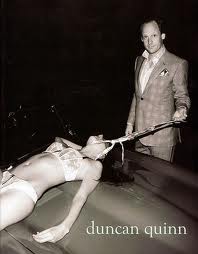
5) Does the image suggest that sexual availability is the defining characteristic of the person?
This American Apparel ad, with the copy “now open,” sends the message that this woman is open for sex. She presumably can be had by anyone.

6) Does the image show a sexualized person as a commodity that can be bought and sold?
By definition, objects can be bought and sold, and some images portray women as everyday commodities. Conflating women with food is a common sub-category. This PETA ad, for example, shows Pamela Anderson’s sexualized body divided into pieces of meat:

And this album cover shows a woman being salted and eaten, along with a platter of chicken:

In the ad below for Red Tape shoes, women are literally for sale and consumption, “served chilled”:

7) Does the image treat a sexualized person’s body as a canvas?
In the two images below, women’s bodies are presented as a particular type of object: a canvas that is marked up or drawn upon.


The damage caused by widespread female objectification in popular culture is not just theoretical. We now have more than 10 years of research demonstrating that living in an objectifying society is highly toxic for girls and women. I’ll describe that research in Part 2 of this series.
Cross-posted at Ms., Caroline Heldman’s Blog and Sociological Images
Popular Posts on BroadBlogs
Anything Good About Being A Sex Object?
Sex Objects Who Don’t Enjoy Sex
Does Porn Objectify? Experts Disagree
Share this:

Are Men More Homophobic Than Women?
 There is plenty of bad news on the gay/lesbian front. Suicides, gay-bashing. At one point a gubernatorial candidate maintained that “homosexuality is not an equally valid option” but felt women having sex with horses was hot. Historically, men have been more homophobic than women. But why?
It’s common to think of gay men as woman-like. Some act feminine, feminine stereotypes abound, and gay men do often perform sexually like women.
The very idea that men might be like, or act like, women is pretty threatening to manly men. But even more so when manhood feels insecure.
Men acting anywhere in the realm of womanhood collapses the great divide between male and female. Seeming more the same, male dominance and status are at risk.
Further, if gays and lesbians couple together no one can be the male head of home. Another blockage to male dominance.
But in the last four years the level of homophobia among men has dropped drastically, according to a more recent Gallup poll. Today men are no more homophobic than women. What happened?
Importantly, women’s status has risen. If women and men are equal, then men acting like women isn’t the big threat it had once been.
But women and men haven’t achieved full equality yet. So what else is going on?
New York Times columnist, Charles Blow called a couple of experts to get insight into the change in men’s attitudes. He talked with sociologist, Michael Kimmel, who studies men, and Ritch Savin-Williams, Cornell’s Chair of Human Development and an expert on same-sex attraction.
Dr. Kimmel explains that,
Men have gotten increasingly comfortable with the relative equality of ‘the other.’ The dire predictions for diversity have not only not come true, they’ve been proved to be other way.
Additionally, as gays and lesbians come out of the closet people come to see that they are like the rest of us: our fathers and mothers, our sisters and brothers, our friends and coworkers. Who knew they were real people?
Most interestingly, “virulent homophobes are increasingly being exposed for engaging in homosexuality,” as Blow put it. Evangelical Ted Haggard and George Rekers of the Family Research Council have both been outed. A while back, anti-gay megachurch pastor Eddie Long was accused of coercing young men into sex. Some are starting to see that spouting homophobia can be a front for the gay man inside. (Is homophobia acting to decrease claims of homophobia?)
Despite continued gay bashing, things are looking up.
Related Posts on BroadBlogs
Homophobes Aroused by Gay Porn
Higher Suicide Rates in Conservative “Values Voters” States
Gay Marriage Helps Families

 BroadBlogs