Blog Archives
Snow White’s Dark Forest of the Psyche
 Snow White’s popping up all over with two movies, a popular TV series and another on the way. A graphic novel centered on the Snow White fable is out. Even indie rockers and Snoop Dogg are flocking to Snow.
What’s up?
As one of our earliest childhood memories, Snow White has a certain primal appeal. But the lack of plot leaves room to explore the dark forest of the psyche, that shadowy, terror-filled place of dreams that Snow White, and all of us, must make our way through.
As these regions are reflected in Snow White, matters of beauty, power and love loom large. How have they evolved since Disney’s Depression-Era version?
Beauty is crucial both now and then. Though then it was the whole story. Now there’s more.
In Once Upon a Time Queen Regina is less concerned with being fairist than seeking to avenge the lost love that Snow unwittingly took from her.
In Snow White and the Huntsman Snow’s death would bring Queen Ravenna immortality. The Queen is also wounded and angered by a patriarchy that commits sexual crimes without penalty. She thinks herself a righteous avenger.
But beauty does weigh heavily. For much of history this has been a rare source of female power, a lesson Ravenna learned as a little girl. But the pursuit of beauty destroys her.
Which provokes questions: What will we do to gain allure? And might we destroy ourselves chasing beauty?
Certainly, the pursuit of beauty messes with our health as some live on diet coke and cigarettes, becoming malnourished, anorexic or bulimic, which can end in death. Implants too often deaden sensual nerve endings. Some die on the plastic surgeon’s table.
When beauty feels evasive we can get depressed and down on ourselves, a spiritual dying.
Queen Ravenna devours raven hearts to gain eternal youth. An LA Times reviewer suggests this is frighteningly reflective of our times.
Those bloody little raven hearts she seems to be munching would sell like hotcakes if they had half of the rejuvenating properties we witness on screen.
The evil Queen has been deemed a female Darth Vader who loses her humanity, capturing beautiful women and seeking to consume Snow White’s heart so she can remain “fairest of all.”
In our envy, women become alienated from each other. We demean and slut-shame those whose beauty seems to threaten our own, not seeing that the shaming dampens our sexuality. We scorn others’ flaws even as the distain highlights our own blemishes.
No wonder Ravenna, angry at male dominance, directs her wrath at other women. Too often we do so ourselves.
 Or, in one village women disfigured themselves to avoid Ravenna’s evil. How often do women diminish themselves to appease power?
But we find women becoming empowered, too. Disney’s Snow White needs to be rescued. Today’s Snow kicks butt. Sometimes she’s saved. But she saves too. She’s strong, she battles, she defeats Ravenna, ending her reign of terror.
And then there is love. Throughout the decades love remains the most powerful magic. “Love conquers all” is both trite and true. Trite, because we hear it all the time. But maybe we hear it so much because it is true. Love overcomes alienation, reconnects us to one another, brings back our humanity, empowers and offers deep fulfillment.
Perhaps we may have a happy ending, after all.
Popular Posts on BroadBlogs
So Nice We Let Others Hurt Us
Harry Potter’s Hermione: Less Brainy, Brave. More Sexy
My Son Wants to Be Snow White for Halloween
Share this:


Guys Are Getting More Romantic
 Guys are all about getting sex and avoiding love. Guys want random sex more than committed relationships. Women, the old ball and chain…
That’s what stereotypes say. But that’s not what guys say. A large-scale survey called “That’s What He Said” found that young men between the ages of 15 and 19 are more romantic than past generations.
That’s right, 95% of them would rather have sex with their girlfriends or someone they love than with a random girl they don’t know and don’t care about. In fact, over half of these guys don’t want to have sex with a woman unless they really love her. And three-quarters want to lose their virginity to someone they love.
The lead researcher told the New York Times:
In fact, (the young men) often used strong, almost hyper-romantic language to talk about love. (A) boy whose condom broke told me the most important thing to him was being in love with his girlfriend and “giving her everything I can.”
Interestingly, while 61% do say they’d rather have sex with a “super hot” woman than with someone who is smart and funny, 78% would choose a relationship with someone who is smart and funny over super hot. So it logically follows from the above data that if a young man is in a relationship with Smart-and-Funny he’d rather have sex with her, too, right?
Further, if they must choose between sex and love, most choose love. Two thirds would rather have a girlfriend and no sex than sex and no girlfriend. These young men say they could be happy in a sexless relationship.
Sounds mind blowing.
Yet these findings resonate with a recent study of sex on college campuses where casual hookups are supposedly all the rage — yet really aren’t — as well as another large-scale study reported in the 2006 American Sociological Review which found that teen boys were just as emotionally engaged in their relationships as girls.
The researchers cite one surprising force behind the change. Now that internet porn can so easily feed their sex drive, young men can seek love and not worry so much about sex. But young men should be warned: overindulging may lead them to lose sexual interest in real women. (See my post Porn Can Cause E.D.?)
But young men today also have greater emotional depth, or are at least more willing to express it, than men of past generations. That may be due to less sexism and homophobia, leaving men better able to tap into and express emotion, and feeling less need to act macho and prove their manhood and heterosexuality by screwing a girl.
Popular Posts on BroadBlogs
Are Men More Likely to Separate Love & Sex?
Why Are Men Surprised by Breakups?
Men, Women & Internet Porn
Share this:

Teen Cougars at Prom
 A cougar is a hot “older woman” who pursues men twenty years her junior, right? Well, lately teen cougars have been asking junior guys to senior prom.
So why do young women increasingly want relationships with younger men? Once was, girls only dated older guys. As one mom observing the phenomenon explains:
Back in my prom days (when the big slow dance was still “Stairway to Heaven”), I went with a boy who was not just taller than me, but older as well. O.K., I was only a few months younger than him, but that still mattered to my friends and me. We would never have even considered venturing out to the prom, let alone the school parking lot, with a boy in a lower grade, unless we were baby-sitting him.
Why the change? It may be that we no longer expect guys to be “ranked” so much more highly than girls anymore.
We’re not completely over gender ranking, which places males above females. You still see it when a man avoids dating or marrying a highly successful woman, since that success gives her higher rank than him. Or, when guys do girl-things like hopscotch they’re “lowering themselves” and taunted as sissies, wimps and fags — or girls. But girls can climb trees, play with trucks and be tomboys with little worry. And, girls can wear pants but guys can’t wear dresses. Girls aren’t demeaning themselves by doing boy-stuff.
Traditionally, women have wanted someone “older and wiser” as sixteen-year-old Liesl sang to Rolf in The Sound of Music:
I need someone
Older and wiser
Telling me what to do
You are 17 going on 18
I’ll depend on you
But suddenly girls don’t need someone older and wiser.
Furthermore, these girls like “nice guys” who are more respectful and nicer to date than the dominant “bad boys” that girls are thought to prefer.
When they get to college upper-class women often continue favoring younger men:
Here at Dartmouth we have a saying, ‘Get the guy before he pledges’ (because) that way you grab them before they are corrupted by fraternity brothers.
That would be frat boys who work hard to create a “superior man” status by demeaning women as bitches and sluts, and who maintain their independence and invulnerability by avoiding relationships with women, choosing to conquer them in one-night-stands, instead.
But back in high school a senior girl simply reasons, “The senior guys at my school tend to like to go out with the younger girls, so now I guess we are doing the same with younger guys.”
I’m all for gender parity. Why not?
Popular Posts on BroadBlogs
Should Women Play Hard To Get?
The Allure of Bad Boys
Share this:

Crying Religious Intolerance While Violating Rights
 Last week Notre Dame and more than 40 other Catholic institutions announced they are filing lawsuits suing Obama on the contraception mandate. As usual, they’re claiming that the government is running all over their religious rights.
Meanwhile, bills have been proposed claiming to protect the conscience of employers to opt out of providing coverage that goes against their religious convictions, including the Bunt Amendment and a similar bill in the Arizona Legislature.
Are Catholic Bishops and other employers the only people who hold religious beliefs? Or the only ones whose religious beliefs count?
You’d think so to hear the debate on the matter.
In the face of this war on women progressives have rarely questioned whose religious rights are in play. And so conservatives have undisputedly argued that employers – Bishops or otherwise – must be free to follow their conscience. But that leaves women forced to follow the conscience of their employers. The argument is then framed as “right to contraception” vs “religious rights” which makes the latter stronger since that is undisputedly in the constitution.
Maybe women’s religious beliefs are ignored because the perspective of the powerful tends to trump the perspective of the powerless. The powerful have a history of airing their beliefs and they can bully from their pulpits. The Catholic Church has historically been powerful. Women have not. Business leaders have historically been powerful. Women have not.
I was heartened to hear Salon editor, Joan Walsh, finally make the reverse argument last week, five months after the start of this debate. She pointed out that the Priests have religious freedom backwards as they try to force their religion on everyone else. They and the Republican Right are working to impose their religion on the country. Maureen Dowd and the New York Times editorial page have thankfully followed suit.
Shouldn’t the pious be the ones to sacrifice for their convictions instead of asking everyone else to sacrifice for their beliefs?
And when there is a conflict, the religious beliefs and conscience of those whose bodies, health and well-being are directly affected should certainly trump the conscience of those who simply hold the purse strings.
Popular Posts on BroadBlogs
Markets Must Be Free; Women Must Be Constrained
Strip Searches Strip Our Liberty
Share this:

Lose Virginity, Lose Self-Esteem?
 When women lose their virginity, they can lose self-esteem, too, experiencing a small drop. That’s what a recent Penn State study reveals.
Why?
Women college students were surveyed over time. Before sex the women felt increasingly good about their bodies. But after first sex they felt worse. Looks like when they’re in bed women start worrying about whether they look good enough. Masters and Johnson tagged the phenomenon of watching yourself from a third person perspective instead of focusing on sexual sensations or your partner, “spectatoring.” Women are much more prone, being the objectified. Then, feeling they don’t measure up, self-worth drops.
Other usual suspects may also affect self-esteem, including the double standard that provokes worries about labels like slut and whore. Tracy Clark-Flory over at salon.com points to a 1995 study that found “women were significantly more likely to report that their first sexual experience left them feeling less pleasure, satisfaction, and excitement than men, and more sadness, guilt, nervousness, tension, embarrassment, and fear.” Even now women continue to experience that bind.
The double standard strikes again when women feel used, unappreciated, and worried about reputations after short flings or one-night stands.
Meanwhile, a study I recently posted finds 35% of women in strong partnerships feeling sad, anxious, restless, or irritable, after sex. Researchers don’t know why. Commenters, speculating on their own experience with the phenomenon, fingered sexual repression or difficulties with orgasm (which are related to repression) as culprit.
Studies repeatedly find that women are less likely than men to enjoy sex. Other research suggests the problem is not biologically based, or inevitable. Women in sex-positive cultures enjoy sexuality a great deal.
We are going to have to move beyond sexism for women to reclaim their sexuality. That would benefit both women and men.
Popular Posts on BroadBlogs
Are Women Naturally Monogamous?
Are Women Culturally Monogamous?
Surprises in Indiana University Sex Survey
Share this:

My Son Likes Girl Stuff. Is He Gay?
Random Moms across America think they know: My son has got to be gay. He wears khakis today but wore a dress to school from age 4 to 6; he used to do ballet and still doesn’t like sports; in preschool he was all about playing princess but now is all about Pokemon; and, in spite of the clear gender divisions in third grade, he plays with both girls and boys. I mean, what straight boy is into that kinda freaky gender mash-up?

This mom knows better, and she goes on to remark that, actually, butch boys can grow up to be gay, and fem boys can grow up to be straight.
Interestingly, few moms worry that their little tomboys will grow up to be lesbians.
But this mom gets LOADS of advice on how to turn her son “boyish.” Take away the girly toys and clothes, and enroll him in sports!
So much worry about girly boys.
Yet what we think of as “girl stuff” turns out to be “boy stuff” in other times and places.
Boys shouldn’t wear pink? Years ago the country staged a great debate on whether pink or blue should designate girls or boys. Some advocated pink for boys – such a robust color! Blue is so dainty.
The Cabbage Patch craze of the last generation led a lot of boys to want dolls. One of my little boy cousins got one for Christmas. Today most people would call him a manly man, complete with wife and baby. (And G.I. Joe is a doll, too.)

Ancient Roman men wore skirts, though the one on the left is armored! (A likely relief to some macho men out there.) Other Roman men wore dresses (robes).


And we mustn’t forget men in tights, circa “Romeo and Juliet.”

Moving on to the court of the “Sun King,” Louis XIV, we find him wearing lots of lace, ruffles, curls, and color. And gracefully posed!


The American founding fathers had considerably less glitz, but they still wore more color, lace, ruffles, and curls than most men today would be caught dead in. They also hired instructors to help present a more graceful appearance. One of my male students asked, “Ok, but what did the manly men wear?” This is what they wore!

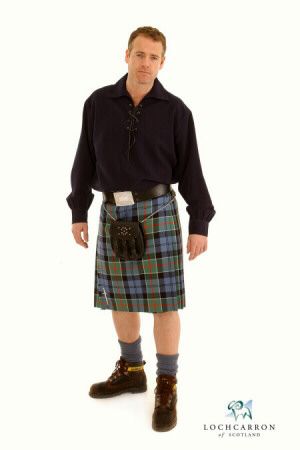
In more modern times, Scottish men can still be partial to skirts, though they call them kilts. Below are traditional and more recent versions of the garment.

Judges, priests, and scholars also continue to wear “dresses” today.


Perhaps the most surprising expressions of manhood come from a culture entirely different from our own: the Wodaabe of Nigeria in Africa. There, men adorn themselves with makeup and jewelry. Because white eyes and teeth are part of the beauty ideal for men, they often roll their eyes and show their teeth to show off these features.

In our own time and place there’s Rod Stewart, who seems to be strongly hetero by all accounts. But check out these shots:


There’s a difference between sex and gender. Sex is biologically-based. It’s made up of our genes (xx for girls, xy for boys), hormones (testosterone, estrogen), anatomy (vagina, penis, breasts, etc.). But gender is all made up. Or what cultures make up to mark biological differences.
If clothing, makeup, jewelry and toys aren’t naturally “boy” or “girl” things, how can doing “boy” or “girl” things mark sexual orientation?
Popular Posts on BroadBlogs
Sex Objects Who Don’t Enjoy Sex
“Cock” vs “Down There”
Men: More Homophobic Than Women?
Share this:

Men’s Mags Celebrate Varied Body Types
 From time to time men’s magazines exalt body types that vary from the tall, skinny, buxom shape they typically flaunt. True, the lovely ladies on Maxim’s and FHM’s “Hot 100” lists look pretty much the same, but it’s nice to see a little branching out now and again, so let’s celebrate what we can.
Small Busted Bombshells
While buxom breasts are a highly appreciated part of the female form, Mila Kunis was just named #3 on Maxim’s Hot 100, which considers their picks “the definitive list” of the world’s most beautiful women. Mila also made #9 on FHM where male readers vote for their faves. Also on that list are Kristin Stewart, Paris Hilton, Pippa and her sister Kate Middleton, the Duchess of Cambridge. And Keira Knightly once made FHM’s #1 hottest hottie.
“Un-Skinny” Stunners
Slim figures are also admired, but Kim Kardashian, along with Scarlett Johansson and pear-shaped Jennifer Lopez, made FHM’s top 100 this year. And, Christina Hendricks, “Joan” of Mad Men, was picked as a “Girls We Love” covergirl.
When women see men gaping in appreciation of Joan’s full figure, I’m sure they are better able to appreciate their own curves. And when Mila Kunis asked Justin Timberlake if her breasts were too small in “Friends With Benefits,” I’m sure plenty of women were happy to hear him respond, “They’re breasts, aren’t they?” No problem. And then he falls in love.
Opening up the ideal is good for both women and men, even if there is still far to go.
When a woman sees herself as beautiful her self-esteem rises. It’s also easier to feel sexy. And when she feels sexier her interest in sex rises, too. She isn’t distracted, wondering if she’s attractive enough. And, women tend to get aroused by feeling that their partners see them as alluring. Plus, when men see that the ladies they love resemble Maxim’s Top 100 in some way, they can more easily see the beauty of their partners.
I suspect most women overestimate how harshly men see them and I suspect that most men are more accepting of women’s bodies than women are, themselves. So that’s good news ladies.
Our society’s ideals don’t have to determine our self-esteem, but they usually play a heavy role both in how we see ourselves and in how others see us. And so while we can work to move beyond the superficial, we’d all benefit if our culture expanded its notions of beauty, too.
Popular Posts on BroadBlogs
Lose Virginity, Lose Self-Esteem?
Beauty Tricks to Remove Your Power
Being Sexual vs Looking Sexual
Share this:

Vibrators Were Invented to Cure Hysteria
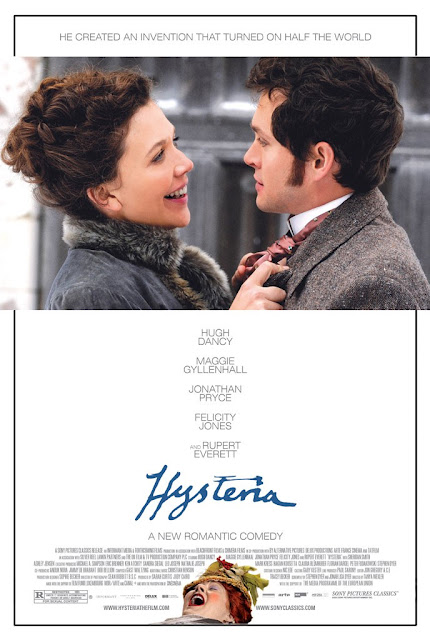 Hollywood has made a major motion picture that’s all about vibrators and women’s orgasm. Who da thunk? In a series of new movies, women’s sexuality is making its film debut.
“Hysteria,” tells how vibrators were created. Dr. Joseph Mortimer Granville fabricated the device around 1880 to cure “hysterical paroxysm,” a condition that had been concerning the medical community since Hippocrates.
Symptoms included anxiety, sleeplessness, irritability, nervousness, fluid retention, insomnia and erotic fantasy, and was thought to result from a blocked reproductive system. The cure involved clitoral stimulation to orgasm. But women should not necessarily administer the cure themselves. As The Guardian explained:
Avicenna, the Muslim founder of early modern medicine, advised women not to treat themselves for the condition. It was, he wrote, “a man’s job, suitable only for husbands and doctors.”
So strangely, vibrators were created as a medical device having nothing to do with women’s pleasure – or so the good doctors thought. Sex, in fact, was believed to have little to do with women’s satisfaction at that time.
Vibrator as medicine and not sex aid? That’s probably why it managed to be the fifth electrical device to be mass marketed at the turn of the last century, right after the sewing machine, the fan, the kettle and the toaster. And that’s certainly why Sears was selling it in their 1918 catalog.
In bringing women’s sexuality to the screen, Hollywood has changed direction. There, sexuality had always been about men’s, with women’s body parts the focus of male desire.
The notion that sex is for men, while women look good for them, seems to have real-world impacts. In casual college hookups women often give men blow jobs while they go without, reasoning that men need sex but they don’t so much. Or, Caroline Heldman, Assistant Professor at Occidental College, found that women are often focused on how their bodies create men’s pleasure while ignoring how they feel sexually, themselves.
Meanwhile, women’s sexuality is thought more dirty and unspeakable, with lots of choice words to describe the sexual woman (slut, ho, skank…). Or, Viagra ads appear on TV but aids for the female libido are off limits. Including vibrators, which have even been banned in some states. Not surprisingly, “Hysteria” took seven years to make because producers balked. As producer Tracey Becker, explained,
When it came right down to it, we had this script which dealt with these very blush-inducing themes and most of the time it was in the hands of a male executive, who had the veto power.
With a slate of female directors making films like “Hysteria,” “Take This Waltz,” “Elles,” “2 Days in New York,” and on the small screen, “Sex and the City” and “Girls,” women’s sexuality is beginning to come out of the Hollywood closet.
Popular Posts on BroadBlogs
Sex Objects Who Don’t Enjoy Sex
Wanting “X” from Sex, but Doing “Y”
Does Porn Objectify? Experts Disagree
Share this:

Women Don’t Rape, They’re Merely Insatiable
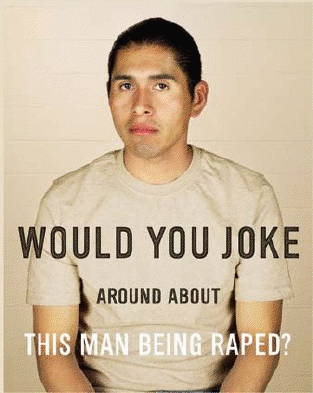 A 43-year-old German man met a 47-year-old woman in a bar. He went to her home and had sex with her, but when he wanted to leave she trapped him and demanded more. Seeing no other choice he agreed, expecting that afterwards she would let him go. But more wasn’t enough. Desperate, he fled out a balcony and cried for help.
She met her next victim on a bus. After his ordeal he was found “sobbing in the street” and begging the police, “Oh God, it was hell. I can’t walk. Please help me.” Sounds like she wounded him to prevent his escape.
Police charged her with sexual assault and illegal restraint. Yet the press is not calling her what she is: a rapist.
Beneath a photo of a couple in bed, the Mirror described the woman as a “nymphomaniac” while the Province posted the story next to a couple pictured blissfully in bed, and called the woman merely “insatiable.”
The inability to see this as rape likely stems from stereotypes about what rape is and who commits it.
Some people simply can’t conceive that men can be raped or that women can rape men. And that is likely mixed up with notions that men always want sex, and are – or should be – insatiable, themselves. And then there’s the belief that men can always overpower women, regardless of “technical help.”
Other stereotypes hold for both male and female victims. Such as, “What do you expect if you go to his/her apartment?” Or, “Once you say ‘yes’ you can’t say ‘no.’”
Some believe “rape myths” (false notions about rape) because that’s what they’ve always heard. Others hold to them because they make them feel safe. If a woman believes that only “bad girls” get raped, then she can feel more safe and secure. If a man believes that women can’t rape men, then he can feel secure, too.
Some just don’t get that rape means “sex without consent.”
Popular Posts on BroadBlogs
Orgasm: It’s All in the Mind
Does Porn Objectify? Experts Disagree
Non-Sex Reasons For First Sex
Share this:

The Cure for Cellulite
 FDA-approved Cellulaze can get rid of cellulite with one doctor’s visit. The cost ranges from $2,500 to $12,000 but the procedure promises long-lasting results.
Only problem is that cellulite doesn’t actually need curing. Ninety percent of women past puberty have it. It’s simply the way women’s fat lays on their bodies. If you are a woman without cellulite there may be a problem, such as too-low bodyweight.
While cellulite is perfectly natural, Cellulaze works by singeing healthy connective fibers inside your body with a laser. It may be FDA-approved but this doesn’t sound too healthy.
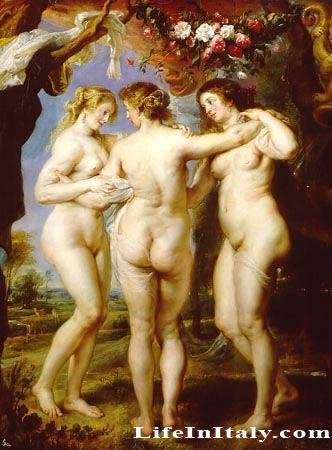
Once upon a time cellulite was thought beautiful, as with the voluptuous women Rubens painted happily dancing in their dimpled flesh.
In her book, The Beauty Myth, Naomi Wolf points out that cellulite was classified as unsightly, disfiguring and “polluted with toxins” by Vouge in 1973.
Untrue. But a good way to sell magazines offering advice, along with products and procedures advertised in their pages to hide or get rid of it.
Wolf goes on to observe:
Women’s flesh, you could acknowledge, is textured, rippled, dense, and complicated; and the way fat is laid down on female muscle, on the hips and thighs that cradle and deliver children and open for sex, is one of the most provocative qualities of the female body. Or you could turn this into an operable condition…
How can an “ideal” be about women if it is defined as how much of a female sexual characteristic does not exist on the woman’s body?
Do we need a cure for cellulite? Or do we need to cure a sick society that is obsessed with finding ways to make women feel bad about themselves? And might the best remedy be love for your body instead?
Popular Posts on BroadBlogs
Lose Virginity, Lose Self-Esteem?
Beautiful Women’s Hips Are Thinner Than Their Heads?
You Are “Less Than”?

 BroadBlogs