Category Archives: objectification
And the Most Sexist Halloween Costume Award Goes to….
by Carrie Baker @ The Ms. Magazine Blog

It’s that time of year again—Halloween!–when corporate America encourages girls and women to celebrate our inner sluts.
I took my 11-year-old son to a newly opened “Halloween City” in the small southern town where I live. After wading through all the wonderfully gory zombies, steam- spewing skeletons and catapulting ghouls, we came to the costumes.
From past experience, I generally know what to expect, but even I was surprised at what I saw. All along the back wall in Halloween City were pictures of hundreds of costumes for females displayed under a sign that read “Hot! Hot! Hot!”
I’m amazed at the ability of Halloween marketers to turn any kind of cartoon character, profession or sport into a sexpot costume for women and girls. The sexed-up witch, nurse or cheerleader is predictable, but here’s what I also found:
Police officers: “Officer Naughty,” “Your Busted,” “Handcuff Hottie,” “Dirty Cop” and “Sexy Border Control Costume.”
Fire fighters: “Fire Fox” and “Smokin’ Firewoman.”
Sports: “Tackle Me,” “Boxer Babe” and “Fastball Fox.”
Fairytale characters: “Seductive Snow White” and “Racy Red Riding Hood,” and “Dorothy Diva” (as in the Wizard of Oz).
Pirates: “Pirates Treasure” (yes, she IS the treasure), “Pirate Wench” and “Sex Swash Buckler” for adults, and “Pirate Cutie” for girls, complete with very short, off-the-shoulder dress, hip wrap, fishnet tights and fishnet elbow-length gloves.
Students: To fulfill men’s sexual harassment fantasies, there’s “Teacher’s Pet Sexy.”
At this small-town Georgia store, hypersexualized costumes far outnumbered other costumes for women (by 10 to 1, easily). And there were no sexualized costumes for men, except for pervert costumes like “Banana Flasher” and “Dr. Howie Feltersnatch, M.D. Gynecologist.”
For little girls, there was “Indian Babe” and “Geisha” (sexualizing and exoticizing the non-white other), while for the boys you had the “MacDaddy” pimp costume, complete with hundred-dollar bills.
Many of these costumes come from Dreamgirls. Their Dreamgirl Junior page includes “Robyn da Hood,” complete with corset, lace-up gauntlets and money bag.
After all this, I finally came upon the costume that clearly wins the Most Sexist Award: “Anita Waxin.’” Designed to be worn by men, it includes a long blond wig, artificial breasts, pale flesh-colored stockings and a red lifeguard bathing suit with black hair protruding out of both sides of the crotch. All for $30–a steal!
The costume’s contempt for the female body is palpable. It oozes scorn for women who don’t wax and says that natural women are disgusting and a joke. Can you imagine a world in which comparable scorn for the male body existed to the degree that it ended up in Halloween costumes?
In sum, the costumes I saw at Halloween City are all about women as objects of men’s sexual pleasure, abuse or scorn.
How about you? What Halloween costume have you seen this year that should get the award for most sexist?
Reposted with permission from the Ms. Magazine Blog.
Related Posts on BroadBlogs
My Son Wants to Be Snow White for Halloween
Playboy Doesn’t Objectify Women?
Women Seeing Women as Sexier than Men
Share this:

Miss Representation: How I Look Is What Matters

Girls get the message early on that the most important thing is how they look. Too often their self-worth depends upon it.
Miss Representation premiered last week on Oprah Winfrey’s OWN network, seeking to combat that unfortunate reality. The film opens our eyes to all that creates the message. And offers change.
From the time they’re small, little girls are told they’re pretty – or notice that they’re not told that. They receive gifts of play makeup and vanity sets. They watch endless repeats of Disney princesses on DVD, buy beautiful princess dolls, and then graduate to Barbie or Bratz. All of whom have extensive wardrobes. It’s all about being pretty. Meanwhile, girls and women are bombarded with media images of impossibly beautiful women who are photoshopped up the wazoo, modeling what they’re supposed to look like.
Who’s popular in middle school and high school? Pretty girls. By the time they’re in college young women are under relentless pressure to be hot, as if that’s the most important thing in the world.
Media creates consciousness, but women don’t have much control over media. As Miss Representation tells us, women hold only 3% of the clout positions in publishing, advertising, telecommunications, and entertainment. And women comprise only 16% of producers, writers, directors and editors.
And so women come to see themselves through men’s eyes.
Meanwhile, media makes its money through advertising. And advertising works by making people feel bad about themselves so that they’ll buy products to “help.” But if the feminine ideal is impossible to achieve, women can buy an endless stream of products and still feel eternally insecure.
Jennifer Siebel Newsom, Miss Representation’s writer-director, makes this observation:
When youth are engaging in cutting and other forms of self-injury, when 65% of American women have eating disorders, when depression rates have doubled in the past ten years, when plastic surgery has tripled in the past decade amongst youth in particular; when you look at that you think Something is wrong. This is not healthy.
Fashion magazines are especially harmful. Girls and women who read them have worse body images than those who don’t. But women aren’t the only ones affected. Just looking at those “perfect” models can leave men finding real women less attractive, too.
So women and men who compare women to unattainable ideals both end up dissatisfied and estranged from each other.
Too many women sit in their inadequate, one-dimensional corners opposite too many men who do the same thing.
And no one is better off.
Popular Posts on BroadBlogs
Grade School Lingerie
500 Calories + Pregnancy Hormones = Perfect Body
Women Want Good Sex, Men Want Cuddling
Share this:

Man as Object: Reversing the Gaze

Della Calfee. Ass Like That
“Men act and women appear. Men look at women. Women watch themselves being looked at,” art critic John Berger famously observed.
Now some feminist artists are turning the tables in the exhibit, Man as Object: Reversing the Gaze:
With a gallery filled with men stripped naked this body of work exposes women’s cheeky, provocative and sometimes shocking commentaries on the opposite sex (which) may make the viewer squirm a little. But that is precisely the point.
The exhibit reveals sundry masculinities from female/feminist/
transgender perspectives, moving from sensuous rear views of the male buttocks to gender-bending to daughters gazing at fathers. Featured artists include Juana Alicia, Nancy Buchanan, Guerrilla Girls on Tour!, Lynn Hershmann, Jill O’Bryan, ORLAN, Carolee Schneemann, Sylvia Sleigh, Annie Sprinkle, Elizabeth Stephens, May Wilson, and Melissa Wolf.
Man as object strikes a pose, buttocks pushed out, offered to us as bedroom eyes shoot a backward glance. Men flex in awkward positions, or bend gracefully into compliant cants. Some men turn submissively into tables.
Others lie down. Natural enough, yet rarely seen in art. Too sensually passive… waiting… vulnerable… or “on the bottom” for mainstream viewing?
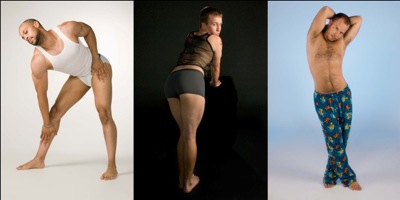
Karen Zack, Man As Object
The visions can come across as “gay.” Since sexual pose is so often meant for the male gaze, on some unconscious level we may see it all through male eyes. And that is jarring, too.
The camera pleasurably zooms in on erotic man-parts. Images of male autoeroticism and penises abound, including a piece called “Where’s His Head?” that depicts a giant phallus-man fondling his much smaller man-phallus. Indeed! And when Pinocchio tells a lie, it’s not his nose that grows. More like a woody that “lasts more than four hours.” Actual penises are rarely displayed, apparently unable to live up to what Richard Dyer called “the mystique implied by the phallus.”
The exhibit includes a lenticular postcard (turn it one way and it’s a woman, turn the other and it’s a man) that juxtaposes Courbet’s “Origin of the World” with a close-up vagina shot versus ORLAN’s “Origin of War” with a penis close-up.
At times men are objectified in one-dimensional, controlling and demeaning ways. But sex-positive feminist photographer Shiloh McCabe explores the other side, working to ensure that her gaze does not consume or dominate. She takes a wide view, seeing those who are usually not. Her subjects help create their own representation so they can retain their power. “I’m not here to objectify or harm; I’m here to nurture and document,” she explains.

Laura Hartford. Graham Reclining
Man as object, Rubenesque, reclining, bathing, cooking, lounging, washing up before bed. Man as Madonna and Child, patriarchal man, veiled man, man as cowboy bunny, trans man. Blonde man in short shorts. Bodybuilder, Founding Father. Homeless man. Nude and vulnerable. Empowered. Bound and submissive. Striking a pose. Objectified.
So much to gaze at. And so much to see.
“In the past it was totally taboo for women to gaze upon the male, yet it was appropriate and common in the reverse,” observes artist Marian Yap. “Do you think that things are changing?”
Good question. This exhibit pushes us out of our taken for granted ways of seeing to explore that path.
Check out a video on the exhibit here.
Man as Object: Reversing the Gaze. Opening Friday, November 4th at SOMArts Cultural Center in San Francisco and running through the end of November. The show will travel to the Kinsey Institute Gallery, Bloomington, IN and will open April 13, 2012 through the end of June.
This exhibition was created by The Women’s Caucus for Art – the founding organization promoting feminist art and art as activism since 1972.
For more information click here.
Ms. Magazine reposted this piece on their blog October 28, 2011
Popular Posts on BroadBlogs
Does Sexual Objectification Lead to Bad Sex?
Men, Women React to Male/Female Nudity
Anything Good About Being A Sex Object?
Share this:

Men, Women React to Male/Female Nudity
By Lisa Wade @ Sociological Images
We’ve all heard the truism “sex sells.”
But whose sex is sold? And to who?
If it was simply that sex sold,
…we’d see men and women equally sexually objectified in popular culture. Instead, we see, primarily, women sold to (presumably heterosexual) men. So what are we selling, exactly, if not “sex”?
What is really being sold is men’s (presumably heterosexual) sexual subjectivity: the experience of being a person in the world who was presented with images that were for his titillation. Women do not live in the world this way. They are not exposed everyday to images that legitimize their lust; instead, the images teach women that they are the object of that lust.
In light of this, Sociologist Beth Eck did a series of interviews attempting to tap into what it felt like for men and women to look at male and female nudes. Her findings were pretty fascinating.
First, she asked men and women to look at naked images of women, including this one of Cindy Crawford:

Women viewing images of female nudes almost inevitably compared themselves to the figure and felt inadequate. Said one women:
…the portrayal of these thin models and I just get depressed… I’m very hard on myself, wanting to be that way.
Women ended up feeling bad whether the model conformed to conventional norms of attractiveness or not. When looking at a heavy set woman, they often responded like this:
I am disgusted by it because she is fat, but I’m also… I need to lose about 10 pounds.
I don’t necessarily find her body that attractive… Her stomach looks like mine.
Men, in contrast, clearly felt pandered to as holders of a heterosexual male gaze. They knew that the image was for them and offered praise (for a job well done) or criticism (for failure to live up to their expectations). About Crawford they said:
Personally I think she is attractive.
I like that.
Both men and women, then, knew exactly how to respond to female nudes: women had internalized their object status (women as sex object-things) and men had internalized their subject status (men were people looking at sexy objects).
Eck then showed them male nudes, including this one of Sylvester Stallone:
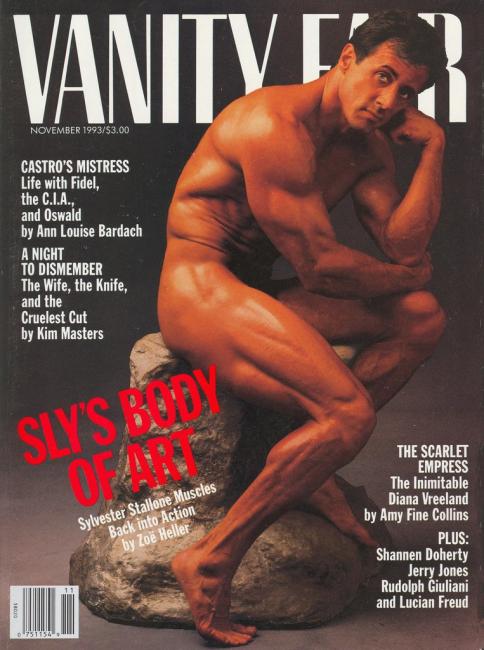
Interestingly, both men and women felt uncomfortable looking at male nudes.
Men responded by either expressing extreme disinterest, re-asserting their heterosexuality, or both. They did not compare themselves to the male nudes (like women did with female nudes), except to say that they were both male and, therefore, there was “nothing to see.” Meanwhile, because men have been trained to be a lustful sexual subject, seeing male nudity tended to raise the specter of homosexuality. They couldn’t see the bodies as anything but sexual objects for them to gaze upon.
In contrast, the specter of homosexuality didn’t arise for women when they looked at female nudes because they weren’t used to being positioned as lustful. Eck explains:
When women view the seductive pose of the female nude, they do not believe she is ‘coming on to’ them. They know she is there to arouse men. Thus, they do not have to work at rejecting an unwanted advance. It is not for them.
Many women also did not feel lustful when looking at male nudes and those that did often experienced lust mixed with guilt or shame. Eck suggests that this may be, in part, a reaction to taking on the active, consuming, masculine role, something they’re not supposed to do.
Summarizing responses to the male nudes, she writes:
Men, over and over again, reject the seductive advance [of a male nude]. While some women welcome the advance, most feel a combination of shame, guilt, or repulsion in interacting with the image…
This is what it means to live in a world in which desire is structured by a gendered sexual subject/object binary. That is, men are taught to be subjects who see women as objects, and women are taught to be objects. It’s not just “out there,” it’s “in us” too.
This piece was originally posted in Sociological Images. A slightly edited version is
reprinted here with permission.
Popular Posts on BroadBlogs
Men: Erotic Objects of Women’s Gaze
Grade School Lingerie
I Can’t Believe I Ate A Whole Head Of Lettuce!
Share this:

Do Women Like Sex Less Than Men?
 Responses to my post asking why women like sex less than men included:
- Says who?
- I think it’s the opposite – I think women like it more
- I don’t think anyone can know who likes sex better
Or as one man put it,
The overwhelming majority of men and women get their attitudes and desires for sex primarily through the natural, healthy desire to have sex… Women are equal to men and thus capable of every form of behavior that men engage in.
To which I respond: no and yes.
Women are certainly capable of enjoying sex immensely. Given their capacity for multiple orgasm, perhaps more. In some societies women are highly orgasmic and take pleasure in engaging in sex with great frequency, as did Tahitian and American Indian women before contact with Europeans.
But highly orgasmic American women? Not so much. Forty-three percent suffer from sexual dysfunction.
While the experience of orgasm is similar for women and men, women are less likely to have one. Sociologist Michael Kimmel surveyed college students on their most recent hookup (where actual sex may or may not have occurred). Only 44% of the men reported having an orgasm. Bad enough. But only 19% of the women did.
Expanding beyond hookups, an Indiana University survey found that 91% of men had an orgasm the last time they had sex but only 64% of women did. And only 58% of women in their 20s had an orgasm in their last encounter.
And orgasm seems to correlate with sexual enjoyment with 66% of women saying they enjoyed sex “extremely” or “quite a bit” while 83% of men did.
Modern American women also have a weaker sex drive, compared with men, with more than one quarter of young women feeling only weak desire according to the Archives of Internal Medicine. Research at the University of Chicago found that 32% of women
(but only 15 -17% of men) have low libidos.
Not surprisingly, 40% of men say they would like to have more sex than they do now, but
only 28% of women feel the same way.
Men don’t want to believe that women are less likely than them to enjoy sex. And women feel insulted if anyone suggests as much.
As I said, women are certainly capable of having great sex. But the extent to which they actually do depends on factors other than just what nature brings them. Repression plays a role as women get labeled sluts and ho’s for indulging. Sexual objectification can leave women more focused on how they look than how they feel. And male dominance takes a toll when it takes the form of rape, incest and child sexual abuse. I’ll explore all this is greater depth in future posts.
Women and men must both deal with a prudish society. But women must also contend with sexism. Still, many think our society has no negative effect. Maybe that’s why we don’t do anything to create change.
Popular Posts on BroadBlogs
Men Have Higher Sex Drive. Why?
Sex and the Walk of Shame
Does Sexual Objectification Lead to Bad Sex?
Share this:

Women as Bunnies: TV Falls Back
While the new fall television lineup is showcasing plenty of strong women – including Christina Applegate, Zooey Deschanel, Debra Messing, Chelsea Handler, Ginnifer Goodwin, and Kristin Chenoweth – there’s an undercurrent of anti-feminist backlash – which is oddly pitched as feminist.
We’ve got Charlies Angels, who are all wet within the first 15 minutes.
Pan Am offers a throwback to air travel’s “‘good old days’ when women didn’t sit in First Class, they just served men who did,” observed New York Times’ Maureen Dowd. Stewardesses strut, Stepford style, “Uniform in every sense of the word. Young, pretty, thin and unmarried, well-groomed and white-gloved… and offering blank smiles of compliance,” says Caitlin Flanagan at the Wall Street Journal.
Not unlike the bunnies who populate The Playboy Club, a show pitched as being all about female empowerment. That’s right. Scantily clad in painful costumes, living in a world where women seemingly exist for the sole purpose of arousing men and being ogled by them. But that’s not demeaning, the producers insist. They’re bunnies, not centerfolds – as though that marks an important difference. Meanwhile the bunnies nakedly play in a pool as men watch them “as if at SeaWorld, only much, much better.”
One observer asked, “Is there something just a little weird about women objectifying themselves (and other women) in the name of empowerment?”
Men are subject. Women, object. Men are human. Women are bunnies, who sometimes reemerge as sea life. Dowd quotes one TV producer describing it all as:
A hot fudge sundae for men: a time when women were not allowed to get uppity or make demands. If the woman got pregnant, she had to drive to a back-alley abortionist in New Jersey. If you got tired of women, they had to go away.
Female empowerment, indeed.
When The Playboy Club’s star bunny was asked at press conference how the show empowered women, she supposed, “It’s just chauvinistic to deny women their sexuality.” But does this show encourage women’s sexual enjoyment, or are they primarily objects in service of others’ desire?
Sold as female empowerment, the shows serve up a subversive message.
Still, the fact that these programs are even posing as feminist suggests we’ve come a long way, baby!
Popular Posts on BroadBlogs
Men Finding Fewer Women “Porn-Worthy”
The Constricting Bodice: Empowerment and Imprisonment?
Keep Your Boobs, Get Better Guys
Share this:

Harry Potter’s Hermione: Less Brainy, Brave. More Sexy
As Harry Potter’s Hermione grew up, her brainy, brave persona turned more sexy, less threatening and less magical, says Sarah Jane Stratford in The Guardian. She continues:
Did Hermione Granger really say “I can’t” during the climactic battle in the final chapter of the Harry Potter film saga? Presented with her chance to destroy one of the horcruxes she had put her life on the line to hunt, she backs away and needs her almost-boyfriend Ron to insist that of course she can.
The transformation of a brave, adventurous girl into a young woman who becomes weakened by, or defined by, her sexuality, has a long literary tradition. The next step, it seems, is to become a mom who is sick or dead.
I discovered this pattern one year when I let fiction take over my usual nonfiction reading habit.
In The Sound and the Fury we meet adventurous, determined and nurturing little
Caddy Compson who is busy exploring the local countryside, climbing trees and sometimes bossing her brothers. Later, she becomes a promiscuous woman, shamed and rejected by her family. And the mother in this story? She’s a neurotic hypochondriac.
Faulkner introduces us to a mother who is dying, and later dead, in the appropriately titled, As I Lay Dying. Her daughter is upset and fixated on her out-of-wedlock pregnancy (instead of her dying/dead mom).
In Atonement creative young Briony Tallis has an over-active imagination that leads to serious trouble. Her older cousin gets raped, and her older sister is overcome by romance. Mom is constantly bedridden with headaches.
Plain Song revolves around a shy 17-year-old whose mother kicked her out after learning she was pregnant. Two young boys have a mom who spends her days locked away, depressed.
I could go on, but you get the point.
If strong, adventurous girls grew up to become strong, adventurous young women, who were also sexual, that would be fine. But too often, sexuality diminishes them or becomes all they’re about.
Maybe that explains why older women (moms) end up sick or dead. Upon reaching womanhood the grown girl leaves behind everything that had empowered and engaged her to become defined by her sexuality. When her allure fades, there’s nothing left.
Which suggests a lesson for real live women. Best to avoid a one-dimensional focus on sexuality that rests on narrow beauty notions. Instead, stay strong and develop many facets of yourself, including an ageless and radiant beauty and sexuality (a la Susan Sarandon, Meryl Streep, Isabella Rossellini, and Hellen Mirren) to enjoy over a lifetime.
Popular Posts on BroadBlogs
Woman, Not the Sum of Flawed Parts
Anything Good About Being A Sex Object?
Boob: A Breast? Or a Fool?
Share this:

Dad Imprisons, Rapes Daughters, Mere Sex Objects
Two Austrian sisters say their father locked them up and both sexually and physically abused them for over 40 years. Now 45 and 53 years old, they lived under this tyranny nearly their entire lives, as reported by The Guardian.
The father, identified as Gottfried W. (Austrians don’t fully identify suspects) threatened his daughters with a pitchfork, a stick, and firearms, repeatedly threatening to kill them if they resisted. The sisters also have mental deficiencies, which the violence may have caused or worsened, further enabling the abuse. Gottfried also forbade contact with the outside world. All of this left the women withdrawn and dependent.
Yet last May the older sister fought an attempted rape, knocking down her now 80-year-old father. Both sisters fled. Days later a social worker discovered Gottfried on the floor. The sisters have been taken in by social services and are receiving psychiatric treatment.
The case only became public last week.
It is all so reminiscent of another Austrian, Josef Fritzl, who imprisoned and raped his daughter in a dark, windowless cellar, where he forced her to live for 24 years.
Makes you wonder what’s up with Austria. Yet in a country of over eight million these cases are the only two of this kind. You might actually expect the opposite in this country. Men who commit incest tend toward authoritarianism (unlike Austrians generally, who came in dead last on a scale measuring autocratic leadership styles) and believe children should obey parents at all times.
But the two men who so savagely raped their daughters fit the profile well. Gottfried
continually bossed and threatened his entire family, while Josef’s children described him as a “dominating tyrant” who frequently beat them.
In incestuous families, there is usually little affection and the mother’s role is often reduced, often due to physical or mental illness. Again, true of these two families.
As a repeatedly abused victim herself, Gottfried’s wife was unable to help her daughters. Josef’s wife was unaware of the cell her husband had built to hold their daughter, and so was unable to intervene. Even as babies were born, Josef simply told his wife that their long lost daughter had left the babies at their doorstep.
Men who commit incest believe that men are entitled to fulfill whatever sexual desires they might have. And they see children as sex objects.
When I first heard complaints about sexual objectification I didn’t get it. I didn’t know what a sex object was. I thought feminists were complaining about grown women and men just being sexy. And the world seemed a bit dull to me without a little sexiness, which I define more broadly than the narrow notions that tie women in knots.
Later I came to understand that when a person is seen as a sex object she (usually) is seen as an OBJECT. A thing. An object thing that is all about sex, and little else. A sex object is not seen as having feelings, a life, dreams, human potential. A sex object exists to satisfy someone else’s purposes. In these fathers’ behaviors we find the more brutal outcomes of this way of seeing.
No, the problem isn’t Austria. The problem isn’t men. The problem is patriarchy, manifested in male dominance over women and girls and less powerful men and boys, sexual objectification and the disempowerment of women.
Related Posts on BroadBlogs
Anything Good About Being A Sex Object?
Men: Erotic Objects of Women’s Gaze
Grade School Lingerie
Share this:

Ogling: Boys Will Be Boys?
“Boys will be boys,” suggested one third of the women who answered my survey on ogling, which asked why some men stare at women’s body parts. Most of these women said their partner’s lingering eyes bothered them at least a little. But if men are “just that way,” maybe they’re less annoyed?
Is it true? Does the male sex drive include an imperative to stare at breasts and bottoms?
Maybe not. Only half of the women I surveyed had dated these distracted lovers. Others said they would be offended if their significant other behaved that way. I never experienced an ogling boyfriend, myself, until my last semester in college.
No. They don’t all do it.
I’m not saying non-oglers never notice feminine charms. Just not in the staring mode that so many of us find rude.
The New York Times reported on a series of studies that might shed some light on the matter.
In one, Florida State University men were asked to assemble a puzzle of Lego blocks. A 21-year-old woman was asked to assist. She wore jeans, a T-shirt, a ponytail and no makeup. Flirting was off limits and she kept eye contact and conversation to a minimum.
Later, the men rated her attractiveness. Single men found her most attractive at the fertile stage of her menstrual cycle, a finding replicated in other studies. Lap dancers, for
instance, get higher tips that time of the month.
But men in relationships found her least attractive while ovulating. Why?
They were relationship guarding. It seems they unconsciously saw the young assistant as more threatening to their relationships when she was most attractive. To resist temptation, they told themselves, “She’s not that hot.”
Another Florida State study found a similar phenomenon. After words like “lust” or “kiss” were quickly flashed, men and women were shown a sequence of photographs and images. Singles gazed longer at attractive pictures of the opposite sex, and they lingered when asked to look at new images.
But those in relationships behaved differently. They looked more quickly away from attractive faces, using subtle mechanisms to rein in a wandering eye. As if to say, “Tempt me not!”
On the other hand, when University of Kentucky researchers made it difficult to focus on good-looking faces, people tried harder to see the forbidden fruit. And afterward, they felt less satisfied with their partners and found cheating more appealing.
Or as Dr. Maner, the lead researcher put it, “We shouldn’t want our partner to be looking at lots of other people, because that’s bad for the relationship. At the same time,” he continued, “preventing them from looking doesn’t help either, and can backfire.”
Self-policing works. Policing your mate may not.
Ogling is not simply a “boys will be boys” phenomenon. Many men are more centered on relationship-guarding than eyeballing the curves that pass by.
Popular Posts on BroadBlogs
Men: Erotic Objects of Women’s Gaze
Sex Objects Who Don’t Enjoy Sex
Staring at Breasts Is Good For Men’s Health? And Women’s?
Share this:

Norway Terrorist is also Misogynist. What’s the Connection?
The Norwegian terrorist who killed scores of people in late July was motivated by racism, particularly Islamophobia. But he is also a misogynist. It’s not unusual for racism and sexism to go hand in hand. But why?
David Futrelle, who blogs about misogyny on Manboobz.com, points out Anders Behring Breivik’s deep sexism on the Ms. Magazine Blog, highlighting quotes like this:
It’s the destructive and suicidal Sex and the City lifestyle (modern feminism, sexual revolution) [that] we are taught to revere as the truth. In that setting, men are not men anymore, but metrosexual and emotional beings that are there to serve the purpose as a never-criticizing soul mate to the new age feminist woman goddess.
Futrelle says Breivik’s rants are typical of “manosphere” blogs, which his manifesto
plagiarizes in part. When a prankster posted his quotes anonymously, they got the “thumbs-up” – at least until his identity was revealed.
Other obsessions of Breivik/the manopshere include no-fault divorce, STDs, and women
manipulating men with their feminine charms. Worried that Islam will out-breed Westerners, Breivik advocates limiting contraception, banning abortion, and discouraging women from education and full-time careers, which “will involve certain sexist and discriminating policies but should increase the fertility rate.”
In his video, “Call to Arms” Breivik displays big-breasted women in tight T-shirts wielding assault weapons. Reduced to sex-object parts plus firearms, she’s the sexist terrorist’s dream girl.

Breivik’s misogyny doesn’t surprise Michael Kimmel, a feminist who studies men, and who says that racist and sexist right-wing movements are largely about manhood. Men who are drawn to them feel emasculated by “Nanny States” that demand equal rights for everyone and whose taxes prevent people from making a free and independent living, as they see it.
These same men also feel that feminism makes men “wimpy, more pacifist, less authoritarian, more ‘sensitive’, less competitive, more androgynous, (and) less possessive.” The merging of masculine and feminine is a problem because how can men be superior if women and men are similar, or equal?
They add racism to further inflate their self-worth. As Kimmel describes it:
White Protestants are set against various “others” who aren’t men the way they are – blacks, Jews, gay men, other non-white immigrants – who are variously depicted as either “too” masculine (rapacious beasts, avariciously cunning, voracious) or not masculine “enough” (feminine, dependent, effeminate).
Bringing sexism and racism together, “real men” can feel “better-than” everyone else.
And by “protecting” white women from (so-called) non-white beasts, they may earn
women’s love and admiration, and further reclaim their manhood.
Breivik and men like him are desperate to feel like they are better than everyone else.
Even when they so clearly are not.
Popular Posts on BroadBlogs
Early Islam’s Feminist Air
Think You’re Not Racist?
Sex Objects Who Don’t Enjoy Sex

 BroadBlogs