Category Archives: objectification
Beastly Breasts. Patriarchy? Or Blasphemy?
 In honor of women’s history month I talked with Brock Neilson, a feminist artist who wonders if he might sometimes unconsciously support patriarchy.
Or, is he blasphemous instead?
BB: It’s very easy for anyone, including feminists, to unconsciously see and think in patriarchal ways, at least some of the time, since we’re all immersed in the system. You wonder if you sometimes unconsciously support patriarchy in your art. How so?
BN: This past year a lot of my art has been about someone – or something — that has enormous or strange looking breasts. These images are what I’d imagine a drunken fraternity or a 12-year-old boy drawing.
I imagine that these kinds of perversions are part of the package with which males are endowed in society, and I feel a responsibility to address that somehow.
Sometimes I might want the breasts to look uncomfortably disfigured or I might want the  viewer to feel a kind of confusion about the body they are seeing. The breasts could also be more humane when they are not perfectly shaped or as easily sexualized, but I worry that I might be reinforcing patriarchy by not allowing something as commonly fetishized as breasts — or the person or entity to which the breasts belong — to just exist without having to be ugly, or strange, or beautiful, or symbolic. However, this concern is unavoidable as these images are being filtered through my nonobjective brain and hands.
The ultimate goal of feminism is to not have to be the mother, the champion goddess, the victim, or even a female or a male in order to have credibility and dignity. It is the hope that everyone could simply be who they want to be without having to force ourselves into degrading positions.
That said, I think it’s important to express these positions — or distortions — of power and powerlessness (and the variations between). My art is preoccupied with the slots we pop people into: the corporate leader, the androgynous, the porn victim, the violent athlete, the disabled or disfigured. I find that I’m often exploring possibilities for a better world by regurgitating things that are offensive to me.
BB: How might your work be blasphemous instead, working against patriarchy?
BN: There’s been a big focus among popular male artists to make big objects and paintings that can be bought and sold — similar to a Wall Street investment. This approach to art is problematic. I have been decorating a lot of brown paper in my work because it’s cheap and accessible. Being a male who is involved in decorating materials that require a kind of gentleness can be a blasphemous act.
I remember overhearing a mother years ago who was telling her five year old son not to smell flowers because she was afraid that this would make him look “gay.” I was so taken back that this innocent behavior — a child smelling flowers — was already perceived as inferior. My work, however crude it may be, is concerned with a hope of reclaiming this kind of sensitivity.
Tawnie Silva, an artist I discovered this last summer, made a beautiful inflatable sculpture of a quirky four-eyed girl with a rainbow coming out of her head. It’s made of fragile plastic bags, but Tawnie Silva’s body is brawny and masculine. It is especially sacrilegious to commercial gender ideals when men make things that are sweet and delicate. Both women and men need to protect and make space for vulnerable things in others and in themselves. This is an important way that we can expand and break dangerous gender stereotypes.
Related Posts on BroadBlogs
Man as Object: Reversing the Gaze
The Constricting Bodice: Empowerment and Imprisonment?
Spoon Fed Barbie
Share this:

What Gossip Magazines & Abusers Have In Common
By Linda Bakke
Star Magazine promotes violence against women.
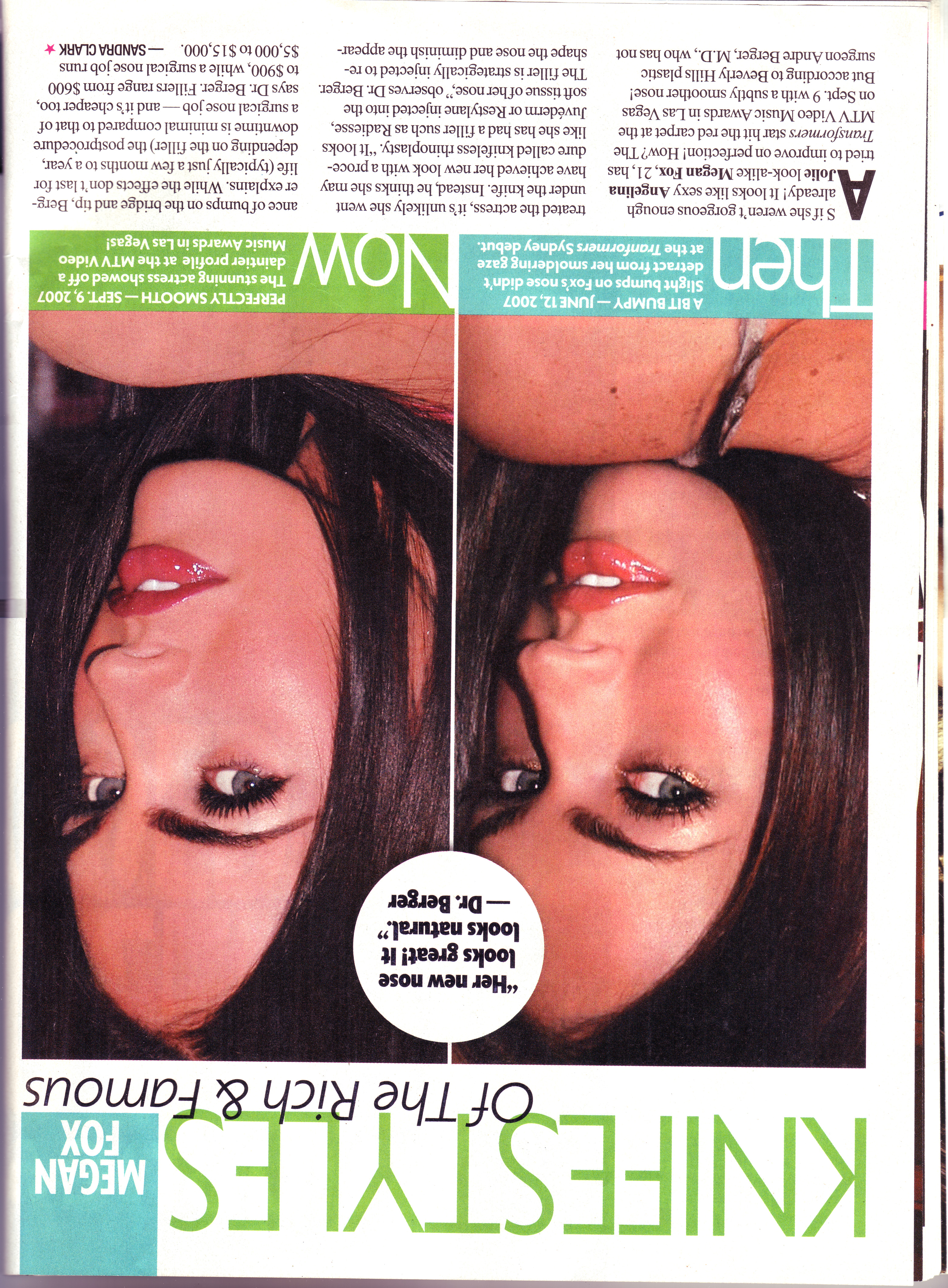 Ok, that sounds like a tabloid headline, but the more I look over Star Magazine, the more I’ve been struck by a sense of violence directed at women.
The starlets are constantly attacked for any extra weight, cellulite, bunions, ugly fingers or thick arms. It feels like open season. “Kill the Celebrity” is the name of the game.
One section called “Knifestyles” advocates mutilating women through plastic surgery. With the accompanying message, “You’re not good enough.”
In fact, Star uses the same devices that characterize domestic abusers: watching the victim’s every move, humiliation, stressing the negative rather than the positive aspects of the victim (who is supposedly adored), using “it’s her fault” to launch an attack, and transferring the abuser’s dissatisfaction with life and himself onto the victim.
After a while, she starts to blame herself.
Paparazzi hunt celebrities down and we all become cannibals of the spoils, savoring the flaws of “perfect” idols as we bring them down a peg.
But it’s not just about starlets. It’s not just their bodies that are under attack. Yours and mine are, too. If they don’t look good, we don’t either.
The depiction of women in gossip magazines represents the degradation, abuse and mutilation of women. We must recognize how damaging these portrayals are for all of us, women, girls, men and boys.
For we are all encouraged to scrutinize and vilify women for being less than perfect.
Popular Posts on BroadBlogs
Men Watch Porn, Women Read Romance. Why?
What Happens When You Beat A Sex Object?
Beautiful Women’s Hips Are Thinner Than Their Heads?
Share this:

Scrutinizing My Body Takes All My Time
On a typical day, you might see ads featuring a naked woman’s body tempting viewers to buy an electronic organizer, partially exposed women’s breasts being used to sell fishing line, and a woman’s rear—wearing only a thong—being used to pitch a new running shoe. Meanwhile, on every newsstand, impossibly slim (and digitally airbrushed) cover “girls” adorn a slew of magazines. With each image, you’re hit with a simple, subliminal message: Girls’ and women’s bodies are objects for others to visually consume.
So says Caroline Heldman, Assistant Professor of Politics at Occidental College, in a piece for Ms.
This notion of bodies for consumption leaves us constantly judging ourselves and others. How do we stack up? How do “they”?
Our friends declare someone too fat or too thin; sitcoms quip on body weight or shape; tabloids spot celebrities’ flaws; men bluster about big boobs; Howard Stern picks women apart and Rush Limbaugh insists feminism was established “to allow unattractive women easier access to the mainstream of society.” (Yes, really, Rush and Howard think they are in a position to make unkind remarks about other people’s appearance.)
All this leads women to “self-objectify” so that we see and judge ourselves through others’ eyes, and especially, the male gaze. Women live in “a state of double consciousness … a sense of always looking at oneself through the eyes of others,” says Heldman.
Self-objectifiers constantly “body monitor” – that is, think about how they look to the outside world. And this often leads to depression, lower self-esteem and diminished faith in their abilities.
Any surprise body monitoring distracts women from tasks at hand, whether math exams or throwing a softball? After all, girls have to split their attention between how they look and what they want their bodies to do.
Body monitoring also replaces the question “Who am I?” with “What image should I project?” It becomes difficult to imagine identities that are truly our own.
What to do? Heldman recommends avoiding fashion magazines, since just viewing those so-called “perfect” images makes women feel less attractive.
She also suggests we voice our concerns to companies and boycott their products.
Too often self-worth is based on unattainable body ideals. And with body image so closely tied to self-esteem, girls and women can end up pretty dissatisfied with themselves.
It wasn’t always so. There has been a dramatic increase in poor body image among women since the mid-20th century. Back then, a woman’s sense of self had revolved more around her talents, abilities and contributions. It was more about who she was than what she looked like. Maybe by shifting focus to who we really are we could more easily emerge out of ridiculous and superficial body consciousness.
Popular Posts on BroadBlogs
Lose Virginity, Lose Self-Esteem?
Harry Potter’s Hermione: Less Brainy, Brave. More Sexy
My Son Likes Girl-Things. Is He Gay?
Share this:

Nude Men Seem Less Intelligent
 The more skin women reveal, the less men see them as intelligent or empowered. Instead, nudity promotes the notion that women are sensitive, “feeling” creatures.
Turns out the perception runs both ways with women seeing men as less intelligent and less competent when they show skin, too. In fact, simply “taking off a sweater — or otherwise revealing flesh — can significantly change the way a mind is perceived” say researchers.
And as psychologist, Kurt Gray of the University of Maryland observed:
This effect can happen even without the removal of clothes. Simply focusing on someone’s attractiveness, in essence concentrating on their body rather than their mind, makes you see her or him as less of an (empowered) agent and more of an experiencer.
Women see partially-clothed men as more sensitive, too, and are disinclined to hurt them. Likewise, most men don’t want to harm unclothed women, either. Perhaps nakedness makes people seem more vulnerable so that we want to protect them.
Interesting. There’s no evidence that showing skin makes men want to rape, and it looks like the opposite effect is more likely. (Of course, some sexual fetishes do combine nudity and violence so the effect isn’t uniform, but that still doesn’t mean nudity causes a person to want to harm.)
Practical take-away? Showing skin can make us seem less competent at work. But it can be great in the bedroom, where it’s all about feeling.
Popular Posts on BroadBlogs
Anything Good About Being A Sex Object?
Men, Women React to Male/Female Nudity
What Happens When You Beat A Sex Object?
Share this:

David Beckham’s Sex Sells
 This Super Bowl Sunday the tables turned — at least a little — as “sex sells” warped into the alluring form of David Beckham, who flaunted his buffed bod to promote his H&M bodywear.
As Mary Elizabeth Williams over at Salon described it:
He flexes his numerous tattooed muscles to the tune of “Please Don’t Let Me Be Misunderstood,” glowers in an “I mean business here” way that’s remarkably persuasive, and uh, I forget what I was talking about.
See the ad here.
Does Beckham bring balance to the scales of objectification? From Ryan Reynolds to Ryan Gosling to Taylor Lautner men’s bodies are increasingly drooled over.
While we are seeing more sexy guys, the fact that it’s newsworthy says it’s a bit unusual.
 But last November DETAILS’ tackled men’s rising fixation with their bodies. Their slide show traced the phenomenon from 1986 home gym informercials through Mark Wahlberg’s giant Times Square boxer briefs ad (that snarled traffic in ‘92) to the emergence of light beer and the “the slim silhouette.” By 2002 Us, In Touch, Star and OK! eagerly exposed men’s six-packs. In 2008 Beckham’s Armani briefs overtook giant billboards on Main Street. And Emma Stone could be heard shrieking, “Seriously?! It’s like you’re Photoshopped!” as she gaped at Ryan Gosling’s rippled abs in Crazy, Stupid, Love.
So is this a turn for the good?
I don’t think it’s a problem to see some sexy men and women in ads. The problem comes when this is the main way people (okay, women, in reality) are portrayed.
And when ALL we see is sexy women, even women start to see females as “the sexy ones.” What are we supposed to look at? It’s hot to see some sizzle emerge in a male form.
And so long as men continue to be portrayed in plenty of other ways Beckham, et al., will hardly transform men-at-large into sex objects.
On the other hand, men are becoming more body-conscious and young men are increasingly falling victim to anorexia and exercise addiction, while cosmetic surgery has increased 88% among men between 1997 and 2011.
Some had hoped that if men were objectified they wouldn’t like it and would stop objectifying us. Instead, men and women now both obediently follow body “perfecting” dictates.
But then, it’s not men so much as marketers, male and female, who know that 1) pretty bodies draw attention, even when they have nothing to do with the thing being sold and 2) inciting insecurity moves a lot of product as we spend endless sums hoping to embody a phantom perfection.
Popular Posts on BroadBlogs
Man as Object: Reversing the Gaze
Men, Women React to Male/Female Nudity
How to Look Like a Victoria’s Secret Angel
Share this:

Does Porn Objectify? Experts Disagree
 When men view porn do they see women as mindless objects? Psychologist, Kurt Gray and his colleagues wanted to know.
Humans have needs, goals, emotions, the ability to act, and hopes and dreams for the future. Mere objects don’t.
So the researchers showed men pictures of women in various states of dress and undress and asked how much “agency” they had, meaning self control and the ability to plan and act. They also asked about their ability to feel fear, desire and pleasure.
The study focused on these two areas because research on the mind shows that that’s how we categorize humans.
Turns out, the more skin women reveal, the less they seem agentic, but the more they are thought to feel.
Men seem to see nude women as a completely different sort of human from themselves. Naked women are “feeling” but not “thinking.” More “animalized” in nature. Interesting that sexualized women have been portrayed as bunnies, pets, cougars and sex kittens.
The researchers conclude that women are not mere objects, after all.
Yet “objectification” isn’t always understood as “unthinking and unfeeling.” It often means seeing people — usually women — as one-dimensional beings that are ALL about sex. If a man is getting off on a woman’s pain or pleasure, that’s a part of the porn experience. He may be drawn to her pain, and at the same time not care that she wants it to stop. So long as he is aroused, that’s all that matters. Regardless, sex objects exist to serve the desires of others.
The Stanford Encyclopedia of Philosophy defines objectification as: treating someone as lacking agency, autonomy and self-determination, and as a tool for the objectifier’s purposes; treating a person as something that is owned and whose experiences and feelings needn’t be taken into account.
Even men who use porn a lot frequently describe it as objectifying women. Fortunately, many can still make a distinction between objectified porn stars and the multi-dimensional women in their lives. And as the researchers point out, it’s fine to be all about sex and feeling if you’re in bed with your lover. Just not when that’s ALL women are about ALL the time. But some women complain that when they’re trying to make love they feel more like objects that are just being used. That’s another symptom of the problem.
As Scientific American concludes, “There is, it turns out, more than one kind of ‘objectification.’”
Popular Posts on BroadBlogs
Does Sexual Objectification Lead to Bad Sex?
Sex Objects Who Don’t Enjoy Sex
Anything Good About Being A Sex Object?
Share this:

Men Who Hate Pretty Women
Let’s say I see a woman and she looks really pretty and really clean and sexy and she’s giving off very feminine, sexy vibes. I think, wow I would love to make love to her, but I know she’s not interested. It’s a tease. A lot of times a woman knows that she’s looking really good and she’ll use that and flaunt it and it makes me feel like she’s laughing at me and I feel degraded…
If I were actually desperate enough to rape somebody it would be from wanting that person, but also it would be a very spiteful thing, just being able to say ‘I have power over you and I can do anything I want with you’ because really I feel that they have power over me just by their presence. Just the fact that they can come up to me and just melt me makes me feel like a dummy, makes me want revenge.

When talking to men about women, Michael Kimmel, one of the nation’s leading researchers on men and masculinity, found that many men’s reactions became surprisingly aggressive. He cites a Men’s Health survey which found that one third of men believed women should be reported for sexual-harassment for their provocative dress. Or, a college chaplain claimed, “The way young women dress in the spring constitutes a sexual assault upon every male within eyesight of them.”
Kimmel says the anger comes from men feeling entitled to women’s bodies. And he says that’s not so surprising given all the “come-on” scantily clad images that surround them, whether in mainstream media or porn. According to Kimmel:
Guys believe that they are entitled to women’s bodies, entitled to sex. Unfortunately for them, a significant number of women don’t see it that way. And when entitlement is thwarted guys seek revenge.
Curiously, while psychologists, feminists and the legal system see male aggression as the initiation of violence, guys describe it not as initiation but as retaliation. What are they retaliating against? The power that women have over them.
All this came as a shock to me. I had known that many men love seeing sexy women on the street, in a bar, at work… I hadn’t known that others found the same visions torturous, as they craved what they couldn’t have. And resented the “rejection.” Maybe some men feel both ways, pleasure and resentment all at once.
The opposing perspectives are striking. Men who enjoy sexy women often feel powerful, believing the women choose to dress alluringly for their pleasure, to please men. Some even think women dress provocatively to feel sexual pleasure in feeling desired. Men who feel this way are turned on, and not angry.
Whether experienced as pleasure or pain, an awful lot of men take women’s appearance personally, thinking it’s about them.
Yet most women dress for their own self-esteem, leading to a double-bind when it comes to dressing sexy: damned if you do, damned if you don’t.
Women feel tremendous pressure to be beautiful because society rewards them. Their self-worth often depends on it. But then women can end up objectified — being seen as all about sex and little else, or (now we know) leaving some men angry at them.
What’s a girl to do? What’s a guy to do?
Here are some thoughts. Maybe you have some ideas, too.
Some men learn that they should have power over women so that when it’s the other way around, they may feel angry and resentful. See women as your equals — neither less-than nor better-than — and respect them.
Some men come to feel entitled to women’s bodies. Know that we are all entitled to our own bodies, first and foremost.
To those who think that women flaunt their beauty as they laugh and degrade you, know that that’s not what’s happening. Women are simply trying to do what society tells them to do: look beautiful.
Many women and men unfortunately learn to see women in one-dimensional ways that are based on narrow notions of “beauty.” How about expanded vision? Why not enjoy beauty in its many forms and see women as people rather than sexy objects. And instead of being angry at women who aren’t interested in you, see the beauty of those who are.
A commentor calling himself Ocelot wrote an interesting reaction to this that I published, with permission, as a blog post. “Seeing Women as Magic and Evil” offers help for men struggling with this issue.
Popular Posts on BroadBlogs
Anything Good About Being A Sex Object?
Men, Women React to Male/Female Nudity
Man as Object: Reversing the Gaze
Share this:

Modesty Objectifies Women Says Nude Egyptian
 Posed in nothing but sheer black polkadot stockings, red patent leather shoes and a red hair clip, Egyptian blogger, Aliaa Mahdy struck a blow to the objectification of women.
Strange. We usually hear that nudity objectifies.
Nudity and modesty don’t mean anything in themselves. The question is: what are they creating in any particular situation?
And Mahdy believes that strict modesty expectations in Egypt help to create “a society where women are nothing but sex objects harassed on a daily basis by men who know nothing about sex or the importance of a woman.”
But how could modesty objectify? Consider the most extreme example:
Women who live in Taliban-controlled provinces of Afghanistan are expected to cover themselves head to toe with mesh across their eyes. There, a woman’s ankle is thought incredibly sexual, as are her arms and face and eyes and hair. Every part of her body becomes sexualized through extreme modesty.
But the entire body needn’t be covered for this surprising effect to arise. One young Christian woman found that less radical modesty objectified her, too:
Modesty taught me that what I looked like was what mattered most of all. Not what I thought. Not how I felt. Not what I was capable of doing.
Modesty made me objectify myself. I was so aware of my own potential desirability at all times that I lost all other ways of defining myself.
Supposedly women should be modest to protect themselves from rape or sexual harassment. Yet “immodest dress” does not force men to rape. And sexual-harassment runs rampant in places where women are fully covered.
Rebecca Chiao tracks sexual harassment and assault in Egypt where she says both are ubiquitous, “Every time you walk out of the house, you are under attack – physically and verbally,” she says. “The reports we get are graphic and angry.”
And as reported in The Guardian:
In a 2008 survey, 83% of women reported having been sexually harassed. Almost three-quarters of Egyptian women who said they had been harassed were veiled and 98% of foreigners said they had been intimidated or groped.
Sexual harassment is a huge problem in Afghanistan too, a place where women couldn’t be more covered. Last July Afghan women marched against the widespread harassment women face there. Noorjahan Akbar, who organized the protest said:
Every woman I know, whether she wears a burqa or simply dresses conservatively, has told me stories of being harassed in Afghanistan. The harassment ranges from comments on appearance to groping and pushing. Even my mother, who is a 40-plus teacher always dressed in her school uniform, arrives home upset almost every day because of the disgusting comments she receives.
These women are sexually harassed despite modesty. But then, the puritanical focus seems to actually define women primarily as sexual beings.
Meanwhile, when women work to broaden themselves, punishment may be administered via a convenient – and hypocritical – appeal to the honor of virginity which modesty supposedly guards.
At one point Egypt’s military sought to suppress women’s voices and power by stripping activists of their clothing and performing “virginity tests” by which two fingers were inserted into their vaginas. Sexual assault parading as a test of “honor”! Yet this brutality was really a tactic to humiliate and silence, observed Mona Eltahawy of The Guardian.
Women journalists are clear models of empowerment so it’s no surprise that they are under attack. So much so that Reporters Sans Frontieres recommended media stop sending female journalists to cover Egypt after two high profile sexual assaults.
No wonder nudity and sexuality arise as political protest in this atmosphere. Eltahawy of The Guardian continues:
When a woman is the sum total of her headscarf and hymen – that is, what’s on her head and what is between her legs – then nakedness and sex become weapons of political resistance.
Modesty isn’t itself a problem. Many women choose modesty for reasons they find meaningful and significant. Modesty becomes a problem when an obsessive focus on women as sex lies behind it.
Reposted on Daily Kos (Spotlight)
Popular Posts on BroadBlogs
Does Sexual Objectification Lead to Bad Sex?
Anything Good About Being A Sex Object?
Men, Women React to Male/Female Nudity
Share this:

Why Are Men Surprised by Breakups?
Over the years I’ve dated men who’ve ogled other women. Actually, only four men behaved that way, most weren’t so rude. When I told them their behavior bothered me, it had no effect. One responded, “Someday you’ll have a breakthrough and get over it.”
Instead of breakthroughs, I broke up with each of them. They were all shocked.
Sometimes the surprise happens differently, as when men “hear” me say that I like what I don’t.
When I was in college at BYU some of the students believed that although Mormons no longer practice polygamy (only “Mormon Fundamentalists” do) polygamy was the way of Heaven. (A religious instructor said this wasn’t the case. I haven’t been to church in years and don’t know what the common view is now.)
Still, I heard men say they couldn’t wait to have many wives up in Heaven. Put off, I asked men how they felt about polygamy. I told one man that it pissed me off. But projecting his own interest onto me, he was certain that I was as intrigued by the idea of heavenly threesomes as he was. Perhaps he got his sex ed from porn? I was mystified. He was surprised when I broke off our relationship.
Breakups can be harder on men than on women. Partly because men are more likely to be surprised.
Why are they so often surprised?
The male role seems to be in play. Men are less likely to monitor their relationships and they often learn that they’re not supposed to listen to women. Plus, taught to constrain their emotions, men are less able to read the emotions of others.
Women are commonly objectified, too. When men see women as objects, sex toys that exist for their pleasure, men lack empathy and can’t feel women’s pain.
Additionally, men often have more power in society and in relationships. How could this hurt them?
The Wall Street Journal reported studies showing that power decreases empathy.
People moving up the ladder of success are typically considerate, outgoing, agreeable and extroverted. Nice “guys” do finish first.
But once in power, things change.
One researcher compared the effect to brain damage, saying that people who hold a lot of authority can behave like neurological patients with damaged orbitofrontal lobes, an area of the brain that’s crucial for empathy.
I’m not saying all men behave this way, but it’s an interesting observation and something to consider since men typically have more power in relationships, and in society, generally.
So it’s interesting that even limited experiments, like asking people to describe a time when they felt powerful, could make them more egocentric.
Power keeps people from hearing points of view that differ from their own. So when a woman says she’s unhappy, and her partner feels she shouldn’t be, he may not sense her suffering even as she tells him about it.
Power diminishes empathy. Lacking empathy, some misread their partner’s feelings.
Then its surprise! Bye, bye baby.
Women, if you’re having issues, perhaps this will help you to understand what’s going on. Maybe you can have a conversation (if he’ll make an effort to listen to you.)
Men, if you want to keep your relationships strong, recognize women as full partners. Be attuned and listen to them. And be empathetic and alert to your partner’s emotions.
Popular Posts on BroadBlogs
Fatal Attraction: Relationship Killed By What Sparked It
Sources of Power in Relationships
Should You Ask Why Your Lover Loves You?
Share this:

Miss Representation: Girls are Pretty, Boys Are Powerful

Powerful Man Pretty Woman
Girls get the message that what’s important is how they look. And boys get the message that what’s important about girls is how they look. That’s one of the observations made in the film, Miss Representation.
Girls and boys both buy into this belief system. And then boys become men, step into power, and perpetuate a social order that favors them. Most CEOs are male, most of Congress is male, most publishers and editors are male, and we’ve never had a female President of the United States. Girls become women and go with the flow, too. Yes, there are many exceptions. But these large patterns remain.
Our world incessantly whispers – or shouts: women are more body than brain. Women are emotion, not rationality and action. Women are sex.
And sex sells, they say. Sex sells products. Sex sells the message that women are all about sex.

Now add demeaning and violent images.

The message: men are powerful, and better than women.
And when women try to move out of the box to gain power?
Well look what happens on conservative networks like Fox, where men dress conservatively while female anchors wear plunging necklines, short skirts, and say things like, “Hillary Clinton looked so haggard and, like what? 92 years old?!” Or Greta Van Susteren asks VP candidate, Sara Palin, whether she has gotten breast implants. When women aren’t co-conspiring, Rush Limbaugh complains that no one wants to see a woman age in office.
Even when women do become powerful a headline runs, “Condi Rice, Dominatrix.”

Condi Rice, dominatrix
Perhaps alongside an ad for a nutcracker shaped as Hillary Clinton.

Hillary Clinton nutcracker
Any wonder 51% of Americans are women, but only 17% of Congress members are?
Jennifer Siebel Newsom, Miss Representation’s writer-director says this is unfortunate since research shows that:
The more diversity and more women you have in leadership, both in government and business, the greater the productivity, the creativity and the bottom line.
And:
There’s this new transformative leadership that’s embracing empathy, collaboration, empowerment… those are more feminine qualities and those are now more associated with success in the global landscape than the traditional sort of command-and-control male leadership traits. So I think we’re going to start to see a shift.
Let’s stop misrepresenting women and their potential. We all lose out when the talents and vision of half our population are stifled. Women and girls are not less important than men and boys.
Newsom urges us to empower both young women and young men to create an equitable society together, making sure that girls are mentored and have a plenty of good role models.
And as Miss Representation points out:
The most common way people give up their power is by thinking they don’t have any.
— Alice Walker
Popular Posts on BroadBlogs
Miss Representation: How I Look Is What Matters
Self-Esteem Falls with Rise in Power? Blame Beauty Ideals
Why Do Women Fight Against Their Own Interests?

 BroadBlogs