Category Archives: feminism
Stop Selling Girls
 Like most girls who end up in prostitution “Alissa” grew up in an abusive home. But at age 16 a deceptive Prince not-so-Charming came to her “rescue.” He told her she was attractive and that he’d like to be her boyfriend. Flattered, she accepted. Soon after, he prostituted her.
Alissa stayed with him, partly because she felt emotionally attached. Girls who have lived without love crave it and often take whatever they can get. Pimps know this and use it. But she also stayed because she feared his violence.
Nick Kristof told this story in the New York Times:
She was sold to johns seven days a week, 365 days a year. After a couple of years, she fled, but a pimp tracked her down and — with the women he controlled — beat and stomped Alissa, breaking her jaw and several ribs, she said. That led her to cooperate with the police.
Perhaps the strangest part of this story is that she was sold on Backpage.com, which is owned by Village Voice Media. Strange, since Village Voice is a well-known alternative journal whose aim is to speak truth to power. Yet Backpage makes up about 70% of prostitution advertising among similar Web sites. Most of the Backpage ads are legit, but the sex slavery that it promotes is troubling.
John Mailer, son of Village Voice co-founder Norman Mailer, has called for Backpage to shut down. As he put it:
The Village Voice was born out of the desire for an independent media voice for the people, a voice that had the freedom and authority to hold those who abuse power accountable for their actions… As my father’s son, knowing all of the hopes and dreams that went into the work of creating this particular paper, the Village Voice appears to have lost its way…
Pandora Young, now at Media BistroI, has also felt the pangs of conscience. For years she worked at the Village Voice-owned LA Weekly. She said:
I knew that I was being paid in some small part by blood money. And while I felt lousy about it, I did nothing beyond kvetching about the problem with fellow employees. I always cashed my paychecks, and I never gave a dime to help victims of sex trafficking.
Some defend Backpage’s right to free speech. And Village Voice says they work hard to make sure all ads are legit. But too much gets through.
The only reasonable argument I’ve heard to keep from shuttering Backpage is that it provides a tool for law enforcement to identify trafficking victims. But Kristof points out that:
Village Voice makes some effort to screen out ads placed by traffickers and to alert authorities to abuses, but neither law enforcement officials nor antitrafficking organizations are much impressed. As a result, pressure is growing on the company to drop escort ads.
Change.org has a petition to shut down Backpage. Weigh the pros and cons yourself. If you want Backpage shut down, sign the petition here.
“All that is necessary for the triumph of evil is that good [people] do nothing.”
– Edmund Burke.
Popular Posts on BroadBlogs
Trafficked Girl Shoots Pimp, Gets Life Sentence
In-laws Rip Off Girl’s Fingernails, But Who Cares?
Why Did Nancy Garrido Help Kidnap Jaycee Dugard?
Share this:

4 Daily Rituals to Stop Objectification

Objectification causes women a lot of harm says Caroline Heldman, a professor who specializes in gender at Occidental College:
In a culture with widespread sexual objectification, women (especially) tend to view themselves as objects of desire for others. This internalized sexual objectification has been linked to problems with mental health (clinical depression, “habitual body monitoring”), eating disorders, body shame,self-worth and life satisfaction, cognitive functioning, motor functioning, sexual dysfunction [PDF],access to leadership [PDF] and political efficacy [PDF]. Women of all ethnicities internalize objectification, as do men to a far lesser extent.
Beyond the internal effects, sexually objectified women are dehumanized by others and seen as less competent and less worthy of empathy by both men and women.
Furthermore, exposure to images of sexually objectified women causes male viewers to be more tolerant of sexual harassment and rape myths. Add to this the countless hours that some girls/women spend primping to garner heterosexual male attention, and the erasure of middle-aged and elderly women who have little value in a society that places women’s primary value on their sexualized bodies.
In a new post she discusses what women can do to navigate a culture that treats them like sex objects. (See Part 1, Part 2.) This is the third of a four-part series.
Sexual Objectification: Daily Rituals to Stop
There are four damaging daily rituals of objectification culture we can immediately stop engaging in to improve our health.
1) Stop seeking random male attention.
Most women were taught that heterosexual male attention is our Holy Grail before we were even conscious of being conscious, and its hard to reject this system of validation. But we must. We give our power away a thousand times a day when we engage in habitual body monitoring so we can be visually pleasing to others. The ways in which we seek attention for our bodies varies by sexuality, race, ethnicity and ability, but the goal too often is to attract the male gaze.
Heterosexual male attention is actually pretty easy to give up, when you think about it. First, we seek it mostly from strangers we will never see again, so it doesn’t mean anything in the grand scheme of life. Who cares what the man in the car next to you thinks of your profile? You’ll probably never see him again. Secondly, men in U.S. culture are raised to objectify women as a matter of course, so an approving gaze doesn’t mean you’re unique or special. Thirdly, male validation through the gaze alone doesn’t provide anything tangible; it’s fleeting and meaningless. Lastly, men are terrible validators of physical appearance, because so many are duped by make-up, hair coloring and styling, surgical alterations, etc. If I want an objective evaluation of how I look, a heterosexual male stranger is one of the least reliable sources on the subject.
Suggested activity: When a man catcalls you, respond with an extended laugh and declare, “I don’t exist for you!” Be prepared for a verbally violent reaction as you are challenging his power as the Great Validator. Your gazer likely won’t even know why he becomes angry, since he’s simply following the societal script that you’ve interrupted.
2) Stop consuming damaging media.
 That includes fashion, “beauty” and celebrity magazines, along with sexist television programs, movies and music. Beauty magazines, in particular, give us very detailed instructions on how to hate ourselves, and most of usfeel bad about our bodies immediately after reading. Similar effects are found with televisionand music video viewing. If we avoid this media, we undercut the$80 billion a year Beauty-Industrial Complex that peddles dissatisfaction to sell products we really don’t need.
Suggested activity: Print out sheets that say something subversive about beauty culture, like “This magazine will make you hate your body,” and stealthily put them in front of beauty magazines at your local supermarket or corner store.
3) Stop playing the tapes.
Many of us girls and women play internal tapes on loop for most of our waking hours, constantly criticizing the way we look and chiding ourselves for not being properly pleasing in what we say and do. Like a smoker taking a drag first thing in the morning, many of us are addicted to this self-hatred, inspecting our bodies first thing as we hop out of bed to see what sleep has done to our waistline. Self-deprecating tapes like these cause my female students to speak up less in class. They cause some women to act stupid when they’re not, in order to appear submissive and therefore less threatening. These tapes are the primary way we sustain our body hatred.
Stopping the body-hatred tapes is no easy task, but keep in mind that we would be highly offended if someone else said the insulting things to us that we say to ourselves. These tapes aren’t constructive, and they don’t change anything in the physical world. They are just a mental drain.
Suggested activity: Sit with your legs sprawled and the fat popping out wherever. Walk with a wide stride and some swagger. Eat in public in a decidedly non-ladylike fashion. Burp and fart without apology. Adjust your breasts when necessary. Unapologetically take up space.
4) Stop competing with other women.
 Unwritten rules require us to compete with other women for our own self-esteem. The game is simple: The prize is male attention, which we perceive as finite, so when other girls/women get attention from men we lose. This game causes many of us to reflexively see other women as natural competitors, and we feel bad when we encounter women who garner more male attention than we do. We walk into parties and see where we fit in the “pretty girl pecking order.” We secretly feel happy when our female friends gain weight. We criticize other women’s hair and clothing. We flirt with other women’s boyfriends to get attention, even if we’re not romantically interested in them.
Suggested activity: When you see a woman who triggers competitiveness, practice active love instead. Smile at her. Go out of your way to talk to her. Do whatever you can to dispel the notion that female competition is the natural order. If you see a woman who appears to embrace the male attention game, recognize the pressure that produces this and go out of your way to accept and love her.
Cross-posted at Ms. and on Caroline Heldman’s blog
Popular Posts on BroadBlogs
Sexual Objectification, What is it?
Sexual Objectification, The Harm
Why Men Objectify
Share this:

Burning Wives
 By Hanna Ingraham
Rhuksana’s husband threw acid on her face and then her sister-in-law lit her on fire. Shortly after, one of her children got sick and she was forced to move back in with them because she couldn’t afford to feed her kids.
Zakia was divorcing her husband and just leaving the courthouse when he found her and threw acid on her. She is now disfigured and has lost an eye.
I learned about Rhuksana and Zakia in the documentary “Saving Face” which tells of the many Pakistani women who are victims of these attacks — about 100 cases each year. Women who consider themselves “the living dead.”
A patriarchy that devalues women appears to be the culprit.
Men who feel disgraced or embarrassed because of an argument over the dishes, or discarded advances, or who hold a generalized hatred of women, lash out. If women don’t do what men want, they deserve it.
These men want to ruin the women’s lives. And they succeed.
Agonizing acid burns through skin and fuses it together, making it difficult to eat or breathe. It blinds and kills. Women who survive become ashamed of their bodies and are ostracized. They are emotionally wrecked from being burned alive by their own husbands.
Abuse is rife in Pakistan with 65% of men saying they were abused as children and about half now say they abuse their wives. Through generations the men become diseased with a lust to harm women.
For years Pakistani women had not fought back because they had no voice. They may have believed that this was life and there was no other way. But recently the scales are falling from their eyes and the women are seeing possibilities and working to end the abuse. The government is listening and passing bills to protect them.
Here we see the cycle of abuse and how it can be broken. We see women once disempowered and blind to the possibility of change gaining both sight and muscle.
I’m inspired!
Popular Posts on BroadBlogs
In-laws Rip Off Girl’s Fingernails, But Who Cares?
Whipping a Daughter. Good Dad? Bad Dad?
Real Men Don’t Beat, Rape Women
Share this:

Celebs Less Weight-Conscious
 Female celebrities are obsessing less about their weight. Will that body acceptance free the rest of us to accept ourselves?
Voluptuous celebs include Christina Hendricks of “Mad Men,” Kat Dennings, a star of “2 Broke Girls,” Christina Aguilera from “The Voice,” Emmy winner Melissa McCarthy of “Mike & Molly,” Mindy Kaling of “The Mindy Project,” Rebel Wilson, who won a hunky guy in “Bachelorette,” and Lena Dunham, writer-director-producer-star of “Girls.”
Even the modeling industry has branched out with Real Beauty ads and Cosmo featuring a “plus-size” model at size 12 instead of the usual size 0.
Maybe the biggest surprise was Lady Gaga whose oversized personality materialized in bodily form last year. As Alessandra Stanley at the New York Times put it:
Gaining weight is the most outrageous stunt Lady Gaga has pulled to date. Instead of wearing raw animal flesh at a public event this summer, she wore her own — the one metamorphosis that even Madonna wouldn’t dare undertake.
But I’m also struck by Lena Dunham who as “Hannah” unselfconsciously runs about in her undies – if she wears anything at all – while eating assorted goodies. It’s remarkable. No body shame or food shame.
Of course, Ms. Dunham and Ms. Kaling have more power to break rules because they have created, produced and written their own shows, as a Times piece points out.
Interesting how power can free you, considering the body torture women have historically undergone to show off their husbands’ success — as the men sit comfortably by. At one point women wore constricting corsets so people could see that their husbands were wealthy enough to support a spouse who didn’t need to work – and couldn’t in that straight jacket. Tiny bound feet once served the same end in China. In parts of West Africa today women are force fed into obesity to demonstrate their husbands’ financial ability to over-feed them. And then the poor copy the rich and end up in even worse straits.
Women the world over internalize beauty norms that harm them.
Some suspect the ideals are put in place with the aim of harming them: make women obedient and so distracted by their looks that they have no time for anything else, like gaining political power. As Naomi Wolf suggested in her bestseller, The Beauty Myth:
A culture fixated on female thinness is not an obsession about female beauty, it is an obsession about female obedience. Dieting is the most potent political sedative in women’s history: a quietly mad population is a tractable one.
So it’s interesting that when Dunham’s character Hannah is asked about her flabby tummy she responds:
No, I have not tried a lot to lose weight. Because I decided I was going to have some other concerns in my life.
You know, so the real Lena Dunham could become the writer, director, producer and star of “Girls.”
Maybe we should all have greater concerns in our lives than how slim we can be.
Popular Posts on BroadBlogs
Beauty Tricks to Remove Your Power
Miss Representation: Girls are Pretty, Boys Are Powerful
Scrutinizing My Body Takes All My Time
Share this:

Racism: Genetic or Learned?
 Evolutionary psychology says racism is in our genes — a genetic adaptation that helps groups survive by favoring themselves over others. Skin color cues us in to who’s “in” and who’s “out.” (Yet the most prosperous areas of the world are those that cooperate and trade with each other?)
When I explain the theory, my students are appalled. (Though they readily accept evolutionary psych when it comes to explaining supposed sex differences.)
I once wrote a comment questioning evolutionary psychology on Slate and got the following response:
And what about all of those studies on doctors that found they treat patients differently because of race? What about those studies that show that we show preference to people wearing the same color of shirts as us?
Then shouldn’t children prefer parents who have their same hair/eye color? Not in my case. My mom has brown eyes and very light skin like me and my dad has green eyes and darker skin. Yet as a child I preferred him because mom was the disciplinarian.
And doctors could treat patients differently because they learn prejudice and not because they are genetically programmed to discriminate.
You also have to wonder why so many brown-haired, brown-eyed people have a preference for blonde, blue-eyed looks if our genes cause us to prefer our own type. But then, we’re all bombarded with messages that teach us that blue eyes and blond hair are best, at least on women.
Relatedly, about half of the Black people who take Harvard’s test of unconscious prejudice show a preference for Whites. If evolutionary psychology is right, shouldn’t they have a preference for Blacks? But again, Black Americans (just like the rest of us) are barraged with unfortunate messages that White is prettier, smarter, and less criminal.
Meanwhile, some people show “no preference” for either race when they take Harvard’s “implicit” test of unconscious bias.
Or consider the most recent presidential elections. The younger a person was, the more likely she or he cast a ballot for Barack Obama. Was there a mass genetic mutation that caused younger voters to be less racist? Or has society changed enough through the years that young people have simply learned less racism?
Evolutionary psychology says racism is in our genes. Looks more like it’s learned.
You inherited you grandmother’s eyes. Did you inherit her racism, as well?
February is Black History Month
Related Posts on BroadBlogs
Are Women Naturally Monogamous?
Black Isn’t Beautiful Claims Evolutionary Psychologist
Women Want Casual Sex? Yes and No
Share this:

Rapists Get Child Custody?
I would learn firsthand that in the vast majority of states — 31 — men who father through rape are able to assert the same custody and visitation rights to their children that other fathers enjoy.
That’s Shauna Prewitt. In her final year of college she became the victim of a horrifying rape. Nine months later she gave birth to a beautiful baby girl. She chose to keep and raise her because her daughter was,
so much more than her beginnings. I blissfully believed that after I finally had decided to give birth to and to raise my daughter, life would be all roses and endless days at the playground.
I was wrong again.
Nearly 1/3 of women who conceive by rape choose to keep and raise their children. Like Shauna, they probably don’t realize that their rapist will be given visitation rights and end up in their lives forever.
As if the violent rape weren’t bad enough now she must be constantly reminded of it as she is forced into contact with the child’s father.
That may be just why the men seek custody. Rapists enjoy power and intimidation and can now create dread and fear through a lifetime. Or, as Shauna sees it:
It is not surprising that a man who cruelly degrades a woman would also seek to torture her in an even more agonizing way, by seeking access to her child.
A rape victim may, alternatively, sacrifice her need for justice by dropping the charges in a bargain to gain sole custody of the child.
Apparently, the court’s concern is that the man may not have raped the woman. But in this “he said/she said,” why does he win? Especially since rapists tend to have a controlling nature and a violent streak, risking child endangerment.
When I look at which causes greater harm, a man denied custody or a woman forever tormented and a child at risk for abuse, I wonder why the man’s rights trump the woman’s and the child’s.
Probably because every society is ruled from the perspective of the powerful. In this case, men. Those making the law are looking at things more from the man’s perspective than from the perspective of where the greater harm occurs.
It’s all reminiscent of a newly proposed bill “aimed at throwing rape victims in jail if they refuse to honor their rapist’s right to control their body by carrying his child,” as Amanda Marcotte put it.
That’s right. Rep. Cathrynn Brown of New Mexico wants a bill banning abortion for rape victims because it “tampers with evidence.” Sounds phony since pregnancies may occur without rape and rape can occur without pregnancy. Wonder how much money one of her constituents contributed to get that bill proposed?
At best this ban sees through the eyes of the powerful instead of the powerless.
At worst it is misogynistic, an excuse to hurt a woman even more than she has already been harmed by rape.
When it comes to justice sometimes it’s a world turned upside-down.
Popular Posts on BroadBlogs
Community Bullies Rape Victim
If She Was Drunk, Did She Rape Herself?
Mind of a Rapist: Trying to Bridge a Gap between a Small Self and a Big Man
Share this:

From Feminist to Doormat, and Liking It?
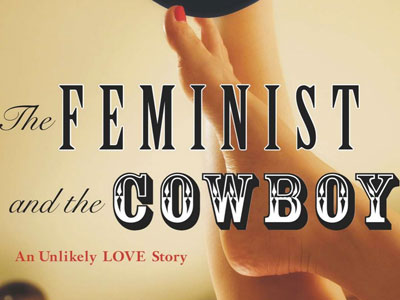 Alisa Valdes tells the story of her devolution from feminist to doormat in the memoir, The Feminist and The Cowboy.
And liking it, she claims. Or not.
Ms. Valdes says she was raised in a feminist home. She was named one of the top feminist writers by Ms. Magazine. Her first husband even “let” her hyphenate her name.
But as a single mom at age 42 she met “the Cowboy,” a conservative ranch manager who watches Fox News and believes women must submit to men. Her book blurb:
Their relationship finds harmony (and) she finds the strength, peace, and happiness that comes from embracing her femininity.
Femininity. Which here means doormat.
Instructions from Cowboy include: No back-talking; no second-guessing; no sarcastic, smart-ass remarks…
… and apparently, stay monogamous while he cats around.
In one incident she hears a women’s voicemail telling Cowboy she wants him in her shower. Alisa feels the agonizing pangs of jealousy. But she remembers that women are biologically wired to find cheaters alluring. What can you do?
Through it all she celebrates her submission, embracing women’s “natural role.” So does anti-feminist, Christina Hoff Sommers who calls the book,
An irresistible, post-feminist Taming of the Shrew… a riveting tale about how a brilliant, strong-minded woman liberated herself from a dreary, male-bashing, reality-denying feminism.
But weeks before going to press the two broke up. A problem since, as Amanda Marcotte points out, Valdes insists women will live happily ever after in orgasmic bliss if they just submit to controlling, misogynist men.
The abuse escalated soon after turning in her manuscript. During one fight he
dragged me down the hall to the bedroom, bent me over, and took me, telling me as he did so that I must never forget who was in charge.
Later, when she accidentally got pregnant and wanted to keep the child Cowboy got violent and left her. She returned to him after a miscarriage, but the violence escalated. Mostly verbal, with threats of violence.
The last time she saw him she jumped from a moving truck, fearing he would hurt or kill her:
I landed facedown on a bunch of rocks, nearly crushed under the back tires, dislocating my shoulder, badly cut and bruised everywhere, my hip filling with blood. I screamed. He stopped the truck, walked over, looked at me on the ground as I begged him to call an ambulance. “Only you would be stupid enough to jump out of a moving truck,” he told me. He did not help me, or come near me. Instead, he said he was going to the hunting lodge to get some witnesses, in case I tried to tell the police he had done this to me.
Noah Berlatsky at The Atlantic explains that:
Finally, Valdes realized that “this man did not love me. He could not love anyone,” and she left him for good—though, obviously, something of the terror remains. She notes that writing the (blog) post (about the violent incidents) puts her “in danger—real physical danger.”
Plenty of people, men and women, celebrate male dominance and female submission. But it hasn’t been so great for Ms. Valdes, and I have friends who’ve tried it and not liked it.
There is much wounding in this story that passes, in her mind, as “the natural order of things.” And Ms. Valdes as is now in a relationship with another abusive man.
The poet and writer, bell hooks, asks us to consider the nature of relationships.
“Pleasure + wound” vs “pleasure + love.”
Which makes you happier?
Which will you choose?
Popular Posts on BroadBlogs
Eminem Makes Sexism Seem Sexy – And That’s A Problem
What Happens When You Beat A Sex Object?
Frats Invite Sluts, Bitches; Women Accept Degradation. Why?
Share this:

Girls Walk Fine Line Between Attractive, Slut
 Women and men both use sexual allure to raise their status. Men may try to “score” with as many women as possible, with each conquest boosting their place among men.
For women it’s more complicated. Many college women think that being “hot” is the most important thing in the world. That’s because self-worth is so attached to beauty. But Elizabethe C. Payne, Director of Queering Education Research Institute (QuERI), explained in the Huffington Post that girls can face a double bind of “damned if you do, damned if you don’t” as society tells them they will only be loved and held in high regard if they show off their bodies – but they’d better not do it the wrong way:
Girls have to “straddle an often unclear line in appearing sexually attractive (desirable) and receptive (thus not “gay”) yet unavailable (not “sluts”).
She says that middle school girls who simply dress attractively and wear makeup—or who develop breasts before their peers – may be labeled “sluts.” And any girl who actively pursues a boy, defying the double standard, can get slut-shamed too. She needn’t have sex, she only needs to be assertive:
Many young girls who have never had sex or anything close to it — at all — have been marked as “sluts.” Once marked, young girls are repeatedly subjected to sexual harassment, threats and taunts.
But the pressure on young women to constrain themselves moves beyond sexuality and sexual allure. Middle school girls can also be labeled as sluts, bitches, whores or gay for acting assertively or challenging male authority – including the authority of boys.
Girls and boys both slut-shame. Girls, because they feel threatened by attractive young women, especially when they feel they cannot be attractive, themselves. And boys might sustain the male privilege to act and be free while girls must hold themselves back.
Which brings us to another double-bind. Women and girls who criticize a system that judges us only by our beauty, and who seek, instead, to work for equality can be labeled “feminazis.” But if they smile and take it they still lose.
If you’re going to lose either way in the short-term, you might as well work toward long-term freedom and empowerment, I’d say.
Popular Posts on BroadBlogs
Did Slut-Shaming Kill Phoebe Prince?
Sex and the Walk of Shame
Lose Virginity, Lose Self-Esteem?
Share this:

Men: Erotic Objects of Women’s Gaze

Sexy, but all covered up.
A nude woman frolics in silhouette as clothed men sleuth about, guns in hand and feet in chase. These images introduce The Spy Who Loved Me.
Flipping through TV stations the other day, this Bond rerun caught my eye and left me imagining the reverse: a nude man cavorting about as clothed women race in pursuit of criminals. Weird.
The female body is celebrated – or exploited – while the male body is ignored.
Check out People’s sexiest men. Until 2013s Channing Tatum you would be hard-pressed to see anything but face shots, loose T-shirts, and very few rippled muscles. Who could imagine a “sexiest woman” shoot sans bodies.
Searching for a calendar of sexy men at one bookstore, the closest I could find was Barack Obama.
Yeah, yeah, there is the occasional men’s underwear ad, but they are rare.
And when men walk around in the world they’re all covered up.
No wonder women don’t spend a lot of time checking out men’s bodies, ogling them or judging them.
A man commented on one of my posts that (to paraphrase):
Not only are men not considered erotic, they are often used to get laughs. In Seinfeld, Elaine referred to the male body as “utilitarian,” implying that the female is much more erotic. George Costanza became a victim of “shrinkage.” Scenes of Johnny Knoxville running around in a thong get chuckles.
Why is the male body so de-eroticized?
One possibility: Men have historically controlled media, and they focus on what they find sexy (about 95% of them anyway). Homophobia further hinders eroticization. As women enter the industry we find more focus on men, but still not much compared with women. Meanwhile, showered with sexy-women images from the time they are small, even women come to find women the sexier of the species.
What if the world were to switch? Suddenly, a universe of men in Speedo’s?
What if women became subject, and men erotic object for women to gaze upon? What if women sought to consume men as objects? Judging them, grading their beauty? Would women feel empowered, experiencing themselves on the “person” side of the person/object divide?
Something to think about.
Popular Posts on BroadBlogs
Women Seeing Women as Sexier than Men
Man as Object: Reversing the Gaze
Women Learn the Breast Fetish, Too
Share this:

The Rules vs The Game
 The Rules and The Game are manuals created to teach men and women how to attract the opposite sex. What do they tell us about the war between the sexes in this new millennium? For in these manuals, it is war.
The Game
The Game was written in 2005 by Neil Strauss after his book editor asked him to investigate the community of pickup artists. After a few workshops this self-described “chick repellant” found that the techniques worked surprisingly well for a “pick up” — but not for relationships. And, as it turns out, the game works best for misogynistic men, but only works to attract women who are misogynistic, themselves.
Here are some rules of The Game:
- Approach a woman within three seconds of seeing her so you won’t lose your nerve
- Ask something benign like “What’s your sign?” or “What’s your type?”
- Act somewhat disinterested
- Briefly disqualify yourself from being a potential suitor
- Ignore the girl you want and flirt with one of her friends instead
- Ogle other women
- Subtly insult her to lower her self-worth
- Isolate “the target” from her friends
Clearly, these rules are all about bedding women by means of controlling them and weakening their self-esteem, while inflating the confidence of men.
The Rules
The Rules were written to aid women in getting a man to commit. Published in 1995, they were updated in 2002 to reflect single life in a high-tech culture.
Here are a few rules:
- Let him take the lead
- Don’t talk to a man first and don’t ask him to dance
- Don’t call him and rarely return his calls
- Always end a date first
- Don’t see him more than once or twice a week
- Don’t talk very much on the first date
- Break up with him if he doesn’t buy you a romantic gift for your birthday or Valentine’s Day
- Don’t open up too fast
- Be sexy
In sum, The Rules urge women to manipulate men by playing hard to get. In an ironic twist women are advised to make men the leader even while creating a sense of female independence. (Even keeping her mouth shut works to create a sense of “man as leader” as some research finds that when women talk more than one third of the time they are seen as honing in on men’s space.)
On the bright side, women are urged to get on with their lives instead of waiting around for “him.”
What The Rules/The Game have in common
Both manuals advise game-playing, so we have not evolved much — or many of us have not.
Both amass power to “their side” by means of disinterest – which may work since whomever cares least has more power.
The Rules advises a traditional source of power for those who lack it: manipulation, controlling men without their knowing. Interestingly, The Game urges this same feminine technique for men, who do not have direct control over women’s minds and bodies.
And we find sexism surviving in both books.
The war of the sexes lives on
Not surprisingly, the books also differ in a way that reflects traditional gender norms. The goal of The Game is to bed women while the goal of The Rules is to snag men. The stereotypes live on.
My students are surprised that The Rules weren’t written in the middle of the last century. But The Game’s even more recent publication comes as no shock. I guess we are more puzzled by women who agree to sexism, whereas no one is surprised that some men continue to support it.
Popular Posts on BroadBlogs
Using Insults to Pick Up Women
Are Men More Likely to Separate Love & Sex?
Sources of Power in Relationships

 BroadBlogs