Blog Archives
Women’s Sexuality in Islam
By Dania Jafar
Islam represses women’s sexuality, right? Think again.
We all see Muslim women draped in head-to-toe burqas, or read about 10-year-olds being married off to 50-year-old men, or cringe at women being stoned for adultery or knifed to death by family members in “honor killings” for such crimes as fornication or being with a man without a chaperone – or for being raped. (The stain of sexual impurity must be removed from the family, it is thought.) In some parts of North Africa and the Middle East women’s genitals are ritually cut or removed in the name of Islam.
In such a world, whose sexuality wouldn’t be repressed?
But nothing you just read has anything to do with Islam. All of the above are cultural practices that are not approved in the Quran.
Unfortunately, a lack of understanding has created mistaken beliefs about women and sexuality in Islam, says scholar and feminist Pınar İlkkaracan. And the confusion exists among Muslim and non-Muslim, alike. As she explains (paraphrased):
The classical figh texts of early Islam’s legal jurisprudence kept with their patriarchal societies and ignored the gender equality of the Quran. Today, many on the religious right claim that customary practices that subjugate women are Islamic, and use them to control women and their sexuality. This has led to an incorrect portrayal of scripture both in Muslim societies and in the West.
What does the Quran say? Women have the right to consent to marriage. But ten-year-old girls are not old enough to understand and give consent, so they should not be given to older men. Holy Scripture says that adulterers (male and female) should be lashed, not stoned. But there must be four witnesses, otherwise a woman’s word must be accepted. And genital cutting was practiced long before Islam arose. There’s nothing about it in the Quran.
Even veiling is largely misunderstood. The scripture declares, “Say to the believing women that they guard their private parts, and reveal not their outward adornment and let them cast their veils over their bosoms (24:30-31).”
This scripture simply advises modesty. But what is considered modest varies from place to place. That is cultural. There is nothing in the Quran about full body covering. Or even about veiling your hair.
And covering can be viewed as a good thing with women seen as precious gems, shielded from the unpleasant stares of strangers. Covering can also be experienced as a positive affirmation of devotion to God.
Additionally, Islam stresses the equal status of a man and woman and by no means deems one less than the other. The attitude of the Quran and Muslim scholars bear witness to “the fact that woman is, at least, as vital to life as man himself, and that she is not inferior to him nor is she one of the lower species,” according to Hammuda Abdul-Ati, PH.D. This is also demonstrated in the first word of the Quran, “Iqra,” which commands all humans to search for, and equip themselves with knowledge. God doesn’t differentiate between man and woman and tells us that both are of equal importance.
In contradiction to popular belief, Islam takes a positive approach to women’s sexuality. It affirms their sexual desire and right to its fulfillment in a responsible way, after marriage.
Consider these quotes from the great mufti ‘Sheikh Ahmad Kutty’:
Now coming to mutual obligations of spouses, it is lucidly and beautifully expressed in the following verses: And cohabit with them on terms of utmost decency and fairness (An-Nisa’ 4: 19); And they (women) have rights similar to those of men in fairness (Al-Baqarah 2: 228).
According to the Qur’an, the purpose of marriage is to attain sukun (tranquility and peace; see for instance verses 30:21; 7:189), which can never be achieved through impulsive sexual fulfillment unless it is accompanied by mutual love, affection, caring, and sharing, which are all part and parcel of a fulfilling and productive marriage relationship.
In Islam, man and woman in general, as well as husband and wife in particular, are equal partners; just as a husband has needs to which a wife is expected to be responsive, a wife also has needs to which a husband should be responsive. To be successful, marriage must be based on mutual reciprocity and consensual relationship.
Yes, Islam sees women’s sexuality as beautiful, natural, and fulfilling.
Popular Posts on BroadBlogs
Early Islam’s Feminist Air
Cartoonish vs Authentic Sexuality
Men, Women React to Male/Female Nudity
Share this:

Past life
by Joy Farber @ littletreefarber
The scene though far removed remains vivid in my mind.
Images pulse in front of me like morse code.
A little girl– afraid– watches mute as acts that will shape her identity, and behavior for much of her life are committed.
The blue, glossy lockers are fixed to the walls outside the classrooms behind, and to the left. A few trees are scattered, and caged– not more than overgrown household plants on the cement to her right– creating the illusion of nature on the dilapidated school campus.
Two older boys– familiar to her only through her few “popular” attractive friends come running up behind her, laughing. At first she doesn’t see their faces– but eleven years later they are clear– burned into her mind.
She had switched from the skimpy tank tops and tight pants– her dress code of the year before– to a more comfortable outfit of oversized sweatshirts, and baggy men’s pants.
Before there was time to react– the sweatshirt was being pulled over her head. He stopped it at her face so she couldn’t see her assailants– looping his arms through hers, he held her there– her flailing no match for his strength.
His partner ran to the front, and reached out his hands. She felt a clumsy, uncomfortable grabbing at her chest. There wasn’t much to hold onto, but he tried his best– as if his failure to find developed breasts encouraged him to dig deeper.
She stood there, frozen as their laughter, and footsteps faded into the distance, and the remainder of the day was spent in silent waiting. How long would it be until people were talking– and what would they say?
The attention filled her with shame, and embarrassment. There was nowhere to escape. An older friend walked her home, stopping half way to kiss her. She had never kissed a boy she liked– just the ones that wanted her– and never asked permission.
Whether or not she attended school the next few days wasn’t important. When she did return, her pants were bigger, her hair was shorter, the sunglasses she wore in the morning didn’t come off, and the people she had associated with the previous week were replaced by the two “outcasts” a grade above her. Together they built a life– it was new, unfamiliar, but it felt safe. Her response now would be a simple “sorry, I’m gay.”
The words became reality for her, and with them she felt protected.
She had assumed that telling all the boys in school when they gathered the courage to make their advances that she was gay would be a deterrent.
For the first little while, she succeeded in deflecting the attention that had made her hate them all. Those stupid, evil people who were only out for themselves, with no regard for the lives they may damage. Rage welled up inside, insulating her– the hot blinding flashes of anger somehow made it all hurt a little less.
To her horror, and dismay she realized soon after, however that this new identity would not do what she wished it would. While the physical attacks had stopped– the words still cut, sharper than knives right through her.
That one who had walked her home, unwilling to admit defeat appeared on the football field. No one else was there. They locked eyes, and there was nowhere to run. “So what if you’re a lesbian. Pretend my dick is a tittie, and suck it” he whispered into her ear. She could feel the heat, and moisture on his breath so close to her face.
She had no choice after trying, and failing time and time again– but to remove herself completely. She changed names, changed schools, and dove further into the new life she made for herself.
Love would fix all her problems, would cure the feeling of self loathing that inhabited her daily, would make her whole. And for two years she proved this. She met Elena at an amusement park. The place full of other people, lost and looking for love. The black boots, and white tube socks were the first things she saw. Walking slowly, slightly drunk through the crowd– the next thing she saw were those eyes. Golden, with a small ring of green around her pupils. They spoke of the pain that she knew all too well, and of the longing for love that they shared.
They were happy in their secret life together for a while– content in knowing that all they needed was each other. When Elena died– all hope for happiness was lost completely. Drugs, booze, one night stands with both women, and men, but nothing would make her feel whole again.
She ran from the truth, and continued to live the life that she had adopted years before. Thinking somehow that it would still fix her, that men would hurt her more than women could. She clung tight to it.
One day she met a man that saw right through her. She loved him, but there was nothing to like. The harshness of his tone, and unwillingness to let her be herself was painful– but he loved her, and that was all she needed.
He saw her for who she was. She felt exposed. It was uncomfortable, and in secret she still claimed her old identity, but from him she had to hide it. He didn’t like it, so she adapted. She made herself in to what he wanted.
Sex was always the interesting part.
She had read about it, listened in on conversations with her friends, seen it on TV, but when it happened in her life– it was much different. She felt the chill of the moist grass on her lower back. She leaned up against the tree, and pulled down her stockings. They were covered, and protected by the darkness around them. Her partner looked at her, but not for too long, and never in the eyes– she had her own reasons for that– and slid her face down between her thighs.
When it was all said and done, she didn’t feel much different. Perhaps she felt more confident, more like a woman– but these feelings didn’t last. It was more out of obligation than anything else. She was in a relationship, and when you’re in a relationship you have sex. That is that.
Years later when she had her first experience with a man it wasn’t much different. The light was dim through the brown floral pattern curtains. There were other people in the house, just outside the door, drinking rum in plastic cups in the kitchen. They all lived there, but the house didn’t belong to them. The sheets were pulled up– it was daytime, and she felt awkward, vulnerable, exposed. She was six feet tall, and way past slender. These two things combined had always made her feel she wasn’t nearly feminine enough– and the situation she had found herself in only made it worse. If he was the man– she was supposed to be the woman, but she didn’t feel like a woman at all. Maybe a scared little girl– but her body resembled that of a pre–pubescent twelve year old boy.
Nothing felt different afterwards, the nervousness she felt before they had sex hadn’t faded at all. She felt strange to lay in bed looking at a man. It was new. It was uncomfortable. But she didn’t say anything. She kept seeing him– but when she was out with her friends, and the liquor had taken hold of her, she would sneak upstairs with attractive women– always the one in power. She was the one in control. Still seeking this life that no longer made sense. Neither of them did, really. Neither one felt authentic, but what else was there to do? Life had become about drinking, and sex. There were worse lives to live, she figured.
It was years before she had her first satisfying sexual experience. Laying in bed afterward, held in his large arms she heard herself say (as if she was watching from outside her body) how anyone could think that sex with a woman measured up to that was insane. She didn’t have to test it anymore– she felt real for the first time. She felt like herself– though to be honest she had never quite known herself. She continued to keep the old part, the false face alive. It had been with her so long, she was afraid to let it go. But with each relationship after that– it faded into the distance and became a shadow, a ghost of the past, as if it were never there at all.
She sat in class– a class she had never imagined taking. If there was one thing she had learned in her life, it was that she didn’t like women. They were all the same. She was bored with their cattiness, their petty jealousies, their cruel behavior– but here she sat.
It may have been reading, it may have been listening, it may have just been a day dream– but she was hit in the gut all of a sudden with a memory so old, and so painful she could barely breathe.
This is where it all made sense. All the running, all the fighting, all the labels, all the language, this way of living she had been going in and out of for years. She thought of the two boys in the hallway at school, when she was much younger. She clenched her jaw when she heard those words in her head, the ones she had fought so hard to forget. She looked at the women in her class– and she thought of the man she had been spending time with the past few weeks. It was all so clear to her then. However necessary she felt it was, this had all been a lie. A lie so intricate that she herself had believed it for years.
There is beauty, and freedom in the pain of breaking down, and being exposed.
The words have changed. “I’m straight.”
These four pieces were originally posted by Joy Farber @ littletreefarber
Share this:

Being Sexual vs Looking Sexual

Is “beauty” really sex? Does a woman’s sexuality correspond to what she looks like? Does she have the right to sexual pleasure and self-esteem because she’s a person, or must she earn that right through “beauty”?
– Naomi Wolf
A lot of women and men confuse looking sexual with being sexual. We look at an attractive woman and think, oh, she’s really sexual. Then we see a not-so-pretty woman and suppose she’s not.
But “pretty” and “sexuality” are actually two different things. Sex is all about feeling, not the surface experience of just existing, however beautifully.
But as Naomi Wolf points out in The Beauty Myth, too many women don’t enjoy sex because they think they don’t look sexy enough. And since a lot of women think they don’t look sexy because of their body type, age, or low self-esteem, a lot of women miss out on great sex.
Because a woman’s ability to enjoy sexuality can be so closely tied to how she looks, many cut their breasts to get implants just so that they can experience eroticism. Even when their partners don’t want them to. As Wolf put it, “In a diseased environment, they are doing this ‘for themselves.’”
And about one-third of women lose sensitivity in their nipples, post surgery, becoming less capable of enjoying the sensations of the breast.
And even then a lot of “hot” women spend their time thinking about how they look and not experiencing how they feel. So there you have pretty sex objects who don’t enjoy sex.
Women think they need to look a certain way because men are hardwired to be visual. Yet it’s not true. In tribal societies women walk around nearly nude, and no one cares. Those men aren’t visually attuned to the breast as erotic. In our culture men learn to be aroused by breasts through the strategic revealing and covering of them, creating the allure.
Wolf says beauty is not the same as sexuality. Instead:
Wherever we feel pleasure, all women have “good” bodies. We do not have to spend money and go hungry and struggle and study to become sensual; we always were. We need not believe we must somehow earn good erotic care; we always deserved it.
Popular Posts on BroadBlogs
Men Aren’t Hard Wired To Find Breasts Attractive
Sex Objects Who Don’t Enjoy Sex
Cartoonish vs Authentic Sexuality
Share this:

Pleasuring A Woman
Men get much of their sex ed from porn, which has little to do with pleasing actual women (porn stars are acting ecstatic, after all, and the focus is often on pleasing the man). So WebMD asked reputed sex educators, Tristan Taormino and Lou Paget, to talk
about some common sex mistakes men make. Go here to see the full text. We’ll also look at research from Cindy Meston and David Buss, who researched and wrote, Why Women Have Sex.
Men imagine that women feel something parallel to what they feel, says Paget, leaving a “huge disconnect” about what feels good to women:
When a man has intercourse with a woman, and his penis goes into her body, that sensation is so off the charts for most men, they cannot imagine that it isn’t feeling the same way for her. It couldn’t be further from the truth.
The vagina is actually less sensitive than the clitoris and the surrounding parts for most women.
And a vibrator can help. So don’t be insulted, thinking something is wrong if that’s what she needs, say the authors. “Some women can’t have an orgasm with less than 3,000 rpm, so think of a vibrator as your assistant, not your substitute.”
But many men continue to believe that women should be able to reach orgasm from vaginal penetration. Taormino says:
I still get letters from people who say things like, my wife can’t [orgasm] from intercourse unless she has clitoral stimulation — please help. I want to write back and say, ‘OK, what’s the problem?’
And then there’s the myth that bigger is better. It all depends. Length is great for women who enjoy having their cervix stimulated, say Meston and Buss. But the same stimulation can be painful for other women. And if the penis is too long, “it feels like you’re getting punched in the stomach,” Paget explains. “It makes you feel nauseous.” Still others feel neither pleasure nor pain—and often not much of anything.
Generally speaking, width is more important than length. But depending on the woman, some prefer larger and some smaller.
And men should not assume they know what a woman wants based upon what other women have wanted. Taormino points out that:
You develop a repertoire as you mature sexually, but you should never assume that what worked for the last person is going to work for this person.
So open the lines of communication. But consider: If you constantly ask her if she’s coming, do you really think she will? The badgering can move her from erotic to just feeling pressured. So don’t overdo it.
Popular Posts on BroadBlogs
Sex Drive: How Men and Women Match Up
One Out of Ten Women Get Depressed After Sex
Orgasm: It’s All in the Mind
Share this:

Any Reason to Have Sex If You’d Rather Not?
Saying “yes” to sex when you’d rather not can be a real problem, yet unexpected benefits may emerge. Typically, problems arise when women agree to unwanted sex that repels them and that runs counter to their values and damages their self-respect. But University of Texas, Austin researchers, who wrote Why Women Have Sex, found that sometimes women who lack initial interest can find sex rewarding in the end.
As one woman put it,
When my fiancée needs to feel closer to me or release tension, I feel I owe it to him to have sex with him. Even if I’m not particularly “in the mood” at the time. He has done the same for me on numerous occasions. I feel that it’s a part of a healthy, loving, monogamous relationship to be able to see your partner’s needs and help them in any way you can. I never feel anything but the satisfaction of knowing that I have given to him all that I can, as he does for me.
And what starts out as “not really interested” can end in pleasure. As another related,
There have been instances where I have told my partner that I did not feel like having sex. On the occasions when I have had sex due to my partner’s insistence it has been because his insistence came in the form of foreplay (romantic kissing, petting, etc.), and I found that I had changed my mind about wanting to have sex.
Some women said they felt “extremely glad” afterward, or that it “boosted their confidence.” Many saw it as a healthy way by which partners can nurture each other.
Women who enjoy themselves, despite little initial interest, are typically not entirely against the idea beforehand. But whether mood turns to desire depends on her partner’s skill at foreplay, her bodily responses, and the extent to which she comes to experience pleasure, physically and emotionally.
Whether a woman feels happy after reluctantly agreeing to sex depends on her motivation, too.
Detrimental consequences often arise when the motive is avoiding negative or painful outcomes. Desperation, shame and remorse can arise when we go against our values, leading to feelings of self-betrayal and damaged self-respect.
But different circumstances can lead to positive outcomes. Was she seeking a positive experience? Did making her partner happy make her feel good? Does her partner do the same for her? Did she stay true to her values? If so, she likely felt good about the decision, creating a positive experience all around.
Popular Posts on BroadBlogs
Sex: Saying “Yes” When You Don’t Want To: The Downside
Women Want Emotionally Connected Sex. Why?
Surprises in Indiana University Sex Survey
Share this:

Miss Representation: How I Look Is What Matters

Girls get the message early on that the most important thing is how they look. Too often their self-worth depends upon it.
Miss Representation premiered last week on Oprah Winfrey’s OWN network, seeking to combat that unfortunate reality. The film opens our eyes to all that creates the message. And offers change.
From the time they’re small, little girls are told they’re pretty – or notice that they’re not told that. They receive gifts of play makeup and vanity sets. They watch endless repeats of Disney princesses on DVD, buy beautiful princess dolls, and then graduate to Barbie or Bratz. All of whom have extensive wardrobes. It’s all about being pretty. Meanwhile, girls and women are bombarded with media images of impossibly beautiful women who are photoshopped up the wazoo, modeling what they’re supposed to look like.
Who’s popular in middle school and high school? Pretty girls. By the time they’re in college young women are under relentless pressure to be hot, as if that’s the most important thing in the world.
Media creates consciousness, but women don’t have much control over media. As Miss Representation tells us, women hold only 3% of the clout positions in publishing, advertising, telecommunications, and entertainment. And women comprise only 16% of producers, writers, directors and editors.
And so women come to see themselves through men’s eyes.
Meanwhile, media makes its money through advertising. And advertising works by making people feel bad about themselves so that they’ll buy products to “help.” But if the feminine ideal is impossible to achieve, women can buy an endless stream of products and still feel eternally insecure.
Jennifer Siebel Newsom, Miss Representation’s writer-director, makes this observation:
When youth are engaging in cutting and other forms of self-injury, when 65% of American women have eating disorders, when depression rates have doubled in the past ten years, when plastic surgery has tripled in the past decade amongst youth in particular; when you look at that you think Something is wrong. This is not healthy.
Fashion magazines are especially harmful. Girls and women who read them have worse body images than those who don’t. But women aren’t the only ones affected. Just looking at those “perfect” models can leave men finding real women less attractive, too.
So women and men who compare women to unattainable ideals both end up dissatisfied and estranged from each other.
Too many women sit in their inadequate, one-dimensional corners opposite too many men who do the same thing.
And no one is better off.
Popular Posts on BroadBlogs
Grade School Lingerie
500 Calories + Pregnancy Hormones = Perfect Body
Women Want Good Sex, Men Want Cuddling
Share this:

Man as Object: Reversing the Gaze

Della Calfee. Ass Like That
“Men act and women appear. Men look at women. Women watch themselves being looked at,” art critic John Berger famously observed.
Now some feminist artists are turning the tables in the exhibit, Man as Object: Reversing the Gaze:
With a gallery filled with men stripped naked this body of work exposes women’s cheeky, provocative and sometimes shocking commentaries on the opposite sex (which) may make the viewer squirm a little. But that is precisely the point.
The exhibit reveals sundry masculinities from female/feminist/
transgender perspectives, moving from sensuous rear views of the male buttocks to gender-bending to daughters gazing at fathers. Featured artists include Juana Alicia, Nancy Buchanan, Guerrilla Girls on Tour!, Lynn Hershmann, Jill O’Bryan, ORLAN, Carolee Schneemann, Sylvia Sleigh, Annie Sprinkle, Elizabeth Stephens, May Wilson, and Melissa Wolf.
Man as object strikes a pose, buttocks pushed out, offered to us as bedroom eyes shoot a backward glance. Men flex in awkward positions, or bend gracefully into compliant cants. Some men turn submissively into tables.
Others lie down. Natural enough, yet rarely seen in art. Too sensually passive… waiting… vulnerable… or “on the bottom” for mainstream viewing?
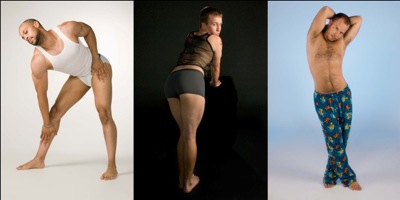
Karen Zack, Man As Object
The visions can come across as “gay.” Since sexual pose is so often meant for the male gaze, on some unconscious level we may see it all through male eyes. And that is jarring, too.
The camera pleasurably zooms in on erotic man-parts. Images of male autoeroticism and penises abound, including a piece called “Where’s His Head?” that depicts a giant phallus-man fondling his much smaller man-phallus. Indeed! And when Pinocchio tells a lie, it’s not his nose that grows. More like a woody that “lasts more than four hours.” Actual penises are rarely displayed, apparently unable to live up to what Richard Dyer called “the mystique implied by the phallus.”
The exhibit includes a lenticular postcard (turn it one way and it’s a woman, turn the other and it’s a man) that juxtaposes Courbet’s “Origin of the World” with a close-up vagina shot versus ORLAN’s “Origin of War” with a penis close-up.
At times men are objectified in one-dimensional, controlling and demeaning ways. But sex-positive feminist photographer Shiloh McCabe explores the other side, working to ensure that her gaze does not consume or dominate. She takes a wide view, seeing those who are usually not. Her subjects help create their own representation so they can retain their power. “I’m not here to objectify or harm; I’m here to nurture and document,” she explains.

Laura Hartford. Graham Reclining
Man as object, Rubenesque, reclining, bathing, cooking, lounging, washing up before bed. Man as Madonna and Child, patriarchal man, veiled man, man as cowboy bunny, trans man. Blonde man in short shorts. Bodybuilder, Founding Father. Homeless man. Nude and vulnerable. Empowered. Bound and submissive. Striking a pose. Objectified.
So much to gaze at. And so much to see.
“In the past it was totally taboo for women to gaze upon the male, yet it was appropriate and common in the reverse,” observes artist Marian Yap. “Do you think that things are changing?”
Good question. This exhibit pushes us out of our taken for granted ways of seeing to explore that path.
Check out a video on the exhibit here.
Man as Object: Reversing the Gaze. Opening Friday, November 4th at SOMArts Cultural Center in San Francisco and running through the end of November. The show will travel to the Kinsey Institute Gallery, Bloomington, IN and will open April 13, 2012 through the end of June.
This exhibition was created by The Women’s Caucus for Art – the founding organization promoting feminist art and art as activism since 1972.
For more information click here.
Ms. Magazine reposted this piece on their blog October 28, 2011
Popular Posts on BroadBlogs
Does Sexual Objectification Lead to Bad Sex?
Men, Women React to Male/Female Nudity
Anything Good About Being A Sex Object?
Share this:

Better My Daughter Die Than Signal “Sex is Ok”
If adolescent girls are given the HPV vaccine to guard against cervical cancer, will they be more likely to have sex? Some worry they will, and are pushing to keep girls from getting
vaccinated.
I’ve never understood the concern.
I suspect few girls or women think much about the sex/cancer relationship. So how would inoculation make sexual activity more likely? “Oh, now I won’t get cancer, so I’ll have sex!” Who cares about STDs or pregnancy (which is what girls are much more likely to worry about).
Maybe parents fear that signing a consent form is tantamount to giving their okay to adolescent sex. All the more reason to allow girls to get vaccinated without parental consent.
And besides, a girl could end up getting cancer from HPV without ever having consensual sex outside marriage. She could be raped, or her husband could have an affair and transmit the disease to her in that way.
Still, it’s been a huge fuss in the conservative ranks. But why do so many conservatives feel that girls’ and women’s lives are not worth saving?
Right now, political fights revolve around limiting girls’ or women’s access to: the HPV vaccine, cancer screenings, tests for STDs — including H.I.V., nutrition programs for women and children, and Topeka, Kansas recently decriminalized domestic violence, saying they couldn’t afford it. Most recently the House passed HR 358, the “protect life” but kill women act, under which hospitals could refuse to perform emergency abortions even when a woman’s life is threatened by her pregnancy.
But back to the HPV controversy. Why would some parents risk their daughter’s death to send a signal about sex?
And is sex really so bad?
Popular Posts on BroadBlogs
Why Some Guys Want to Screw You
Sex Drive: How Men and Women Match Up
Why Is the Right-Wing Attacking Women?
Share this:

Men, Women React to Male/Female Nudity
By Lisa Wade @ Sociological Images
We’ve all heard the truism “sex sells.”
But whose sex is sold? And to who?
If it was simply that sex sold,
…we’d see men and women equally sexually objectified in popular culture. Instead, we see, primarily, women sold to (presumably heterosexual) men. So what are we selling, exactly, if not “sex”?
What is really being sold is men’s (presumably heterosexual) sexual subjectivity: the experience of being a person in the world who was presented with images that were for his titillation. Women do not live in the world this way. They are not exposed everyday to images that legitimize their lust; instead, the images teach women that they are the object of that lust.
In light of this, Sociologist Beth Eck did a series of interviews attempting to tap into what it felt like for men and women to look at male and female nudes. Her findings were pretty fascinating.
First, she asked men and women to look at naked images of women, including this one of Cindy Crawford:

Women viewing images of female nudes almost inevitably compared themselves to the figure and felt inadequate. Said one women:
…the portrayal of these thin models and I just get depressed… I’m very hard on myself, wanting to be that way.
Women ended up feeling bad whether the model conformed to conventional norms of attractiveness or not. When looking at a heavy set woman, they often responded like this:
I am disgusted by it because she is fat, but I’m also… I need to lose about 10 pounds.
I don’t necessarily find her body that attractive… Her stomach looks like mine.
Men, in contrast, clearly felt pandered to as holders of a heterosexual male gaze. They knew that the image was for them and offered praise (for a job well done) or criticism (for failure to live up to their expectations). About Crawford they said:
Personally I think she is attractive.
I like that.
Both men and women, then, knew exactly how to respond to female nudes: women had internalized their object status (women as sex object-things) and men had internalized their subject status (men were people looking at sexy objects).
Eck then showed them male nudes, including this one of Sylvester Stallone:
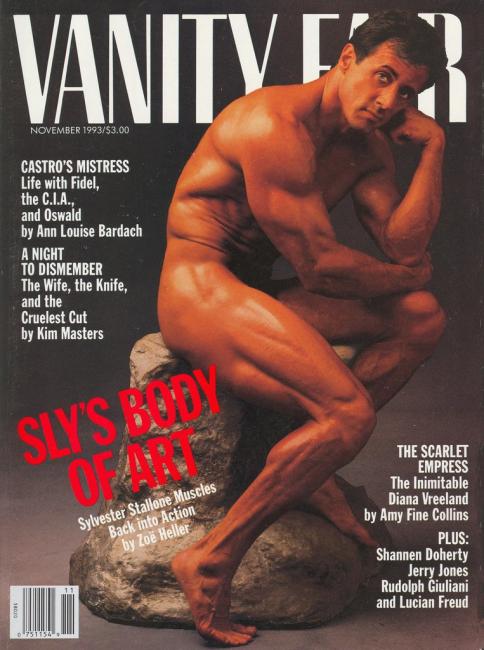
Interestingly, both men and women felt uncomfortable looking at male nudes.
Men responded by either expressing extreme disinterest, re-asserting their heterosexuality, or both. They did not compare themselves to the male nudes (like women did with female nudes), except to say that they were both male and, therefore, there was “nothing to see.” Meanwhile, because men have been trained to be a lustful sexual subject, seeing male nudity tended to raise the specter of homosexuality. They couldn’t see the bodies as anything but sexual objects for them to gaze upon.
In contrast, the specter of homosexuality didn’t arise for women when they looked at female nudes because they weren’t used to being positioned as lustful. Eck explains:
When women view the seductive pose of the female nude, they do not believe she is ‘coming on to’ them. They know she is there to arouse men. Thus, they do not have to work at rejecting an unwanted advance. It is not for them.
Many women also did not feel lustful when looking at male nudes and those that did often experienced lust mixed with guilt or shame. Eck suggests that this may be, in part, a reaction to taking on the active, consuming, masculine role, something they’re not supposed to do.
Summarizing responses to the male nudes, she writes:
Men, over and over again, reject the seductive advance [of a male nude]. While some women welcome the advance, most feel a combination of shame, guilt, or repulsion in interacting with the image…
This is what it means to live in a world in which desire is structured by a gendered sexual subject/object binary. That is, men are taught to be subjects who see women as objects, and women are taught to be objects. It’s not just “out there,” it’s “in us” too.
This piece was originally posted in Sociological Images. A slightly edited version is
reprinted here with permission.
Popular Posts on BroadBlogs
Men: Erotic Objects of Women’s Gaze
Grade School Lingerie
I Can’t Believe I Ate A Whole Head Of Lettuce!
Share this:

Hookup Culture
College students are having sex, but not as much as you might think. And most of them are kind of disappointed about the whole thing.
Sociologist Lisa Wade told MTV that’s what she learned after interviewing first-year college students. You can see the three-minute video at Sociological Images.
Rumor has it that at four-year universities one and all are hooking up with random strangers to have no-strings-attached, emotion-free sex. Everyone thinks everyone else is having great sex, and lots of it. But not them. Turns out, they’re not alone. They’re typical.
Throughout the entire four years of college, most average only 4 to 7 different hookups. That’s just more than one a year!
And nearly one third of the women have opted out entirely, figuring if the only sex they can get is with acquaintances or strangers, why bother?
Others tolerate the hookup hoping to find love, or at least relationship. But things don’t usually work out as hoped.
And most are dissatisfied by quality, too.
Almost everyone is drunk, which doesn’t help. Women complain that men are not skilled. And an awful lot of these encounters involve women giving men oral sex, but getting nothing in return.
Only about 11% say they enjoy hooking up.
Students wanted at least one of three things:
- pleasure
- meaningfulness
- empowerment
But few were getting any of these.
Yet everyone assumes they know what everyone else wants so no one ever asks.
Wade found that 70% of women and 73% of men wanted a committed relationship, but thought that everyone else felt differently. And they don’t want to talk about it because they fear they’ll come across as repressed, dysfunctional, or needy.
So no one says anything and hookup culture ends up the only game in town.
Wade says casual sex can be a good thing for students who want to focus on school since relationships — and breakups — take up a lot of time and energy.
But with widespread dissatisfaction, she feels that hooking up shouldn’t be the only option.
Students think no-strings sex is sexual liberation. But if you believe you have no other choice, is it?
Maybe it’s time for students to talk to one another.
Popular Posts on BroadBlogs
Men Watch Porn, Women Read Romance. Why?
Women Want Casual Sex? Yes and No
Are Women Naturally Monogamous?

 BroadBlogs