Blog Archives
Dominance, Submission, Meaning & VOICE

Sally Deskins, Red Belly
Feminism has long sought to gain equality by obliterating dominance and submission. Yet some find the ends of this dichotomy alluring… erotic, and seek to drink in both sides. So comes the quandary: how to sustain this sensuality yet stay true to a feminist commitment? That’s a question that artist, Trilety Wade asks in the new exhibit: Les Femmes Folles: VOICE.
Wade knows that submission and dominance can vacillate and be exchanged. She explores how balance might be gained in the space between while reveling in both sides. As she describes it:
I usually find myself on the cusp of submitting. I almost give in to my desires. I almost give in to another person. I never wholly submit, thus I am also dominant. That push and pull of submission and dominance leaves me in a static state of anticipation, which is reflected in the distance between the figures in my paintings.
My paintings make me question why there are some people and desires I want to submit to, and why I never allow myself the freedom to either be submissive or dominant; instead I freeze.
Moving to other matters involving passion, power, surrender and control, Sally Deskins’ “Red Belly” signifies motherhood, the scarlet color evoking fiery emotion, passion and sacrifice — which may be ennobling blood-life or deadening blood-loss. The energy of this red belly calls to mind more life than loss, though the two may be intertwined.
A passionate theme continues in the seductive vibes of breasts and loins:
The curly-prints from my pubic hair give the image an erotic flair. The white stamped nipples provide a ghostly aura, and the various drips and red line at the bottom sheds light on the beautiful indeterminism that is visual art and sometimes life as well.
Inspired by Yves Klein’s “Anthropometries,” Deskins’ self-portraits explore the relationship of mind and body. She paints her body with as if it were a canvas and then physically straps herself to paper or canvas to form an imprint, painting her psyche on what appear to be a series of Rorschach Inkblot Tests. Through these self-portraits Deskins searches for her voice.
Ella Weber explores how identity evolves over a lifetime. In her “Boy’s n’ toys” series she places a person next to a person-sized inanimate object from pop culture. The drawings seem to be all about innocence, nostalgia and humor. But look closely and see something more subversive.
 In “but is she worth it?” Weber places Mrs. Butterworth’s on a bed of sticky syrup. Next to her a woman holds a plate in each hand, resembling scales. Perhaps she’s weighing her options, to serve or not? A stack of hotcakes lie between the two figures.
What is the appeal of nostalgia… falling back to a place of greater inequity when women and Blacks were all about serving others? Why does the past still loom so large? And why is it so sticky?
Inanimate object and human being stand side by side. What does it mean to be human – and female? How does identity grow? And might those hotcakes be just fine levitating in thin air? Weber voices the questions.
Wanda Ewing knits social commentary into latch-hook yarn rugs that explore how race factors into society’s notions of feminine beauty and sexuality. The interlace of gender and race adds further texture. In her hands a surprising juxtaposition of risqué images of women’s bodies attaches to cozy yarn rugs. As if Madonna and whore are woven together?
 Megan Loudon Sanders delves into identities that lie hidden yet seek expression. Historically, women were asked to conform to rigid standards that left their potential concealed from them. By mixing stylistically dissimilar elements, Sanders depicts a woman who at first glance could pass for any suburbanite. Yet she subversively announces on her body, This is who I am:
A young woman in a blue polka-dot dress brings her teacup up to sip, a simpering smile to the viewer. Intricate and colorful tattoos line her hands and arms, challenging the pristine environment.
While identities can lie hidden, so can the emotional significance of everyday life. Trudie Teijink uses a digital camera to document the remnants of family suppers, highlighting the colors and shapes of food and the utensils used to prepare it. She reveals how art emerges in the mish-mash that falls together. Her work makes us ponder how sentiments and human connections arise through the sights, smells and tastes of food, and of preparing and imbibing together. But sometimes, she says, the mundane still seems futile.
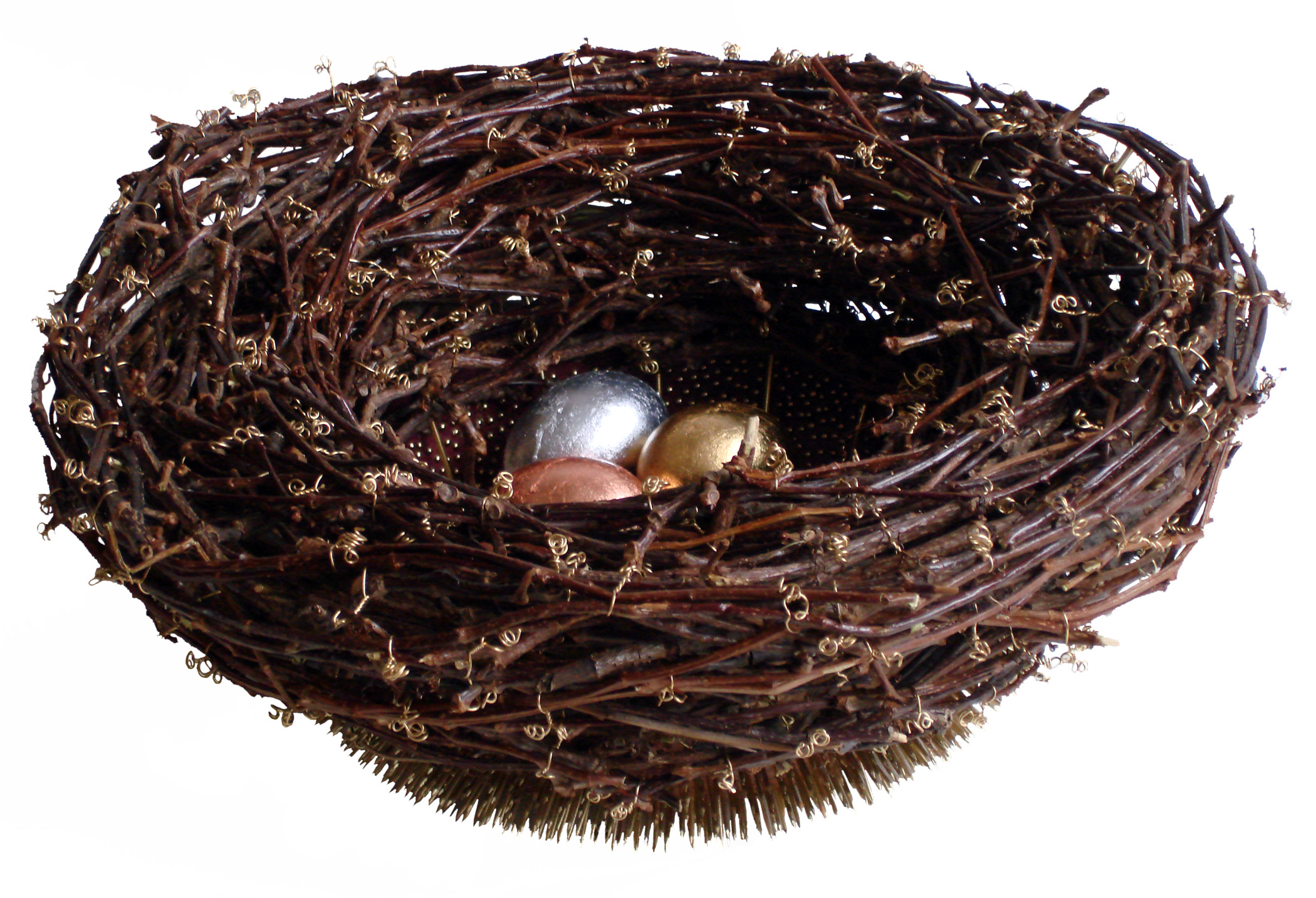 While domesticity seems a safe haven, home can be dangerous. Marcia Joffe-Bouska uses barbed nests to pose the question, “How might things appear safe when they are not?”
Joffe-Bouska also uses egg and nest imagery to express the worth of each individual and to explore how we might create our own safe havens. Strong metal nests signify strength, fabrications representing DNA indicate smarts, and lacy trimmings suggest patience. Each egg/nest combo represents a reason, a justification, or a reminder of why we have value. And each titled piece opens with this mantra: “I am ….”
Other themes look at the voices in our heads, how so much of the work women do everyday lies invisible or seemingly insignificant even to those who do it, and performance art invites attendees to write out notes to be re-interpreted by performers, with response. And more.
Women are speaking up, challenging status quo power politics and giving voice to lives and identities that too often remain shrouded and undervalued, all the while promoting positive communication in the VOICE exhibit.
Together, this art calls for deeper thought, broader expansion, and raised voices.
Co-curated by Sally Deskins and Megan Loudon Sanders, VOICE artists include Marcia Joffe-Bouska, Sally Deskins, Wanda Ewing, Kristin Lubbert, Jewel Noll, Melanie Pruitt, Amy Quinn, Megan Loudon Sanders, Trudie Teijink, Trilety Wade and Ella Weber.
Les Femmes Folles Presents: VOICE, a curated exhibition
The New BLK, 1213 Jones St.
Opening reception: Friday, April 13, 7-10p.m. Exhibition runs thru April 30. Preview art-talk at Indian Oven: April 11, 7p.m.
Art Talk at The New BLK, April 18, 7p.m.
LES FEMMES FOLLES: VOICE WANTS YOUR VOICE
Call for art
Deadline: April 6, 5pm deliver to The New BLK, 1213 Jones St.
Open to: artists who identify themselves as women
Les Femmes Folles: Voice is a curated exhibit featuring the artistic perspective of 11 Midwestern artists who are women at The New BLK Gallery opening April 13, 2012. The artists would like to also showcase the VOICES of other artists who are women with a collaborative piece. Artists are invited to create a mouth in any medium, in 2-dimensional form, no larger than 18×24” that can be hung on a wall. Deliver to The New BLK by April 6 to have it included in the show opening April 13 with artist contact information. Details sallydeskins@yahoo.com or mloundons@unmc.eduor shane@thenewblk.com
More information on the exhibit at thenewblk.com or facebook.com/newblk
Share this:

Is Male or Female Sexuality Better?
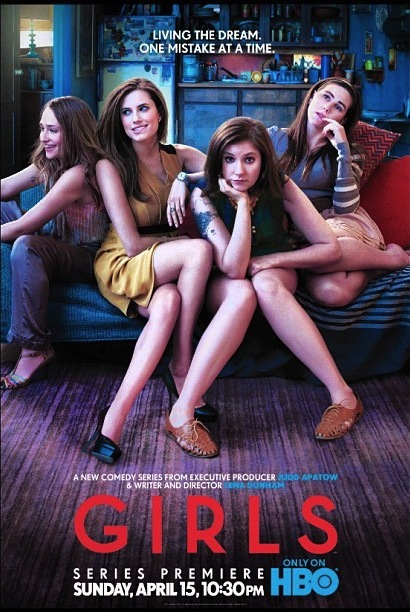 “I heard so many of my friends saying, ‘Why can’t I have sex and feel nothing?’ It was amazing: that this was the new goal.”
That’s what 25-year-old Lena Dunham told New York Times columnist, Frank Bruni as they discussed her new Sex-and-the-Cityish HBO series called “Girls,” which she writes, directs and stars in.
Dunham points out that numerous cultural cues press women to take on non-emotional, non-connected, “empowered” sexuality.
Yet she can’t manage to do it, herself. And she is not sure it’s empowering.
“There’s a biological reason why women feel about sex the way they do and men feel about sex the way they do,” she adds. “It’s not as simple as divesting yourself of your gender roles.”
Evolutionary psychology says women are genetically programmed for monogamy so fathers will stick around and provide resources for their children, while men are promiscuous so that they can widely “spread their seed.”
I have my doubts. If women are monogamous then men can’t be promiscuous. And both men and women are promiscuous in some tribal cultures.
Modernity seems to breed a monogamous ideal (meaning lifetime marriage after a few years of “sewing your wild oats”) among both women and men, perhaps because these societies are complex and children aren’t raised by the entire community (as they are in small tribes) making single parenthood difficult.
And even while casual, male-stereotypic hookup sex has overtaken college campuses (at least in theory), a recent study of hookup culture found that both men and women prefer close, connected relationships.
Still, study after study shows most women preferring sex in a context of love and connection, while men are more open to casual encounters.
So which is better? Casual or connected?
I’ve asked my students what they think. They see positives and negatives in each approach.
The variety offered in non-connected sex can be fun, and if you really do it “man-style,” guilt-free. There are no ruts! But STDs and unwanted pregnancies are bigger risks. And it’s possible that one partner will end up wanting more, which can create hurt and complications. Emotional connection adds depth and dimension, and many can’t enjoy sex without it.
The problem, my students think, lies in feeling pressured to behave in ways that are inauthentic – which isn’t pleasurable, either!
And is non-emotional, non-connected sex more “empowered”? Or do some just think so because it’s the “male” way in a culture that values masculine over feminine? Or that sees men and “their ways” as more powerful, by definition. Sure, you’re less vulnerable and dependent, but there is great power in relationship.
Likely the “best” and “most empowered” sex is that which is most fulfilling, and which best expresses who you are and what you want, and which is acted out most responsibly.
Popular Posts on BroadBlogs
“Dressing Like Prostitutes”? Authentic Sexuality?
Cartoonish vs Authentic Sexuality
It’s Ok To Be A Tomboy But Not A Sissy. Why?
Share this:

Women Seeing Women as Sexier than Men
 Girls are so inundated with sexualized images of women that they learn to see women as sexier than men. Women come to see women through male eyes?
In the bedroom, this can make women’s sexuality a bit convoluted, which I’ll discuss later.
But consider my students:
“Women’s bodies are just naturally sexier than men’s,” my class tells me when I ask why women are portrayed as sex objects.
In this belief, my students are not alone.
A few years back Lisa Kudrow, of Friends fame, told Jay Leno that female nudity is displayed more in movies because, “Who wants to look at a guy?”
Hugh Hefner thinks women are natural sex objects, “If women weren’t sex objects, there wouldn’t be another generation.”
I’ve talked before about how the breast fetish is not natural, but is learned by both men and women. But how do we all learn that women are sexier than men in ways that go beyond the fetish?
Growing up, girls are bombarded with visions of women as sexy, with skin selectively hidden and revealed, the camera focused on those intriguingly concealed parts.
When I was little my mom took me to the Ice Capades. After noticing that the women were half dressed while the men were fully clothed, I asked why. Mom told me that women just have better legs.
Do they? One warm summer day an adult from my church youth group commented, “It’s too bad the guys have the best legs.” (Thanks!) But what is our cultural ideal? Longer, leaner. Young men typically have longer legs, and they don’t have the extra layer of fat that women do. So most young men’s legs come closer to our ideal. Yet we say women have better legs? When I think about it, I actually think men have pretty nice looking legs. But nothing and no one directs our attention to them.
On Dancing With The Stars, women are half-dressed and men are fully-clothed. During an advertisement, the camera lingers on women’s breasts and legs in a Victoria’s Secret display. Next, a commercial for shoes focuses on women’s behinds: See this Rebook ad for EasyTone. Try to imagine the same focus on men’s butts (which actually are pretty attractive)!
Watch a football game and see big, fully-dressed, aggressive guys playing on the field, while scantily clad cheerleaders show off their stuff from the sidelines. In the Bikini Open men sport golf wear while women dawn bikinis. When does Sports Illustrated most focus on women? In the swimsuit edition.
Through it all, the camera gazes at women’s body parts, but not men’s. Telling us what’s important to notice. What’s sexy and what’s not.
Men’s bodies are rarely sexualized outside infrequent underwear ads.
Historically, men have had control of media, and they’ve portrayed what they see as sexy.
Bombarded with these images, girls come to see women as sexier than men. As I’ve said before, when I tell my class that I find a Playboy pinup sexier than a Playgirl pinup, women’s heads nod in agreement.
Meanwhile, when women answer surveys about what they find sexy they say “men.” But when they are wired up, blood flow to the vagina is stronger when viewing an image of a nude woman than a nude man – conscious responses and bodily responses not agreeing.
Oddly, and yet logically, women come to see women through male eyes.
So women come to see themselves as the sexy half of the species. Being sexy has some advantages. It can just be fun, it’s easier to attract mates (consider the success of women versus men in singles bars), and sexiness is a source of power.
But there’s a downside, too, including the narrow construct that leaves so many women feeling they exist outside the “sexy” box, with a drop in self esteem kicking in.
Taken to extreme, some women can become sex objects, taking an unhealthy one-dimensional focus on themselves, feeling that how they look is all that matters. And some men may see them as objects whose sole purpose is to be used for their pleasure.
It ain’t so great to be, or be seen, as mere object.
Popular Posts on BroadBlogs
Sex Objects Who Don’t Enjoy Sex
Men Have Higher Sex Drive. Why?
Women Learn the Breast Fetish, Too
Originally posted on January 10, 2011by BroadBlogs
Share this:

Women Make Men Dumber?
 “Talking to an attractive woman really can make a man lose his mind,” says The Telegraph. “Men get dumber just thinking women are nearby,” adds The Globe & Mail. And the more attractive she is, the dumber he gets.
Actually men may make women dumber, too. I’ll get to that in a moment.
Dutch researchers asked 71 straight male and female college students to perform a series of cognitive tests. Some were told they would be monitored by an unseen person. Others interacted with real live people.
When women were involved, seen or not, men’s performance dropped. But the presence of men had no effect on women’s functioning.
Why the difference? Lead researcher, Sanne Nauts, speculates that the men were preoccupied with how to impress the women – or how to make a good impression should they meet. And that distracted them from the task at hand.
While the researchers turned to evolutionary psychology to suggest that men get distracted because they pursue, while women wait and choose, I might note that while men are biologically more oriented toward pursuing sex (they have more testosterone, twice as much of their brain is devoted to sex, and their brain more quickly activates to pursue sex), in our culture men are also expected to take the lead. All this leaves them more distracted when given an opportunity to make that first move.
Interestingly, the study arose after one of the researchers was so struck by an attractive woman that he couldn’t remember his address when she asked where he lived. Apparently he was trying too hard to make a good impression.
But men may make women dumber, too. Once a woman is alerted to the fact that an attractive man might be interested in her, a woman may become flustered, distracted by the work of trying to look good.
Most people get distracted when they’re trying to look good. And that, unfortunately, can make us flub up. Sad but true: wanting to make a good impression can leave us looking like dimwits.
Popular Posts on BroadBlogs
Women Want Casual Sex? Yes and No
Women Want Good Sex, Men Want Cuddling
Sex Drive: How Men and Women Match Up
Share this:

Wanting “X” from Sex, but Doing “Y”
 Most people say they want pleasure and closeness from sex. But they don’t act like it.
Instead, they’re preoccupied with how they look, what their partner is thinking, how they’re performing, and what is “normal”
That’s what Dr. Marty Klein, a Certified Sex Therapist and sociologist, says in his book, “Sexual Intelligence: What We Really Want From Sex and How to Get It.”
Perhaps because of fashion magazines, or porn, or because we see “good sex” as the sex of our 20s, we conclude that great sex is looking like 20-year-old “perfectly” built porn stars, and doing what 20-year-old “perfectly” built porn stars do.
And that leaves most women feeling insecure about their bodies (since most women are insecure about their bodies): “Am I too fat? Are my breasts too small, too lopsided, too droopy? Do I have cellulite?” instead of having close, pleasurable sex.
Which naturally leads to: “Is my partner thinking I’m too big, too small…? Is he thinking about someone else?” Again, worries — not good sex.
Most men don’t yet expect to look like Ryan Reynolds. But they may worry about penis size. And they may notice that neither they nor their partners look like porn stars. Or, they may worry about performance or wish their bodies would do what they did years ago. And wish their ladies would act like porn stars. Or they may imagine porn stars instead of really being with their ladies. Distractions. Not good sex.
Too often, new positions or techniques are prescribed to perk things up. But Klein says the key is mind, not matter. Who can have great sex with all the distractions? You’ve got to clear out the baggage first.
A bit of advice:
First, embrace your body as it is – how it looks, what it can do. That frees you up to be present. As Klein points out, “You’d be foolish to craft a definition of sexy or manly or womanly that excludes you” (or your partner). He adds:
It is possible to detach how you look from how you feel and see that sexiness is not a product of what your body looks like from the outside, that sexiness is a product of how you feel on the inside… From there it’s a question of a person tuning into what do I have to offer somebody else sexually, and what do I have to offer myself sexually?
And let go of worries about what’s ‘normal,’ he says, because that takes us out of authenticity. Move “from ‘sex has to validate me’ to ‘I validate my sexuality.’”
The focus, according to Klein, should be on creating lasting physical and emotional connection with your partner. Don’t overburden genitalia with too much responsibility for making sex enjoyable. Media portray orgasm as the most important thing, he says, “But focusing on those few seconds misses most of what sex offers.” Instead, feeling good with your partner is the big payoff.
Popular Posts on BroadBlogs
Does Sexual Objectification Lead to Bad Sex?
Being Sexual vs Looking Sexual
Cartoonish vs Authentic Sexuality
Share this:

Love Hurts Others
We all know that lost love and unrequited love hurts. But as a headline from Live Science points out, “Love Hurts (Other People)” too.
Florida State researchers surveyed 130 hetero students in long-term relationships on their levels of jealousy (e.g., “How likely are you to surprise-visit your partner to see who is with him/her?”).
They also asked them to think about a time when they 1) felt lots of love for their partner or 2) a time when they felt lots of lust. Next, the students underwent three ordeals.
First they looked at pictures of an attractive or unattractive same-sex peer and then rated the appeal of a Chinese character. When asked to think about intense sexual desire for their partner everyone rated the character about the same. But when asked to think about intense love for their partner those who tend toward jealousy became quite negative.
Next the students played a video game with an attractive, but hidden, same-sex player. Whoever won got to blast their opponent with a loud noise. When reminded of their love for their partners, the jealous types more harshly blasted their sexy “rivals.” (Fortunately, there was no real person to torment.) But the effect disappeared when these same folks were told to think about lust instead of love.
Finally, the researchers upped the ante, creating a seriously threatening situation.
Students were asked to help design a university dating site, and given profiles of “attractive, interesting, outgoing, fun-loving” people of their own sex who were single and looking. After being reminded of their deep love for their partners everyone responded harshly, labeling the rivals unattractive, unfriendly and heaping on abuse. Jon Maner, the lead researcher added, “The more love they felt for their partner, the more negatively they tended to evaluate these objectively attractive members of their own sex.”
He concludes that low- and high-jealousy people may not be so different after all. What matters is the level of threat.
Study researcher and grad student, Jennifer Leo opined,
Ultimately, love works in the service of protecting the relationship and maintaining it into the long term. Even if that means acting out.
Love makes the world go round. Too bad it can also harm innocent bystanders.
Popular Posts on BroadBlogs
Why Hasn’t Open Marriage Caught On?
Is Your Partner’s Ogling a Turn-Off?
Real Women Competing With Porn Stars
Share this:

Why Do Right-Wingers Hate Sex?

Why do right-wingers hate sex? And why don’t they want the rest of us to get any? Okay, not all of them. Newt Gingrich, for instance, seems to be a fan. But what he likes isn’t something he’d necessarily want anyone else to do.
Rick Santorum is the reigning sex-hating champ – unless it leads to procreation, of course. He once warned that Satan was using sensuality to attack America and he disagrees with the Supreme Court decision to allow birth control. As columnist Maureen Dowd explains,
(Santorum) believes that America’s soul wounds include men and women having sex for reasons other than procreation, people involved in same-sex relationships, women using contraception… (He feels) contraception is “not O.K. It’s a license to do things in a sexual realm that is counter to how things are supposed to be.”
Actually, those who lack contraception but don’t want pregnancy could still do anal and oral. Or, men could simply ejaculate on woman’s faces. So a lack of contraception may only encourage sodomy and other “perversities.”
And then there’s Santorum spokesperson, Foster Friess, who insists:
Back in my day, they used Bayer Aspirin for contraception. The gals put it between their knees.
Or, conservative columnist Ross Douthat helpfully explains, “Monogamy, not chemicals or latex, is the main line of defense against unwanted pregnancies.”
So if a married couple only want two kids, how often should they have sex sans chemicals or latex?
Or how about this guy who responded to a post I wrote saying women should be able to follow their conscience on birth control, and not be bullied by Catholic Bishops:
Where’s the discussion of men’s responsibility to do what they can to control their own passions? Are men just dogs who cannot control themselves?
And does all this repression make the right-wing sex drive reemerge in creepy ways? One bill sought to force women seeking abortions to undergo ultrasounds via vaginal probe. Democratic Delegate Lionell Spruill says this is tantamount to rape: inserting objects into vaginas without consent. Women’s advocates say the procedure is meant to shame women, which is similar to a motive of rapists: degrade the victim.
But why so anti-sex?
Are these just church-going folk who’ve been warned against sexuality their whole lives?
Some worry uncontrolled passions will harm the social fabric: children bearing children… unwanted babies. But that’s what contraception is for. As conservative columnist David Brooks admits, despite more sexually liberal attitudes, teen pregnancy rates are down, abortion is down, and crime is down. “There are problems with the social fabric,” he says, “but they no longer have to do with the sexual revolution.”
Others think right-wingers simply cling to clarity and order, and crave control (a common bent among extreme conservatives). And indeed, some may feel a sense of power in controlling women’s bodies. They may gain a sense of control by reigning in the flesh and wild sexuality of themselves and others. And, they can gain a sense of clarity and structure by seeing women and men as different, each in their separate spheres with men on top and women below, barefoot, pregnant, and obeying men.
Popular Posts on BroadBlogs
Markets Must Be Free; Women Must Be Constrained
Should Organized Religion Have More Rights Than Women?
Modesty Objectifies Women Says Nude Egyptian
Share this:

Sex: Who Gets Screwed?
One day I asked my class to think of slang words for sex. I got the following list:
Screw, f-, bang, nail, ram, smash, smack that, beat those, cut, boning, git-in-em-guts, get some trim, get some grip, do it, get some pussy, nasty time, make love.
I don’t know about you, but I only want to do one of those things.
Most of this list suggests a good deal of violence. And who gets screwed, rammed, nailed, cut, boned, banged, smacked, beaten, and f’d, anyway?
Really, it isn’t pretty.
The music I grew up on offered the B-52’s singing “Bang, bang, bang (on the door baby),” David Bowie intoning, “Wham, bam, thank you ma’am,” and the Tubes celebrating the raw tuna of a sushi girl. A nice piece of meat.
A DJ interrupts to suggest, “Could you trim that thing?”
It all sounds so appealing.
And we wonder why women indicate less sexual interest than men on surveys. But these words are only a small tip of that iceberg.
Popular Posts on BroadBlogs
Does Sexual Objectification Lead to Bad Sex?
Men, Women React to Male/Female Nudity
Men Are Naturally Attracted To Unnatural Women
Share this:


Women Must Be Free To Follow Their Conscience on Contraception

Catholic Bishops continue to plead that they must be free to exercise their conscience on contraception, which entails preventing women from exercising that same right. If there’s any conflict of rights here women should win out since it is their bodies and well-being that are at stake.
And shouldn’t the rights of individuals take precedence over the rights of institutions (whatever the conscience of an institution is)?
The Bishops would not even be the one’s buying the contraceptives. Women would.
In patriarchal societies men feel that they should govern women’s bodies. In some places women must get permission from their husbands to see a doctor. And now these male church leaders want to take on that role for women employees?
As Gail Collins at the New York Times points out, the Bishops can teach, but they can’t force others to align with their teachings.
Besides, why don’t other religions have similar issues? As Times columnist Nick Kristof observes,
I wondered what other religiously affiliated organizations do in this situation. Christian Science traditionally opposed medical care. Does The Christian Science Monitor deny health insurance to employees?
“We offer a standard health insurance package,” John Yemma, the editor, told me.
That makes sense. After all, do we really want to make accommodations across the range of faith? What if organizations affiliated with Jehovah’s Witnesses insisted on health insurance that did not cover blood transfusions? What if ultraconservative Muslim or Jewish organizations objected to health care except at sex-segregated clinics?
Or should employers, insurers or doctors refuse access to a drug or medical procedure because a disease arose from a practice they disagree with on religious grounds, whether that be the use of drugs, alcohol, tobacco, meat, sex outside of marriage, a patient’s sexual orientation, etc., etc.?
And anyway, religious people should sacrifice for their own convictions. They should not ask non-members to sacrifice for their church’s beliefs.
No surprise that political right-wingers have jumped on the bandwagon, given their pattern of seeking to strip women’s rights to their bodies, health and well-being. The far-right has tried to defund Planned Parenthood and some now want HHS to strip contraceptive coverage requirements for all employers, religious or not. Extreme conservatives have worked to prevent abortions that could save women’s lives, they have tried to redefine rape into “no rape,” and some have backtracked on protecting women from domestic violence. In fact, this past year has been widely regarded as a war on women by the extreme right.
Religious liberty? No this is about acting “severely conservative” with the aim of controlling women.
Popular Posts on BroadBlogs
Markets Must Be Free; Women Must Be Constrained
Why Is the Right-Wing Attacking Women?
Modesty Objectifies Women Says Nude Egyptian
Share this:

Nude Men Seem Less Intelligent
 The more skin women reveal, the less men see them as intelligent or empowered. Instead, nudity promotes the notion that women are sensitive, “feeling” creatures.
Turns out the perception runs both ways with women seeing men as less intelligent and less competent when they show skin, too. In fact, simply “taking off a sweater — or otherwise revealing flesh — can significantly change the way a mind is perceived” say researchers.
And as psychologist, Kurt Gray of the University of Maryland observed:
This effect can happen even without the removal of clothes. Simply focusing on someone’s attractiveness, in essence concentrating on their body rather than their mind, makes you see her or him as less of an (empowered) agent and more of an experiencer.
Women see partially-clothed men as more sensitive, too, and are disinclined to hurt them. Likewise, most men don’t want to harm unclothed women, either. Perhaps nakedness makes people seem more vulnerable so that we want to protect them.
Interesting. There’s no evidence that showing skin makes men want to rape, and it looks like the opposite effect is more likely. (Of course, some sexual fetishes do combine nudity and violence so the effect isn’t uniform, but that still doesn’t mean nudity causes a person to want to harm.)
Practical take-away? Showing skin can make us seem less competent at work. But it can be great in the bedroom, where it’s all about feeling.
Popular Posts on BroadBlogs
Anything Good About Being A Sex Object?
Men, Women React to Male/Female Nudity
What Happens When You Beat A Sex Object?

 BroadBlogs