Blog Archives
When Did This Become Hotter?
![when-did-this-become-hotter-than-this[1]](https://broadblogs.com/wp-content/uploads/2012/12/when-did-this-become-hotter-than-this1.jpg?w=300&h=280) By Rebecca Gardner
By Rebecca Gardner
Because of its popularity on the Internet, this image has been a hot button of conversation, controversy, and conflict. Comparing thin modern day celebrities to slightly more voluptuous sex-bombs of a former era, these pictures make a statement: the standard of beauty is no longer realistic and the ideal is too thin.
This simply isn’t true.
Yes, women are judged on a harsh scale when it comes to body shape and size. But this meme reinforces it.
By stating that the women on the bottom row are hotter, beauty is narrowly defined and women who don’t fit are marginalized. A woman may be naturally thin or athletic but because she lacks Betty’s voluptuous curves her perfectly healthy body is now judged too thin or too athletic.
And who’s defining “what’s best”? John Berger famously declared, “Men look at women. Women watch themselves being looked at.” So “When did this become hotter?” is all about the eyes of men declaring who’s hot. And who’s worthy.
The image also reinforces narrow gender norms. Other than Kiera Knightly’s six-pack, all are bathing suit clad and overtly feminine. Again with the exception of Knightly, all are posed in traditionally feminine ways—tilting heads and submissive stances.
And, all the women are white, no minorities allowed.
Finally, the picture reinforces the notion that outer beauty determines a woman’s worth. And that has huge psychological ramifications—low self-esteem, depression, self-harm. Other interests and talents become diminished as women become more one-dimensional.
In addition to broadening notions of beauty, we need a more solid platform on which women can build their identity. Celebrating intellect, athleticism, creativity, and compassion adds serious dimensions.
Women come in varieties of shapes, colors, heights, widths, personalities and abilities. To celebrate our womanhood, those variations must be recognized and admired, and this image does nothing of the sort.
Popular Posts on BroadBlogs
Love My Body
Real Photos for Real Girls in Seventeen Magazine
Beauty and Self-Esteem
Share this:

Sexual Objectification, The Harm
![Dolce-Gabbana-Ad-Sexist[1]](https://broadblogs.com/wp-content/uploads/2012/12/dolce-gabbana-ad-sexist1.jpg?w=300&h=224) By Caroline Heldman (Cross-posted at Ms. and Caroline Heldman’s Blog)
By Caroline Heldman (Cross-posted at Ms. and Caroline Heldman’s Blog)
This is the second part in a series about how girls and women can navigate a culture that treats them like sex objects. (Part 1 can be found here.)
Sexual objectification is nothing new, but this latest era is characterized by greater exposure to advertising and increased sexual explicitness in advertising [PDF], magazines, television shows, movies [PDF], video games, music videos, television news, and “reality” television.
In a culture with widespread sexual objectification, women (especially) tend to view themselves as objects of desire for others. This internalized sexual objectification has been linked to problems with mental health (clinical depression, “habitual body monitoring”), eating disorders, body shame, self-worth and life satisfaction, cognitive functioning, motor functioning, sexual dysfunction [PDF], access to leadership [PDF] and political efficacy [PDF]. Women of all ethnicities internalize objectification, as do men to a far lesser extent.
Beyond the internal effects, sexually objectified women are dehumanized by others and seen as less competent and less worthy of empathy by both men and women. Furthermore, exposure to images of sexually objectified women causes male viewers to be more tolerant of sexual harassment and rape myths (false notions about rape). Add to this the countless hours that some girls/women spend primping to garner heterosexual male attention, and the erasure of middle-aged and elderly women who have little value in a society that places women’s primary value on their sexualized bodies.

Theorists [PDF] have contributed to understanding the harm of objectification culture by pointing out the difference between sexy and sexual. If one thinks of the subject/object dichotomy that dominates Western culture, subjects act and objects are acted upon. Subjects are sexual, while objects are sexy.
Pop culture sells women and girls a hurtful fiction that their value lies in how sexy they appear to others; they learn at a very young age that their sexuality is for others. At the same time, sexuality is stigmatized in women but encouraged in men. We learn that men want and women want-to-be-wanted. The yardstick for women’s value (sexiness) automatically puts them in a subordinate societal position, regardless of how well they otherwise measure up. Perfectly sexy women are perfectly subordinate.
The documentary Miss Representation has received considerable mainstream attention, one indicator that the public is now recognizing the damaging effects of sexual objectification of women.
Widespread sexual objectification in U.S. popular culture creates a toxic environment for girls and women. The next two posts in this series provide ideas for navigating objectification culture in personally and politically meaningful ways.
Popular Posts on BroadBlogs
Sexual Objectification, What is it?
Nude Men Seem Less Intelligent
Objectification’s Role in a Suicide
Share this:

“Fat Actress” Is Most Desirable Woman
![hunger-games-katniss-everdeen_458[1]](https://broadblogs.com/wp-content/uploads/2012/12/hunger-games-katniss-everdeen_4581.jpg?w=225&h=300) It seems that just yesterday Jennifer Lawrence was deemed a fat actress — in Hollyweird, anyway. But now she’s been named “Most Desirable Woman” by more than 2.4 million AskMen readers. Also on the list were her sisters in non-starvation, Christina Hendricks and Kim Kardashian.
It seems that just yesterday Jennifer Lawrence was deemed a fat actress — in Hollyweird, anyway. But now she’s been named “Most Desirable Woman” by more than 2.4 million AskMen readers. Also on the list were her sisters in non-starvation, Christina Hendricks and Kim Kardashian.
But actually, different sizes, shapes, colors and ages are on this list, too. And in a truly revolutionary move:
These men were tasked with voting on more than just sex appeal, taking into account character, intelligence, talent, sense of humor, professional success, achievements in 2012 and potential for 2013.
And as a result, “a new breed of women have changed the definition of ‘desirability’” read one headline.
And so the list includes non-voluptuous celebs with Mila Kunis at #2, along with Kristen Stewart and Kate Middleton.
Women of different colors were named: Rihanna, Selena Gomez and Lucy Liu, among them.
You needn’t be a classic beauty, either. Check out Emma Stone and Claire Danes, who got her start playing a very ordinary teen.
Even the over-40 set was lauded, including Sofia Vergara, Sarah Silverman and Rachel Weisz.
Powerful women were also among the most desirable, including Michelle Obama, Marissa Mayer, President and CEO of Yahoo! and Nadezhda Tolokonnikova of the Russian activist-punk group Pussy Riot.
As feminism has spread men have become less intimidated by, and more appreciative of, strong women. James Bassil, the Editor-In-Chief of AskMen, put it this way:
The top-rated women on AskMen’s 12th edition of the Top 99 Most Desirable Women list speaks to men’s growing comfort with strong and independent partners.
It speaks to men’s growing confidence in themselves, as well.
I’m not thrilled about ranking women. But perhaps this varied list that moves beyond looks will encourage more women to move outside the one-dimensionality of narrow beauty norms and help us to broaden and grow greater confidence in ourselves, too.
Popular Posts on BroadBlogs
Beauty Tricks to Remove Your Power
Miss Representation: Girls are Pretty, Boys Are Powerful
Scrutinizing My Body Takes All My Time
Share this:

Sexual Objectification, What is it?
Cross-posted at Ms., Caroline Heldman’s Blog and Sociological Images
This is Part 1 of a four-part series on sexual objectification–what it is and how to respond to it.
The phrase “sexual objectification” has been around since the 1970s, but the phenomenon is more rampant than ever in popular culture–and we now know that it causes real harm.
What exactly is it, though? If objectification is the process of representing or treating a person like an object, then sexual objectification is the process of representing or treating a person like a sex object, one that serves another’s sexual pleasure.
How do we know sexual objectification when we see it? Building on the work of Nussbaum and Langton, I’ve devised the Sex Object Test (SOT) to measure the presence of sexual objectification in images. In it, I propose that sexual objectification is present if the answer to any of the following seven questions is “yes”:
1) Does the image show only part(s) of a sexualized person’s body?
Headless women, for example, make it easy to see them as only a body by erasing the individuality communicated through faces, eyes and eye contact:


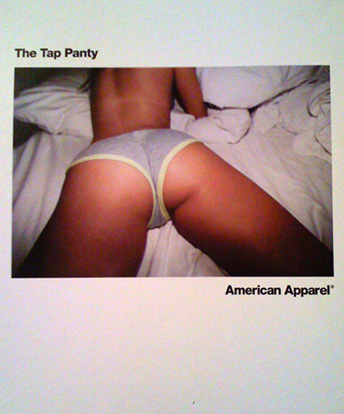
We achieve the same effect when showing women from behind, which adds another layer of sexual violability. American Apparel seems to be a culprit in this regard:

Covering up a woman’s face works well, too:


2) Does the image present a sexualized person as a stand-in for an object?
The breasts of the woman in this beer ad, for example, are conflated with the cans: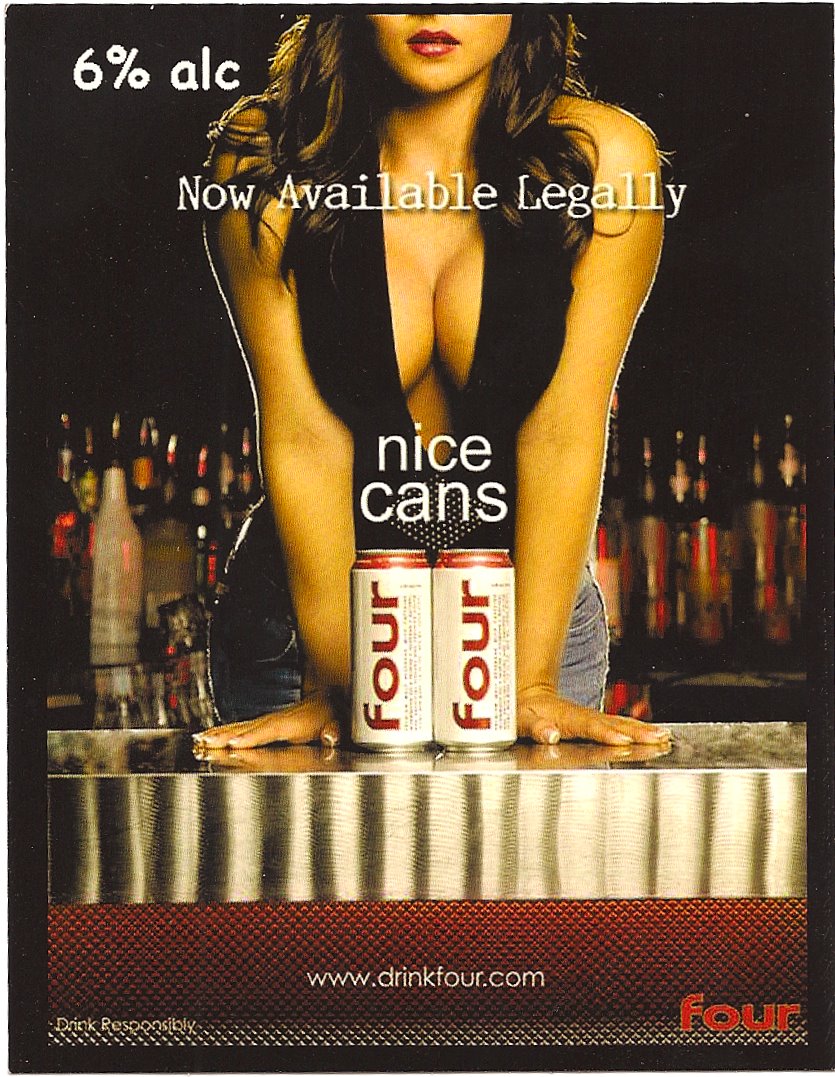
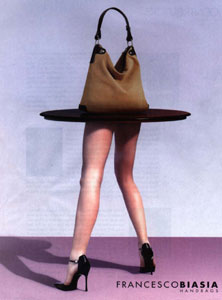
Likewise the woman in this fashion spread in Details, in which a woman becomes a table upon which things are perched. She is reduced to an inanimate object, a useful tool for the assumed heterosexual male viewer:

3) Does the image show sexualized persons as interchangeable?
Interchangeability is a common advertising theme that reinforces the idea that women, like objects, are fungible. And like objects, “more is better,” a market sentiment that erases the worth of individual women. The image below, advertising Mercedes-Benz, presents just part of a woman’s body (breasts) as interchangeable and additive:

This image of a set of Victoria’s Secret models, borrowed from a previous Sociological Images post, has a similar effect. Their hair and skin color varies slightly, but they are also presented as all of a kind:

4) Does the image affirm the idea of violating the bodily integrity of a sexualized person who can’t consent?
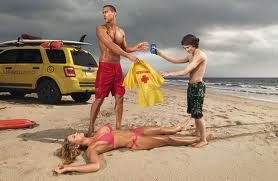
In this “spec” ad for Pepsi (not endorsed by the company), a boy is being given permission by the lifeguard to “save” an unconscious woman:
Likewise, this ad shows an incapacitated woman in a sexualized position with a male protagonist holding her on a leash. It glamorizes the possibility that he has attacked and subdued her:
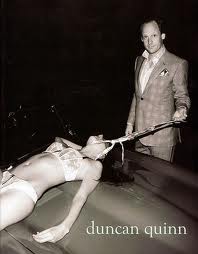
5) Does the image suggest that sexual availability is the defining characteristic of the person?
This American Apparel ad, with the copy “now open,” sends the message that this woman is open for sex. She presumably can be had by anyone.

6) Does the image show a sexualized person as a commodity that can be bought and sold?
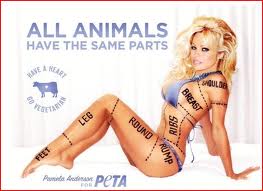
By definition, objects can be bought and sold, and some images portray women as everyday commodities. Conflating women with food is a common sub-category. This PETA ad, for example, shows Pamela Anderson’s sexualized body divided into pieces of meat:
And this album cover shows a woman being salted and eaten, along with a platter of chicken:

In the ad below for Red Tape shoes, women are literally for sale and consumption, “served chilled”:

7) Does the image treat a sexualized person’s body as a canvas?
In the two images below, women’s bodies are presented as a particular type of object: a canvas that is marked up or drawn upon.


The damage caused by widespread female objectification in popular culture is not just theoretical. We now have more than 10 years of research demonstrating that living in an objectifying society is highly toxic for girls and women. I’ll describe that research in Part 2 of this series.
Cross-posted at Ms., Caroline Heldman’s Blog and Sociological Images
Popular Posts on BroadBlogs
Anything Good About Being A Sex Object?
Sex Objects Who Don’t Enjoy Sex
Does Porn Objectify? Experts Disagree
Share this:

Woman, Not the Sum of Flawed Parts
![anistonpubis[1]](https://broadblogs.com/wp-content/uploads/2012/11/anistonpubis11.jpg) By Linda Bakke
By Linda Bakke
Star Magazine. Full of faces covered by question marks, bodies sliced up. Women diminished to the details of their flaws, circled in bold. A dissection of celebrities’ body parts.
I was working as a receptionist at a hair salon when I discovered Star. I picked it up and paged through. It was awful. I could not put it down.
One article divulged a star’s “hairy secret,” detailing the frequency of her waxing regimen and suggesting her pubic area was overly hairy. A two page spread highlighted shameful “sausage fingers.” Another asked who had the worst toes.
It all oddly evoked the serial killers who keep articles – or worse, dismembered body parts – as trophies.
And what is the triumph here? A sensed superiority over the goddess’ faults as we lie in judgment?
And who can blame us? Their supposedly error-free bodies stress us out! Destroying them and their presumed perfection just might lift our spirits.
But maybe scrutinizing them only returns scrutiny to us, as the judgments tell us we must correct our own “blemishes,” whether buttocks, breasts, fingers or toes.
The message: women’s imperfections cannot be tolerated.
As we eat it up, we fail to see how we become victims, too, unconsciously nodding agreement that this treatment of women is acceptable.
While the pictures and text underline our preoccupation with facade over character, men’s bodily foibles are untouched by these tabloids. Who can imagine placing a man in such light?
Hopefully one day we will take on realistic and healthy expectations so that women will no longer be seen as the sum of flawed parts.
Popular Posts on BroadBlogs
Keep Your Boobs, Get Better Guys
How to Look Like a Victoria’s Secret Angel
Beautiful Women’s Hips Are Thinner Than Their Heads?
Share this:

Playboy Bunnies Are Scary
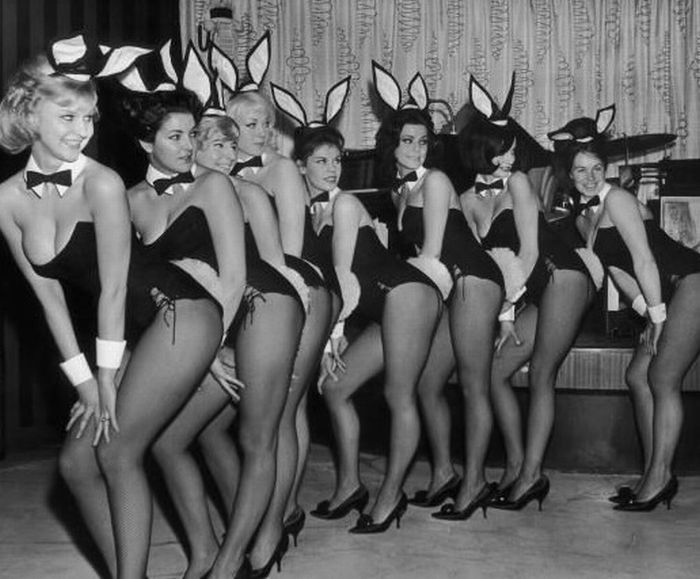 Would you like to be a Playboy Bunny this Halloween? The Bunny is a popular costume, and you may have some fun. But one real, live ex-Bunny paints a bleaker picture.
Lili Bee had once worked at the New York City Playboy Club. One day when a Bunny/Playmate emerged from the shower Lili was “struck by how absolutely human she looked.”
Curious about the Playmate’s spread, Lili flipped through the stacks of Playboys that sat in the Club’s employee lounge:
In front of me was sprawled virtual perfection, not a flaw in sight, her skin pore-less, tawny, with the texture of velvet. Her eyes were sparkling and bright. Her lips perfectly moist, parted ever so slightly to show off her perfect, non-rejecting smile.
Her body was portrayed in much the same way: All good features were highlighted to the extreme, and the less than perfect were ‘corrected,’ which is to say, rendered invisible.
Yes, the centerfolds were pretty. But so were her aunt, her boyfriend’s sister, and the woman who had handed her the New York Times that morning. In fact,
Most women were attractive if you could just see them outside of the narrow rules, and yet it seemed that Playboy had extolled some illusory woman as the absolute gold standard for perfection.
That presents a scary perspective for your average women. A fear that she can never live up to an ideal. She might undergo scary surgeries or diets to try to achieve that “perfection.” Or wear tortuous outfits to create an unreal shape. In fact, the Bunny costume is kind of scary.
In its shape-shifting, Lili’s outfit was painful and the boning left marks around her ribs. When feminist, Gloria Steinem, worked undercover as a Bunny, she had to wrap gauze around herself to keep the boning from rubbing her raw. And the stuffing the breasts sit on to make “anyone” look large-breasted was sweltering and tight. In fact, the costume was “so tight it would give a man cleavage,” Steinem recalled. Even the modified outfits that actresses wore for last year’s cancelled Playboy TV series were described as, “tight,” “constricting,” and, “Child, you cannot breathe.” All this pain to create the illusion of an “ideal” female figure that does not exist in reality.
Today Lili is leery of all that Playboy has created: Unattainable ideals that will hurt American women for the next 40 years, and counting…
So women can feel they don’t match up. And men can feel deprived, never finding the idealized perfection.
A little scary.
Popular Posts on BroadBlogs
Men Are Naturally Attracted To Unnatural Women
Miss Representation: Girls are Pretty, Boys Are Powerful
Beauty Tricks to Remove Your Power
Share this:

Love My Body
 By Zhe Cheng
I step on the scale, glance at the digital 135 and sigh silently.
“Hi, listen,” my boyfriend’s words ring in my mind, “I want you to lose weight. Immediately!”
I know I am a bit bigger than most Asian girls, but I never thought I was “fat.” I do want to lose weight to “look good,” but it is just so hard. Now, this stupid man, who is 5’10 and 110 pounds, who thinks of himself as “fit and charming,” sees me as “overweight.”
And my mind wanders back to a girl who smiles sweetly and says, “If you were thin, you would be very pretty.” My lips smile back but my mind glares. I’d already thought I was beautiful.
Mother wants me to lose weight, too. She claims I haven’t because I’m not insistent.
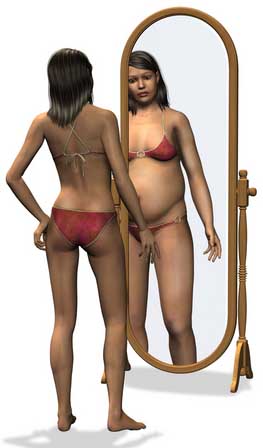
Although I love my body, although I am a feminist, although I try to ignore the thin girls around me, I am shaped by my society. Sometimes I feel upset when I see my round belly. And I feel guilty when I eat too much.
But I worry about dieting. Courtney Martin, who wrote Perfect Girls, Starving Daughters, says that 25% of dieters develop eating disorders. One of those disorders is especially dangerous: 7.4% of anorexics die. Then she tells us about Janet who says, “Even after my friend had a ministroke from taking Ephedra, I sometimes wonder if I can search the Internet and find some on the black market.”
Why risk death to lose weight?
We watch TV and see slim heroines, we pick up magazines and see skinny models, and we learn that thin is hot. We accept what society wants, and deny ourselves.
We accept superficiality over the inner beauty of independence, wisdom, and achievement.
Men don’t face such strict standards or such close scrutiny. My father is a bit overweight, but no one judges him by his body. Yet men feel free to judge us.
Martin suggests a solution:
If a women of any size is able to stop her negative self-talk and accept herself, she may experience the world with a little peace of mind.
I see my body in the mirror. It is so perfect. I face my boyfriend and stare at him, “If I wanna lose weight, I would. But I just think it is so stupid to lose weight because my boyfriend thinks I’m fat.”
I say to him, “If you don’t like my body, then don’t even touch me!”
He stands there shocked, saying “sorry” with his eyes.
This was written by one of my students (who is perfect weight and perfectly beautiful) and posted with permission.
Popular Posts on BroadBlogs
How to Look Like a Victoria’s Secret Angel
500 Calories + Pregnancy Hormones = Perfect Body
Beautiful Women’s Hips Are Thinner Than Their Heads?
Share this:

Can A Small-Breasted Woman Be Sexiest Woman Alive?
 We’re such a big-boob obsessed culture you have to wonder whether small breasted women can ever be seen as sexy.
Turns out, they can. Esquire just named sultry Mila Kunis “Sexiest Woman Alive.” This follows Maxim naming her third hottest woman in the world, while FHM put her in the top 10. Gorgeous mate, Ashton Kutcher, is good with her, too.
Other women of petite boobage have also landed on these lists, and a few years back FHM named Kiera Knightley the hottest of the hot. More recently Kate Middleton’s “Boobgate” inspired 311 million searches for “Middleton topless photos.” (The Duchess also made FHM’s “Hottest 100” this year.) Seems many men find smaller-breasted women attractive.
Now, I’m no fan of objectification and ranking women on lists. But so long as they’re doing it, I am glad to see some branching out from a narrow ideal of “skinny + big boobs = attractive.”
Without implants or obesity, B is the average cup size. Since so many women are an A or B cup it’s no wonder that by age seventeen, 78 percent of young women are unhappy with their bodies – worries about weight being another big issue.
007 Breasts – 007b.com, a website devoted to women and their breasts, gets (not surprisingly?) quite a few male readers. Based on comments they receive WOMEN do most of the fussing over breast size, not men. Men most commonly communicate these thoughts:
- Men are happy with any pair of breasts their partner has
- Men often say implants seem unnatural and hard
- A woman who appears secure and confident is attractive
Well, Mila Kunis exudes confidence.
So it looks like women don’t need to mutilate themselves and harm their health to be attractive. And moms don’t need to give their seven-year-old daughters a $10,000 voucher for a future boob job, as one did.
And if your boyfriend thinks you’re boobs are too small, it sounds like he’s a boob — get a better boyfriend!
Popular Posts on BroadBlogs
Anything Good About Being A Sex Object?
Beauty Tricks to Remove Your Power
Share this:

Beauty and Self-Esteem
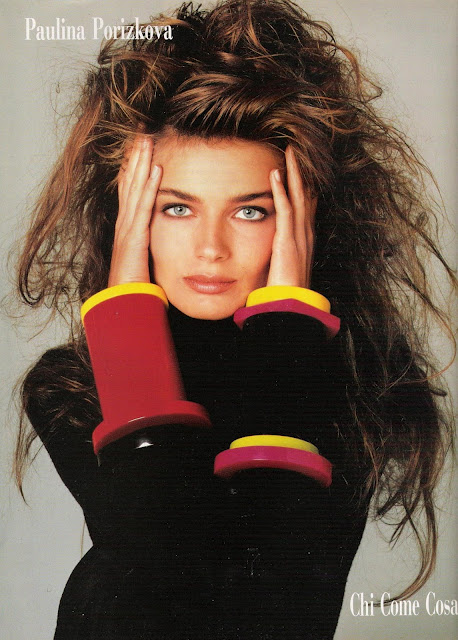
For women, beauty and self-worth can seem like the same thing. So do women at the top of the hierarchy have the highest self-esteem in the world? That’s one question that “About Face” explored in an HBO documentary on supermodels that aired over the summer.
Some supermodels did think their beauty made them better than others. Kim Alexis admitted she felt that way for while – but got over it. And Beverly Johnson explained:
You do live in a bubble where everyone is telling you you’re beautiful all the time, and get you coffee or whatever you want.
But I was also struck by how many of the world’s most beautiful women had thought they were unattractive in some way or at some point in their lives. Usually because someone had told them so.
While looking at a lovely shot of Carmen Dell’Orefice skipping in the street I was surprised that she didn’t like the photo because of her feet.
I don’t like my feet. I don’t have sexy feet. My mom used to tell me I had feet like coffins and ears like sedan doors. Then I internalized that.
First of all, her feet are perfectly fine. But you have to wonder about the self-criticism that fills women’s heads to make them find phantom flaws were they don’t exist.
Marisa Berenson had not thought she was beautiful, either:
People called me Olive Oil because I was long and lanky. I used to cut out pictures of actresses of the time, Audrey Hepburn and Rita Hayworth, and wish I looked like that.
Jerry Hall – Mick Jagger’s ex — felt she was unattractive, too, because society said so:
I used to be really upset about not having a boyfriend. I’d say, “I feel like a failure. What am I going to do?” And my mom would say, “Well, look at Twiggy. She’s a model and she is even skinnier and flatter than you.”
She got over it and went to St. Tropez to be discovered. A story in itself:
I wore a crocheted metallic bikini and platform shoes that made me 6’4. And I was expecting to be discovered. And I was, within about an hour this guy came up to me and asked if I’d like to be a model.
Most people see themselves through a positive bias according to psychological research. I assume that includes our assessment of our looks. If so, it seems strange that models so often go the opposite way. Maybe it’s a matter of age, going through the self-doubt of adolescence. Maybe it’s feeling unworthy of being at “the top.” Lisa Taylor got into cocaine because:
I was so insecure that I needed to do it. It made me feel like I had something to say, that I was worthy of being photographed, that I was somebody.
But the modeling industry, with its exacting standards — and lack of Photoshop in the early days — could be hard on self-esteem, too.
Paulina Porizkova got the double-whammy. As an immigrant child she was relentlessly teased, only to land as a supermodel and be torn apart once more:
My parents escaped to Sweden from the Czech Republic, and I was called a dirty communist bastard for years. And so when I had the chance to escape and be called beautiful – I don’t think there is any 15-year-old girl who would give up the chance to be called beautiful.
You don’t realize at that point that you will also be called ugly.
They would open my portfolio and start discussing me, start cutting me apart. “Good mouth, but what are we going to do about those teeth? Don’t let her open her mouth. And I don’t like the color of her hair. That can be fixed, but what about those thighs!”
Paulina goes on to explain that looks are not a very good platform on which to base self-esteem:
Beauty is about being self-confident and modeling has nothing to do with self-confidence. Working off your looks makes you the opposite of self-confident. So maybe I became beautiful once I stopped modeling.
Advice we should all heed.
Popular Posts on BroadBlogs
Am I Ugly? Girls Ask YouTube
The Plump Beauty Ideal: Exotic Dancers in 1890
Believe You’re Beautiful – Others Will, Too
Share this:

Tangled Up in Femininity
 If femininity came naturally, women wouldn’t need to tie themselves up in knots.
Some can barely walk in spiked heels that hurt. Some relentlessly guard against short skirts offering a quick flash. Some shift their weight around in corset-like contraptions. Others rearrange their faces, breasts and thighs under the knife.
Many squirm into a one-size-fits-all prescription that a husband and children will be 100% fulfilling.
Or, how about twisting yourself into Howcast’s rules for free drinks at a bar?
- Dress sexy, but not slutty, or you’re asking for it. How do you know if you’ve crossed the line? Well, if any men act inappropriately toward you, you must have shown too much boob. Better luck next time!
- Buy yourself one drink right off the bat, so it looks like you’re an independent-minded woman who isn’t trying to get free shit in return for being pretty. I mean, you are doing that, but you don’t want to make it obvious. Men might be turned off if the gendered exchange were made explicit.
In other words, don’t be who you are, be as you are expected, and walk a fine line on top of egg shells.
It all reminds me of a scene from “Brave,” as Natalie Wilson over at Ms. describes it:
Brave also offers a funny take on gender as performance when the very prim and proper Elinor is transformed into a hulking bear with a decidedly non-feminine body. Despite her new furry form, Elinor still “performs” femininity, prancing and posing and doing her best to have “good manners” with her unwieldy claws as she eats berries and fish.
So many of us jam ourselves into straightjackets. But why?
This is the “patriarchal bargain” that Lisa Wade, over at Sociological Images, calls a choice to accept roles that disadvantage women in exchange for whatever power they can wrest from the system. They gain advantages but leave the system intact.
And in fact, Howcast (mockingly?) instructs women to do just that:
Don’t ever stop to question a system that tells women that trading on our appearance, faking interest in people, excluding friends from social outings because they might be annoying to random men you’ve never met, and being manipulative are all totally empowering and socially-acceptable ways to behave as long as ladies get a fairly low-cost item for free in return for our efforts.
Yes. Never question the system.
Because the free drinks are so worth it.
Popular Posts on BroadBlogs
500 Calories + Pregnancy Hormones = Perfect Body
Beautiful Women’s Hips Are Thinner Than Their Heads?
Harry Potter’s Hermione: Less Brainy, Brave. More Sexy

 BroadBlogs