Category Archives: women
Vibrators & Women’s Sexuality are Out of the Closet
 Vibrators, once steeped in shame and secrecy, are going mainstream. Does this mean women’s sexuality has thrown off the covers, too?
As a culture, we are of two minds.
Vibrators were once illegal in several states, including Texas, Mississippi, and Alabama, or found only in seedy sex shops. But as the New York Times reports, today they may be purchased at your neighborhood drug store. Out in the open, even Oprah has pitched the helpful tool. And who can forget the “Rabbit Pearl” popping up in Sex and the City?
And yet, they aren’t quite out of the closet.
As one seller described the problem, “I can sit with my 10-year-old daughter during prime-time TV and watch a commercial for Viagra,” she said, “but I can’t advertise our OhMiBod fan page within Facebook.” Nylon Magazine won’t run her ads and the Small Business Administration refused her loan application because vibrators are a “prurient” business.
Ambivalence over tools and meds that enhance women’s sexuality reflects the larger cultural view. On the one hand the media glamorizes women’s sexuality. And plenty of porn approvingly portrays women with voracious sexual appetites.
But porn is off-limits. And women are told “Keep your legs together,” as if open legs were an open invitation.
Male sexuality is something to brag about, but female sexuality is something to hide. Men are praised as players and pimps. Women are called sluts, whores, tramps, and skanks… What positive word applies to women who enjoy sexuality?
Slang for penis and vagina says a lot, especially “cock” and “down there.” Cock: Cocky, boastful, swaggering. “Down there”? Unspeakable. Shameful.
This all reminds me of Zestra’s difficulty getting ads on TV for a product that arouses women. TV networks, national cable stations, radio stations, and Web sites like Facebook and WebMD all resisted. Yet “An erection lasting more than four hours” is O.K.?
Is it any wonder that sex surveys find mixed experiences among women when it comes sexual pleasure?
Indiana University’s comprehensive survey found that while 91% of men had an orgasm the last time they had sex only 64% of women did. These numbers roughly reflect the percentage of men and women who say they enjoyed sex “extremely” or “quite a bit”: 66% of women and 83% of men. Only 58% of women in their 20s had “the big O” on their last occasion.
As I’ve recently posted, 30-40% of women report difficulty climaxing. Women who lose virginity are also likely to lose self esteem, largely because they’re so focused on how they look (bad, they apparently think) and so unfocused on the sexual experience. And one-third of women under 35 often feel sad, anxious, restless or irritable after sex, while 10 percent frequently feel sad after intercourse.
On the other hand, many women do enjoy sex a lot, and frequently orgasm.
Does all this reflect that ambivalence, with enjoyment perhaps affected by which message gets most drilled into a woman’s mind?
Women’s sexuality kept in shadow and suspicion has an effect. Time to come out of the closet!
Ms. Magazine cross-posted this May 16, 2011 I first posted this piece May 9, 2011.
Popular Posts on BroadBlogs
Women: Climax Less Likely in Relationship Sex
Men: Climax More Likely in Relationship Sex
Sex Lessons from Mom and Dad
Share this:

Women’s Rights: Distracting, Shiny Objects?
 With all the rightwing nuts running about, I must make a post mortem on the election and women’s rights. Which would be comical, if it weren’t scary. Ok, both.
Let’s start with Katherine Fenton, scolded for asking how the candidates would ensure equal pay for women in the second debate. All hell broke loose in Wingnut-Sphere where the “femanazi question” was deemed illegitimate and Fenton became the “Whore of Babylon” inciting “Twitter hate masturbation” as Amanda Marcotte over at Pandagon put it.
Nearly every Republican congress member knows better, having voted down the Lilly Ledbetter Fair Pay Act.
The loony right’s insensitivity to rape has been widely panned, but deserves a brief review. Representative John Koster cavalierly called it “The rape thing.” Mike Huckabee sees rape as an alternative baby delivery system and Paul Ryan minimizes rape by calling it a “method of conception.” In fact, Paul Ryan co-authored a bill with Todd Akin (victims of “legitimate rape” don’t get pregnant) to narrow the definition to “forcible rape.” Richard Mourdock found forced pregnancy through rape “a gift from God” and told folks to “get over it.”
Feminist, Caroline Heldman wondered how pregnancy from rape could be a gift from God if raped women can’t get pregnant?
Meanwhile, Republicans voted time and again against contraception and abortion (even to save a woman’s life) even though contraception prevents abortion.
And if women die because they can’t get the procedure legally and safely, who cares, says Mississippi State Rep. Bubba Carpenter:
They’re like, “Well, the poor pitiful women that can’t afford to go out of state are just going to start doing them at home with a coat hanger.” That’s what we’ve heard over and over and over. But hey–you have to have moral values.
Laws that lead to women’s deaths are moral?
In other news most of the GOP refused to protect all women in the U.S. from domestic violence.
And, they pushed to block cancer screenings and HIV testing for underprivileged women.
Women’s rights just aren’t important says Eric Fehrnstrom, senior campaign adviser for Mitt Romney. They’re just “shiny objects” that are used to distract voters from real issues as he explained to ABC’s George Stephanopoulos:
Mitt Romney is pro-life. He’ll govern as a pro-life president, but you’re going to see the Democrats use all sorts of shiny objects to distract people’s attention from the Obama performance on the economy.
First it’s women as objects. Now it’s women’s rights as objects.
These guys haven’t got a clue. And they lost, big time.
Popular Posts on BroadBlogs
Spilling Sperm Harms Unborn, Law Says
Rush’s War on Women is No Fluke
Why Do Right-Wingers Hate Sex?
Share this:

Why We Have Sex
 Psychologists Cindy Meston and David Buss of the University of Texas, Austin, asked nearly 2,000 people why they had sex and assembled a list of 237 reasons.
Strangely, a few had sex “to get rid of a headache.” It’s No. 173. Aren’t headaches an excuse to avoid sex?
Other reasons include exercise, revenge, a sense of duty, adventure, an ego boost, desiring a gift, drunkenness, to keep warm, so my partner won’t have an affair, wanting a child… the list goes on, ranging from, “So my husband will put out the trash” to “It’s the closest thing to God” (perhaps explaining shrieks of “Oh God!”).
While evolutionary psychology claims women are more likely to have sex to get resources, men were actually more likely to do this. Men were also more likely to have sex to gain status. But then, women often lose status when they have sex, becoming “loose” sluts, whores or skanks…
This one’s interesting: Men were more likely to have sex because “the person demanded it.” Is that because men are more inclined to have sex for any reason, anyway?
Regardless of the reason, the researchers found that men were more likely to cite it, except for “expressing love” or “realizing I was in love.” I suspect women were also more likely to have sex to avoid taking out the rubbish. Consider that 84% of women admitted they’d had sex so her guy would do household chores or to put an end to sex-nagging. Older women were especially likely to have sex from a sense of duty. It’s what a wife does, they felt.
The good news? Men and women ranked the same reason most often: being attracted to the person. Actually, most of the top 10 were the same for each gender, including expressing love, being sexually aroused and having fun.
The psychologists placed the motivations into four general categories, as laid out in the New York Times:
- Physical: “The person had beautiful eyes” or “a desirable body,” or “was a good kisser” or “too physically attractive to resist.” Or “I wanted to achieve an orgasm.”
- Goal Attainment: “I wanted to even the score with a cheating partner” or “break up a rival’s relationship” or “make money” or “be popular.” Or “because of a bet.”
- Insecurity: “I felt like it was my duty” or “I wanted to boost my self-esteem” or “It was the only way my partner would spend time with me.”
- Emotional: “I wanted to communicate at a deeper level” or “lift my partner’s spirits” or “say ‘Thank you.’ ” Or just because “the person was intelligent.”
It is remarkable to see how often the motivations for sex lie outside of the pleasure of sex, itself.
Popular Posts on BroadBlogs
Wanting “X” from Sex, but Doing “Y”
Is Male or Female Sexuality Better?
Cartoonish vs Authentic Sexuality
Share this:

Raping, Shaming Girls to Impress Guys

Felicia Garcia
Young men at Piedmont High near San Francisco were caught “drafting” female schoolmates (unbeknownst to most of them) into a secret “Fantasy Slut League.” Upper classmen earned points for documenting their sexual exploits and used social pressure to manipulate the girls’ yearnings to feel attractive, included and popular. Sometimes they plied their targets with alcohol to impair judgment and control, that is, to commit rape.
Meanwhile, in the Stanton Island borough of New York, 15-year-old Felicia Garcia of Tottenville High had sex with four football players. The escapade was recorded and passed around the school as football players bragged about their conquest. Two of the ball players involved began tormenting her, and as news spread through the school, bullying spread, too.
One of Felicia’s friends told the New York Daily News,
Kids are saying she had sex with some guys from the football team at a party after the game. Later on, they wouldn’t leave her alone about it. They just kept bullying her and bullying her.
The young women of Piedmont High were left shamed and humiliated, and too many of them were sexually assaulted. Felicia killed herself on October 24 when she jumped in front of a Staten Island train as 200 students watched in horror.
You have to wonder why so many young men are willing to harm so many young women.
The answer likely revolves around guys trying to feel like men.
Michael Kimmel is an expert on men and masculinity who has studied “guys” at the cusp of manhood. He says that too often guys hurt themselves or others as they latch onto the more negative notions of manhood like aggression, violence, dominance and being tough.
Meanwhile, women are often objectified and seen as “things” that are all about sex. If they are things, and not people, you don’t have to worry about their feelings or their lives.
The young men at Piedmont High and Tottenville High were working to create a culture that painted men as aggressive and dominant, and women as silenced and humiliated victims who were made to feel lower in status… and who may even end up killing themselves.
Surely there are better ways to be a man.
Popular Posts on BroadBlogs
Yale Fraternity Chants “No Means Yes.” Men? Or Scaredy Cats?
Frats Invite Sluts, Bitches; Women Accept Degradation. Why?
It’s Ok To Be A Tomboy But Not A Sissy. Why?
Share this:

Playboy Bunnies Are Scary
 Would you like to be a Playboy Bunny this Halloween? The Bunny is a popular costume, and you may have some fun. But one real, live ex-Bunny paints a bleaker picture.
Lili Bee had once worked at the New York City Playboy Club. One day when a Bunny/Playmate emerged from the shower Lili was “struck by how absolutely human she looked.”
Curious about the Playmate’s spread, Lili flipped through the stacks of Playboys that sat in the Club’s employee lounge:
In front of me was sprawled virtual perfection, not a flaw in sight, her skin pore-less, tawny, with the texture of velvet. Her eyes were sparkling and bright. Her lips perfectly moist, parted ever so slightly to show off her perfect, non-rejecting smile.
Her body was portrayed in much the same way: All good features were highlighted to the extreme, and the less than perfect were ‘corrected,’ which is to say, rendered invisible.
Yes, the centerfolds were pretty. But so were her aunt, her boyfriend’s sister, and the woman who had handed her the New York Times that morning. In fact,
Most women were attractive if you could just see them outside of the narrow rules, and yet it seemed that Playboy had extolled some illusory woman as the absolute gold standard for perfection.
That presents a scary perspective for your average women. A fear that she can never live up to an ideal. She might undergo scary surgeries or diets to try to achieve that “perfection.” Or wear tortuous outfits to create an unreal shape. In fact, the Bunny costume is kind of scary.
In its shape-shifting, Lili’s outfit was painful and the boning left marks around her ribs. When feminist, Gloria Steinem, worked undercover as a Bunny, she had to wrap gauze around herself to keep the boning from rubbing her raw. And the stuffing the breasts sit on to make “anyone” look large-breasted was sweltering and tight. In fact, the costume was “so tight it would give a man cleavage,” Steinem recalled. Even the modified outfits that actresses wore for last year’s cancelled Playboy TV series were described as, “tight,” “constricting,” and, “Child, you cannot breathe.” All this pain to create the illusion of an “ideal” female figure that does not exist in reality.
Today Lili is leery of all that Playboy has created: Unattainable ideals that will hurt American women for the next 40 years, and counting…
So women can feel they don’t match up. And men can feel deprived, never finding the idealized perfection.
A little scary.
Popular Posts on BroadBlogs
Men Are Naturally Attracted To Unnatural Women
Miss Representation: Girls are Pretty, Boys Are Powerful
Beauty Tricks to Remove Your Power
Share this:

Why Men Objectify
 Some men wonder why they objectify women. So Jayson Gaddis asked men on his Facebook page why they thought they did, and then he wrote about it for The Good Men Project.
What is objectification? Jayson describes it as:
Staring, gawking, or checking out women and their bodies and body parts. Seeing them as objects instead of actual people, and thinking of them in a sexual way.
Why do they do it? Most blame “nature.” As one man exclaimed,
I love looking at women. They’re just amazing. It’s part of my biological make up to think that they’re beautiful.
Jayson believes biology plays a role since men are hardwired to look for mates and procreate. But he thinks cultural conditioning is involved, too. To paraphrase:
In men’s culture, it’s acceptable to objectify women. Men bond around it. And, it’s pervasive and all around us. Notice where men buy stuff, there are often photos of women present. I can barely go on any male-focused website now without being hit at some point by a tiny, physically attractive, disproportioned airbrushed woman looking at me.
Some men objectify because the “feel good” feeling acts like a drug or pick me up. Objectification can fill an empty place inside:
I’m stuck in the belief that that feminine essence is outside of myself. I’m alienated from the larger truth of my Completeness as a human being. That sexy, juicy, radiant paradise is not inside myself, therefore it’s an object I obsess about outside myself and I treat it like entertainment. This insight leads me to believe I haven’t spent enough time balancing the relationship with My (whole) Self.
Others want gratification without any real work or risk of rejection.
I objectify women cause it’s “safer.” I receive an immediate gratification, a thrill if you will, albeit superficial, it does keep me safe at least for a time from annihilation — from a treacherous road of intimacy and vulnerability — the risk of being really seen and connected with – or actually rejected!! Yes, that’s it — it’s an avoidance of rejection… Intimacy takes a lot of work, courage and commitment. Objectifying is an “easy” road out of the potential of rejections.
Maybe some men simply enjoy the sense of being with many women, polygamous, a way of living that doesn’t appear to be a possibility in our culture. One man says he likes to play with the fantasy and the illusion like he does with porn:
The most fun and exciting and ego gratifying times in my life have been when i have embraced it and danced with it and gave myself permission to play with the illusions, projections, feelings, etc.
Like this man, many say they seek approval or self-esteem. I’m not sure what that means. Might a man’s self worth rise when he imagines the women enjoying his attention?
Or, does self-esteem rise from gaining a sense of power over women? After all, they dressed and adorned themselves to please men – and thus, “him.”
Some talk of the power women have over men – making them melt and creating unrequited desire. But by objectifying women a man can feel superior. “He” is subject while “she” is an object that exists for his pleasure and purposes.
The fear of annihilation has been cited before, but one man describes it in a way that echoes this fear of female power. He seeks “to avoid the terror of annihilation — being reabsorbed back into the feminine.”
Whatever’s going on, Jayson suggests men consider how objectification is working for them and the women in their lives. For those who feel it’s not working, here’s how some have dealt with the matter:
What I’ve found works best for me so far is being a yes to everything in my own experience and in what’s happening AND at some point in my development simply realizing that objectification is not enough for me … I love appreciating and experiencing another human being for more than just her physical traits. What I prefer physically doesn’t in itself inspire me to want to connect with a woman, and doesn’t in itself have me feel attracted. The attraction and inspiration simply are there or not independent of how she looks.
Or this:
The answer for me was to stop trying to get this woman but use that energy to make myself the best possible me I could become. A me that now has confidence because I am self assured, self respecting, and full of self accepting unconditional love. Part of becoming that man means that I must accept and own the truth of my motives and be willing to see the motives of others. That is when I was finally able to let go of the fantasy and see this woman for who she really is inside.
My biggest life breakthrough and victory came as a result of that growth.
As a result, something incredible is happening to me now. Something wonderful has started growing in the void where my fantasy used to live. It’s a genuine curiosity and appreciation for all woman. Especially for all the women who actually live and display their authentic self and freely give their love to all as an expression of their femininity.
Or this,
Once I get connected to me again, I notice how I can appreciate a beautiful woman and I’m in my body, connected to my heart. It has a totally different quality. She feels it and I feel it.
By the way, objectification and desire are two different things. And men are rarely objectified. See these two articles:
For more on all this, go to The Good Men Project.
Related Posts on BroadBlogs
Anything Good About Being A Sex Object?
Being Sexual vs Looking Sexual
Does Porn Objectify? Experts Disagree
Share this:

Love My Body
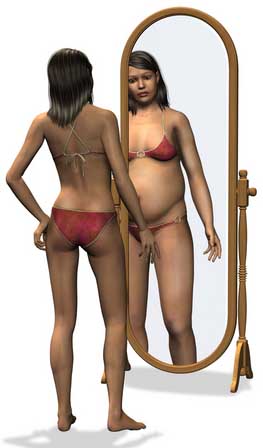 By Zhe Cheng
I step on the scale, glance at the digital 135 and sigh silently.
“Hi, listen,” my boyfriend’s words ring in my mind, “I want you to lose weight. Immediately!”
I know I am a bit bigger than most Asian girls, but I never thought I was “fat.” I do want to lose weight to “look good,” but it is just so hard. Now, this stupid man, who is 5’10 and 110 pounds, who thinks of himself as “fit and charming,” sees me as “overweight.”
And my mind wanders back to a girl who smiles sweetly and says, “If you were thin, you would be very pretty.” My lips smile back but my mind glares. I’d already thought I was beautiful.
Mother wants me to lose weight, too. She claims I haven’t because I’m not insistent.
Although I love my body, although I am a feminist, although I try to ignore the thin girls around me, I am shaped by my society. Sometimes I feel upset when I see my round belly. And I feel guilty when I eat too much.
But I worry about dieting. Courtney Martin, who wrote Perfect Girls, Starving Daughters, says that 25% of dieters develop eating disorders. One of those disorders is especially dangerous: 7.4% of anorexics die. Then she tells us about Janet who says, “Even after my friend had a ministroke from taking Ephedra, I sometimes wonder if I can search the Internet and find some on the black market.”
Why risk death to lose weight?
We watch TV and see slim heroines, we pick up magazines and see skinny models, and we learn that thin is hot. We accept what society wants, and deny ourselves.
We accept superficiality over the inner beauty of independence, wisdom, and achievement.
Men don’t face such strict standards or such close scrutiny. My father is a bit overweight, but no one judges him by his body. Yet men feel free to judge us.
Martin suggests a solution:
If a women of any size is able to stop her negative self-talk and accept herself, she may experience the world with a little peace of mind.
I see my body in the mirror. It is so perfect. I face my boyfriend and stare at him, “If I wanna lose weight, I would. But I just think it is so stupid to lose weight because my boyfriend thinks I’m fat.”
I say to him, “If you don’t like my body, then don’t even touch me!”
He stands there shocked, saying “sorry” with his eyes.
This was written by one of my students (who is perfect weight and perfectly beautiful) and posted with permission.
Popular Posts on BroadBlogs
How to Look Like a Victoria’s Secret Angel
500 Calories + Pregnancy Hormones = Perfect Body
Beautiful Women’s Hips Are Thinner Than Their Heads?
Share this:

Gay Marriage, Slippery Slope to Polygamy?
 Obama and Romney both have grandparents who practiced polygamy, yet both have said (and one’s still saying) that marriage should be between one man and one woman. Some think it odd that they both reject the practice when they’ve each got a family history. But I, too, have grandparents who practiced polygamy yet I don’t like the practice, either. This brings me to the concern that marriage equality is a slippery slope to polygamy.
If you hold marriage to “two consenting adults” the problem goes away.
At the same time, while I have a personal distaste for polygamy, I’m not sure that decriminalization would be a bad thing.
First, the problems with the practice.
Gender inequality can be created by simple supply and demand, with “the one” having more power, whether polygyny (one man, many wives) or polyandry (one wife, many husbands). In the polyandrous Lahaul Valley of the Himalayas women have great say over matters. As one young man in this community explained, “The wife’s voice is the dominant voice in the household.”
Typically, polygamy is practiced under patriarchy (as polygyny) so the power of “the one” man becomes intensified. As one New York Times letter writer observed in response to Jonathan Turley’s insistence that polygamous families should be free to live their religion and values:
(In highly patriarchal families) this is not ‘the right to live your life.’ The men have rights, but not the girls (who are) brainwashed, uneducated and mothers while in their teens.
In polygyny it can seem that women make all the sacrifices so that men may take unlimited pleasure. A Sufi who agreed to be a third wife of her teacher (the article title “My Husband, My Teacher” suggests additional inequality of relationship) described her experience this way:
I went through, as did the other wives, all of the usual feelings of jealousy, fear, and insecurity.
She had to learn to let go of attachment, or seeing her spouse as property. Yet her husband didn’t need to learn any of these lessons, enjoying greater freedom and sexual variety than any of his wives ever will.
The addition of a new wife may even be used as a threat in polygamous cultures. Not surprisingly, 86 percent of Afghani women are against the practice.
Moving to larger societal problems, at marriageable age women and men are in equal number so girls in polygamous communities must be married at younger and younger ages, and are often forced into marriage. Their youth further disempowers them. Meanwhile, teenaged boys may be thrown out of these communities via trivial charges like watching “inappropriate” movies.
Joseph Henrich, a University of British Columbia professor whose expertise lies in psychology, anthropology and economics says higher levels of polygamy are tied to higher crime rates, lower GDP per capita, and worse outcomes for children.
And, fewer available women may mean more frustrated bachelors who support the sex trafficking of girls and women. These young men are also vulnerable to recruitment by extremists in some parts of the world.
There is plenty that is not pretty. So why legalize polygamy?
When the practice is illegal and stigmatized, those who live it end up isolated from the rest of society. That means its practitioners hear few alternate voices, and are less aware of the possibility of living differently. Or, choices become limited as others ostracize them and reject their friendship. In other words, they’re more stuck.
Oddly, adherence to “plural marriage” might actually decrease if it were made legal and destigmatized.
I don’t know if legalization will ever destigmatize polygamy, which is an important step in freeing people to hear different voices and to help them to have more options.
Regardless, I doubt legalization will bring people flocking to the practice. The notion of sharing your husband or wife while being forced to be monogamous, yourself, just isn’t that appealing to most people. In the U.S. polygamy is pretty much only practiced for religious reasons, so it’s not likely to catch on. And where it does, it would be more likely voluntary and not coerced.
If you fear gay marriage because polygamy might come next, I doubt there’s really much to worry about.
Popular Posts on BroadBlogs
Are Women Brainwashed Into Polygamy?
Frats Invite Sluts, Bitches; Women Accept Degradation. Why?
Early Islam’s Feminist Air
Share this:

Objectification’s Role in a Suicide
 More than sexual objectification was certainly involved in 15-year-old Amanda Todd’s death. But it seems to have played a role.
It all began when Amanda and a few of her middle school friends started videochatting with strangers just for fun. Some told her she was “stunning, beautiful, perfect,” a complement any 13-year-old would enjoy. Eventually, a man asked her to flash. And she did.
A year later this same guy found her and threatened to send the nude photos to her family, friends and her entire school if she didn’t “put on a show for him.” When she refused, he did.
Amanda became the laughingstock of the school and lost all of her friends. Anxiety and major depression overtook her life and she turned to drugs, alcohol and cutting to cover the pain.
She moved a couple of times, trying to get away, but her stalker always collected the names of her new friends and even set up a Facebook page with her boobs as the profile picture.
The pictures followed her wherever she went. And so did the derision. And the isolation.
She made two suicide attempts.
A couple of weeks ago she posted a nine-minute video, “My story: Struggling, bullying, suicide and self harm.” She never speaks in it, but holds up note cards that tell her story. Maybe you’ve seen it. If not, it’s a powerful message against bullying which you can see here.
Near the end she seems hopeful, holding a card that reads:
Everyone’s future will be bright one day, you just gotta pull through. I’m still here, aren’t I?
But depression finally won and she committed suicide last week.
How could objectification have played a role? Well, how does objectification encourage men to see women? Actually, it doesn’t encourage men to see women, but to see women’s bodies – as objects that exist for their purposes.
The images are often bodies without heads—without minds and thoughts and emotions or personalities or a will to act in the world. Sometimes the bodies are shaped in the form of an object, like a table, for a man to use as he will.
The man who harassed Amanda did not see her as a person who had hopes and dreams for the future. He is not a man who cared about her. He did not think of her as a person. She was just a thing for him to play with and manipulate for his own sadistic purposes. If he had seen her as a real person and felt any empathy he would not have behaved as he did.
Now, all men are subjected to objectification, yet not all men behave like Amanda’s stalker. So of course it takes more than objectification to drive a man like that. But objectification combined with a twisted mind can be a dangerous thing.
Popular Posts on BroadBlogs
Anything Good About Being A Sex Object?
Nude Men Seem Less Intelligent
Does Porn Objectify? Experts Disagree
Share this:

Batterers Brag
 I was out of town when Chris Brown unveiled his neck tattoo of a battered woman, possibly Rihanna, but now I’m back and I have to comment.
Strange that Brown would brand himself with a battered Rihanna for all the world to see. And if it’s not Rihanna, why sport an image that will remind everyone of the pummeling?
Publicity seeking seems likely.
Still, you have to wonder why shame doesn’t stop him.
Apparently Chris Brown is not alone in feeling no shame. Sean Connery and others feel that it is “absolutely right” to slap a woman. Televangelist, Pat Robertson, advised one man to beat his wife into submission – even if he had to move to Saudi Arabia to legally do it. To these Neanderthals, beating women is all part of being a real man (or caveman).
Amanda Marcotte over at Pandagon sees it as a batterer’s brag:
There’s a myth that men who beat and rape women just “lose control” and that after they act out, they sit around stewing in shame. That is because this is what these men tell people they are trying to ingratiate themselves with, in order to gain their acceptance and forgiveness. But inside, as many victims who have seen their true face can tell you, they are defiant. They believe they are entitled to dominate women, and they feel victimized by a world that doesn’t give them what they believe is theirs. They act out, looking for little ways to assert the right to dominate [what] they believe is theirs.
Marcotte cites research from psychologist David Lisak, who found that certain men will happily tell stories about successful sexual assaults. Joanna Schroeder over at The Good Men Project feels the analysis rings true:
The batterers I’ve known have betrayed a certain pride over the pain they cause their partner. They want their partner to keep the abuse a secret, but they themselves say things like “Jodi knows better than to look twice at another guy” while making a punching motion with their hands. It’s always under the guise of being a joke, but it makes the hairs on the back of your neck stand up when you already know or suspect that the guy is abusing his wife. One man I knew who was a batterer would threaten to rape his wife, seemingly joking, in front of almost anyone. Turned out he had been raping her for almost as long as they were married.
If you see yourself as righting the scales of justice — punishing those who have “hurt you,” and returning gender to its rightful order, with men on top — I guess bragging makes sense.
Marcotte continues:
…telling others about it and watching them recoil basically means reliving the power trip… Not only did they dominate the victim, but they have provoked anger and disgust in you, and that makes them feel powerful all over again.
Growing up, Brown was tormented by watching his stepdad beat his mom. That childhood horror and helplessness seem to have deeply scared him. Too bad he hasn’t dealt with his issues in therapy and focused his power in positive ways – in real ways – because how much power does this guy really get from beating his girlfriend?
Popular Posts on BroadBlogs
Real Men Don’t Beat, Rape Women
Mind of a Rapist: Trying to Bridge a Gap between a Small Self and a Big Man
Boys on the Bus Grasping at Fake Power

 BroadBlogs