Category Archives: body image
Self-Esteem Falls with Rise in Power? Blame Beauty Ideals
Even as women’s power has increased over the last fifty years, self-esteem has too often diminished. Why? Blame unachievable beauty ideals.
Since the mid-twentieth century, the number of women and girls with poor body image has greatly risen. A big problem, since feminine self-worth has become closely tied to body image.
As Naomi Wolf explains in The Beauty Myth, women have more money and power than ever before but, “a secret ‘underlife’ poisons our freedom; infused with notions of beauty, it is a dark vein of self-hatred, physical obsessions, terror of aging and a dread of lost control… In fact, in terms of how we feel about ourselves physically, we may be worse off than our unliberated grandmothers.” Too bad her book, which was written twenty years ago, is not now obsolete.
Once upon a time, she says, the family was a productive unit so that a woman’s value lay in her work skills, economic shrewdness, physical strength, and fertility, with physical beauty playing a lesser, and less oppressive, role.
Before the industrial revolution – before photographs, photoshop, and plastic surgery – women did not feel pressured to live up to a mass-marketed ideal – one that is nearly impossible to achieve, leaving women frustrated and depressed, obsessed with their looks, and wondering what is wrong with them.
As the beauty myth creates a hierarchy pegging some better than others, I am reminded of a piece by Nick Kristof of the New York Times, entitled, “Equality, a True Soul Food.”
He cites evidence from two British epidemiologists who wrote a book called, The Spirit Level. Richard Wilkinson and Kate Pickett argue that “Gross inequality tears at the human psyche, creating anxiety, distrust and an array of mental and physical ailments,” with those at the bottom of unequal societies suffering from a range of pathologies.
The Spirit Level is concerned with economic disparity. But the theory fits with other
inequities. Beauty hierarchies leave too many women depressed with low self-esteem, eating disorders, competing to be plastic on reality TV, jealous, envious, and sometimes dying from anorexia or plastic surgery. Notably, the problem isn’t so much where you stand as where you think you do. Unfortunately, it’s common for women to place themselves at the bottom, and suffer.
Inequality undermines social trust and community life, and people feel stressed when they sit at the bottom of a pecking order. Kristof discerns that the toll of our inequality is a melancholy of the soul.
Why not celebrate the wonderful variety of figures and faces that women embody, instead?
Popular Posts on BroadBlogs
Men Are Naturally Attracted To Unnatural Women
The Constricting Bodice: Empowerment and Imprisonment?
Men Finding Fewer Women “Porn-Worthy”
Share this:

I Overate Because I Felt Guilty Eating
What if I just have a small slice of raspberry cheesecake? I was good today, I deserve it. Maybe a bigger slice would be okay if I eat celery later? They would cancel each other out, right? Or I could eat the cake while jogging in place?

These are the musings of a young woman’s mind in a Yoplait yogurt ad. (See ad here.) Sound familiar?
Does to me. Evokes the mantra that once ruled my twenty-something brain. Back then, food was both magic and evil. That’s a noxious combination, known to create obsessions and addictions.
A person who feels guilty about eating often overeats. They obsess about food. Food calls to them. Think you’ve had a little too much? Feel guilty! Now that you’ve sinned you might as well go all the way. Besides, a pint of Häagen-Dazs feels sooo good. At least while there is still some left in the container.
Works the same with alcohol. To the Irish, spirits magically change your mood. But overindulging brings shame and disgrace. Imbibed a bit too much? Might as well drink more and feel better. The Irish have fairly high levels of alcoholism. It’s different in places where alcohol is simply a part of dinner. A good wine is a dining must in France. And alcoholism is low.
But back to eating disorders. Some are more serious than mine. Jenni Schaefer survived both anorexia and bulimia. She told the Huffington Post that you start to divide foods into “good” and “bad” categories until they all seem bad. “I was shocked by how (the ad) really nailed it on the head,” she said. “That’s exactly what I thought every time I opened a refrigerator door.”
Experts worry that the ad’s message makes this sort of obsessive thinking seem completely normal, with some responding by eating too little, while others eat too much. To their credit, Yoplait pulled the piece once concerns surfaced.
I was lucky to eventually hear a different message. I was shocked to find a diet that denied the notion that food is bad. Maybe because the book, Eat to Win, was written for athletes with tennis champ, Martina Navratilova, a fan.
The notion that food is good and shouldn’t be an obsession had a profound effect on me. I highly recommend a healthy perspective on food that recognizes the need for nourishment and enjoyment.
Related Posts on BroadBlogs
I Can’t Believe I Ate A Whole Head Of Lettuce!
500 Calories + Pregnancy Hormones = Perfect Body
Beautiful Women’s Hips Are Thinner Than Their Heads?
Share this:

Sex with Men, Hoping to Feel Beautiful
By Anonymous
Imagery is powerful. I remember my mother watching Marilyn Monroe movies and looking at her pictures in magazines. She bleached her hair and styled it like Marilyn’s. Mom dressed in high heeled boots and miniskirts and wore the style of make-up that graced magazine covers. My father loved it. I saw the attention men gave her, especially at parties. Looking back I see how the ideal of the perfect woman had a huge impact on the psychology of my mother. And me.
Although beautiful, mom lacked self-confidence and self-esteem. She gave up on her dreams to pursue the love of a man through beautifying herself. She became a submissive woman at the beck and call of the men in her life. No surprise, she married eight times before age thirty.
I watched men walk all over my mother, treating her like a trophy wife in front of their friends. But behind closed doors they demeaned and objectified her. I grew to dislike men, yet followed in her footsteps. It began in elementary school.
In elementary school super cute girls wore bows in their hair and cute dresses with knee high boots in white patent leather. I was plain looking and had a poor self-image, partly because of experiences with my mom. But also because I looked nothing like the ideal
images that surrounded me on magazine covers.
At the same time, I felt uncomfortable wearing glamour styles and dressed more like a tomboy. I covered my body even though looking back, it was rockin’! I still got attention from boys, but not the kind a girl wants. I was one of the guys.
My low self-esteem carried over into my teen years. Mom made comments about my body and told me I better be careful or no man would want me. I’d never had weight issues until my mom made me painfully aware of it.
I looked in the mirror and saw things that weren’t there. I wasn’t fat, but I thought I was. I wasn’t ugly, but I thought I was. I thought my friends were prettier than me. Funny, my low self-esteem made me less attractive.
With poor body image and low self-esteem women don’t reach their full potential. I didn’t. My life goal: attracting a man. I dropped out of high school. I dropped out of college. I had sex with many men hoping to feel beautiful, adored and loved.
I recently took a photography class and learned the secrets of Photoshop. The instructor showed an un-retouched photo of Cindy Crawford, highlighting the roughness of her face, acne, arm fat, and a “thick” waist. He then showed how they thinned her waist, removed the arm fat, elongated her chin, and gave her a flawless complexion for the magazine cover.
I sat in disbelief. None of the images we see in Playboy, Vogue, Glamour,
Sports Illustrated Swimsuit, Shape or InStyle are real images. Men are made to
believe this is what women should look like and they view women who don’t
harshly. Women and girls also believe these images are true representations of
beauty and glamour.
They Aren’t.
But I hadn’t known that.
Hopefully the future will see new media sprout up portraying real women without airbrushing and manipulation. Let women embrace who they are so they can be strong and healthy. I want to get to that point in my life. I am still dieting and still struggling with poor body image.
One day, I will embrace myself for who I am and not worry about what I eat. One
day I will have the confidence I need to make my way through this second half
of life with a great career and a great love of myself. I wish that for all
women.
This piece was written by a student of mine. I asked if I could publish it on my
blog. She requested anonymity.
Popular Posts on BroadBlogs
Cartoonish vs Authentic Sexuality
Should You Ask Why Your Lover Loves You?
Spoon Fed Barbie
Share this:

Grade School Lingerie
When I was ten years old plenty of my friends would wear “big girl lingerie” that they got from Abercrombie and the like. I felt pressured to constantly push to be sexier, or more desirable. At ten years old, who exactly am I trying to attract?
This comment (paraphrased) came in reaction to a piece I recently wrote called, “Cartoonish vs Authentic Sexuality.”
I found the remark a bit starling. At age ten I did not feel any pressure to be sexy. I was a kid! None of my little-girl friends seemed to have such notions, either.
Wondering who she was trying to attract, the young woman added, “I don’t think any of us really knew the answer to that, but it felt necessary all the same.” And then she asked what lay behind the focus on sexualizing young girls.
My first thoughts are that companies like Abercrombie are trying to get young kids to like their brand by appealing to the desire to feel “grown up.” Not to mention all the free
publicity they get from controversies surrounding their products.
But I’ve also noticed a broad trend toward sexualizing both girls and women that goes beyond what I had experienced at the age of ten, or even twenty.
In fact, not long ago I was flipping through TV channels looking for movies when I saw the 1988 film Crossing Delancy with Amy Irving (Steven Speilberg’s ex) and the 1986 film About Last Night with Demi Moore and Rob Lowe. And then I noticed that in these films – and several other romantic comedies of that period – the women were not dressed sexually. No body-hugging clothing. No revealing décolletage.
Why the change?
Naomi Wolf’s The Beauty Myth might help us out. Wolf points out that as women
have gained power they have also become more sexualized. She says it’s no accident.
Think about it. As women take on sex object status, they become objects. Objects aren’t quite human, leaving them at a lower rung on the ladder than men. Meanwhile, the ideal of huge breasts and skinny waists is near impossible to achieve, leading to poor self-esteem and an awful lot of time spent trying to fulfill this “requirement.” And if you’re busy focused on your looks, you’ll take your attention off more substantive things.
In sum: As women become more sexualized, even as they gain power they lose status by becoming objects. Even as women gain power, narrow notions of beauty leave them feeling worse about themselves as body image suffers. As women put tremendous time and energy into their looks, they have little time or energy left to become more empowered.
I personally feel that sexy is fine (and beyond the cartoonish narrow notions, please!), but that “sex object” isn’t. Sexy can be one part of a well-rounded woman’s life, while “sex object” sees women as being only about sex.
Women should not be seen as only sexy. Sexy should not be the primary source of self-worth. Sexy should not be the most important thing in the world.
And children should not be trained to see themselves as objects.
Georgia Platts
Popular Posts on BroadBlogs
Cartoonish vs Authentic Sexuality
Spoon Fed Barbie
Women Seeing Women as Sexier than Men
Share this:

Anything Good About Being A Sex Object?
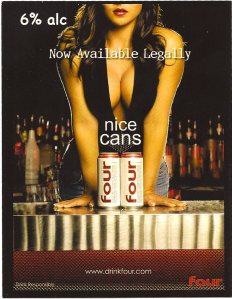 When I ask my students if they can think of anything good about being a sex object they think there must be something positive, since so many women put a lot of effort into being sexy, with some aspiring to “sex symbolness.” Here’s what they say:
- Sexy women get attention. They feel attractive and admired, so it’s a source of self-esteem.
- It’s nice to feel wanted and desired. It’s easier to attract mates or just get sex.
- It can be fun to feel sexy.
- Sex is a historic source of power for women. Sexiness can gain women resources, whether through marriage or getting men to do favors. It puts women in control over men.
Then I ask if there’s a downside. More comments:
- It can be uncomfortable being gawked at. You can feel like you’re only a sex object – and that’s all, like you’re not worth a lot.
- You can feel disrespected. Guys just want one thing. You get used.
- When women are seen as all about sex, and they don’t want to put out, they’re seen as bitches.
- You aren’t seen as intelligent. You aren’t taken seriously.
- Your personality disappears.
- It can feel inauthentic, feeling pressured from friends or society to look sexy.
- Sexual objectification leads to sex trafficking. Treating young women and girls like they are nothing but objects that exist to pleasure men. They have no lives. They’re all about sex and nothing else. And they’re not given an opportunity to be anything else.
But there are problems when you don’t meet sex-object standards, too:
- You feel like you’re constantly being judged, and not coming out well.
- You may starve. Or get implants and die (that does happen). You have false hope, and when you don’t meet the standard you lose self-esteem.
So much contradiction. Is there any way to get some of the positive upside without all the downside? I’ll admit to feeling the world would be a bit dull without any spice of sexiness.
How about distinguishing between sexy and sex object. And broadening our notion of what “sexy” means?
Objects are treated as little more than a means to others’ pleasure. They are not people with lives, goals, thoughts or emotions. It’s one-dimensional. A limited box. And who cares how you treat an object?
So if a woman does have – and is seen as having – a life, goals, emotions and intelligence, and sexiness is one part of all that, then she can be a full person – who is also sexy.
But still, can we move outside the narrow notions? Who’s sexy to me? Women and men who are classy, smart, talented, confident, and who make a difference in the world.
I nominate:
Nancy Pelosi, Thandie Newton, French politician Marie-Ségolène Royal, Helen Mirren, Angelina Jolie, Jackie O, Jennifer Lopez, Toni Morrison, Queen Rania of Jordan, Barbara Walters, Sandra Bullock, Zhang Ziyi, America Ferrera, Diane Sawyer, Jennifer Aniston, Queen Latifah, Gloria Steinem, Julia Roberts, and Maria Shriver.
And men? My list includes:
Ezra Klein, Benico del Torro, Ed Harris, New York Times columnist, Princeton professor and Nobel Laureate Paul Krugman, CNN anchor T.J. Holmes, Tom Brokaw, Brad Pitt, Barack Obama, Stephen Colbert, Gabriel Byrne, Japan’s former Prime Minister Koizumi Junichiro, JFK Jr., Antonio Banderas, Sidney Poitier, Javier Bardem, and White House corresspondent, Jake Tapper.
Yeah, sexiness can be fun and alluring, when moving outside narrow limits. But sex objects are just trapped.
Popular Posts on BroadBlogs
Men Are Naturally Attracted To Unnatural Women
The Constricting Bodice: Empowerment and Imprisonment?
What Happens When You Beat A Sex Object?
Share this:

I Can’t Believe I Ate A Whole Head Of Lettuce!
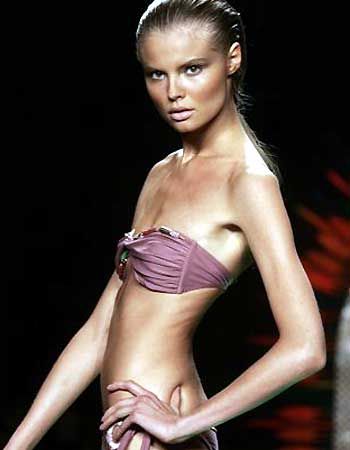 Once upon a time I wanted to look like a cover girl, despite whatever feminist consciousness I may have had.
It had not occurred to me that that wasn’t a possibility. It’s what my culture said I was supposed to look like. What I needed to look like to be truly valued.
Full of contradictions, I began my supermodel project. But in a healthy sort of way, I told myself. Wasn’t going to starve. No anorexia or bulimia for me.
I later came to see that I did end up with an eating disorder.
I became obsessed with food. How much had I eaten that day? Constantly counting calories. My worth depended upon how well I had eaten.
At times I swung between overeating and starving. Very little starving – I wasn’t good at it.
I next developed an exercise obsession. You can’t get too much exercise, right? After developing a knee injury from jogging, I tried Nordic Track. Another knee injury. Next, I began walking three miles a day at a brisk pace. Yet another knee injury. Apparently, you can rub your cartilage too much from over-exercise and lack of rest. My physical therapist told me to start biking instead – and don’t overdo it! No more than four days a week, and no hills.
After all the food and exercise mania, I still looked nothing like a supermodel. One day standing in line at a grocery store I picked up People Magazine and read a story on how supermodels did it. I finally understood why I didn’t look like them, and never would.
Kim Alexis had tried every fad diet and at one point starved herself for four days straight.
Carol Alt went on a fruit-only diet. Later, she drank eight cups of coffee a day, and ate salad for dinner.
Andie Macdowell said many models took drugs to deal with the stress of starving.
What struck me most was when Kim Alexis said,
When I first started out, I was rooming in a New York City hotel with (supermodel) Kelly Emberg. One night I came home, and I was eating only a head of lettuce for dinner. Kelly walked in and said, “You’re eating a whole head of lettuce? How could you?” I cried and said, “But it’s all I’ve had all day. It’s not even 50 calories!”
To which I say, “Are you freaking kidding me?!” That big “cheat” would be insane dieting in my book. In anyone’s book, one would hope.
That’s when my hopes for supermodel slim were dashed.
Yes, I had been insane. But not that insane.
And it’s not just me. It’s society. What kind of crazy culture says women must feel guilty about eating nothing but a head of lettuce to “look good”?
So I determined to gain my mental and physical health back. I’ve had ups and downs, but so far so good.
Georgia Platts
Related Posts on BroadBlogs
How to Look Like a Victoria’s Secret Angel
Beautiful Women’s Hips Are Thinner Than Their Heads?
Spoon Fed Barbie
Share this:

Vibrators and Women’s Sexuality: Out of the Closet?
Vibrators, once steeped in shame and secrecy, are going mainstream. Does this mean women’s sexuality has thrown off the covers, too?
As a culture, we are of two minds.
Vibrators were once illegal in several states, including Texas, Mississippi, and Alabama, or found only in seedy sex shops. But as the New York Times reports, today they may be purchased at your neighborhood drug store. Out in the open, even Oprah has pitched the helpful tool. And who can forget the “Rabbit Pearl” popping up in Sex and the City?
And yet, they aren’t quite out of the closet.
As one seller described the problem, “I can sit with my 10-year-old daughter during prime-time TV and watch a commercial for Viagra,” she said, “but I can’t advertise our OhMiBod fan page within Facebook.” Nylon Magazine won’t run her ads and the Small Business Administration refused her loan application because vibrators are a “prurient” business.
Ambivalence over tools and meds that enhance women’s sexuality reflects the larger cultural view. On the one hand the media glamorizes women’s sexuality. And plenty of porn approvingly portrays women with voracious sexual appetites.
But porn is off-limits. And women are told “Keep your legs together,” as if open legs were an open invitation.
Male sexuality is something to brag about, but female sexuality is something to hide. Men are praised as players and pimps. Women are called sluts, whores, tramps, and skanks… What positive word applies to women who enjoy sexuality?
Slang for penis and vagina says a lot, especially “cock” and “down there.” Cock: Cocky, boastful, swaggering. “Down there”? Unspeakable. Shameful.
This all reminds me of Zestra’s difficulty getting ads on TV for a product that arouses women. TV networks, national cable stations, radio stations, and Web sites like Facebook and WebMD all resisted. Yet “An erection lasting more than four hours” is O.K.?
Is it any wonder that sex surveys find mixed experiences among women when it comes sexual pleasure?
Indiana University’s comprehensive survey found that while 91% of men had an orgasm the last time they had sex only 64% of women did. These numbers roughly reflect the percentage of men and women who say they enjoyed sex “extremely” or “quite a bit”: 66% of women and 83% of men. Only 58% of women in their 20s had “the big O” on their last occasion.
As I’ve recently posted, 30-40% of women report difficulty climaxing. Women who lose virginity are also likely to lose self esteem, largely because they’re so focused on how they look (bad, they apparently think) and so unfocused on the sexual experience. And one-third of women under 35 often feel sad, anxious, restless or irritable after sex, while 10 percent frequently feel sad after intercourse.
On the other hand, many women do enjoy sex a lot, and frequently orgasm.
Does all this reflect that ambivalence, with enjoyment perhaps affected by which message gets most drilled into a woman’s mind?
Women’s sexuality kept in shadow and suspicion has an effect. Time to come out of the closet!
Georgia Platts
Ms. Magazine cross-posted this on their blog May 16, 2011.
Popular Posts on BroadBlogs
Women: Climax Less Likely in Relationship Sex
Men: Climax More Likely in Relationship Sex
Sex Lessons from Mom and Dad
Share this:

Cartoonish vs Authentic Sexuality
 “I believe we should afford our daughters and ourselves a right to our own authentic sexuality,” to paraphrase psychoanalyst and author Joyce McFadden. “Not the cartoonish MTV kind, but the kind where we respect ourselves enough to listen to what our bodies and hearts feel is right for us.”
What is authentic sexuality? In a recent post I suggested it is neither shameful nor a crutch for powerlessness or low self-esteem. But what else?
Young women are flooded with images screaming “sexy is” which can feel foreign or unpleasant. Or the market offers limited choice. Some have a hard time finding anything they feel comfortable wearing because sexy is all that’s offered.
Cartoonish sexuality is all about surface. It’s about plastic and peroxide, feeling famished and wearing clothing – or even implants – that don’t quite fit.
Actor Gabriel Olds tells a story about a woman he met at a party who blurted out, “By the way, these fake boobs are so not me.” He asked why she’d gotten them. A former boyfriend had awoken her one morning with the romantic proposition, “Hey, you ever think about getting better tits?” So she bought D-cups. He left her soon after. Eventually, she got the implants removed because they had never felt like “her.”
I asked my students how they imagined cartoonish sexuality. They saw it as a freakish figure not found in nature: Huge boobs combined with small waist and hips, big lips, bleached blond hair. Also, how society sees sexy – not what comes from inside. Artificial and superficial.
Taking it further, how cartoonish are seven-year-olds wearing Abercrombie and Finch padded bras or ten-year-olds in thongs? (Do parents actually buy these or does Abercrombie just stock them knowing they’ll bring plenty of free publicity?)
And authentic sexuality? When it came to looks, my students described it as natural, appreciating a range of sizes and body types, including your own. Light makeup (or none), a real smile, good personality, a sense of humor and confidence. Who you really are. I’ve got some pretty wise students.
Let’s turn to what inauthentic sexuality feels like. Having sex out of feeling pressured from friends or boyfriends. Having sex because it seems like the “right time,” but not because you want to.
Experiencing sexuality through the male gaze is not authentic, either. Women too often focus on how they look instead of how they feel in the bedroom. They are observing (and often criticizing) but not experiencing.
Inauthentic sexuality involves unhappily acting like porn stars for your partner’s pleasure, but not your own. (If you’re both enjoying it, that’s different). Some do things they don’t like just to keep the guy. One woman called these experiences “harrowing.”
We can all take a page from our ancient sex-positive Tahitian sisters who were not objectified in the way Western women are today, who learned the beauty of sexuality, and who did not act only for others. Of course, we live in a complex world so our sexuality must be conscientious. We must protect ourselves and others from sexually transmitted diseases. We must take care not to bring lives into the world when we are not ready for the responsibility.
Here’s what one commenter on Part I of this series wrote.
Personally, I’m constantly questioning myself when I get dressed; am I choosing this outfit for attention or simply because I genuinely like it? I try to embrace my sexuality and my femininity and dress/act in a way that’s natural for me. I don’t like playing games or feeling like I have to put on a show for others… Perhaps one small step towards liberation is dressing and acting for oneself rather than for others.
Georgia Platts
Related Posts on BroadBlogs
“Dressing Like Prostitutes”? Authentic Sexuality?
Men Are Naturally Attracted To Unnatural Women
Beautiful Women’s Hips Are Thinner Than Their Heads?
Share this:

Lose Virginity, Lose Self-Esteem?
When women lose their virginity, they can lose self-esteem, too, experiencing a small drop. That’s what a recent Penn State study reveals.
Why?
Women college students were surveyed over time. Before sex the women felt increasingly good about their bodies. But after first sex they felt worse. Looks like when they’re in bed women start worrying about whether they look good enough. Masters and Johnson tagged the phenomenon of watching yourself from a third person perspective instead of focusing on sexual sensations or your partner, “spectatoring.” Women are much more prone, being the objectified. Then, feeling they don’t measure up, self-worth drops.
Other usual suspects may also affect self-esteem, including the double standard that provokes worries about labels like slut and whore. Tracy Clark-Flory over at salon.com points to a 1995 study that found “women were significantly more likely to report that their first sexual experience left them feeling less pleasure, satisfaction, and excitement than men, and more sadness, guilt, nervousness, tension, embarrassment, and fear.” Even now women continue to experience that bind.
The double standard strikes again when women feel used, unappreciated, and worried about reputations after short flings or one-night stands.
Meanwhile, a study I recently posted finds 35% of women in strong partnerships feeling sad, anxious, restless, or irritable, after sex. Researchers don’t know why. Commenters, speculating on their own experience with the phenomenon, fingered sexual repression or difficulties with orgasm (which are related to repression) as culprit.
Studies repeatedly find that women are less likely than men to enjoy sex. Other research suggests the problem is not biologically based, or inevitable. Women in sex-positive cultures enjoy sexuality a great deal.
We are going to have to move beyond sexism for women to reclaim their sexuality. That would benefit both women and men.
Popular Posts on BroadBlogs
DO Women Like Sex Less Than Men?
Are Women Naturally Monogamous?
Are Women Culturally Monogamous?
Surprises in Indiana University Sex Survey
Share this:

Men: Erotic Objects of Women’s Gaze

Michelangelo’s “David” — a view from behind.
A nude woman frolics in silhouette as clothed men sleuth about, guns in hand and feet in chase. These images introduce The Spy Who Loved Me.
Flipping through TV stations the other day, this Bond rerun caught my eye and left me imagining the reverse: a nude man cavorting about as clothed women raced in pursuit of criminals. Weird.
The female body is celebrated – or exploited – while the male body is ignored.
Check out People’s sexiest men and you will see face shots, loose T-shirts, and very few rippled muscles. Who could imagine a “sexiest woman” shoot sans bodies.
Searching for a calendar of sexy men at Boarders, the closest I could find was Barack Obama.
Yeah, yeah, there is the occasional men’s underwear ad, but they are rare.
No wonder women don’t spend a lot of time checking out men’s bodies, ogling them or judging them.
A man commented on one of my posts that (to paraphrase):
Not only are men not considered erotic, they are often used to get laughs. In Seinfeld, Elaine referred to the male body as “utilitarian,” implying that the female is much more erotic. George Costanza became a victim of “shrinkage.” Scenes of Johnny Knoxville running around in a thong get chuckles.
Why is the male body so de-eroticized?
One possibility: Men have historically controlled media, and they focus on what they find sexy (about 95% of them anyway). Homophobia further hinders eroticization. As women enter the industry we find more focus on men, but still not much compared with women. Meanwhile, showered with sexy-women images from the time they are small, even women come to find women the sexier of the species.
What if the world were to switch? Suddenly, a universe of men in Speedo’s?
What if women became subject, and men erotic object for women to gaze upon? What if women sought to consume men as objects? Judging them, grading their beauty? Would women feel empowered, experiencing themselves on the “person” side of the person/object divide?
Something to think about.
Popular Posts on BroadBlogs
Women Seeing Women as Sexier than Men
Man as Object: Reversing the Gaze
Women Learn the Breast Fetish, Too

 BroadBlogs