Category Archives: violence against women
Rapists Echo “Blurred Lines” Lyrics
 by Sezin Koehler (Originally published at Ms.)
TRIGGER WARNING: Graphic descriptions of sexual assault.
Robin Thicke’s summer hit “Blurred Lines” addresses what he considers to be sounds like a grey area between consensual sex and assault. The images in this post place the song into a real-life context. They are from Project Unbreakable, an online photo essay exhibit, and feature women and men holding signs with sentences that their rapist said before, during or after their assault. Let’s begin going through the lyrics:
I know you want it.
Thicke sings “I know you want it,” a phrase that many sexual assault survivors report their rapists saying to justify their actions, as demonstrated over and over in the Project Unbreakable testimonials. Read the rest of this entry
Share this:

When Playboy Pushes Consent It’s Cool
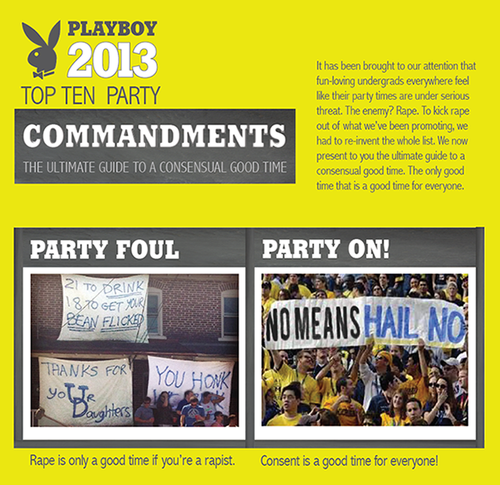 You’ve probably heard about Playboy’s new and revised Top 10 Party Commandments for the ultimate guide to a consensual good time.
Because without consent, “party times are under serious threat” by rape:
A good college party is all about everyone having a good time. Consent is all about everyone having a good time. Rape is only a good time if you’re a rapist. And f— those people.
You’ve probably also heard that these revised commandments are a hoax unleashed by college feminists.
Share this:

GIRLS “On All Fours”
 If we started saying, “It ain’t sex unless everyone enjoys it” would rape and “gray-rape” (where consent is unclear) become less common? And might we all enjoy sex more?
An Emmy-nominated episode of “Girls” sparks the question.
“On All Fours” finds “Natalia” ready to have sex with “Adam” because, “You’ve been really nice all week.” And then she tells him what she likes and what she doesn’t as they indulge.
The next time is very different.
Share this:

Man Chops Off Wife’s Fingers Because She’s More Educated Than Him
 Rafiqul Islam told his wife that he wanted to give her a surprise present. He blindfolded her, taped her mouth shut (huh?) and asked her to hold out her hand.
Then he chopped off all five of her fingers.
Why? Because she was working toward a college degree without his permission.
Mr. Islam had only made it to eighth grade and was a migrant worker in the United Arab Emirates. He did not want his wife thinking that she was better than him with some hoity-toity education and future career.
His wife, Hawa Akhter, promptly moved in with her parents and took to writing with her left hand in order to finish her studies.
According to the Daily Mail, this was one of a series of attacks against educated women in the Middle-East. Here’s another: Read the rest of this entry
Share this:

Who’s Afraid of a Feminist? And Why?
CLICK IMAGE TO ZOOM
CLICK IMAGE TO ZOOM
Scary stuff, eh?
Placing these images on the Internet was only the third frightening thing that 17-year-old Jinan Younis did this year.
A group of men in a car started wolf-whistling and shouting sexual remarks at my friends and me. I asked the men if they thought it was appropriate for them to be abusing a group of 17-year-old girls. The response was furious. The men started swearing at me, called me a bitch and threw a cup of coffee over me.
In response to this and concerns about other ways girls suffer – eating disorders, abusive relationships, and pressure to put out – she started a feminist group. She didn’t anticipate how ominously boys in her peer group would find it:
They took to Twitter… One boy declared that “bitches should keep their bitchiness to their bitch-selves #BITCH” and another smugly quipped, “feminism doesn’t mean they don’t like the D, they just haven’t found one to satisfy them yet.” Any attempt we made to stick up for each other was aggressively shot down with “get in your lane before I [ridicule] you too,” or belittled with remarks like “cute, they got offended.”
Next, girls were photographed with white boards that completed the sentence “I need feminism because…” and posted on the Internet. The response?
We were told that our “militant vaginas” were “as dry as the Sahara desert,” girls who complained of sexual objectification in their photos were given ratings out of 10, details of the sex lives of some of the girls were posted beside their photos, and others were sent threatening messages warning them that things would soon “get personal.”
Luckily, most guys don’t act that way.
But why do these guys feel so threatened? Read the rest of this entry
Share this:

She Asked For It?
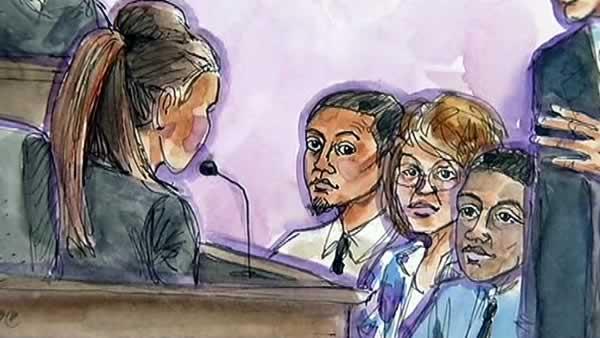 Why are victims so often blamed for rape?
What’s “her” motive in the situation? What drives the rapist? And who has control?
I’ve been thinking about this as two men are sentenced for joining eighteen others to brutally rape a 16-year-old Richmond, California girl.
—
She wore a lavender dress to the homecoming dance. But she left early and began dialing her dad to pick her up. And then a schoolmate invited her to join some friends who were drinking on school property, and who encouraged her to drink too much. She said they were polite — at first.
She doesn’t remember anything after one kicked her in the stomach and she fell over.
Share this:

Deep Throat. Porn Star? Or Victim?
 Lovelace, staring Amanda Seyfried, comes out this weekend. Seyfried plays Linda Lovelace, a porn star who famously played a woman with a clitoris inside her throat. So she LOVES giving head in Deep Throat.
Nora Ephron checked out the film when it came out in the 70s, approaching it with an open mind. But when a hollow glass dildo was inserted inside Linda’s vagina and filled with Coca-Cola, Ephron felt both humiliated and terrified, worried the glass might break. Guys chided her for overreacting, calling the scene “hilarious.” So she asked Linda about it. Her response?
I totally enjoyed myself making the movie. I don’t have any inhibitions about sex. I just hope that everybody goes to see the film… (and) loses some of their inhibitions.
That was then. Years later Linda wrote a memoir that told a very different story, entitled, “Ordeal.”
Her ordeal began Read the rest of this entry
Share this:

Fifty Shades of Pro-Orgasm
 Some worry that the deluge of male dominance/female submission imagery in our culture helps to make sexism seem sexy, encourages women to crave their own submission and abuse, and spurs some men to abuse women.
Others are less concerned. Specifically regarding the Fifty Shades series one of my students — a fan — says,
To those feminists who are bashing the book and those of us who read it: Give us more credit! Women are not that easily influenced by a piece of poorly written fiction. At least not the women I know.
Or this from Feministing:
I’m not perplexed by (the appeal of Fifty Shades of Grey). And I am in no way appalled. I am fully in support of anyone doing whatever (safe, consensual) thing that they want to do to get themselves off. Feminists for Orgasms.
Feminists for Orgasms. Pro-choice feminists. Feminists who think women have more sense than to be so easily swayed by a pornified culture that sexualizes male dominance.
And anyway, since male domination is rather of off-limits for feminists, that makes it that much more forbidden and O-inducing, right? Katie Roiphe, whose Newsweek piece on “Shades” was widely panned, has a point when she says,
What is interesting is that this material still, in our jaded porn-saturated age, manages to be titillating or controversial or newsworthy. We still seem to want to debate or interrogate or voyeuristically absorb scenes of extreme sexual submission. Even though we are, at this point, familiar with sadomasochism, it still seems to strike the culture as new, as shocking, as overturning certain values, because something in it still feels, to a surprisingly large segment of our tolerant post-sexual-revolution world, wrong or shameful.
I have mixed feelings. On the one hand sure, women should choose what they want. On the other hand, how much choice do you have when you’ve unconsciously internalized society’s way of seeing? Or, as one of my readers put it,
I find this post (on women learning to like torture) extremely frustrating because it points out an issue that bothers me so much. I have always struggled with the fact that morally (and in general) I am completely disgusted by degrading and torturing women, but when it comes to sexual fantasies, I feel completely differently. I think that this is a serious problem and needs to be addressed by my and the coming generations. I think it is perfectly fine to enjoy D/s if that’s what you’re into, however I do not think it should be subconsciously shoved into the minds of every girl growing up in our society.
And while many believe that we aren’t affected by our culture and the messages around us, we do seem to be. Sales go up for products that are advertised. Why else would companies spend mega-millions on a 30-second Super Bowl ad?
Or, a post from Feministing reads:
I am in no way surprised that many women, who have been socialized in a culture in which male sexuality is linked to domination and in which women are taught their sexual power comes from being wanted, have fantasies of submission.
And actually, “dominating men” is one of the few ways that men in our culture are eroticized at all.
Meanwhile, nearly 80% of young women have poor body image and can get distracted from sex by worries over what their bodies look like. The whole dominance/submission thing could help young women to get away from that focus and get into the sexy happenings they are engaged in.
Still, I don’t care to see abuse eroticized, whether based on gender or ethnicity. Or whether the target is children or animals. And I will continue to work against it.
But eroticized abuse is what we’ve got. And many women, including many feminists, find it arousing.
So I’ve given this a lot of thought.
While people do unconsciously internalize the messages of their society, we can also become conscious of them, which makes choice more possible. We may then choose to overcome the messages or, alternatively, compartmentalize them.
So, a woman could live an egalitarian and empowered life while keeping submission fantasies confined to the bedroom in order to neutralize the potential harm that comes from feeling — and becoming — “lesser than.” She could also do the BDSM-thing in ways that are not physically harmful.
Many who engage in D/s only do so with partners who respect them as equals and who see these “cut off from reality” moments as play.
Others keep the fantasies in their heads and don’t act them out. As one dominatrix put it,
In many cases people’s eyes are bigger than their stomachs and they prefer the fantasy to reality.
If anyone chooses to act out their fantasies I suggest avoiding anything that is actually harmful. Pain exists to warn against whatever is causing it. Those who lack pain receptors die young.
Others protest that some people deal with emotional problems by harming themselves. Like cutting. Again, cutting is not healthy. If you need that sort of release, seeing a therapist to deal with the underlying issue is healthier.
Finally, so that women don’t consistently act in ways that bolster an ideology that encourages them to submit, how about turning it around sometimes? Maybe he’d like to be dominated now and again. Or, maybe you could spend an evening with him serving your every desire.
Now that would be nice.
Popular Posts on BroadBlogs
Why Women Want Shades of Grey
Learning to Like Torture in Shades of Grey
Shades of Making Sexism Sexy
Share this:

Women Write Resistance to Violence

It is easier to program a child than a VCR. Only three steps. Easy, time-tested, ancient, a sure thing.
First, hurt the child. Hurt her a little, hurt her a lot, threaten to do more, things she can’t imagine. Since she couldn’t have imagined what you’ve already done, her own fear will now control her. She will blindfold and gag herself.
Those are the opening lines of a poem by Elliott Battzedek entitled, “His Favorite Gun is Me.” The poem is part of a new anthology called, Women Write Resistance.
Poetry resisting violence. Gendered violence: Battering, rape, incest, trans-violence.
Poetry as resistance may sound strange.
Yet poetry emerges from the unconscious, beyond conventional notions provided by the powerful, creating competing narratives.
That’s crucial since gender violence holds a “double-bind: keep silent or speak and be ashamed,” says scholar Cheryl Glenn.
When he held her by her ankles
upside down on the roof
like she was
a bird he was plucking
…
I wish he doesn’t drop me
I wish this hadn’t
happened,
this being
the molesting, the threats, then
– to come –
the disbelief,
when the girl came forward and said
he made me
touch him,
and she, my mother said, me too,
they told her she was
a naughty girl who just wanted attention
— Lines from Shevaun Branigan’s, “Why My Mother is Afraid of Heights”
This poetry uses sass language: naming experience in personal terms, using language that is impolite, blunt, passionate or sarcastic. Sass uses natural speech and slang to resist the illusion of objectivity and refuses to take on a disembodied voice.
and long before you
forbade a ribbon for my hair
yelled when my contact slipped out in the pool
or kicked our toddler’s stuffed snow leopard across the room,
it was moonlight,
and you were handsome,
and we were in love,
and I was 19
and had sworn, after the trailer park of childhood,
never to let a man hit me.
I felt so proud of that rule I’d made up myself.
— Lines from, “Before You” by Joy Castro
Making it personal moves us beyond customary news coverage that is abstract, sometimes titillating, and that ignores the consequences of gender violence.
By creating and communicating new ways of seeing, this poetry provides the possibility of both personal and social transformation, as Audre Lorde would put it.
Part of that transformation is reflected in the anthology’s title. Lauren Madeline Wiseman, the editor, points out that we once had only the concept of victim. Now we see one-time victims transformed into survivors. But another dimension must be added: resister.
Here are a few of the poets busy writing resistance: Ellen Bass, Alicia Ostriker, Judy Grahn, Wendy Barker, Lisa Lewis, Maureen Seaton, Judith Vollmer, Lyn Fifhin, Alison Luterman, Frannie Lindsey, Linda McCarriston, Leslie Adrienne Miller, Jehanne Dubrow, Rebecca Foust, Allison Hedge Coke, and Hilda Raz, along with many others.
The resistance emerges in broken silences, disrupted narratives, being sassy, witnessing, harnessing anger and raising consciousness to connect the dots between the personal, the political and the societal: the place where resistance lives.
Poetry that urges us all to empowered resistance.
Popular Posts on BroadBlogs
Man as Object: Reversing the Gaze
Spoon Fed Barbie
Artists Urge: Break Limits, Follow Bliss
Share this:

In-laws Rip Off Girl’s Fingernails, But Who Cares?
Sahar Gul
KABUL, Afghanistan — A court has reversed the convictions of three Afghans jailed for torturing a young relative who had refused to become a prostitute, alarming activists who had celebrated the guilty verdicts as a warning to all those who would seek to reverse the strides made by women here in the past 12 years… the defendants — Sahar Gul’s mother-in-law, sister-in-law and father-in-law — (will) be set free.

In objection to this reversal, I am rerunning my original post and unfortunately asking this same question: In-laws rip off girl’s fingernails, but who cares?
Fifteen-year-old Sahar Gul’s in-laws locked her away in a basement for six months. They beat her, tortured her with hot irons, broke her fingers, and ripped her fingernails off. Her uncle called authorities and by the time she arrived at a hospital her eyes were swollen nearly shut and scabs crusted her fingertips.
Afghanistan allows multiple wives, including child brides. This young bride had been taken in hopes of pimping her out in prostitution. The abuse was meant to persuade.
What struck me most in the AP report were the following lines:
The outcry over a case like Gul’s probably would not have happened just a few years ago because of deep cultural taboos against airing private family conflicts and acknowledging sexual abuse.
I am heartened that things are changing, with public outrage and an editorial in the Afghanistan Times reading, “Let’s break the dead silence on women’s plight.”
But to think that not long ago horrendous abuses like Sahar’s would have provoked no comment is outrageous. You have to wonder why women’s plight has been invisible for so long. And whether Afghanistan is alone in its blindness.
Women must be poorly valued for such abuses to go on without remark: mere property to be sold off, to make money off of, to beat when “disobedient,” to be stoned as spectator sport. And in some cases, to be tortured like lab rats.
When that is all you’ve known your whole life, when this world seems normal to all around you, who can fully see the horror?
Yet America isn’t always so different. Many still blame rape victims for their rape, and many victims still fear coming forward. Battering victims may be blamed for their abuse. Bullied spouses may feel shamed and cover up — and cover for their partners.
The world may be changing in Afghanistan.
The world needs changing right here in America, too.
Popular Posts on BroadBlogs
Why Do Women Fight Against Their Own Interests?
Should Organized Religion Have More Rights Than Women?
Better My Daughter Die Than Signal “Sex is Ok”

 BroadBlogs