Category Archives: gender
How I Overcame My Misogyny
 By Laura Wolff
I was a pre-teen bitch.
I wasn’t exceptionally mean or catty — in fact, I was an anti-bullying advocate. But my deeply internalized sexism led me to disdain anything and everything considered “girly,” from “Twilight” to dresses to teenybopper Disney stars. And the girls who enjoyed them. Read the rest of this entry
Share this:

Do Men Want Women To Ask Them Out?
 Some guys wonder why women don’t ask men out. Some women wonder how men would feel if they did. So I asked guys in my women’s studies class for their thoughts.
Out of a class of 46 I’ve just got nine men (this is women’s studies, after all) — and only seven of them showed up in time to take the survey, so this is a very small sampling. And between a willingness to take that class and living in the Bay Area, they may be more liberal than most.
Here’s what I asked them:
Has a woman ever asked you out? If yes, what did you think and why? If no, would you like a woman to ask you out, or would it make you feel uncomfortable? Should it be socially acceptable for women to ask men out?
And here’s what they said: Read the rest of this entry
Share this:


How Women Experience The World
 In case you’ve missed it, the video below shows the life of a woman — you might say an extremely bad day in the life of a woman — through the body of a man.
In this gender reversal you’ll see things, ranging from a passively obedient man, to a man being dismissed (men shouldn’t worry their pretty little heads about important stuff) to sexual harassment and assault.
It all may be more jarring when a man experiences it. Partly because we can grow numb to things we are used to seeing and hearing about. So this video breaks the taken-for-grantedness of it. And, since these things don’t typically affect men, they don’t really have to think about it. Read the rest of this entry
Share this:

Yeah, I’ve Asked Men Out
 Guys sometimes wonder why women don’t ask men out. Plenty of women don’t. But it turns out that many have — and do. Here’s what students from one of my women’s studies classes had to say. (My method was discussed in another post.)
Out of the 26 women who responded to my survey, 17 had actually made the first move at some point. So many more had than hadn’t.
Here’s what they had to say: Read the rest of this entry
Share this:

Why Women Don’t Ask Guys Out
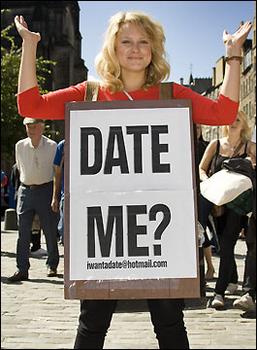 Guys sometimes ask why women don’t ask men out. Some suppose they can’t take rejection.
I teach women’s studies so I asked my students to write down what they thought on the topic.
I asked:
Have you ever asked a guy out? If not, why not? If yes, why? Were you nervous? How did he respond? Should it be socially acceptable for women to ask men out? Would making a move make you feel more empowered? Or would you rather not have to face rejection?
This is an intro to women’s studies class in the Bay Area, so the women may be more liberal than most.
I got 26 responses. Interestingly, most had asked a guy out at some point. But over a third (9) had not. Why not? Here’s what they said: Read the rest of this entry
Share this:

Women Get All The Good Emotions, Says Cross-Dresser
I think it’s quite hard for men today, because there’s an increasingly narrow bandwidth of behaviors which are seen as exclusively masculine. As women have quite rightly encroached on what used to be seen as male territory, all that’s left is the negative things. There’s less scope for a sensitive man to feel at home. What kind of men do we actually want boys to become?
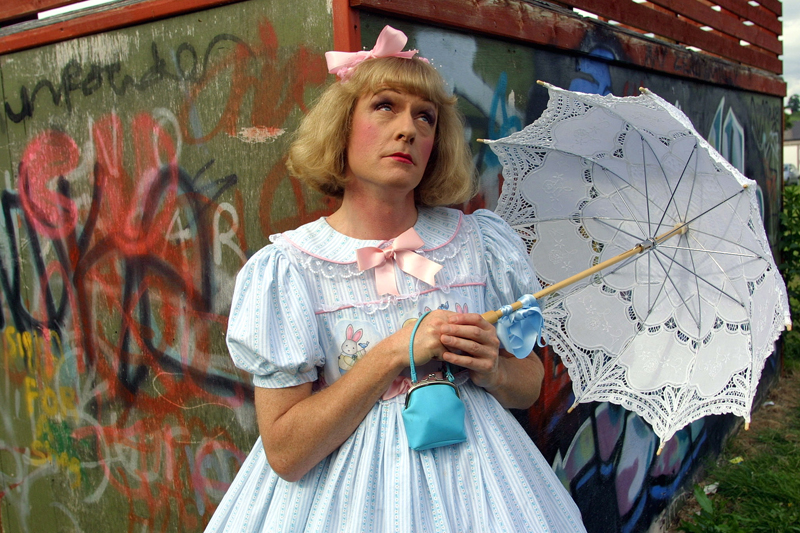
That’s British artist and cross-dresser, Grayson Perry. We met him earlier in a discussion on “Men Who Wear Frocks.” He wears dresses, he says, because they help him get in touch with the feminine side of his humanity, which is blocked by a culture that suppresses male emotion.
 Here’s how Perry explains that process of female “encroachment” into (so-called) male territory:
Until the later part of the 19th century, cross-dressing in ordinary life was an overwhelmingly female to male activity. Typically it tended to be a woman just trying to get on in a man’s world. But in the Victorian age, the traffic started to switch direction. Since then transvestism has become an overwhelmingly male to female behavior.
As the Victorians increasingly corralled all the softer emotions, vulnerability, innocence, gentleness, beauty into an exclusively feminine realm, men were cast as stoical, butch, practical providers, and dressed accordingly. Is it any wonder that some men started to want to cross over? For me, what the Victorians wore is the most striking example of how clothes can come to symbolize complex emotions.
So women started out more apt to mimic men in order to grasp greater opportunity and self-expression. Not to mention, gaining the status and privilege of the masculine world.
These days, women commonly express a whole range of so-called masculine traits and activities without being seen as crossing gender boundaries. They’re just doing “people-stuff.”
But men have not taken on feminine traits and activities to the same degree. Not because they can’t, but because they mostly won’t.
Why not?
Share this:

It’s Not Easy Being A Man
![self-madeManCoverweb[1]](https://broadblogs.com/wp-content/uploads/2014/01/self-mademancoverweb1.jpg) Norah Vincent passed as a man for a year and a half. She wrote a book about the experience, Self-Made Man, which was published in 2006. When one gender visits the world of another it can be eye-opening, so let’s take a peek at one part of the woman-turned-man experience.
Norah Vincent passed as a man for a year and a half. She wrote a book about the experience, Self-Made Man, which was published in 2006. When one gender visits the world of another it can be eye-opening, so let’s take a peek at one part of the woman-turned-man experience.
Turns out, it’s not easy being a man.
Norah had thought she’d love joining the privileged man-club that, until her transition, she had only glimpsed from the outside. Instead, she felt strangely inadequate.
For instance, as a lesbian, she’d expected dating to be the fun part. But it was arduous. One of the most difficult parts of her research. In her new man-role she felt an expectation to lead, take charge. This made her feel small in her costume. Read the rest of this entry
Share this:

Women as Prey, Men as Predator
Women are expected to attract, men are supposed to be attracted. Men want, women want to be wanted. Metaphorically, this is a predator/prey type relationship. Women are subject to the hunt whether they like it or not, so men’s attention can be pleasing, annoying, or frightening. It all depends.
Accordingly, women know what it feels like to be prey.

That’s from Prof. Lisa Wade of Occidental College and the popular blog, Sociological Images (where I got the great cartoon, too.)
Not all men make women feel this way, she says, and probably most don’t, but we’ve all pretty much had this experience, whether it’s,
The leering guy on the street, the heavy hitter in the bar, the frotteurist on the subway, the molesting uncle, the aggressive fraternity brother, etc.
Does homophobia arise partly from being demoted on the food chain and feeling like prey, she wonders? Read the rest of this entry
Share this:

The Allure of Bad Boys
 Why do women fall for bad boys?
My students ask that question all the time.
Michael Kimmel, who studies men, asked his women students to choose between the charming rouge, Rhett Butler and dependable Ashley Wilkes.
Do I have to choose?
They groaned.
Are those my only choices?
They pled.
Because the women liked — and disliked — characteristics of both.
Forced to choose Read the rest of this entry
Share this:

Saying Yes When You Want To Say No
 Many women agree to sex that they aren’t too interested in. University of Texas, Austin researchers say the reasons vary. Some want to nurture relationship. Some are doing what they think is expected. Others feel pressured. A few want to avoid a fight. It can be a problem. Or, unexpected benefits may arise. Today, let’s look at the downside.
Some women are pleasers and feel uncomfortable saying no. Ironically, one woman’s religion got her saying yes to premarital sex because her church had kept her naïve and encouraged passivity,
Persistence from a partner, emotional games, alcohol, passivity, and difficulty saying no were all important factors. I felt nervous, unsure and confused. I didn’t want to make the other person angry with me. When things didn’t go the way I trusted them to I didn’t know what to do. These experiences all occurred before age 19, after which I got stronger and wiser.
Some fear rejection. As another woman explained, Read the rest of this entry

 BroadBlogs