Category Archives: feminism
I Love My Wife Because She’s Aging
 By James Stafford @ The Good Men Project
I’ve grown immune to the use of sex to sell products. I can’t tell you who the starlet of the week is. I’m immune to beer commercials and other “buy this product and have sex with hot hard bodies” advertisements. What I find attractive has aged along with me.
I have no more interest in twenty-year-olds than they have in me. Flirty young waitresses just embarrass me, but you wouldn’t know that from commercials, movies, and television. According to pop culture, all I want is a girl gone wild.
And because pop culture insists on making every woman believe that she isn’t beautiful if she isn’t a twenty year-old size zero, and on making every man doubt his virility if he’s not chasing (and catching) supermodels, I decided to break the man code and tell you the truth about what I find attractive.
I love the gray in your hair Read the rest of this entry
Share this:

Women Write Resistance to Violence

It is easier to program a child than a VCR. Only three steps. Easy, time-tested, ancient, a sure thing.
First, hurt the child. Hurt her a little, hurt her a lot, threaten to do more, things she can’t imagine. Since she couldn’t have imagined what you’ve already done, her own fear will now control her. She will blindfold and gag herself.
Those are the opening lines of a poem by Elliott Battzedek entitled, “His Favorite Gun is Me.” The poem is part of a new anthology called, Women Write Resistance.
Poetry resisting violence. Gendered violence: Battering, rape, incest, trans-violence.
Poetry as resistance may sound strange.
Yet poetry emerges from the unconscious, beyond conventional notions provided by the powerful, creating competing narratives.
That’s crucial since gender violence holds a “double-bind: keep silent or speak and be ashamed,” says scholar Cheryl Glenn.
When he held her by her ankles
upside down on the roof
like she was
a bird he was plucking
…
I wish he doesn’t drop me
I wish this hadn’t
happened,
this being
the molesting, the threats, then
– to come –
the disbelief,
when the girl came forward and said
he made me
touch him,
and she, my mother said, me too,
they told her she was
a naughty girl who just wanted attention
— Lines from Shevaun Branigan’s, “Why My Mother is Afraid of Heights”
This poetry uses sass language: naming experience in personal terms, using language that is impolite, blunt, passionate or sarcastic. Sass uses natural speech and slang to resist the illusion of objectivity and refuses to take on a disembodied voice.
and long before you
forbade a ribbon for my hair
yelled when my contact slipped out in the pool
or kicked our toddler’s stuffed snow leopard across the room,
it was moonlight,
and you were handsome,
and we were in love,
and I was 19
and had sworn, after the trailer park of childhood,
never to let a man hit me.
I felt so proud of that rule I’d made up myself.
— Lines from, “Before You” by Joy Castro
Making it personal moves us beyond customary news coverage that is abstract, sometimes titillating, and that ignores the consequences of gender violence.
By creating and communicating new ways of seeing, this poetry provides the possibility of both personal and social transformation, as Audre Lorde would put it.
Part of that transformation is reflected in the anthology’s title. Lauren Madeline Wiseman, the editor, points out that we once had only the concept of victim. Now we see one-time victims transformed into survivors. But another dimension must be added: resister.
Here are a few of the poets busy writing resistance: Ellen Bass, Alicia Ostriker, Judy Grahn, Wendy Barker, Lisa Lewis, Maureen Seaton, Judith Vollmer, Lyn Fifhin, Alison Luterman, Frannie Lindsey, Linda McCarriston, Leslie Adrienne Miller, Jehanne Dubrow, Rebecca Foust, Allison Hedge Coke, and Hilda Raz, along with many others.
The resistance emerges in broken silences, disrupted narratives, being sassy, witnessing, harnessing anger and raising consciousness to connect the dots between the personal, the political and the societal: the place where resistance lives.
Poetry that urges us all to empowered resistance.
Popular Posts on BroadBlogs
Man as Object: Reversing the Gaze
Spoon Fed Barbie
Artists Urge: Break Limits, Follow Bliss
Share this:

1/10 of Women Depressed After Sex

One-third of women have felt depressed after sex, and 10% regularly do.
It’s not about feeling down after a one night stand, worried you’ve made a mistake. Many of the women were in stable relationships. One explained:
I did not associate the feeling with an absence of love or affection for my sexual partner nor with an absence of love or affection from them towards me, because it seemed so unconnected with them.
I thought of this study as I read a blog post from “Overcoming Depression,” by a man who struggles with this same issue:
A passionate love making is one of the most enriching experience of one’s life. Let me tell you one difficulty that I sometimes face in love making. If I did not get enough satisfaction after sex I become very sad and I feel very ‘low’ and slightly depressed. I don’t like it happening to me. It makes my girl-friend feel bad as well by thinking that it is her fault. I don’t know how to tackle this issue. Any suggestions?
This is a hard one because even the researchers don’t know.
The problem is common among women who have been sexually abused or grown up in sex-shaming religions of families. They often feel guilty or frustrated afterward.
But that was not so for everyone in the study.
Depression may arise from issues outside the bedroom. Researcher, Dr. Debby Herbenick suggests talking with your partner, your doctor or seeing a therapist. Ask yourself, “Are you upset with your partner? Are you having self-esteem or body issues? Are you sad about other things in your life?”
Below are some reader comments from Clutch, where I first read about this study:
- I would imagine that women my age at least (over 40) may still have some guilt tied up with sex. Growing up in the 60′s and being browbeaten, threatened and dared to “keep your dress down and your panties up,” by the time many women did get some, they felt too guilty about it to enjoy it. And then these women raised their daughters this same way as they were raised, which would explain younger women suffering from the same emotional malady. We pass along a lot of twisted notions to our kids sometimes, even when we know it’s not right.
- I had that problem in the past but for some reason, it hasn’t occurred in a very long time. I have also experienced extreme agitation and anger, but um, I’m sure that was due to not being satisfied.
- i get irritable when i don’t have an orgasm. this is why i believe in using a magic wand. go get one – around $35. best money you will ever spend.
My thoughts:
In cultures that are sex-positive, women enjoy sex a great deal and are highly orgasmic. Something is terribly wrong in our society when one-third of American women have experienced sadness or anxiety after sex.
Otherwise, I’d suggest focusing on the connection, on the merging with each other, rather than the goal of an amazing orgasm.
And Casey, who blogs at The Sprightly Writer also has some interesting suggestions:
Hmm…after making love, I’ve felt sad and low at times too. But I think the solution to this is to focus on the full body experience and not focus on the goal, but on the exploration of the other person.
How much do you incorporate sensory play? A lot of people whose sex lives become too boring will improve with incorporating different sensations – ice cubes, feathers, soft fabrics. If your partner is willing, she might even go for a little bit of wicked fun.
…For men, there is also a trick you can try to prolong and enhance your personal experience. If they can learn to practice coming to the edge of ‘completion’, backing off from it and focus on her, coming back to that place, and backing away from it, it extends the duration and the intensity when you finally do find release.
If anyone finds any of this helpful, let me know.
Related Posts on BroadBlogs
DO Women Like Sex Less Than Men?
Repressive Female Sex Culture
Sex Lessons from Mom and Dad
Surprises in Indiana University Sex Survey
Share this:

Tampons Confiscated as Women Protest in Texas
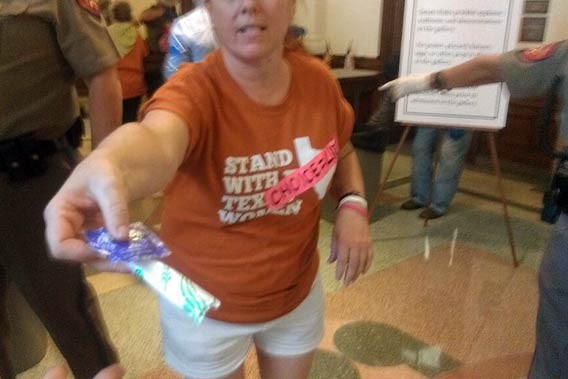 You know what happens when women protest restrictions on their rights?
In Egypt they’re harassed and raped.
In Texas their tampons are confiscated.
If you can’t bully women by forcing something into their vaginas, just keep women from putting anything in there, themselves.
That’s right. You can take a gun into the Texas State Capital. But tampons, pads, and condemns are forbidden. Or even diabetic supplies that could save your life. Because pro-lifers just don’t like that sort of thing.
After all, women’s lives and autonomy are far more dangerous than guns.
Any sort of control women have over their bodies and reproductive lives must be stopped by Texas law enforcement! Abortion, contraception, sex ed… and now tampons.

Popular Posts on BroadBlogs
Extremists Messing With The Vajayjay
What Abusers and “Pro-Family” Conservatives Have in Common
Beat, Rape… Whatever It Takes To Control Women
Share this:

Trayvon Martin’s Right to ‘Stand His Ground’
We’re told over and over that if Zimmerman was afraid of Martin, according to Florida law, he had the right to put a bullet in the chamber of his concealed handgun, get out of his car after being told not to by the 911 dispatcher and follow and confront Martin and shoot him to death.

That’s from CNN opinion writer, Miller Francis. He continues:
At the same time, we are told that Martin, who had far greater reason to fear Zimmerman, practically and for reasons of American history, did not have the right to confront his stalker, stand his ground and defend himself, including by using his fists. We are told that this was entirely unjustified and by doing so, Martin justified his own execution.
Talk about victim-blaming!
The contradiction-in-rights likely arises because we tend to see through the eyes of the powerful and not through the eyes of the powerless. After all, the powerless have little control over media or the political or religious pulpits. With that in mind, I’m reposting the following as the Martin v. Zimmerman jury deliberates:
The Crimes of Hoodies, Short Skirts and Fannie Mae
“More guns, fewer hoodies” and we’d all be safer, Gail Collins advised in a New York Times piece after Trayvon Martin was gunned down for “eating skittles while black” – and while wearing said hoodie – in a gated community. A clear threat that had to be stopped.
That’s right. Guns don’t kill people, hoodies do: Trayvon Martin’s “hoodie killed him as surely as George Zimmerman did,” claimed Geraldo Rivera (who later apologized).
Sounds familiar. When women are raped short skirts become the culprit.
Yet few rape victims are wearing short skirts. And even nicely dressed black men can create fear. Journalist Brent Staples noticed that people got out of his way when he nonchalantly walked about. Amazed at his ability to alter public space, he tried humming Mozart to project his innocence. Seemed to help.
But why aren’t pricey cars, fancy suits and expensive watches blamed when rich, white men get robbed? What thief could resist?
Why? Because making more powerless members of society the culprit is meant to distract from the sins of the powerful. It’s women’s fault if men rape them, and it’s black men’s fault if lighter men kill them.
In another example, some blamed liberals for foolishly using Fannie Mae and Freddie Mac to help Blacks and Hispanics “buy homes they couldn’t afford,” leading to the banking crises that nearly drove the U.S. economy off a cliff.
What really happened is that rich bankers gave rich campaign contributions to government officials, who in gratitude disposed of pesky regulations. That helped bankers get mega-rich by devising complex financial packages that no one could comprehend.
Used to be that when someone bought a home bankers made sure they’d get paid back. But under deregulation it didn’t matter because the loan was sold to someone else. And that investor sold the loan again. And financial packages were created and sold, composed of fractions of many people’s mortgage loans. They were rated AAA since they were 1) diversified – and hence “safe” investments and 2) the housing market never goes down. (Yeah, right!)
Fannie and Freddie entered the process late, thinking they’d better join in or lose out.
When the housing market dropped and people couldn’t afford their homes, or sell them for a profit, the banks began collapsing. Lucky for them, the taxpayers bailed them out (or the whole economy likely would have collapsed).
Did deregulation get blamed for the fiasco? By some. But plenty of the “powers that be” — and especially “hate radio” — blamed Blacks and Latinos.
Because blaming more powerless members of society distracts from the sins of the powerful.
The crime does not lie with the man who pulls the trigger, nor with the man who rapes, and certainly not with the fat cat who pays to rig the game. No, the crime lies with those who wear hoodies, short skirts and who bank while black or brown.
Popular Posts on BroadBlogs
Cheerleader Ordered To Cheer Her Rapist, and Other Stories
Markets Must Be Free; Women Must Be Constrained
8-Year-Old Called “Whore” for Long Sleeves, Skirts
Share this:

In-laws Rip Off Girl’s Fingernails, But Who Cares?
Sahar Gul
KABUL, Afghanistan — A court has reversed the convictions of three Afghans jailed for torturing a young relative who had refused to become a prostitute, alarming activists who had celebrated the guilty verdicts as a warning to all those who would seek to reverse the strides made by women here in the past 12 years… the defendants — Sahar Gul’s mother-in-law, sister-in-law and father-in-law — (will) be set free.

In objection to this reversal, I am rerunning my original post and unfortunately asking this same question: In-laws rip off girl’s fingernails, but who cares?
Fifteen-year-old Sahar Gul’s in-laws locked her away in a basement for six months. They beat her, tortured her with hot irons, broke her fingers, and ripped her fingernails off. Her uncle called authorities and by the time she arrived at a hospital her eyes were swollen nearly shut and scabs crusted her fingertips.
Afghanistan allows multiple wives, including child brides. This young bride had been taken in hopes of pimping her out in prostitution. The abuse was meant to persuade.
What struck me most in the AP report were the following lines:
The outcry over a case like Gul’s probably would not have happened just a few years ago because of deep cultural taboos against airing private family conflicts and acknowledging sexual abuse.
I am heartened that things are changing, with public outrage and an editorial in the Afghanistan Times reading, “Let’s break the dead silence on women’s plight.”
But to think that not long ago horrendous abuses like Sahar’s would have provoked no comment is outrageous. You have to wonder why women’s plight has been invisible for so long. And whether Afghanistan is alone in its blindness.
Women must be poorly valued for such abuses to go on without remark: mere property to be sold off, to make money off of, to beat when “disobedient,” to be stoned as spectator sport. And in some cases, to be tortured like lab rats.
When that is all you’ve known your whole life, when this world seems normal to all around you, who can fully see the horror?
Yet America isn’t always so different. Many still blame rape victims for their rape, and many victims still fear coming forward. Battering victims may be blamed for their abuse. Bullied spouses may feel shamed and cover up — and cover for their partners.
The world may be changing in Afghanistan.
The world needs changing right here in America, too.
Popular Posts on BroadBlogs
Why Do Women Fight Against Their Own Interests?
Should Organized Religion Have More Rights Than Women?
Better My Daughter Die Than Signal “Sex is Ok”
Share this:

Choosing Beauty Over Sex, or Anything Else–Lessons From Tootsie
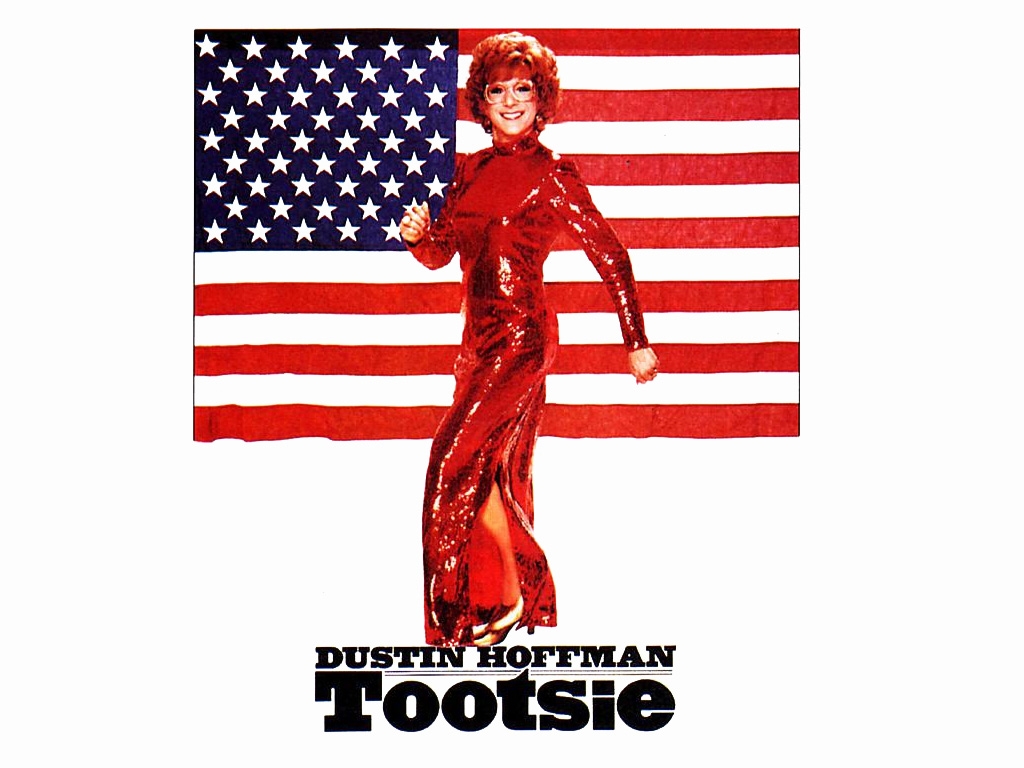
Dustin Hoffman as Tootsie
A lot of guys think women want to be beautiful so they can get sex. I’m sure many do. But some guys are surprised that — or don’t believe that — it’s often the reverse: many women have sex hoping to feel beautiful.
But then, men’s value often rests on how much sex they have, while women’s value often rests on their looks.
A woman may capture the Wimbledon title yet be slighted as not “a looker.” She may even become Prime Minister of Australia yet folks debate, “the size of her bottom… the cut of her hair.”
And as I’ve said before:
From the time they’re small, little girls are told they’re pretty – or notice when they’re not told that. They receive gifts of play makeup and vanity sets. They watch endless repeats of Disney princesses on DVD, buy beautiful princess dolls, and then graduate to Barbie or Bratz. All of whom have extensive wardrobes. It’s all about being pretty.
Meanwhile, girls and women are bombarded with media images of impossibly beautiful women who are photoshopped up the wazoo, modeling what they’re supposed to look like.
Who’s popular in middle school and high school? Pretty girls. By the time they’re in college young women are under relentless pressure to be hot, as if that’s the most important thing in the world.
 When Dustin Hoffman took the role of Tootsie he got a shocking first-hand glimpse of all this.
In the film, Hoffman plays a difficult-to-work-with actor who no one will hire. So he poses as an actress to get a role. In an interview that’s gained a lot of attention, Hoffman says the experience helped him to see how men can unknowingly reinforce impossible beauty ideals.
His make-up artist had made him look like woman, he recalls, but:
I was shocked that I wasn’t more attractive… I said “Now you have me looking like a woman. Now make me beautiful.” I thought I should be beautiful. If I was going to be a woman, I would want to be as beautiful as possible. But they said, “This is as good as it gets.”
At that moment he had an epiphany that made him think twice about how he treated women. He told his wife,
I think I am an interesting woman when I look at myself on screen. And I know that if I met myself at a party, I would never talk to that character because she doesn’t fulfill physically the demands that we’re brought up to think women have to have in order to ask them out… There’s too many interesting women I have…not had the experience to know in this life because I have been brainwashed.
Women are taught from the time they are small that their value lies in their beauty — unfortunate since our shell is shallow and looks are fleeting.
But is it any surprise that beauty so often seems more important than sex – or anything else?
Popular Posts on BroadBlogs
Beauty Tricks to Remove Your Power
Miss Representation: How I Look Is What Matters
Scrutinizing My Body Takes All My Time
Share this:

Shades of Making Sexism Sexy
 Do Fifty Shades of Grey, along with the deluge of violent and humiliating images that flood our consciousness, support patriarchy by making male dominance seem sexy?
Some worry that it might.
John Stoltenberg, a feminist activist and scholar, wrote a piece called “Pornography and Freedom,” observing that plenty of porn seems to promote oppression, whether a woman is pictured bound and gagged with her genitals open to the camera or whether lines from a book read, “The man wanted only to abuse and ravish her until she was broken and subservient.”
These sorts of images in both mainstream media and porn are mostly about women submitting to men.
In the eroticization, male dominance can seem sexy, he says.
If it’s sexy, who would want to end it?
A student of mine once asked why we should care about women’s equality when a lot of women (like her?) find male dominance sexy.
Two of my friends told me that they wanted to marry dominant men. One did and eventually divorced him because she didn’t like the reality of it. The other stayed married but had a lot of emotional problems.
I’ve mentioned Alisa Valdes before. She was raised feminist, and was even named one of the top feminist writers by Ms. Magazine. But when she met “the Cowboy,” she “embraced her femininity” and learned to submit: No back-talking; no second-guessing; no sarcastic, smart-ass remarks. She stayed monogamous and ignored her jealousy while Cowboy catted about. Her book, “The Feminist and the Cowboy,” suggests women will live happily ever after in orgasmic bliss if they just submit to controlling, misogynist men. In a recent post I described how her submission turned increasingly violent.
Still, my students often wonder “What’s the big deal?”
But what if the imagery were about race instead of sex? What if blacks nearly always had white lovers in real life, and at the same time nearly all of the “D/s” imagery depicted white domination and sadistic acts inflicted upon blacks? And what if some blacks came to crave submission and their own abuse at the hands of whites?
Would that be healthy?
Of course, once patriarchy sexualizes submission you can turn it around with “the dominatrix” emerging. Yet we are not bombarded with imagery that makes matriarchy sexy. So guys don’t go around wanting to marry dominant females who will boss them around in real life.
But a lot of people don’t want to engage this discussion. Repression and all that.
Prof. Robert Jensen, of the University of Texas, studies porn and says,
When I critique pornography, I am often told to lighten up. Sex is just sex… (but) Pornography offers men a politics of sex and gender – and that politics is patriarchal and reactionary…
There should be nothing surprising about the fact that some pornography includes explicit images of women in pain. But my question is: Wouldn’t a healthy society want to deal with that? Why aren’t more people, men or women, concerned? …
We should be free to talk about our desire for an egalitarian intimacy and for sexuality that rejects pain and humiliation.
I feel it is important to discuss things that are rarely discussed, and that make distinctions between what is healthy and what is not.
Next time I will turn to the other side of this question, looking at “pro-orgasm” feminists.
Popular Posts on BroadBlogs
Enslaving Sex Objects
Why Women Want Shades of Grey
Learning to Like Torture in Shades of Grey
Share this:

How to Pleasure A Woman
 Men get much of their sex ed from porn, which has little to do with pleasing actual women (porn stars are acting ecstatic, after all, and the focus is often on pleasing the man). So WebMD asked reputed sex educators, Tristan Taormino and Lou Paget, to talk about some common mistakes men make. Go here to see the full text. We’ll also look at research from Cindy Meston and David Buss, who researched and wrote, Why Women Have Sex.
Men imagine that women feel something parallel to what they feel, says Paget, leaving a “huge disconnect” about what feels good to women:
When a man has intercourse with a woman, and his penis goes into her body, that sensation is so off the charts for most men, they cannot imagine that it isn’t feeling the same way for her. It couldn’t be further from the truth.
The vagina is actually less sensitive than the clitoris and the surrounding parts for most women.
And a vibrator can help. So don’t be insulted, thinking something is wrong if that’s what she needs, say the authors. “Some women can’t have an orgasm with less than 3,000 rpm, so think of a vibrator as your assistant, not your substitute.”
But many men continue to believe that women should be able to reach orgasm from vaginal penetration. Taormino says:
I still get letters from people who say things like, my wife can’t [orgasm] from intercourse unless she has clitoral stimulation — please help. I want to write back and say, ‘OK, what’s the problem?’
And then there’s the myth that bigger is better. It all depends. Length is great for women who enjoy having their cervix stimulated, say Meston and Buss. But the same stimulation can be painful for other women. And if the penis is too long, “it feels like you’re getting punched in the stomach,” Paget explains. “It makes you feel nauseous.” Still others feel neither pleasure nor pain—and often not much of anything.
Generally speaking, width is more important than length. But depending on the woman, some prefer larger and some smaller.
And men should not assume they know what a woman wants based upon what other women have wanted. Taormino points out that:
You develop a repertoire as you mature sexually, but you should never assume that what worked for the last person is going to work for this person.
So open the lines of communication and ask what feels good. But consider: If you constantly ask her if she’s coming, do you really think she will? The badgering can move her from erotic to just feeling pressured. So don’t overdo it.
And finally, let her know how gorgeous and sexy she is. That’s one of the biggest turn-ons a woman can get.
Popular Posts on BroadBlogs
Sex Drive: How Men and Women Match Up
One Out of Ten Women Get Depressed After Sex
Orgasm: It’s All in the Mind
Share this:

Tween Panties That Say “No”
![PantyTrio[1]](https://broadblogs.com/wp-content/uploads/2013/06/pantytrio1.jpg) By Annie Shields @ Ms. Magazine Blog
By Annie Shields @ Ms. Magazine Blog
What better way to reinforce family morals than by wearing underwear that doubles as a conversation starter, right? If the junior prom after-party starts to get dull, just take off your pants and encourage a dialogue! Awkward first date? Lift up your dress and ask for some feedback!
On the one hand, these panties were created by parents to encourage their teens to remain abstinent. On the other hand, these are panties. A strange choice of merchandise to hawk in the name of chastity.
Stranger still, these 75-percent “frisky” garments seem to be closely tied to a religious agenda. The very name of the line implies a Christian affiliation–subbing “your mother” for Jesus in the familiar WWJD. So what’s really going on here? Let’s take a closer look at some of the site’s offerings.
The messages on these panties – ”Dream On,” “Zip It!” and “Not Tonight” – coyly indicate non-consent to a potential romantic partner.
But the whole concept of abstinence-promoting underwear makes about as much sense as commemorating sobriety with flasks instead of coins at AA meetings.
It isn’t just dumb, it’s dangerous. There’s nothing wrong with encouraging your children to choose abstinence before marriage; there is something wrong, however, with not empowering them with the knowledge and tools to make that choice and confidently communicate it to romantic partners. Without pulling down their pants.
What’s more, the panties can really muddy the notion of “consent” in young people’s minds. What if a teen girl wears “Not Tonight” panties and decides at some point in the evening that she actually does want to have sex? Nothing wrong with that, but the dissonance between the panty-message and her ultimate decision may well reinforce the mistaken idea that “no means yes” in her partner’s mind.
This bizarre line of undergarments calls to mind what Jessica Valenti dubbed The Purity Myth in her book of the same name. In an interview, she argues that oversexualization of women in the media and pop culture has begun to intersect with the conservative movement, resulting in the fetishization of virginity:
If you are telling young women over and over that what’s most important is their virginity … then you’re sending the message that it’s the body and sexuality that defines who they are … With the virginity movement it’s adults–and a lot of men–deciding what appropriate sexuality is for younger women. It’s anyone and everyone except young women themselves defining (their) sexuality.
This is ridiculously displayed in WWYMD’s promotional videos, which feature abstinence-friendly songs and wind-blown girls posing suggestively in their skivies next to fully-clothed young men. Here are some of the choice lyrics:
No kiss, no touch, no makin’ out hey, hey, hey, hey, hey, hey… When men see a body like this, they have a tendency to dismiss that I got anything upstairs, but I got me a lot of brains up there … Let me make it clear, so there’s no mistake my life’s goin’ good, there’s too much at stake to just hand it over, to any man…
The second video is even more explicit and confusing, combining gratuitous crotch shots with pro-chastity song lyrics:
I am waitin’, for my time in life, I am waitin’ for love. I am waitin’ on the world to change I am waitin’ on you
Abstinence-promoting strategies as ineffective as these will certainly prove to be are, unfortunately, not unprecedented. With the rise of what’s been called the chastity-industrial complex, peddling purity is big business. Once again, social and religious conservatives say one thing, do another and wait for the money to roll in.
This lightly edited post was originally posted on the Ms. Magazine Blog on April 14, 2011.
Popular Posts on BroadBlogs
Sex Objects Who Don’t Enjoy Sex
Women Want Casual Sex? Yes and No
Men Have Higher Sex Drive. Why?

 BroadBlogs