Blog Archives
Deep Throat. Porn Star? Or Victim?
 Lovelace, staring Amanda Seyfried, comes out this weekend. Seyfried plays Linda Lovelace, a porn star who famously played a woman with a clitoris inside her throat. So she LOVES giving head in Deep Throat.
Nora Ephron checked out the film when it came out in the 70s, approaching it with an open mind. But when a hollow glass dildo was inserted inside Linda’s vagina and filled with Coca-Cola, Ephron felt both humiliated and terrified, worried the glass might break. Guys chided her for overreacting, calling the scene “hilarious.” So she asked Linda about it. Her response?
I totally enjoyed myself making the movie. I don’t have any inhibitions about sex. I just hope that everybody goes to see the film… (and) loses some of their inhibitions.
That was then. Years later Linda wrote a memoir that told a very different story, entitled, “Ordeal.”
Her ordeal began Read the rest of this entry
Share this:

Fifty Shades of Pro-Orgasm
 Some worry that the deluge of male dominance/female submission imagery in our culture helps to make sexism seem sexy, encourages women to crave their own submission and abuse, and spurs some men to abuse women.
Others are less concerned. Specifically regarding the Fifty Shades series one of my students — a fan — says,
To those feminists who are bashing the book and those of us who read it: Give us more credit! Women are not that easily influenced by a piece of poorly written fiction. At least not the women I know.
Or this from Feministing:
I’m not perplexed by (the appeal of Fifty Shades of Grey). And I am in no way appalled. I am fully in support of anyone doing whatever (safe, consensual) thing that they want to do to get themselves off. Feminists for Orgasms.
Feminists for Orgasms. Pro-choice feminists. Feminists who think women have more sense than to be so easily swayed by a pornified culture that sexualizes male dominance.
And anyway, since male domination is rather of off-limits for feminists, that makes it that much more forbidden and O-inducing, right? Katie Roiphe, whose Newsweek piece on “Shades” was widely panned, has a point when she says,
What is interesting is that this material still, in our jaded porn-saturated age, manages to be titillating or controversial or newsworthy. We still seem to want to debate or interrogate or voyeuristically absorb scenes of extreme sexual submission. Even though we are, at this point, familiar with sadomasochism, it still seems to strike the culture as new, as shocking, as overturning certain values, because something in it still feels, to a surprisingly large segment of our tolerant post-sexual-revolution world, wrong or shameful.
I have mixed feelings. On the one hand sure, women should choose what they want. On the other hand, how much choice do you have when you’ve unconsciously internalized society’s way of seeing? Or, as one of my readers put it,
I find this post (on women learning to like torture) extremely frustrating because it points out an issue that bothers me so much. I have always struggled with the fact that morally (and in general) I am completely disgusted by degrading and torturing women, but when it comes to sexual fantasies, I feel completely differently. I think that this is a serious problem and needs to be addressed by my and the coming generations. I think it is perfectly fine to enjoy D/s if that’s what you’re into, however I do not think it should be subconsciously shoved into the minds of every girl growing up in our society.
And while many believe that we aren’t affected by our culture and the messages around us, we do seem to be. Sales go up for products that are advertised. Why else would companies spend mega-millions on a 30-second Super Bowl ad?
Or, a post from Feministing reads:
I am in no way surprised that many women, who have been socialized in a culture in which male sexuality is linked to domination and in which women are taught their sexual power comes from being wanted, have fantasies of submission.
And actually, “dominating men” is one of the few ways that men in our culture are eroticized at all.
Meanwhile, nearly 80% of young women have poor body image and can get distracted from sex by worries over what their bodies look like. The whole dominance/submission thing could help young women to get away from that focus and get into the sexy happenings they are engaged in.
Still, I don’t care to see abuse eroticized, whether based on gender or ethnicity. Or whether the target is children or animals. And I will continue to work against it.
But eroticized abuse is what we’ve got. And many women, including many feminists, find it arousing.
So I’ve given this a lot of thought.
While people do unconsciously internalize the messages of their society, we can also become conscious of them, which makes choice more possible. We may then choose to overcome the messages or, alternatively, compartmentalize them.
So, a woman could live an egalitarian and empowered life while keeping submission fantasies confined to the bedroom in order to neutralize the potential harm that comes from feeling — and becoming — “lesser than.” She could also do the BDSM-thing in ways that are not physically harmful.
Many who engage in D/s only do so with partners who respect them as equals and who see these “cut off from reality” moments as play.
Others keep the fantasies in their heads and don’t act them out. As one dominatrix put it,
In many cases people’s eyes are bigger than their stomachs and they prefer the fantasy to reality.
If anyone chooses to act out their fantasies I suggest avoiding anything that is actually harmful. Pain exists to warn against whatever is causing it. Those who lack pain receptors die young.
Others protest that some people deal with emotional problems by harming themselves. Like cutting. Again, cutting is not healthy. If you need that sort of release, seeing a therapist to deal with the underlying issue is healthier.
Finally, so that women don’t consistently act in ways that bolster an ideology that encourages them to submit, how about turning it around sometimes? Maybe he’d like to be dominated now and again. Or, maybe you could spend an evening with him serving your every desire.
Now that would be nice.
Popular Posts on BroadBlogs
Why Women Want Shades of Grey
Learning to Like Torture in Shades of Grey
Shades of Making Sexism Sexy
Share this:

Women Write Resistance to Violence

It is easier to program a child than a VCR. Only three steps. Easy, time-tested, ancient, a sure thing.
First, hurt the child. Hurt her a little, hurt her a lot, threaten to do more, things she can’t imagine. Since she couldn’t have imagined what you’ve already done, her own fear will now control her. She will blindfold and gag herself.
Those are the opening lines of a poem by Elliott Battzedek entitled, “His Favorite Gun is Me.” The poem is part of a new anthology called, Women Write Resistance.
Poetry resisting violence. Gendered violence: Battering, rape, incest, trans-violence.
Poetry as resistance may sound strange.
Yet poetry emerges from the unconscious, beyond conventional notions provided by the powerful, creating competing narratives.
That’s crucial since gender violence holds a “double-bind: keep silent or speak and be ashamed,” says scholar Cheryl Glenn.
When he held her by her ankles
upside down on the roof
like she was
a bird he was plucking
…
I wish he doesn’t drop me
I wish this hadn’t
happened,
this being
the molesting, the threats, then
– to come –
the disbelief,
when the girl came forward and said
he made me
touch him,
and she, my mother said, me too,
they told her she was
a naughty girl who just wanted attention
— Lines from Shevaun Branigan’s, “Why My Mother is Afraid of Heights”
This poetry uses sass language: naming experience in personal terms, using language that is impolite, blunt, passionate or sarcastic. Sass uses natural speech and slang to resist the illusion of objectivity and refuses to take on a disembodied voice.
and long before you
forbade a ribbon for my hair
yelled when my contact slipped out in the pool
or kicked our toddler’s stuffed snow leopard across the room,
it was moonlight,
and you were handsome,
and we were in love,
and I was 19
and had sworn, after the trailer park of childhood,
never to let a man hit me.
I felt so proud of that rule I’d made up myself.
— Lines from, “Before You” by Joy Castro
Making it personal moves us beyond customary news coverage that is abstract, sometimes titillating, and that ignores the consequences of gender violence.
By creating and communicating new ways of seeing, this poetry provides the possibility of both personal and social transformation, as Audre Lorde would put it.
Part of that transformation is reflected in the anthology’s title. Lauren Madeline Wiseman, the editor, points out that we once had only the concept of victim. Now we see one-time victims transformed into survivors. But another dimension must be added: resister.
Here are a few of the poets busy writing resistance: Ellen Bass, Alicia Ostriker, Judy Grahn, Wendy Barker, Lisa Lewis, Maureen Seaton, Judith Vollmer, Lyn Fifhin, Alison Luterman, Frannie Lindsey, Linda McCarriston, Leslie Adrienne Miller, Jehanne Dubrow, Rebecca Foust, Allison Hedge Coke, and Hilda Raz, along with many others.
The resistance emerges in broken silences, disrupted narratives, being sassy, witnessing, harnessing anger and raising consciousness to connect the dots between the personal, the political and the societal: the place where resistance lives.
Poetry that urges us all to empowered resistance.
Popular Posts on BroadBlogs
Man as Object: Reversing the Gaze
Spoon Fed Barbie
Artists Urge: Break Limits, Follow Bliss
Share this:

In-laws Rip Off Girl’s Fingernails, But Who Cares?
Sahar Gul
KABUL, Afghanistan — A court has reversed the convictions of three Afghans jailed for torturing a young relative who had refused to become a prostitute, alarming activists who had celebrated the guilty verdicts as a warning to all those who would seek to reverse the strides made by women here in the past 12 years… the defendants — Sahar Gul’s mother-in-law, sister-in-law and father-in-law — (will) be set free.

In objection to this reversal, I am rerunning my original post and unfortunately asking this same question: In-laws rip off girl’s fingernails, but who cares?
Fifteen-year-old Sahar Gul’s in-laws locked her away in a basement for six months. They beat her, tortured her with hot irons, broke her fingers, and ripped her fingernails off. Her uncle called authorities and by the time she arrived at a hospital her eyes were swollen nearly shut and scabs crusted her fingertips.
Afghanistan allows multiple wives, including child brides. This young bride had been taken in hopes of pimping her out in prostitution. The abuse was meant to persuade.
What struck me most in the AP report were the following lines:
The outcry over a case like Gul’s probably would not have happened just a few years ago because of deep cultural taboos against airing private family conflicts and acknowledging sexual abuse.
I am heartened that things are changing, with public outrage and an editorial in the Afghanistan Times reading, “Let’s break the dead silence on women’s plight.”
But to think that not long ago horrendous abuses like Sahar’s would have provoked no comment is outrageous. You have to wonder why women’s plight has been invisible for so long. And whether Afghanistan is alone in its blindness.
Women must be poorly valued for such abuses to go on without remark: mere property to be sold off, to make money off of, to beat when “disobedient,” to be stoned as spectator sport. And in some cases, to be tortured like lab rats.
When that is all you’ve known your whole life, when this world seems normal to all around you, who can fully see the horror?
Yet America isn’t always so different. Many still blame rape victims for their rape, and many victims still fear coming forward. Battering victims may be blamed for their abuse. Bullied spouses may feel shamed and cover up — and cover for their partners.
The world may be changing in Afghanistan.
The world needs changing right here in America, too.
Popular Posts on BroadBlogs
Why Do Women Fight Against Their Own Interests?
Should Organized Religion Have More Rights Than Women?
Better My Daughter Die Than Signal “Sex is Ok”
Share this:

Shades of Craving Your Own Abuse
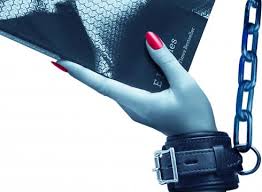 I’ve mused over why so many women want Fifty Shades of Grey. Some may crave a brief escape from the power and responsibility of their lives. Others may fetishize their own disempowerment. Random happenings may play a role. And certainly, a media blitz that eroticizes the degradation and torture of women can end up living in women’s own heads.
Some stick to fantasy and role-play. Others come to accept, or even crave, their own abuse.
Alisa Valdes was raised a feminist but eventually learned to submit when she met “the Cowboy.” What began as obedience turned violent, as when he:
dragged me down the hall to the bedroom, bent me over, and took me, telling me as he did so that I must never forget who was in charge.
The violence escalated and she eventually leapt from a moving truck, fearing he would kill her.
Or, I read this on the feminist blog, Jezebel:
“Hit me. Harder. Hard.” …
I slapped her as hard as I could. She made a noise, like crying but also like a hot intake of breath. She nodded. I did it again, a little less hard. I could see her face darkening and didn’t want to leave a mark. My hand stung. I assumed her face hurt more… As we fucked increasingly hard, she made noises I didn’t know. I took them as cues, so I would slap her as hard as I could, as hard as she seemed to want.
Another woman posted this comment on my blog:
However, as far as the violent sex goes, I will admit being one of those women who enjoys it.
I also know from experience, however, that violent sex is addicting and only induces more desire for increased violence, which almost became borderline physically dangerous sometimes.
We experience pain for a reason. It is a warning to stop whatever we are doing because it is harming us. People who lack pain receptors die young.
Does this eroticization teach women to crave their own abuse? Almost like a backlash to a movement that teaches men not to abuse and that teaches women they don’t have to take it?
A counterblast to a society that now provides women’s shelters, hot lines and mandatory arrest? Maybe we can get you to crave your own abuse, without complaint?
That’s one of my worries about the Dominance/submission trend, which includes the appeal of Fifty Shades.
In my next post in this series, I’ll look at how sexualizing male dominance keeps male dominance sexy. After that I’ll consider the other side: pro-orgasm feminism that wants women to cum, however they cum.
Popular Posts on BroadBlogs
Why Women Want Shades of Grey
Learning to Like Torture in Shades of Grey
Enslaving Sex Objects
Share this:

Male/Female Friendships Help End Rape
![220px-WhenHarryMetSallyPoster[1]](https://broadblogs.com/wp-content/uploads/2013/04/220px-whenharrymetsallyposter1.jpg) by Michael Kimmel PhD
by Michael Kimmel PhD
Cross-posted at Sociological Images
Let me ask you a question: Do you have a good friend of the opposite sex?
Odds are you do. In fact, the odds are overwhelming.
When I first began teaching, 25 or so years ago, I asked my students how many of them had a good friend of the opposite sex. About 10% said they did. The rest were from what I called the When Harry Met Sally generation. You’ll remember the scene, early in the film, when Harry asserts that women and men can’t be friends because “sex always gets in the way.” Sally is sure he’s wrong. They fight about it. Then, thinking she has the clincher for her position, she says, confidently, “So that means that you can be friends with them if you’re not attracted to them!”
“Ah,” says Harry, “you pretty much want to nail them too.”
Young people today have utterly and completely repudiated this idea. These days, when I ask my students, I’ve had to revise the question: “Is there anyone here who does not have a friend of the opposite sex?” A few hands perhaps, in the more than 400 students in the class.
But let’s think, for a moment, about the “politics” of friendship. With whom do you make friends? With your peers. Not your supervisor or boss. Not your subordinate. Your equal. More than romance, and surely more than workplace relationships, friendships are the relationships with the least amount of inequality.
This changes how we can engage men in the efforts to end sexual assault, because there are three elements to sexual assault that can be discussed and disentangled.
First is men’s sense of entitlement to women’s bodies, to sex. This sense of entitlement dissolves in the face of an encounter with your friends. After all, entitlement is premised on inequality. The more equal women are, the less entitlement men may feel. (Entitlement is not to be confused with resentment; equality often breeds resentment in the privileged group. The privileged rarely support equality because they fear they have something to lose.) Entitlement leads men to think that they can do whatever they want.
Second, the Bro Code tells those guys that they’re right – that they can get away with it because their bros won’t challenge or confront them. The bonds of brotherhood demand men’s silent complicity with predatory and potentially assaultive behavior. One never rats out the brotherhood. But if we see our female friends as our equals, then we might be more likely to act ethically to intervene and resist being a passive bystander. (And, of course, we rescue our male friends from doing something that could land him in jail for a very long time.)
Men’s silence is what perpetuates the culture of sexual assault; many of the excellent programs that work to engage men suggest that men start making some noise. We know the women, or know people who know them. This is personal.
Finally, we’re better than that – and we know it.
Sexual assault is often seen as an abstraction, a “bad” thing that happens to other people: Bad people do bad things to people who weren’t careful, were drunk or compromised. But, as I said, it’s personal. And besides, this framing puts all the responsibility on women to monitor their activities, alcohol consumption, and environments; if they don’t, whose fault is it?
This sets the bar far too low to men. It assumes that unless women monitor and police everything they do, drink, say, wear etc., we men are wild, out of control animals and we cannot be held responsible for our actions.
Surely we can do better than this. Surely we can be the good and decent and ethical men we say we are. Surely we can promise, publicly and loudly, the pledge of the White Ribbon Campaign (the world’s largest effort to engage men to end men’s violence against women): I pledge never to commit, condone, or remain silent about violence against women and girls.
Our friends – both women and men – deserve and expect no less of us.
Michael Kimmel is a professor of sociology at the State University of New York at Stonybrook. He has written or edited over twenty volumes, including Manhood in America: A Cultural History and Guyland: The Perilous World Where Boys Become Men. You can visit his website here.
Popular Posts on BroadBlogs
Real Men Don’t Beat, Rape Women: A Guy’s View
Guys Are Getting More Romantic
Men, Women not from Mars, Venus
Share this:

Learning to Like Torture in Shades of Grey
 What’s the appeal of Fifty Shades of Grey? As I’ve written before, release from power, fetishizing disempowerment, and random happenings may all play a part.
Internalizing a culture that eroticizes the degradation and torture of women surely plays a role, too.
A post from Feministing reads:
I am in no way surprised that many women, who have been socialized in a culture in which male sexuality is linked to domination and in which women are taught their sexual power comes from being wanted, have fantasies of submission.
When you are bombarded by images, ideas subconsciously get inside your head. And we are drenched in “male dominance is sexy” imagery.
![Dolce-Gabbana-Ad-Sexist[1]](https://broadblogs.com/wp-content/uploads/2012/12/dolce-gabbana-ad-sexist1.jpg) Dolce & Gabana has a sexy ad suggesting gang rape. In another, a swimsuit-clad woman lies down as fully clothed men look menacingly down on her.
Dolce & Gabana has a sexy ad suggesting gang rape. In another, a swimsuit-clad woman lies down as fully clothed men look menacingly down on her.
A Tom Ford eyewear ad seems to say F-you to a woman, in a BJ kind of way.
Fashion ads suggest that black and blue is beautiful.
At Superbowl XXXVIII Justin Timberlake slapped Janet Jackson around before ripping off her bodice.
Rhett Butler “takes” Scarlett in an act of marital rape – and she awakens sexually satisfied in the morning. Luke rapes Laura on “General Hospital” — and they fall in love.
 Law & Order: Special Victims Unit invites us to indulge in the rape, battering and torture of sex victims — usually women.
Meanwhile, The Secretary indulges in a little D/s on the side.
Or go to the ballet and watch a man overtake a woman in “Petite Mort” or “little death” (in idiom: orgasm).
On the music scene sexy women are routinely debased as bitches and ho’s while Eminem chants “I’m in flight high of a love drunk from the hate” while Rihanna submits saying, “I like the way it hurts” — and periodically returns to a lover who beat her.
Women are also watching more porn these days. Now showing: violence and degradation of women. Watching, they increasingly find it all arousing.
On the High Court Justice Breyer asks why thirteen-year-olds are protected from Playboy while video games that let boys bind, torture and kill a woman are just fine – so long as the she’s not topless.
 As a kid I checked out Grimm’s Fairy Tales at the library only to read a tale about a woman who was punished by being stripped and driven through the town in humiliation as sharp spikes pierced her skin. Another childhood memory emerges of a woman being thrown over a man’s knee to be spanked on TV.
When young girls are steeped in these sexy images, is it any surprise that they come to see male domination and violence as sexy, themselves?
So really, it is no surprise that so many women are enthralled by the domination and submission of Fifty Shades of Grey.
I’ll talk more on what I make of all this later.
Popular Posts on BroadBlogs
What Do Top Model and Hard Core Porn Have in Common?
Eminem Makes Sexism Seem Sexy
Virtually Attack Women, But No Nudity
Share this:

Enslaving Sex Objects
 Every day, girls are kidnapped and forced into sexual slavery. Stella Marr was attending Columbia University, working to make a good life for herself and escape the abuses of home. But the more she succeeded, the more violent her mother became. Her mom finally kicked her out of the house. A friend knew a friend who needed a roommate. But when she got to the apartment three men beat and raped her and locked her in a tiny room with no window. Next, they forced her into prostitution. Men bought her for sex, and some who knew she was enslaved didn’t care.
Not so long ago, even Osaka’s Mayor, Toru Hashimoto, excused sex slavery – at least in times of war — explaining that soldiers need “comfort women”:
When soldiers are risking their lives by running through storms of bullets, and you want to give these emotionally charged soldiers a rest somewhere, it’s clear that you need a comfort women system.
 The “comfort women” enduring this intense trauma — which sounds worse than war to me — don’t need comfort (and freedom!) themselves? I guess only men count. Women exist only to serve them?
Then there are men who kidnap girls for their own uses. Like Cleveland’s Ariel Castro who was arrested last month for locking three young women in his house — even chaining them in his basement in the early years — while he emotionally, physically and sexually abused them.
And right now trial has begun in the Bay Area over the gang rape of a 16-year-old Richmond girl who was lured by a “friend” who saw her walking home early from a high school dance. The girl was “slapped, punched, kicked, robbed, urinated on, groped and raped by both people and objects,” according to a news report. As many as 20 men were involved. Some laughed and took pictures. The ringleader said he wanted to “pimp her out.” Her enslavement was more short-lived, but nearly fatal.
Do these men have no sense of women as human beings? Are they mere objects that exist to sexually satiate men?
Instead of living fulfilling, growing lives, developing their potential and creating bonds with family and friends, these women are kept in small, dark rooms, beaten and raped. They are denied health care. Some are starved. One of the women Castro kidnapped was starved and beaten to induce miscarriages — from five pregnancies. About three quarters of Japan’s sex slaves died, while survivors were often left infertile from trauma or from STDs.
Kris Mohandie, a forensic psychologist who works with long-term kidnapping cases says, “These are some of the most catastrophic kinds of experiences a human being can be subjected to.”
He also says that when a man abducts a woman for his own personal pleasure — and for her pain — he has “had longstanding fantasies of capturing, controlling, abusing and dominating women.”
And that, in turn, comes out of a pornified culture that objecifies women and ties eroticism to their abuse.
You don’t find sexuality and violence tied together in every culture. Indians of America’s east coast were free from that sort of violence when Europeans first arrived. The Arapesh still don’t “get” rape.
But inside of violent, objectifying porn cultures, some men both find violence against women arousing and enact their fantasies in real life.
All the more likely when women are seen as mere objects that don’t deserve empathy as a result of objectification.
Violent pornography is also correlated with both aggressive behavior and men becoming more callus toward women who are sexually assaulted, says Robert Johnson of the University of Texas.
But the whole culture has become pornified, so it’s not just pornography that’s at fault. As Slippery Rock University’s women’s studies director observed about the Ariel Castro case:
Sadly, in a world that endlessly replicates and sexualizes male domination of women, I am not surprised that this “fantasy” narrative has been literalized. Though there are doubtless myriad factors that contributed to this nightmare crime, I hope that one positive outcome is broader critical analyses of how pornography normalizes the domination and degradation of women in pervasive and damaging ways.
Some wonder why we don’t talk about this. Maybe because critiques of violent, degrading porn seem anti-sex. But there are plenty of non-violent and non-degrading ways to enjoy sex!
Popular Posts on BroadBlogs
Eminem Makes Sexism Seem Sexy
Stop Selling Girls
Laughing at Violence Against Women
Share this:

It’s Crucial to Call Women Names?
 Not so long ago you could go to Facebook pages called “Violently Raping Your Friend Just for Laughs” or “Kicking Your Girlfriend in the Fanny because she won’t make you a Sandwich,” or pages promoting sexual violence against female Marines — and fb didn’t really care.
But after letting companies know that many of us would not buy products that were advertised on these pages, Facebook began including gender-based hate among its banned content, including racial and religious hostilities.
And so we move further away from normalizing women’s debasement.
But some guys are pitching a hissy fit. As Make Me a Sammich declared,
It’s amazing to me how many people seem to think that rape culture on Facebook is something to be protected and defended by coming to #FBrape and calling campaigners “bitches” and “cunts” and “fascists.”
All these guys with their knickers in a twist.
Really, why’s it so important to call women cunts?
I can see how women and girls are harmed by the name-calling and celebration of violence against them. Psych 101 says that when we are repeatedly called names many of us internalize and believe it. So girls and women could be left feeling degraded and secondary.
Rape jokes also signal to rapists that sex assault is normal and accepted. As Time Machine at Shakesville points out:
A lot of people accuse feminists of thinking that all men are rapists. That’s not true. But do you know who think all men are rapists? Rapists do.
Calling women cunts may buttress some guys’ sorry egos, making them feel “superior” by putting women down.
They don’t get that they make themselves look worse: depraved, small-minded and immature.
Related Posts on BroadBlogs
Frats Invite Sluts, Bitches; Women Accept Degradation. Why?
A Raped Girl Is A Joke
Raping, Shaming Girls to Impress Guys
Share this:

“Eve Teasing” Gets Guys Off the Hook
![Eve-teasing[1]](https://broadblogs.com/wp-content/uploads/2012/12/eve-teasing1.jpg?w=300&h=225) Egypt’s fight for freedom and democracy is increasingly met with public sexual assaults. In addition to assault, rape and sexual harassment, rape-like virginity tests and tortures may also be administered. Or perhaps a woman will be dragged naked on the ground.
Egypt’s fight for freedom and democracy is increasingly met with public sexual assaults. In addition to assault, rape and sexual harassment, rape-like virginity tests and tortures may also be administered. Or perhaps a woman will be dragged naked on the ground.
There’s a reason for that.
Many sexist men fear women’s power or the chaos of a receding patriarchy. But women’s rights are also symbolic of freedom for all, so best to snuff it out and demoralize other agitators.
The tormentors are aided, wittingly or not, by the media. As Laura Bates at The Women’s Media Center points out, article titles typically label it all “sexual-harassment” even though the behavior is much crueler: “grabbing, groping, stripping, touching and penetrating—acts that are more accurately described as ‘sexual assault’ or ‘rape.’”
She says the dismissive language is part of a wider trend:
In India, the term “Eve teasing” is popularly used to describe the public harassment, assault, or molestation of women. The term has gained global familiarity, spreading to other countries including Pakistan, Bangladesh, and Nepal and being used by the international media.
“Eve teasing.” Eve, a weak, lying temptress. Suspicion is cast upon the woman, herself.
And if it’s all her fault, she feels shame. Leopard, over at Crates and Ribbons, says shame can lead a woman to see her whole self as flawed with self-worth fading until she can no longer face public scrutiny and defend herself.
“Eve” joined by “teasing” tells us that the crime is small, “a bit of fun,” Bates says. It’s not serious or threatening and the perpetrators mean no harm. Anyone who objects can’t take a joke.
Yet,
The problem is so severe that it has caused at least 14 women to commit suicide in Bangladesh, young men have been murdered in Mumbai for trying to protect their female friends, a 17-year-old Indian girl has acid thrown in her face for daring to resist it. It doesn’t seem particularly funny.
If women are at fault and the “teasers” mean no real harm, who will stop the assaults?
Popular Posts on BroadBlogs
Modesty Objectifies Women Says Nude Egyptian
Why Is There A War On Women?
Rape Victims Shamed Into Suicide. In Pakistan. In America

 BroadBlogs