Blog Archives
Men Know My Sexuality Better Than Me
 Men think they understand my sexuality better than I do. At least some of them.
Some are sure I want sex with them even when I’ve said I don’t. Some Mormon guys thought I’d enjoy a polygamous marriage in Heaven. (No. That sounds like Hell.) Another guy thought I’d like to bring in another woman and have a threesome relationship, or at least periodic threeways. That’s because I told him about research showing that women got more genitally aroused by a nude man than a nude woman. Or, that when women watched hetero couples in foreplay through goggles tracking eye movement, they spent half their time looking at men’s faces and the other half looking at women’s bodies.
Later, I wrote about this research in a blog post called, “Women Learn the Breast Fetish, Too” and followed up with another entitled “Women Seeing Women as Sexier than Men.”
The strange pattern of women seeing women as sexier is not about sexual orientation. As I’ve said before:
I’m straight, but ask me which image I find more erotic, a nude female or a nude male, and I’ll choose the girl. Many of my straight female students nod in agreement.
But men have “informed me” that I am bisexual. Or that all women are either lesbian or bi:
You are a great person but you aren’t straight.
Or:
I’m afraid I don’t agree with you… doesn’t matter if you say that you are not interested in having sex with women, if you feel sexual arousal with female images, it is more than enough to be bisexual… Definitely, women are bisexual.
The comments come often enough that I’m writing this post so that I can simply insert a link in response to future comments because I’m tired of repeating myself.
On the breast fetish being learned and not biological, here’s what I said in one post:
Women’s bodies are obsessed over, with breasts selectively hidden and revealed, creating a captivation, leaving us wondering about that which is hidden. The camera gazes, zeroes in on women’s bodies. We talk about women’s breasts as alluring. So they become a sexual signal to both men and women. We don’t treat any part of the male body in the same way.
When cultures don’t fixate on breasts that are selectively concealed they are no big deal. So tribal men, who see them all the time, aren’t especially interested. European men’s attraction waned in the 80’s when topless women appeared all over local beaches and billboards. And men can become numbed to titillation with overexposure to porn.
I could add that mere covering has managed to make women’s hair erotic in the Middle East. A student of mine said that when she lived in Iran she would sometimes draw back her veil to reveal a hint of, shall we say, hair cleavage. It drove men wild.
In a culture obsessed with boobs is it any surprise that both men and women learn the fetish (though hetero women may experience it a bit differently)?
Sexual appeal is a part of being human, but must it be turbo-charged with women and withheld with men?
I’d like to see balance: women portrayed more multidimensionally in addition to sex appeal, and I’d like to see sexuality attached more often to men. But not narrow notions that say you have to look like “this” to be attractive. Variety is the spice of life!
On the breast fetish being no indication of sexual orientation, I have explained to various guys that:
Being a guy you likely associate the fetish with attraction to the woman who’s attached to the breasts. I don’t. It’s the breasts, only, that are arousing. I was in Nice, France, where some women were topless at a beach. I found that arousing but was not drawn to any of the actual women. I suspect a lot of the arousal came from a sexual breach: Topless women in a public place! Scandalous!
Tribal men are the opposite. They are drawn to women but aren’t aroused by breasts. So if they don’t get aroused by breasts they’re not hetero, right?
Now, given the research, some guys insist that all women are either gay or bi. Yet tribal women aren’t aroused by breasts, either. So they’re the one exception to all women being lesbian or bi?
You can’t seem to understand that breasts have been made into such a strong sexual symbol in our culture that they can provoke a fetish response in the West, on some level, among men and women alike, but not in places like tribal societies, where they are not sexualized.
And oddly – or maybe not — it is not uncommon for a woman in Western society to get aroused by seeing her own sexy self through her lover’s eyes. As she imagines his arousal over her body and lives through it, on some level she vicariously makes love to herself. After all, he’s not a sex object to focus on. She is. Yet it’s hetero because she needs his gaze and his lust to get aroused. This may sound strange to a lot of guys, but plenty of women recognize themselves in this.
Meanwhile, I know quite a few lesbians and bisexual women and more than one has offered to have sex with me. But I’m just not interested.
If despite all this explanation it’s important to you to believe that I’m bi, go ahead. No big deal. I’m interested in educating people but I’m tired of trying to explain something that you may never understand.
Now, it could even be that I have a natural ability to be bisexual but that that potentiality is so repressed in our homophobic culture that I no longer have access to it. In fact, one time I found myself rather drawn to one woman, but still didn’t want sex with her. So it just seems weird to me to think of myself as bisexual when I have no interest in actual sex.
But the thing is, the breast fetish has nothing to do with male heterosexuality, either.
In fact, men are more likely than women to like enormously large and unnatural breasts. How could being drawn to something that does not exist in nature be biological? In fact, when some men get so that they can only appreciate large, unnatural breasts, they get less aroused by natural, smaller ones. And that makes perpetuation of the species less likely.
Also, when men have been with a particular woman for a while the fetish disappears. A number of men have remarked on this, some on this blog. A man may still find his partner’s breasts attractive, just as he finds her legs attractive — and new lingerie may help create a sense of newness and mystery — but her naked breasts will not provoke a fetish response in the way a new woman’s breasts would. Or in the way that hers did the first few time he saw them. There’s a reason why men needed a new Playboy pinup each month, back when Playboy was the porn of choice. Guys won’t keep getting aroused by the same woman’s breasts over and over again. And yet, he will continue to be turned on by her, and will still want to have sex with her, over and over again. And to repeat: In tribal societies where women are topless all the time men don’t get aroused by breasts. In 1980’s Europe, when men saw plenty of naked breasts on topless beaches and billboards, the fetish disappeared. Men who are overexposed to pornography stop finding breasts attractive.
What’s arousing is the hiddenness and intrigue behind that which is hidden, heightened by a culture obsessed with breasts as a sex signal.
Apparently, many women are confused about experiencing a breast fetish while being sexually drawn to men and not women. “How is that possible?” they have wondered? So my posts have found their way to various sites like “Yahoo! Answers.” Or, a number of women have found my blog by googling something like, “I’m a straight woman but like boobs.” When I put “Women Learn the Breast Fetish, Too” on StumbleUpon, it received a 97% “like” rating. So there must be plenty of women who can relate. I doubt they’re all bi.
That said, women’s sexuality does seem to be more flexible than men’s, which I’ve written about here. Women’s sexuality is also more repressible, as I written about here. And I have suffered major sexual repression as I’ve written about here. So it’s entirely possible that I’m just out of touch with my sexual self so that these two forces are working at cross-purposes for me. But based on my own experience and the experiences that other have reported to me, women can actually find breasts arousing without desiring sex with a woman.
Being bi would probably make me – and all women — more intriguing. Sorry to disappoint.
Related Posts on BroadBlogs
Women Learn the Breast Fetish, Too
Women Seeing Women as Sexier than Men
Men: Erotic Objects of Women’s Gaze
Share this:

4 Daily Rituals to Stop Objectification

Objectification causes women a lot of harm says Caroline Heldman, a professor who specializes in gender at Occidental College:
In a culture with widespread sexual objectification, women (especially) tend to view themselves as objects of desire for others. This internalized sexual objectification has been linked to problems with mental health (clinical depression, “habitual body monitoring”), eating disorders, body shame,self-worth and life satisfaction, cognitive functioning, motor functioning, sexual dysfunction [PDF],access to leadership [PDF] and political efficacy [PDF]. Women of all ethnicities internalize objectification, as do men to a far lesser extent.
Beyond the internal effects, sexually objectified women are dehumanized by others and seen as less competent and less worthy of empathy by both men and women.
Furthermore, exposure to images of sexually objectified women causes male viewers to be more tolerant of sexual harassment and rape myths. Add to this the countless hours that some girls/women spend primping to garner heterosexual male attention, and the erasure of middle-aged and elderly women who have little value in a society that places women’s primary value on their sexualized bodies.
In a new post she discusses what women can do to navigate a culture that treats them like sex objects. (See Part 1, Part 2.) This is the third of a four-part series.
Sexual Objectification: Daily Rituals to Stop
There are four damaging daily rituals of objectification culture we can immediately stop engaging in to improve our health.
1) Stop seeking random male attention.
Most women were taught that heterosexual male attention is our Holy Grail before we were even conscious of being conscious, and its hard to reject this system of validation. But we must. We give our power away a thousand times a day when we engage in habitual body monitoring so we can be visually pleasing to others. The ways in which we seek attention for our bodies varies by sexuality, race, ethnicity and ability, but the goal too often is to attract the male gaze.
Heterosexual male attention is actually pretty easy to give up, when you think about it. First, we seek it mostly from strangers we will never see again, so it doesn’t mean anything in the grand scheme of life. Who cares what the man in the car next to you thinks of your profile? You’ll probably never see him again. Secondly, men in U.S. culture are raised to objectify women as a matter of course, so an approving gaze doesn’t mean you’re unique or special. Thirdly, male validation through the gaze alone doesn’t provide anything tangible; it’s fleeting and meaningless. Lastly, men are terrible validators of physical appearance, because so many are duped by make-up, hair coloring and styling, surgical alterations, etc. If I want an objective evaluation of how I look, a heterosexual male stranger is one of the least reliable sources on the subject.
Suggested activity: When a man catcalls you, respond with an extended laugh and declare, “I don’t exist for you!” Be prepared for a verbally violent reaction as you are challenging his power as the Great Validator. Your gazer likely won’t even know why he becomes angry, since he’s simply following the societal script that you’ve interrupted.
2) Stop consuming damaging media.
 That includes fashion, “beauty” and celebrity magazines, along with sexist television programs, movies and music. Beauty magazines, in particular, give us very detailed instructions on how to hate ourselves, and most of usfeel bad about our bodies immediately after reading. Similar effects are found with televisionand music video viewing. If we avoid this media, we undercut the$80 billion a year Beauty-Industrial Complex that peddles dissatisfaction to sell products we really don’t need.
Suggested activity: Print out sheets that say something subversive about beauty culture, like “This magazine will make you hate your body,” and stealthily put them in front of beauty magazines at your local supermarket or corner store.
3) Stop playing the tapes.
Many of us girls and women play internal tapes on loop for most of our waking hours, constantly criticizing the way we look and chiding ourselves for not being properly pleasing in what we say and do. Like a smoker taking a drag first thing in the morning, many of us are addicted to this self-hatred, inspecting our bodies first thing as we hop out of bed to see what sleep has done to our waistline. Self-deprecating tapes like these cause my female students to speak up less in class. They cause some women to act stupid when they’re not, in order to appear submissive and therefore less threatening. These tapes are the primary way we sustain our body hatred.
Stopping the body-hatred tapes is no easy task, but keep in mind that we would be highly offended if someone else said the insulting things to us that we say to ourselves. These tapes aren’t constructive, and they don’t change anything in the physical world. They are just a mental drain.
Suggested activity: Sit with your legs sprawled and the fat popping out wherever. Walk with a wide stride and some swagger. Eat in public in a decidedly non-ladylike fashion. Burp and fart without apology. Adjust your breasts when necessary. Unapologetically take up space.
4) Stop competing with other women.
 Unwritten rules require us to compete with other women for our own self-esteem. The game is simple: The prize is male attention, which we perceive as finite, so when other girls/women get attention from men we lose. This game causes many of us to reflexively see other women as natural competitors, and we feel bad when we encounter women who garner more male attention than we do. We walk into parties and see where we fit in the “pretty girl pecking order.” We secretly feel happy when our female friends gain weight. We criticize other women’s hair and clothing. We flirt with other women’s boyfriends to get attention, even if we’re not romantically interested in them.
Suggested activity: When you see a woman who triggers competitiveness, practice active love instead. Smile at her. Go out of your way to talk to her. Do whatever you can to dispel the notion that female competition is the natural order. If you see a woman who appears to embrace the male attention game, recognize the pressure that produces this and go out of your way to accept and love her.
Cross-posted at Ms. and on Caroline Heldman’s blog
Popular Posts on BroadBlogs
Sexual Objectification, What is it?
Sexual Objectification, The Harm
Why Men Objectify
Share this:

Girls Walk Fine Line Between Attractive, Slut
 Women and men both use sexual allure to raise their status. Men may try to “score” with as many women as possible, with each conquest boosting their place among men.
For women it’s more complicated. Many college women think that being “hot” is the most important thing in the world. That’s because self-worth is so attached to beauty. But Elizabethe C. Payne, Director of Queering Education Research Institute (QuERI), explained in the Huffington Post that girls can face a double bind of “damned if you do, damned if you don’t” as society tells them they will only be loved and held in high regard if they show off their bodies – but they’d better not do it the wrong way:
Girls have to “straddle an often unclear line in appearing sexually attractive (desirable) and receptive (thus not “gay”) yet unavailable (not “sluts”).
She says that middle school girls who simply dress attractively and wear makeup—or who develop breasts before their peers – may be labeled “sluts.” And any girl who actively pursues a boy, defying the double standard, can get slut-shamed too. She needn’t have sex, she only needs to be assertive:
Many young girls who have never had sex or anything close to it — at all — have been marked as “sluts.” Once marked, young girls are repeatedly subjected to sexual harassment, threats and taunts.
But the pressure on young women to constrain themselves moves beyond sexuality and sexual allure. Middle school girls can also be labeled as sluts, bitches, whores or gay for acting assertively or challenging male authority – including the authority of boys.
Girls and boys both slut-shame. Girls, because they feel threatened by attractive young women, especially when they feel they cannot be attractive, themselves. And boys might sustain the male privilege to act and be free while girls must hold themselves back.
Which brings us to another double-bind. Women and girls who criticize a system that judges us only by our beauty, and who seek, instead, to work for equality can be labeled “feminazis.” But if they smile and take it they still lose.
If you’re going to lose either way in the short-term, you might as well work toward long-term freedom and empowerment, I’d say.
Popular Posts on BroadBlogs
Did Slut-Shaming Kill Phoebe Prince?
Sex and the Walk of Shame
Lose Virginity, Lose Self-Esteem?
Share this:

Men: Erotic Objects of Women’s Gaze

Sexy, but all covered up.
A nude woman frolics in silhouette as clothed men sleuth about, guns in hand and feet in chase. These images introduce The Spy Who Loved Me.
Flipping through TV stations the other day, this Bond rerun caught my eye and left me imagining the reverse: a nude man cavorting about as clothed women race in pursuit of criminals. Weird.
The female body is celebrated – or exploited – while the male body is ignored.
Check out People’s sexiest men. Until 2013s Channing Tatum you would be hard-pressed to see anything but face shots, loose T-shirts, and very few rippled muscles. Who could imagine a “sexiest woman” shoot sans bodies.
Searching for a calendar of sexy men at one bookstore, the closest I could find was Barack Obama.
Yeah, yeah, there is the occasional men’s underwear ad, but they are rare.
And when men walk around in the world they’re all covered up.
No wonder women don’t spend a lot of time checking out men’s bodies, ogling them or judging them.
A man commented on one of my posts that (to paraphrase):
Not only are men not considered erotic, they are often used to get laughs. In Seinfeld, Elaine referred to the male body as “utilitarian,” implying that the female is much more erotic. George Costanza became a victim of “shrinkage.” Scenes of Johnny Knoxville running around in a thong get chuckles.
Why is the male body so de-eroticized?
One possibility: Men have historically controlled media, and they focus on what they find sexy (about 95% of them anyway). Homophobia further hinders eroticization. As women enter the industry we find more focus on men, but still not much compared with women. Meanwhile, showered with sexy-women images from the time they are small, even women come to find women the sexier of the species.
What if the world were to switch? Suddenly, a universe of men in Speedo’s?
What if women became subject, and men erotic object for women to gaze upon? What if women sought to consume men as objects? Judging them, grading their beauty? Would women feel empowered, experiencing themselves on the “person” side of the person/object divide?
Something to think about.
Popular Posts on BroadBlogs
Women Seeing Women as Sexier than Men
Man as Object: Reversing the Gaze
Women Learn the Breast Fetish, Too
Share this:

Boob. A Breast? Or a Fool?
![e412ba0843ed5a18555a51ed4c185b32[1]](https://broadblogs.com/wp-content/uploads/2012/12/e412ba0843ed5a18555a51ed4c185b321.png?w=604) The English language has more than 1000 words that sexually describe women or their body parts. Here are a few:
The English language has more than 1000 words that sexually describe women or their body parts. Here are a few:
Babe, nymph, nymphomaniac, bimbo, fox, dog, beaver, freak, super freak, knockout, melons, tomatoes, whore, ho, dumb blond, shapely, pussy, boobs, hussy, slut, buxom, trim, troll, femme fatale, skank, goddess, jugs, bush, poontang, tart, loose, tramp, butch, bitch, Lolita, Betty, sex kitten, temptress, beast, promiscuous.
Sometimes neutral words take on a sexual meaning when they are applied to women. Call a man a professional and you’ll likely envision a doctor or a lawyer. But say, “She’s a professional” and “prostitute” may be the first thing that comes to mind.
An author was asked to rename a book title before publication. “The Position of Women in Society” seemed too suggestive.
“It’s easy” sounds like a simple task. “He’s easy,” might denote an easy grader. But say, “she’s easy,” and you’ll likely hear “sexually promiscuous.”
One-time courtesy titles, or even high titles, can take on sexual meanings. “Madam” is a polite way of addressing a woman. She may be the female head of household. But she may also be the female head of a house of prostitution. Mistress, another term for the female head of house, is now associated with adultery. “Lady” is a polite title. But “lady of the evening” is not. Even the highest status a woman can gain, “Queen” takes on sexual connotations when applied to a gay man or a “drag queen.”
And notice how these words are demeaning as well as sexual (“gay” is overcoming the stigma, but there’s still a way to go). We could add drama queen and cootie queen to that mix.
Even the term boob, slang for a woman’s breast, is defined in the dictionary as, “a stupid or foolish person.” Odd that something so valued is also degraded. Is the appeal of boobs similar to the draw of a dumb blonde?
What difference does it all make?
In their work in anthropology, Edward Sapir and Benjamin Whorf learned that words affect how we see. The Hopi Indians had no words to distinguish among the past, present, and future. And they had a difficult time with those concepts. Skiers are more attuned than most to different kinds of snow: powder, packed powder, corn, ice, slush, for example. Or, we so often use male terms to describe humanity – man, mankind, brotherhood, fellowship – that when people are asked to think of a person, a man generally comes to mind.
Words dig deep into our unconscious psyches, directing how we see ourselves and others. When we constantly hear sexual and pejorative terms describing women, women come to be sexualized and demeaned in our minds.
The language we learn is neither the fault of the men or the women of our society, in so far as baby girls and baby boys both grow up immersed in these words. What’s important is how we use language once we “get it,” and once we get that it matters.
Related posts on BroadBlogs
“Cock” vs “Down There”
Sex: Who Gets Screwed?
Words: Sticks and Stones? Or Shaping How We See Ourselves?
Share this:

Sexual Objectification, The Harm
![Dolce-Gabbana-Ad-Sexist[1]](https://broadblogs.com/wp-content/uploads/2012/12/dolce-gabbana-ad-sexist1.jpg?w=300&h=224) By Caroline Heldman (Cross-posted at Ms. and Caroline Heldman’s Blog)
By Caroline Heldman (Cross-posted at Ms. and Caroline Heldman’s Blog)
This is the second part in a series about how girls and women can navigate a culture that treats them like sex objects. (Part 1 can be found here.)
Sexual objectification is nothing new, but this latest era is characterized by greater exposure to advertising and increased sexual explicitness in advertising [PDF], magazines, television shows, movies [PDF], video games, music videos, television news, and “reality” television.
In a culture with widespread sexual objectification, women (especially) tend to view themselves as objects of desire for others. This internalized sexual objectification has been linked to problems with mental health (clinical depression, “habitual body monitoring”), eating disorders, body shame, self-worth and life satisfaction, cognitive functioning, motor functioning, sexual dysfunction [PDF], access to leadership [PDF] and political efficacy [PDF]. Women of all ethnicities internalize objectification, as do men to a far lesser extent.
Beyond the internal effects, sexually objectified women are dehumanized by others and seen as less competent and less worthy of empathy by both men and women. Furthermore, exposure to images of sexually objectified women causes male viewers to be more tolerant of sexual harassment and rape myths (false notions about rape). Add to this the countless hours that some girls/women spend primping to garner heterosexual male attention, and the erasure of middle-aged and elderly women who have little value in a society that places women’s primary value on their sexualized bodies.

Theorists [PDF] have contributed to understanding the harm of objectification culture by pointing out the difference between sexy and sexual. If one thinks of the subject/object dichotomy that dominates Western culture, subjects act and objects are acted upon. Subjects are sexual, while objects are sexy.
Pop culture sells women and girls a hurtful fiction that their value lies in how sexy they appear to others; they learn at a very young age that their sexuality is for others. At the same time, sexuality is stigmatized in women but encouraged in men. We learn that men want and women want-to-be-wanted. The yardstick for women’s value (sexiness) automatically puts them in a subordinate societal position, regardless of how well they otherwise measure up. Perfectly sexy women are perfectly subordinate.
The documentary Miss Representation has received considerable mainstream attention, one indicator that the public is now recognizing the damaging effects of sexual objectification of women.
Widespread sexual objectification in U.S. popular culture creates a toxic environment for girls and women. The next two posts in this series provide ideas for navigating objectification culture in personally and politically meaningful ways.
Popular Posts on BroadBlogs
Sexual Objectification, What is it?
Nude Men Seem Less Intelligent
Objectification’s Role in a Suicide
Share this:

Sexual Objectification, What is it?

Cross-posted at Ms., Caroline Heldman’s Blog and Sociological Images
This is Part 1 of a four-part series on sexual objectification–what it is and how to respond to it.
The phrase “sexual objectification” has been around since the 1970s, but the phenomenon is more rampant than ever in popular culture–and we now know that it causes real harm.
What exactly is it, though? If objectification is the process of representing or treating a person like an object, then sexual objectification is the process of representing or treating a person like a sex object, one that serves another’s sexual pleasure.
How do we know sexual objectification when we see it? Building on the work of Nussbaum and Langton, I’ve devised the Sex Object Test (SOT) to measure the presence of sexual objectification in images. In it, I propose that sexual objectification is present if the answer to any of the following seven questions is “yes”:
1) Does the image show only part(s) of a sexualized person’s body?
Headless women, for example, make it easy to see them as only a body by erasing the individuality communicated through faces, eyes and eye contact:


We achieve the same effect when showing women from behind, which adds another layer of sexual violability. American Apparel seems to be a culprit in this regard:

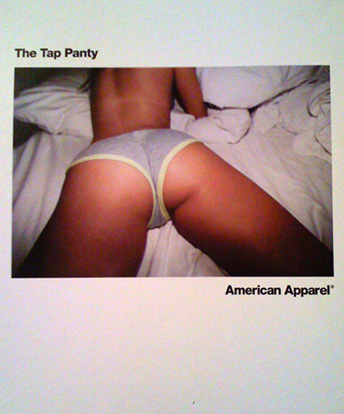
Covering up a woman’s face works well, too:


2) Does the image present a sexualized person as a stand-in for an object?
The breasts of the woman in this beer ad, for example, are conflated with the cans:
Likewise the woman in this fashion spread in Details, in which a woman becomes a table upon which things are perched. She is reduced to an inanimate object, a useful tool for the assumed heterosexual male viewer:

3) Does the image show sexualized persons as interchangeable?
Interchangeability is a common advertising theme that reinforces the idea that women, like objects, are fungible. And like objects, “more is better,” a market sentiment that erases the worth of individual women. The image below, advertising Mercedes-Benz, presents just part of a woman’s body (breasts) as interchangeable and additive:

This image of a set of Victoria’s Secret models, borrowed from a previous Sociological Images post, has a similar effect. Their hair and skin color varies slightly, but they are also presented as all of a kind:

4) Does the image affirm the idea of violating the bodily integrity of a sexualized person who can’t consent?
In this “spec” ad for Pepsi (not endorsed by the company), a boy is being given permission by the lifeguard to “save” an unconscious woman:

Likewise, this ad shows an incapacitated woman in a sexualized position with a male protagonist holding her on a leash. It glamorizes the possibility that he has attacked and subdued her:
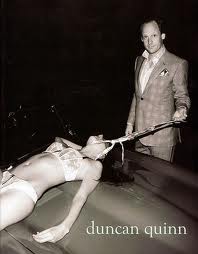
5) Does the image suggest that sexual availability is the defining characteristic of the person?
This American Apparel ad, with the copy “now open,” sends the message that this woman is open for sex. She presumably can be had by anyone.

6) Does the image show a sexualized person as a commodity that can be bought and sold?
By definition, objects can be bought and sold, and some images portray women as everyday commodities. Conflating women with food is a common sub-category. This PETA ad, for example, shows Pamela Anderson’s sexualized body divided into pieces of meat:
And this album cover shows a woman being salted and eaten, along with a platter of chicken:

In the ad below for Red Tape shoes, women are literally for sale and consumption, “served chilled”:

7) Does the image treat a sexualized person’s body as a canvas?
In the two images below, women’s bodies are presented as a particular type of object: a canvas that is marked up or drawn upon.


The damage caused by widespread female objectification in popular culture is not just theoretical. We now have more than 10 years of research demonstrating that living in an objectifying society is highly toxic for girls and women. I’ll describe that research in Part 2 of this series.
Cross-posted at Ms., Caroline Heldman’s Blog and Sociological Images
Popular Posts on BroadBlogs
Anything Good About Being A Sex Object?
Sex Objects Who Don’t Enjoy Sex
Does Porn Objectify? Experts Disagree
Share this:

Playboy Bunnies Are Scary
 Would you like to be a Playboy Bunny this Halloween? The Bunny is a popular costume, and you may have some fun. But one real, live ex-Bunny paints a bleaker picture.
Lili Bee had once worked at the New York City Playboy Club. One day when a Bunny/Playmate emerged from the shower Lili was “struck by how absolutely human she looked.”
Curious about the Playmate’s spread, Lili flipped through the stacks of Playboys that sat in the Club’s employee lounge:
In front of me was sprawled virtual perfection, not a flaw in sight, her skin pore-less, tawny, with the texture of velvet. Her eyes were sparkling and bright. Her lips perfectly moist, parted ever so slightly to show off her perfect, non-rejecting smile.
Her body was portrayed in much the same way: All good features were highlighted to the extreme, and the less than perfect were ‘corrected,’ which is to say, rendered invisible.
Yes, the centerfolds were pretty. But so were her aunt, her boyfriend’s sister, and the woman who had handed her the New York Times that morning. In fact,
Most women were attractive if you could just see them outside of the narrow rules, and yet it seemed that Playboy had extolled some illusory woman as the absolute gold standard for perfection.
That presents a scary perspective for your average women. A fear that she can never live up to an ideal. She might undergo scary surgeries or diets to try to achieve that “perfection.” Or wear tortuous outfits to create an unreal shape. In fact, the Bunny costume is kind of scary.
In its shape-shifting, Lili’s outfit was painful and the boning left marks around her ribs. When feminist, Gloria Steinem, worked undercover as a Bunny, she had to wrap gauze around herself to keep the boning from rubbing her raw. And the stuffing the breasts sit on to make “anyone” look large-breasted was sweltering and tight. In fact, the costume was “so tight it would give a man cleavage,” Steinem recalled. Even the modified outfits that actresses wore for last year’s cancelled Playboy TV series were described as, “tight,” “constricting,” and, “Child, you cannot breathe.” All this pain to create the illusion of an “ideal” female figure that does not exist in reality.
Today Lili is leery of all that Playboy has created: Unattainable ideals that will hurt American women for the next 40 years, and counting…
So women can feel they don’t match up. And men can feel deprived, never finding the idealized perfection.
A little scary.
Popular Posts on BroadBlogs
Men Are Naturally Attracted To Unnatural Women
Miss Representation: Girls are Pretty, Boys Are Powerful
Beauty Tricks to Remove Your Power
Share this:

Why Men Objectify
 Some men wonder why they objectify women. So Jayson Gaddis asked men on his Facebook page why they thought they did, and then he wrote about it for The Good Men Project.
What is objectification? Jayson describes it as:
Staring, gawking, or checking out women and their bodies and body parts. Seeing them as objects instead of actual people, and thinking of them in a sexual way.
Why do they do it? Most blame “nature.” As one man exclaimed,
I love looking at women. They’re just amazing. It’s part of my biological make up to think that they’re beautiful.
Jayson believes biology plays a role since men are hardwired to look for mates and procreate. But he thinks cultural conditioning is involved, too. To paraphrase:
In men’s culture, it’s acceptable to objectify women. Men bond around it. And, it’s pervasive and all around us. Notice where men buy stuff, there are often photos of women present. I can barely go on any male-focused website now without being hit at some point by a tiny, physically attractive, disproportioned airbrushed woman looking at me.
Some men objectify because the “feel good” feeling acts like a drug or pick me up. Objectification can fill an empty place inside:
I’m stuck in the belief that that feminine essence is outside of myself. I’m alienated from the larger truth of my Completeness as a human being. That sexy, juicy, radiant paradise is not inside myself, therefore it’s an object I obsess about outside myself and I treat it like entertainment. This insight leads me to believe I haven’t spent enough time balancing the relationship with My (whole) Self.
Others want gratification without any real work or risk of rejection.
I objectify women cause it’s “safer.” I receive an immediate gratification, a thrill if you will, albeit superficial, it does keep me safe at least for a time from annihilation — from a treacherous road of intimacy and vulnerability — the risk of being really seen and connected with – or actually rejected!! Yes, that’s it — it’s an avoidance of rejection… Intimacy takes a lot of work, courage and commitment. Objectifying is an “easy” road out of the potential of rejections.
Maybe some men simply enjoy the sense of being with many women, polygamous, a way of living that doesn’t appear to be a possibility in our culture. One man says he likes to play with the fantasy and the illusion like he does with porn:
The most fun and exciting and ego gratifying times in my life have been when i have embraced it and danced with it and gave myself permission to play with the illusions, projections, feelings, etc.
Like this man, many say they seek approval or self-esteem. I’m not sure what that means. Might a man’s self worth rise when he imagines the women enjoying his attention?
Or, does self-esteem rise from gaining a sense of power over women? After all, they dressed and adorned themselves to please men – and thus, “him.”
Some talk of the power women have over men – making them melt and creating unrequited desire. But by objectifying women a man can feel superior. “He” is subject while “she” is an object that exists for his pleasure and purposes.
The fear of annihilation has been cited before, but one man describes it in a way that echoes this fear of female power. He seeks “to avoid the terror of annihilation — being reabsorbed back into the feminine.”
Whatever’s going on, Jayson suggests men consider how objectification is working for them and the women in their lives. For those who feel it’s not working, here’s how some have dealt with the matter:
What I’ve found works best for me so far is being a yes to everything in my own experience and in what’s happening AND at some point in my development simply realizing that objectification is not enough for me … I love appreciating and experiencing another human being for more than just her physical traits. What I prefer physically doesn’t in itself inspire me to want to connect with a woman, and doesn’t in itself have me feel attracted. The attraction and inspiration simply are there or not independent of how she looks.
Or this:
The answer for me was to stop trying to get this woman but use that energy to make myself the best possible me I could become. A me that now has confidence because I am self assured, self respecting, and full of self accepting unconditional love. Part of becoming that man means that I must accept and own the truth of my motives and be willing to see the motives of others. That is when I was finally able to let go of the fantasy and see this woman for who she really is inside.
My biggest life breakthrough and victory came as a result of that growth.
As a result, something incredible is happening to me now. Something wonderful has started growing in the void where my fantasy used to live. It’s a genuine curiosity and appreciation for all woman. Especially for all the women who actually live and display their authentic self and freely give their love to all as an expression of their femininity.
Or this,
Once I get connected to me again, I notice how I can appreciate a beautiful woman and I’m in my body, connected to my heart. It has a totally different quality. She feels it and I feel it.
By the way, objectification and desire are two different things. And men are rarely objectified. See these two articles:
For more on all this, go to The Good Men Project.
Related Posts on BroadBlogs
Anything Good About Being A Sex Object?
Being Sexual vs Looking Sexual
Does Porn Objectify? Experts Disagree
Share this:

Objectification’s Role in a Suicide
 More than sexual objectification was certainly involved in 15-year-old Amanda Todd’s death. But it seems to have played a role.
It all began when Amanda and a few of her middle school friends started videochatting with strangers just for fun. Some told her she was “stunning, beautiful, perfect,” a complement any 13-year-old would enjoy. Eventually, a man asked her to flash. And she did.
A year later this same guy found her and threatened to send the nude photos to her family, friends and her entire school if she didn’t “put on a show for him.” When she refused, he did.
Amanda became the laughingstock of the school and lost all of her friends. Anxiety and major depression overtook her life and she turned to drugs, alcohol and cutting to cover the pain.
She moved a couple of times, trying to get away, but her stalker always collected the names of her new friends and even set up a Facebook page with her boobs as the profile picture.
The pictures followed her wherever she went. And so did the derision. And the isolation.
She made two suicide attempts.
A couple of weeks ago she posted a nine-minute video, “My story: Struggling, bullying, suicide and self harm.” She never speaks in it, but holds up note cards that tell her story. Maybe you’ve seen it. If not, it’s a powerful message against bullying which you can see here.
Near the end she seems hopeful, holding a card that reads:
Everyone’s future will be bright one day, you just gotta pull through. I’m still here, aren’t I?
But depression finally won and she committed suicide last week.
How could objectification have played a role? Well, how does objectification encourage men to see women? Actually, it doesn’t encourage men to see women, but to see women’s bodies – as objects that exist for their purposes.
The images are often bodies without heads—without minds and thoughts and emotions or personalities or a will to act in the world. Sometimes the bodies are shaped in the form of an object, like a table, for a man to use as he will.
The man who harassed Amanda did not see her as a person who had hopes and dreams for the future. He is not a man who cared about her. He did not think of her as a person. She was just a thing for him to play with and manipulate for his own sadistic purposes. If he had seen her as a real person and felt any empathy he would not have behaved as he did.
Now, all men are subjected to objectification, yet not all men behave like Amanda’s stalker. So of course it takes more than objectification to drive a man like that. But objectification combined with a twisted mind can be a dangerous thing.
Popular Posts on BroadBlogs
Anything Good About Being A Sex Object?
Nude Men Seem Less Intelligent
Does Porn Objectify? Experts Disagree

 BroadBlogs