Blog Archives
How to Look Like a Victoria’s Secret Angel
 “How to be a Victoria’s Secret Angel” Jezebel’s banner teased. “Not that you can be one. You can’t,” ran the verdict following the hopeful headline.
“What people don’t realize is that they’re rarer by far than superstar athletes,” proclaimed Ed Razek, Limited’s chief marketing officer (they also own VS). “The numbers of people who can do this are probably under 100 in the world.”
After all, angels must be skinny and buxom, but also fit enough looking to believably hold up heavy wings. Hard to do all three at the same time (or even two).
Sometime-angel, Angela Lindvall told the New York Times she jumped rope and ate nothing but spinach, chard and kale to lose 20 pounds, post-pregnancy, to “make weight.” Others hire personal trainers, take many-mile runs, do squats and lunges, and generally “kill ourselves,” as one put it.
This Thanksgiving angel Adriana Lim ate no solid foods — only powdered egg-enriched protein shakes. She then added twice-a-day workouts. Finally, no food at all 12 hours before the show, which helps her lose up to eight pounds.
And the resulting body is what all women are supposed to look like? What sort of completely insane society do we live in?
The models “kill themselves” for a few months to acquire angel status. Yet the message is that all women can look like them by simply dawning VC bras and panties.
Much of advertising works by making people feel inadequate – which comes easily when an unachievable ideal is placed before us. But Victoria’s Secret offers a product to help! Really?
The message must be working. Sales are up.
A little VS can add some fun. But don’t stress if you don’t look like an angel. Most of the time, the angels don’t either.
Originally posted on January 6, 2011 by BroadBlogs
Popular Posts on BroadBlogs
Men Are Naturally Attracted To Unnatural Women
Men Aren’t Hard Wired To Find Breasts Attractive
Men Watch Porn, Women Read Romance. Why?
Share this:

Yo, Mama—These Jugs Make Milk!
By Elizabeth Hall Magill @ Yo, Mama
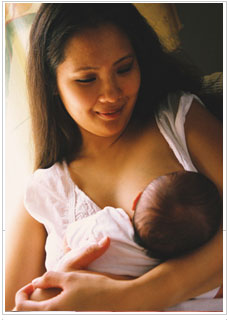 Breasts are fun. They’re so fun that we’ve named them funbags, squeezeboxes, jugs, hooters, racks, boobs, and tits. They’re fun to look at, fun to touch and squeeze. They bounce. Men like them, and that is a good thing.
Breasts can be fun to own. They give a woman pleasure, and that is a good thing. They are an important part of a woman’s body—emblematic of her femininity, her sexuality. When a girl begins to develop breasts, it is her body’s way of saying she will one day be a woman, and a girl listens to that. She listens as the growing pains shoot through her chest, she listens as her mother and grandmother talk about finding a bra. Breasts are such an important part of the transition from girlhood to womanhood that we sometimes call them girls.
Breasts can be a total drag to own. You have to figure out what to do with them—hike ‘em up, pump ‘em up, flatten ‘em out, air ‘em out, cover ‘em up. They’re sensitive, and if one of them gets kicked or pinched or squashed it hurts like hell. Growing them hurts too. Sometimes they grow too fast, and a girl hates being teased for it. Sometimes they grow too slow, and a girl wonders when she will look like other girls. Breasts always grow just right, but girls don’t always know that. It’s confusing to grow breasts.
It’s confusing to own breasts, because breasts are great at selling things. They are FABULOUS at selling beer… a cheeseburger, a car, some soda, a TV show, a video game, or most anything a man could want. Oh, yes, and bras. Breasts are good at selling bras.
It’s confusing to own breasts, because on a deeply subconscious level (or maybe not so subconscious) a woman has to wonder—if breasts are so great at selling things, does that mean the ones on her body would be? What if the ones on her body are smaller than most of the ones that sell stuff—or bigger? What if they bounce less, or more? What if they’re not simultaneously perky and exceedingly large—is that natural, and sexy? Yes, the cultural interest in breasts can be confusing to a woman.
Of all these breasts we see, very few are ever doing what they were made to do: feed children.
There are periodic outcries against women who breastfeed in public. Sometimes women are made to feel ashamed—asked to cover up, as if they were doing something indecent. Facebook has removed pictures of breastfeeding women, labeling them obscene. Breastfeeding has been, in a variety of contexts and for many years, seen as obscene. However, using breasts to sell beer or cheeseburgers does not violate any societal code of conduct. Breasts are for fun, silly. Not for food.
Why, in the name of all that is pleasurable and seductive, do we freak out when a woman wants to feed her child in public, but we don’t freak out when she wants to use her breasts to sell something?
Moving along, then—the breast can be pleasurable for a woman (and for a man), and the breast can feed a baby. If exhausted, overwhelmed, sometimes shamed nursing mothers can figure this out, I think it’s about time we asked the question:
How, in the name of all that is vulnerable and resilient, can we continue to pretend that the breast is anything other than what it is—a beautiful part of a woman’s body that can and sometimes does help another human being to survive, and even to thrive?
A longer version of this piece was originally posted on Yo, Mama
Popular Posts on BroadBlogs
Men Aren’t Hard Wired To Find Breasts Attractive
Women Learn the Breast Fetish, Too
Staring at Breasts Is Good For Men’s Health? And Women’s?
Share this:

Miss Representation: Girls are Pretty, Boys Are Powerful

Powerful Man Pretty Woman
Girls get the message that what’s important is how they look. And boys get the message that what’s important about girls is how they look. That’s one of the observations made in the film, Miss Representation.
Girls and boys both buy into this belief system. And then boys become men, step into power, and perpetuate a social order that favors them. Most CEOs are male, most of Congress is male, most publishers and editors are male, and we’ve never had a female President of the United States. Girls become women and go with the flow, too. Yes, there are many exceptions. But these large patterns remain.
Our world incessantly whispers – or shouts: women are more body than brain. Women are emotion, not rationality and action. Women are sex.
And sex sells, they say. Sex sells products. Sex sells the message that women are all about sex.

Now add demeaning and violent images.
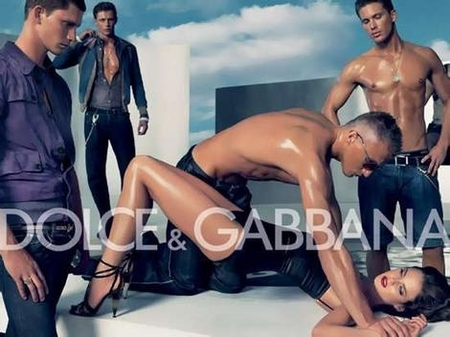
The message: men are powerful, and better than women.
And when women try to move out of the box to gain power?
Well look what happens on conservative networks like Fox, where men dress conservatively while female anchors wear plunging necklines, short skirts, and say things like, “Hillary Clinton looked so haggard and, like what? 92 years old?!” Or Greta Van Susteren asks VP candidate, Sara Palin, whether she has gotten breast implants. When women aren’t co-conspiring, Rush Limbaugh complains that no one wants to see a woman age in office.
Even when women do become powerful a headline runs, “Condi Rice, Dominatrix.”

Condi Rice, dominatrix
Perhaps alongside an ad for a nutcracker shaped as Hillary Clinton.

Hillary Clinton nutcracker
Any wonder 51% of Americans are women, but only 17% of Congress members are?
Jennifer Siebel Newsom, Miss Representation’s writer-director says this is unfortunate since research shows that:
The more diversity and more women you have in leadership, both in government and business, the greater the productivity, the creativity and the bottom line.
And:
There’s this new transformative leadership that’s embracing empathy, collaboration, empowerment… those are more feminine qualities and those are now more associated with success in the global landscape than the traditional sort of command-and-control male leadership traits. So I think we’re going to start to see a shift.
Let’s stop misrepresenting women and their potential. We all lose out when the talents and vision of half our population are stifled. Women and girls are not less important than men and boys.
Newsom urges us to empower both young women and young men to create an equitable society together, making sure that girls are mentored and have a plenty of good role models.
And as Miss Representation points out:
The most common way people give up their power is by thinking they don’t have any.
— Alice Walker
Popular Posts on BroadBlogs
Miss Representation: How I Look Is What Matters
Self-Esteem Falls with Rise in Power? Blame Beauty Ideals
Why Do Women Fight Against Their Own Interests?
Share this:

Being Sexual vs Looking Sexual

Is “beauty” really sex? Does a woman’s sexuality correspond to what she looks like? Does she have the right to sexual pleasure and self-esteem because she’s a person, or must she earn that right through “beauty”?
– Naomi Wolf
A lot of women and men confuse looking sexual with being sexual. We look at an attractive woman and think, oh, she’s really sexual. Then we see a not-so-pretty woman and suppose she’s not.
But “pretty” and “sexuality” are actually two different things. Sex is all about feeling, not the surface experience of just existing, however beautifully.
But as Naomi Wolf points out in The Beauty Myth, too many women don’t enjoy sex because they think they don’t look sexy enough. And since a lot of women think they don’t look sexy because of their body type, age, or low self-esteem, a lot of women miss out on great sex.
Because a woman’s ability to enjoy sexuality can be so closely tied to how she looks, many cut their breasts to get implants just so that they can experience eroticism. Even when their partners don’t want them to. As Wolf put it, “In a diseased environment, they are doing this ‘for themselves.’”
And about one-third of women lose sensitivity in their nipples, post surgery, becoming less capable of enjoying the sensations of the breast.
And even then a lot of “hot” women spend their time thinking about how they look and not experiencing how they feel. So there you have pretty sex objects who don’t enjoy sex.
Women think they need to look a certain way because men are hardwired to be visual. Yet it’s not true. In tribal societies women walk around nearly nude, and no one cares. Those men aren’t visually attuned to the breast as erotic. In our culture men learn to be aroused by breasts through the strategic revealing and covering of them, creating the allure.
Wolf says beauty is not the same as sexuality. Instead:
Wherever we feel pleasure, all women have “good” bodies. We do not have to spend money and go hungry and struggle and study to become sensual; we always were. We need not believe we must somehow earn good erotic care; we always deserved it.
Popular Posts on BroadBlogs
Men Aren’t Hard Wired To Find Breasts Attractive
Sex Objects Who Don’t Enjoy Sex
Cartoonish vs Authentic Sexuality
Share this:

Miss Representation: How I Look Is What Matters

Girls get the message early on that the most important thing is how they look. Too often their self-worth depends upon it.
Miss Representation premiered last week on Oprah Winfrey’s OWN network, seeking to combat that unfortunate reality. The film opens our eyes to all that creates the message. And offers change.
From the time they’re small, little girls are told they’re pretty – or notice that they’re not told that. They receive gifts of play makeup and vanity sets. They watch endless repeats of Disney princesses on DVD, buy beautiful princess dolls, and then graduate to Barbie or Bratz. All of whom have extensive wardrobes. It’s all about being pretty. Meanwhile, girls and women are bombarded with media images of impossibly beautiful women who are photoshopped up the wazoo, modeling what they’re supposed to look like.
Who’s popular in middle school and high school? Pretty girls. By the time they’re in college young women are under relentless pressure to be hot, as if that’s the most important thing in the world.
Media creates consciousness, but women don’t have much control over media. As Miss Representation tells us, women hold only 3% of the clout positions in publishing, advertising, telecommunications, and entertainment. And women comprise only 16% of producers, writers, directors and editors.
And so women come to see themselves through men’s eyes.
Meanwhile, media makes its money through advertising. And advertising works by making people feel bad about themselves so that they’ll buy products to “help.” But if the feminine ideal is impossible to achieve, women can buy an endless stream of products and still feel eternally insecure.
Jennifer Siebel Newsom, Miss Representation’s writer-director, makes this observation:
When youth are engaging in cutting and other forms of self-injury, when 65% of American women have eating disorders, when depression rates have doubled in the past ten years, when plastic surgery has tripled in the past decade amongst youth in particular; when you look at that you think Something is wrong. This is not healthy.
Fashion magazines are especially harmful. Girls and women who read them have worse body images than those who don’t. But women aren’t the only ones affected. Just looking at those “perfect” models can leave men finding real women less attractive, too.
So women and men who compare women to unattainable ideals both end up dissatisfied and estranged from each other.
Too many women sit in their inadequate, one-dimensional corners opposite too many men who do the same thing.
And no one is better off.
Popular Posts on BroadBlogs
Grade School Lingerie
500 Calories + Pregnancy Hormones = Perfect Body
Women Want Good Sex, Men Want Cuddling
Share this:

Man as Object: Reversing the Gaze

Della Calfee. Ass Like That
“Men act and women appear. Men look at women. Women watch themselves being looked at,” art critic John Berger famously observed.
Now some feminist artists are turning the tables in the exhibit, Man as Object: Reversing the Gaze:
With a gallery filled with men stripped naked this body of work exposes women’s cheeky, provocative and sometimes shocking commentaries on the opposite sex (which) may make the viewer squirm a little. But that is precisely the point.
The exhibit reveals sundry masculinities from female/feminist/
transgender perspectives, moving from sensuous rear views of the male buttocks to gender-bending to daughters gazing at fathers. Featured artists include Juana Alicia, Nancy Buchanan, Guerrilla Girls on Tour!, Lynn Hershmann, Jill O’Bryan, ORLAN, Carolee Schneemann, Sylvia Sleigh, Annie Sprinkle, Elizabeth Stephens, May Wilson, and Melissa Wolf.
Man as object strikes a pose, buttocks pushed out, offered to us as bedroom eyes shoot a backward glance. Men flex in awkward positions, or bend gracefully into compliant cants. Some men turn submissively into tables.
Others lie down. Natural enough, yet rarely seen in art. Too sensually passive… waiting… vulnerable… or “on the bottom” for mainstream viewing?
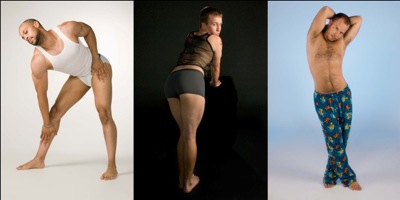
Karen Zack, Man As Object
The visions can come across as “gay.” Since sexual pose is so often meant for the male gaze, on some unconscious level we may see it all through male eyes. And that is jarring, too.
The camera pleasurably zooms in on erotic man-parts. Images of male autoeroticism and penises abound, including a piece called “Where’s His Head?” that depicts a giant phallus-man fondling his much smaller man-phallus. Indeed! And when Pinocchio tells a lie, it’s not his nose that grows. More like a woody that “lasts more than four hours.” Actual penises are rarely displayed, apparently unable to live up to what Richard Dyer called “the mystique implied by the phallus.”
The exhibit includes a lenticular postcard (turn it one way and it’s a woman, turn the other and it’s a man) that juxtaposes Courbet’s “Origin of the World” with a close-up vagina shot versus ORLAN’s “Origin of War” with a penis close-up.
At times men are objectified in one-dimensional, controlling and demeaning ways. But sex-positive feminist photographer Shiloh McCabe explores the other side, working to ensure that her gaze does not consume or dominate. She takes a wide view, seeing those who are usually not. Her subjects help create their own representation so they can retain their power. “I’m not here to objectify or harm; I’m here to nurture and document,” she explains.
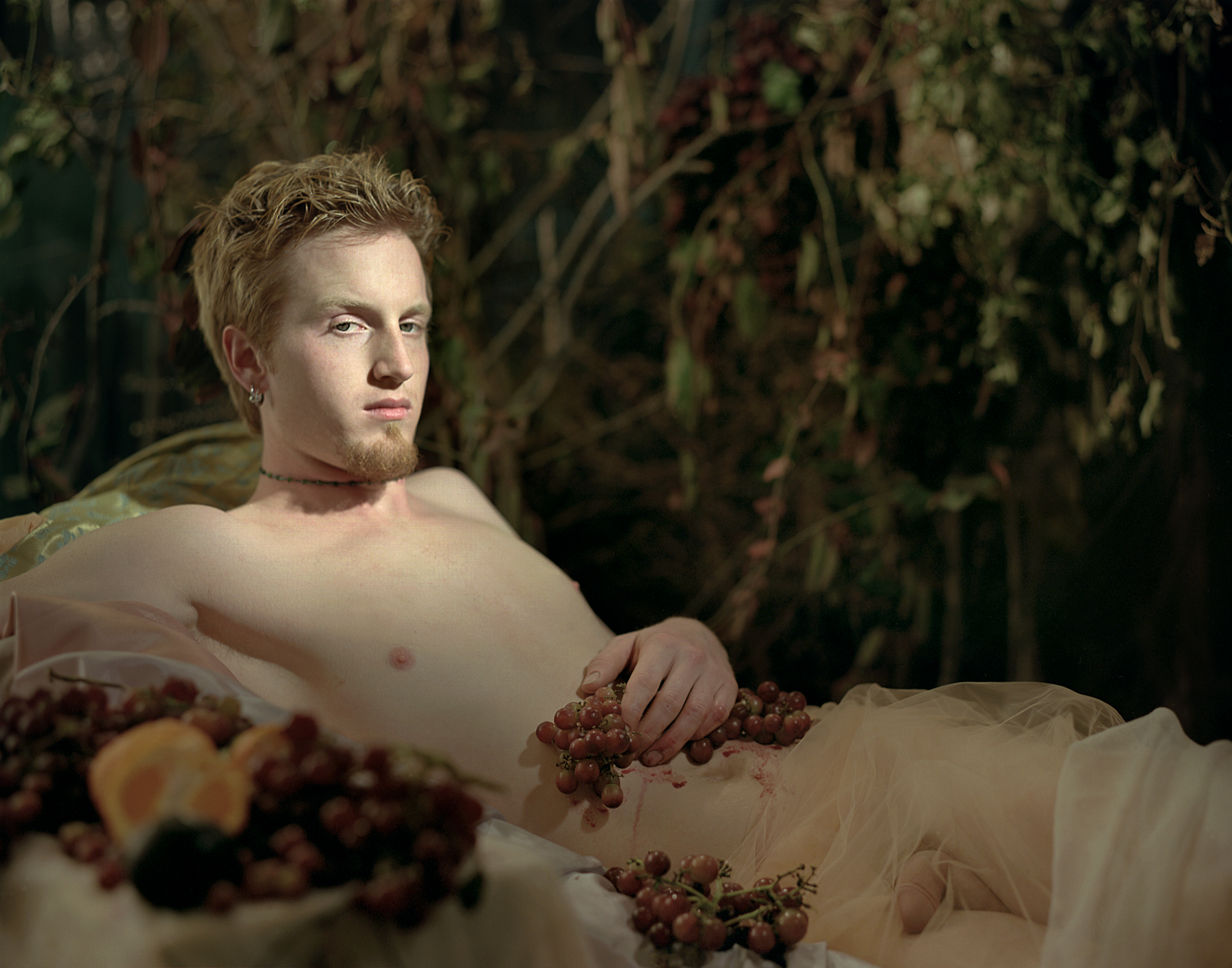
Laura Hartford. Graham Reclining
Man as object, Rubenesque, reclining, bathing, cooking, lounging, washing up before bed. Man as Madonna and Child, patriarchal man, veiled man, man as cowboy bunny, trans man. Blonde man in short shorts. Bodybuilder, Founding Father. Homeless man. Nude and vulnerable. Empowered. Bound and submissive. Striking a pose. Objectified.
So much to gaze at. And so much to see.
“In the past it was totally taboo for women to gaze upon the male, yet it was appropriate and common in the reverse,” observes artist Marian Yap. “Do you think that things are changing?”
Good question. This exhibit pushes us out of our taken for granted ways of seeing to explore that path.
Check out a video on the exhibit here.
Man as Object: Reversing the Gaze. Opening Friday, November 4th at SOMArts Cultural Center in San Francisco and running through the end of November. The show will travel to the Kinsey Institute Gallery, Bloomington, IN and will open April 13, 2012 through the end of June.
This exhibition was created by The Women’s Caucus for Art – the founding organization promoting feminist art and art as activism since 1972.
For more information click here.
Ms. Magazine reposted this piece on their blog October 28, 2011
Popular Posts on BroadBlogs
Does Sexual Objectification Lead to Bad Sex?
Men, Women React to Male/Female Nudity
Anything Good About Being A Sex Object?
Share this:

Men, Women React to Male/Female Nudity
By Lisa Wade @ Sociological Images
We’ve all heard the truism “sex sells.”
But whose sex is sold? And to who?
If it was simply that sex sold,
…we’d see men and women equally sexually objectified in popular culture. Instead, we see, primarily, women sold to (presumably heterosexual) men. So what are we selling, exactly, if not “sex”?
What is really being sold is men’s (presumably heterosexual) sexual subjectivity: the experience of being a person in the world who was presented with images that were for his titillation. Women do not live in the world this way. They are not exposed everyday to images that legitimize their lust; instead, the images teach women that they are the object of that lust.
In light of this, Sociologist Beth Eck did a series of interviews attempting to tap into what it felt like for men and women to look at male and female nudes. Her findings were pretty fascinating.
First, she asked men and women to look at naked images of women, including this one of Cindy Crawford:
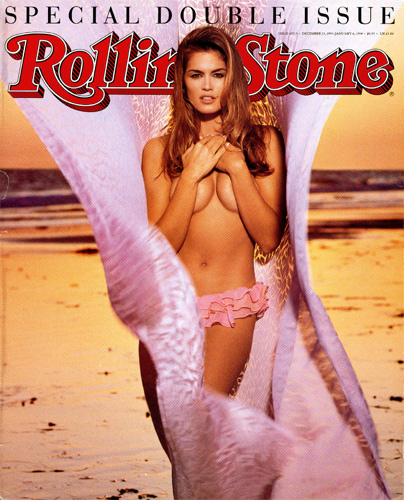
Women viewing images of female nudes almost inevitably compared themselves to the figure and felt inadequate. Said one women:
…the portrayal of these thin models and I just get depressed… I’m very hard on myself, wanting to be that way.
Women ended up feeling bad whether the model conformed to conventional norms of attractiveness or not. When looking at a heavy set woman, they often responded like this:
I am disgusted by it because she is fat, but I’m also… I need to lose about 10 pounds.
I don’t necessarily find her body that attractive… Her stomach looks like mine.
Men, in contrast, clearly felt pandered to as holders of a heterosexual male gaze. They knew that the image was for them and offered praise (for a job well done) or criticism (for failure to live up to their expectations). About Crawford they said:
Personally I think she is attractive.
I like that.
Both men and women, then, knew exactly how to respond to female nudes: women had internalized their object status (women as sex object-things) and men had internalized their subject status (men were people looking at sexy objects).
Eck then showed them male nudes, including this one of Sylvester Stallone:
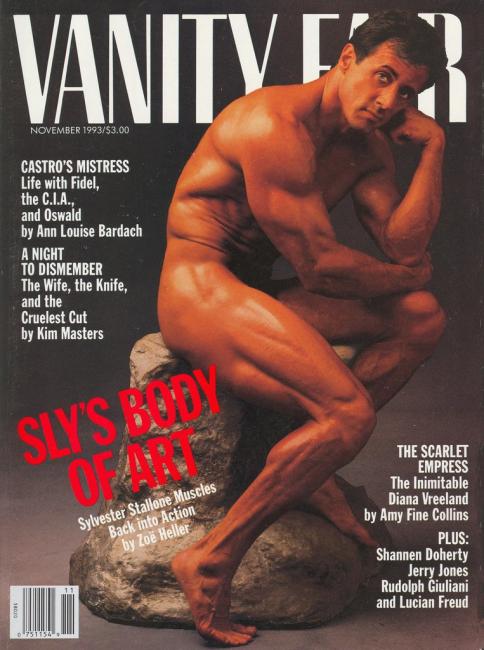
Interestingly, both men and women felt uncomfortable looking at male nudes.
Men responded by either expressing extreme disinterest, re-asserting their heterosexuality, or both. They did not compare themselves to the male nudes (like women did with female nudes), except to say that they were both male and, therefore, there was “nothing to see.” Meanwhile, because men have been trained to be a lustful sexual subject, seeing male nudity tended to raise the specter of homosexuality. They couldn’t see the bodies as anything but sexual objects for them to gaze upon.
In contrast, the specter of homosexuality didn’t arise for women when they looked at female nudes because they weren’t used to being positioned as lustful. Eck explains:
When women view the seductive pose of the female nude, they do not believe she is ‘coming on to’ them. They know she is there to arouse men. Thus, they do not have to work at rejecting an unwanted advance. It is not for them.
Many women also did not feel lustful when looking at male nudes and those that did often experienced lust mixed with guilt or shame. Eck suggests that this may be, in part, a reaction to taking on the active, consuming, masculine role, something they’re not supposed to do.
Summarizing responses to the male nudes, she writes:
Men, over and over again, reject the seductive advance [of a male nude]. While some women welcome the advance, most feel a combination of shame, guilt, or repulsion in interacting with the image…
This is what it means to live in a world in which desire is structured by a gendered sexual subject/object binary. That is, men are taught to be subjects who see women as objects, and women are taught to be objects. It’s not just “out there,” it’s “in us” too.
This piece was originally posted in Sociological Images. A slightly edited version is
reprinted here with permission.
Popular Posts on BroadBlogs
Men: Erotic Objects of Women’s Gaze
Grade School Lingerie
I Can’t Believe I Ate A Whole Head Of Lettuce!
Share this:

Hit the Least Attractive Woman with an Egg

The women are blindfolded and lined up with bulls-eyes on their backs, waiting to be judged “least attractive” on an episode of Bachelor Pad.
Go ahead men, take a paint-filled egg and hit the woman you find least appealing.
With each strike the show’s host announces the intended target, and whether the shot was successful. Erica, on the far right, takes about half the hits. Some of the eggs are thrown pretty hard, but after taking her blindfold off and emerging a stigmatized canvass, Erica lamented,
Being hit by the eggs was painful, but emotionally it was more painful to have the guys say they’re not attracted to me. So now all the girls can feel more attractive than me… better than me.
You can see the video here.
What a way to treat another human being.
Mostly ignoring the women’s feelings, the men worried more about missing needed points. “I didn’t follow through. I kind of like ‘popped’ the egg, and it went right over her shoulder,” bleated one contestant.
A sadistic streak comes into view as the contestants blithely wound each other.
Mercifully, this summer series has ended. And discussing it now won’t serve to make the show more popular.
It should be said that the men took their turn as targets, too, but beauty-connected rejection is probably harder on women since they are taught that their looks measure their worth. Another sad commentary on our society.
Meanwhile, like most of us, egg-splattered Erica didn’t think to question our cultural beauty notions, even though they are not absolute, and change over time. As Gwen Sharp at Sociological Images observes:
In (Erica’s) attempt to defend herself she doesn’t question beauty standards, but refocuses them, pointing to another woman who is “way bigger” and not “that pretty.”
Ms. Sharp explains that this just reaffirms the idea that body size is a legitimate measure of attractiveness (bigger making you less attractive). The comparison also means that self-esteem “Must come at the expense of other women, with whom they are always, and inevitably, in competition,” she adds.
One of the hosts eventually came out to lend the appearance of humanity, saying, “Erica, every person here is beautiful” (measured by our cultural standard, of course).
Erica no doubt felt beautiful after that.
Popular Posts on BroadBlogs
Spoon Fed Barbie
I Overate Because I Felt Guilty Eating
How to Look Like a Victoria’s Secret Angel
Share this:

Harry Potter’s Hermione: Less Brainy, Brave. More Sexy
As Harry Potter’s Hermione grew up, her brainy, brave persona turned more sexy, less threatening and less magical, says Sarah Jane Stratford in The Guardian. She continues:
Did Hermione Granger really say “I can’t” during the climactic battle in the final chapter of the Harry Potter film saga? Presented with her chance to destroy one of the horcruxes she had put her life on the line to hunt, she backs away and needs her almost-boyfriend Ron to insist that of course she can.
The transformation of a brave, adventurous girl into a young woman who becomes weakened by, or defined by, her sexuality, has a long literary tradition. The next step, it seems, is to become a mom who is sick or dead.
I discovered this pattern one year when I let fiction take over my usual nonfiction reading habit.
In The Sound and the Fury we meet adventurous, determined and nurturing little
Caddy Compson who is busy exploring the local countryside, climbing trees and sometimes bossing her brothers. Later, she becomes a promiscuous woman, shamed and rejected by her family. And the mother in this story? She’s a neurotic hypochondriac.
Faulkner introduces us to a mother who is dying, and later dead, in the appropriately titled, As I Lay Dying. Her daughter is upset and fixated on her out-of-wedlock pregnancy (instead of her dying/dead mom).
In Atonement creative young Briony Tallis has an over-active imagination that leads to serious trouble. Her older cousin gets raped, and her older sister is overcome by romance. Mom is constantly bedridden with headaches.
Plain Song revolves around a shy 17-year-old whose mother kicked her out after learning she was pregnant. Two young boys have a mom who spends her days locked away, depressed.
I could go on, but you get the point.
If strong, adventurous girls grew up to become strong, adventurous young women, who were also sexual, that would be fine. But too often, sexuality diminishes them or becomes all they’re about.
Maybe that explains why older women (moms) end up sick or dead. Upon reaching womanhood the grown girl leaves behind everything that had empowered and engaged her to become defined by her sexuality. When her allure fades, there’s nothing left.
Which suggests a lesson for real live women. Best to avoid a one-dimensional focus on sexuality that rests on narrow beauty notions. Instead, stay strong and develop many facets of yourself, including an ageless and radiant beauty and sexuality (a la Susan Sarandon, Meryl Streep, Isabella Rossellini, and Hellen Mirren) to enjoy over a lifetime.
Popular Posts on BroadBlogs
Woman, Not the Sum of Flawed Parts
Anything Good About Being A Sex Object?
Boob: A Breast? Or a Fool?
Share this:

Beautiful Women’s Hips Are Thinner Than Their Heads?
Are women more beautiful when they are thin, thin, thin? Are they more beautiful when their hips are thinner than their heads?
Ralph Lauren apparently thinks so. Check out these images of model, Filippa Hamilton before and after photoshop:

Before photoshop After photoshop
Ok, I’ve definitely been duped by insane notions of beauty. But these go too far.
I don’t care how much the camera gazes at this eerie image, telling me it’s beautiful, I don’t buy it.
Oddly, this bizarre figure is making me rethink the attractiveness of considerably less touched-up photos.
Does Britney Spears really look better thinner? Many will say yes, but (surprising even myself) I don’t. I’m happy to report that I think Britney looks just as beautiful smaller or “bigger” (she’s not really that big).
 Google images
Recently the new Duchess of Cambridge, Catherine Middleton, was photoshopped making her tiny waist appear impossibly thin. Is the new wasp-waist more lovely? I think not.

Fortunately, Germany’s most popular women’s magazine, Brigitte, has chosen to stop using professional models, keeping to real, non-starving and non-photoshopped women. What a breath of fresh air! They may be more attractive, taller, and thinner than average, but at least they’re not abnormal.


Who’s more beautiful, a Ralph Lauren fake lady or a Brigitte real woman?
I vote for the real woman, any day!
A version of this piece was originally published Nov. 1, 2010.
Bad news to update ladies. Looks like two years late Brigitte recanted their decision. Kinda sucks.
Popular Posts on BroadBlogs
Men Aren’t Hard Wired To Find Breasts Attractive
Men Are Naturally Attracted To Unnatural Women
Men Watch Porn, Women Read Romance. Why?

 BroadBlogs