Category Archives: sex and sexuality
It Ain’t Sex Unless You Ooooo
 By Erica Dalton
When it comes to virginity, Jessica Valenti says, “It isn’t sex unless you’ve had an orgasm.”
How different things would be if virginity were explained to young girls that way. Sex is so much more than the old in-and-out.
I can relate all too well. And I cannot help but reassess the image of virginity that I had created long before I knew that I was creating it. An image that I had been mindlessly guided to by my culture.
To this day a lot of us are taught to wait for that one man or woman who will rock our world. But once you get that not everybody experiences sex the same way, you lose grasp of the image that has been pushed down our throats.
If you believe that staying a virgin until marriage will make your first sexual encounter better, followed by a happier and healthier marriage, you may be disappointed. Virginity is not proven to make marriage any simpler or happier. And your marriage could end up worse. I know unhappy couples who are not sexually well-matched. But this problem of ignorance is kept from youth, who are encouraged to stay abstinent to obtain that ultimate magical moment.
It all keeps people uneducated about their bodies and their sexuality. And that does NOT make for better sex.
Until I saw Valenti’s definition, I had not thought that losing virginity meant anything more than a dull night that carries much more expectation than it delivers. But now that I see virginity differently I understand a little more of who I am.
Losing virginity is so much more than that moment of penetration.
This piece was written by one of my students who gave permission to post it.
Popular Posts on BroadBlogs
Sex Lessons from Mom and Dad
Orgasm: It’s All in the Mind
Wanting “X” from Sex, but Doing “Y”
Share this:

Sex Sells — To Women?
 Sex sells, they say.
Last month’s Sports Illustrated swimsuit edition featured bikinied women and women whose nude bodies were painted to look like they were wearing bikinis. (Swimsuits are related to sports, get it?). The scantily clad ladies sell a lot of magazines.
Now SI wants to appeal to its female audience of 18 million. The ladies will get makeup tips. And after all the lovely swimsuit models, women readers may feel badly enough about themselves to want them – a common advertising trick.
But why no Beckham in the buff for us? We aren’t supposed to enjoy ogling sexy men? Instead, we are supposed to be sexy ourselves, so that men can enjoy ogling us?
But SI is hardly alone.
Cosmo, Glamour, Elle, et al., highlight sexy ladies, and at best, lowlight sexy men. In fact, Cosmo and Maxim look an awful lot alike.
But it’s not just magazines. Nearly nude women, but rarely men, draw our eyes to billboards peddling products. The camera hones in on women’s boobs and butts on TV and film. You don’t see much focus on men’s buns and chests.
Why are sexy women marketed to both men and women?
And why aren’t sexy men marketed to women?
Historically, men have controlled media and they put out what they find attractive. Then, flooded with pretty women, we all drink them in. They sink into our minds, and we unconsciously develop notions that that’s the way the world is and the only way things could be.
But the unsaid message is that women’s sexual needs aren’t primary. Men’s are. We are meant to be beautiful decorations for men. We are there to turn men on. Men need sexual pleasure, and we are the one’s to give it to them.
Not the reverse.
As a result, when men look at nearly-nude women, they love it. But when women look at nearly-nude men they can feel uncomfortable.
Shouldn’t women’s sexual pleasure be as important as men’s? And wouldn’t men and women both enjoy sex more if it were?
Popular Posts on BroadBlogs
Sex Objects Who Don’t Enjoy Sex
Men: Erotic Objects of Women’s Gaze
Men, Women React to Male/Female Nudity
Share this:

Women, Men Face Opposing Repressions
![hodgins-and-angela-in-jail[1]](https://broadblogs.com/wp-content/uploads/2013/03/hodgins-and-angela-in-jail1.jpg) Men and women are both repressed, but sometimes in opposing ways. Too many women feel emotionally open but sexually unresponsive, while too many men easily come even while their emotions lie submerged. Either way, when it comes to sex, they lose.
Men and women are both repressed, but sometimes in opposing ways. Too many women feel emotionally open but sexually unresponsive, while too many men easily come even while their emotions lie submerged. Either way, when it comes to sex, they lose.
But should we be surprised when (among other things) buddies push each other to have sex with lots of women who they feel nothing for. Successful “players” are celebrated for “scoring” with the ladies – who may be shamed for “giving it up.”
But as players have sex with women they don’t know and don’t care about, and whose reputations they may destroy, they must check their emotions. But checking emotions goes beyond the bedroom. Boys don’t cry, and shouldn’t express much else, either. When Norah Vincent passed as a man for 18 months, she missed feeling and expressing emotion.
Here’s one man’s response to a post I wrote called “Twilight vs Porn” which contrasts women’s emotionally charged erotica with men’s proclivity for body parts.
It took years for me to untangle the damaging messages I received as a man and to get underneath them to a more genuine understanding of what sex was. I, too, think male sexual modes are primarily culturally reinforced – and exclude men from the best sex within intimacy, leaving them with a series of shallow orgasms and striving egos.
A young woman named Valerie saw it from the other side. She complained about guys gaping at her body and manipulating her into popular porn positions. It’s cold, she says:
I don’t just want to become Body A. I want men to feel like they are with me, Valerie, a particular woman with a particular body and my own unique personality.
Surprisingly, advice to non-orgasmic women may have something in common with helpful advice for non-emotional men.
Sex therapist, Lonnie Barbach encourages women to explore their bodies — without trying to come (because trying to climax just leads to worry that they won’t and keeps them out of the erotic experience). Notice the subtleties of the sensations, she says, feel into them, let them grow.
A guy once told me that he’d had to do the reverse to experience connection. Orgasm was easy. He needed to notice emotional subtleties and center on those as a way to move beyond cold porn sex. And then he couldn’t believe how amazing sex could be — even though he’d thought it was awesome before.
Popular Posts on BroadBlogs
Men Watch Porn, Women Read Romance. Why?
Women Want Casual Sex? Yes and No
Guys Are Getting More Romantic
Share this:

Are Girls Free to Make Love?
 In a recent episode of Girls, non-skinny and not classically beautiful, Hannah, has a short affair with a man who looks exactly like hunky Patrick Wilson. The response? He’s too hot for her!
As Fariha Roisin at Huffington Post put it:
Like, nobody who looks like that would a) Even think about sleeping with Hannah b) Then actually have the impertinence to enjoy it c) Then actually tell her she’s ‘beautiful.’ All he, realistically, would surely feel is remorse/self contempt, but hey sex is sex, right? Even bad sex, with a supposed undesirable.
Roisin then points out that when gender roles are reversed a similar outcry is absent.
- Katherine Heigl would go for Seth Rogen?
- The King of Queens gets the queen of Queens?
- Jon Cryer and Courtney Thorne Smith?
- Gorgeous porn stars with Ron Jeremy?
The list goes on but the outcry does not.
Maybe it’s about who has power over media and ideas – usually, men. And men like the idea of being able to get gorgeous girls even if they, themselves, aren’t so good-looking.
It’s not that men are bad. If women had more power than men it would probably be the reverse. (Lena Dunham gets a little power and look what happens to her character, Hannah. If I were producing, writing and starring in GIRLS I’d write in an affair with Patrick Wilson, too.)
This power over ideas may also affect whose body is shamed and whose is not. Men must be quite obese to garner body shame (if then) but women may be perfectly healthy and be thought too fat. And so Rush Limbaugh says feminism was created to allow unattractive women into mainstream society.
The double standard is reflected yet again as men may make love to many women without censor, but women may not.
In the end it is all about who is free and who is not — to love their bodies, to make love and to love. And it’s all tied to who makes the rules and who does not.
Popular Posts on BroadBlogs
You Are “Less Than”?
Does Sexual Objectification Lead to Bad Sex?
Celebs Less Weight-Conscious
Share this:

Women’s Sexuality Is Like Men’s?
 Women’s and men’s sexuality are pretty much the same, says Dan Slater in a recent New York Times piece.
He goes on to critique evolutionary psych, which says otherwise: Since women have a small number of eggs they best reproduce by putting great time and effort into each child – and by making sure a dependable dad sticks around to provide resources; hence, women are genetically primed for monogamy. But men are promiscuous because, with lots of sperm, they best reproduce by “spreading their seed,” willy-nilly.
But, says Slater, if kids need a dad to provide resources then “loving and leaving” their mothers is counterproductive. Plus, men can’t be promiscuous if women are monogamous. And, women in tribal societies enjoy many partners. I could go on.
Culture must not create differences in sexuality, either, he says, since men and women behave similarly.
For instance, women claim they want fewer partners than men. But when hooked up to a (fake) lie detector, women and men report the same number of actual partners.
Or, in speed dating women are pickier than men. But when the tables are turned with women approaching men, men become the more selective sex.
Finally, early research had found women — but not men — rejecting sex with both friends and strangers. But when that stranger was Johnny Depp, or when the friend was said to be good in bed, women were just as interested in casual sex as men. (No flesh and blood movie stars were involved in this study.)
So neither evolution nor cultural norms seem to be having an effect, leaving men and women just the same.
I agree that women’s sexuality is like men’s in its natural state. In many tribal societies it seems to be.
But can women be untouched by a culture that celebrates women’s bodies — or bodies that very few women actually have — while ignoring men’s? Or that applauds men’s sexuality while repressing their own? Is women’s sexuality untouched by a society that rapes so many?
We are bombarded by “sexy women” but not “sexy men” on billboards, in movies, on Dancing With The Stars… Even women’s everyday clothing shows off their curves while men stay covered up. Amanda Marcotte says “straight women don’t get nearly the provocation on a daily basis.”
No part of the male body is fetishized, either. Men stare at breasts and butts. What are we supposed to look at?
Meanwhile, the “perfect” images that our partners consume can make women feel bad about themselves — a libido killer as women become obsessed by their “flaws” in bed instead of enjoying sex.
The double standard is loosening but sexual women may still be called: slut, ho’, tramp, skank… the list goes on.
Sexual violence also takes a toll, leaving many women fearful or uninterested in sex.
All that has no effect?
Actually, in his evidence for similarity Slater leaves things out.
When it comes to casual sex, men are very interested in their lady friends. But women will only romp with those rumored to be great lovers. Otherwise, why bother?
On sex with strangers, only gorgeous celebs interest women. They seem safe (no reports of rape) and are mega-attractive, charismatic and sexy. Women expect they’ll be great in bed. Plus, sex with a star sounds heavenly, tantamount to intercourse with the gods — or rock gods. So nabbing a guy like that tells her something pretty great about herself.
Turning to speed dating, when things switch around maybe women begin to fear rejection and want to “win” now that the setup feels like a contest. Research in cognitive dissonance suggests that if you try to get someone to like you, you like them more.
Finally, most women say that ideally they would like just one or two partners, lifetime, but Slater thinks they’re lying since they admit to four real partners under duress of lie detection. With or without a lie detector I would say that I have had 5 partners in real life, but ideally I would like just one true love. And a lot of us women need a strong emotional connection to even get aroused.
Meanwhile, the eroticism women typically seek out – romance – is very different from the endless variety of women and their body parts that men more typically “procure” in porn.
While women’s natural sexuality is likely much like men’s, our differing experiences unfortunately pull us apart. And the root cause appears to be sexism, not nature.
Popular Posts on BroadBlogs
Lose Virginity, Lose Self-Esteem?
Women Want Casual Sex? Yes and No
Men Watch Porn, Women Read Romance. Why?
Share this:

Men, Women not from Mars, Venus
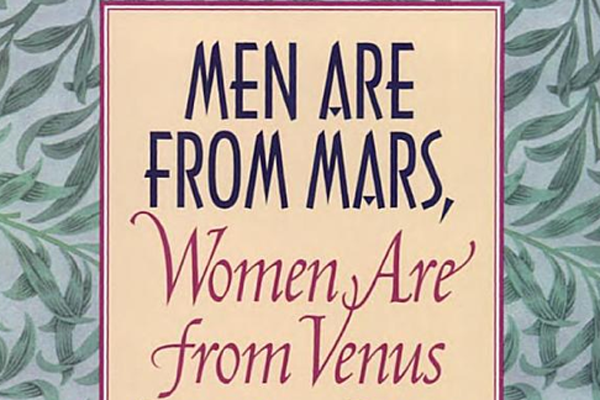 Men and women aren’t so different, after all.
They have similar levels of interest in sex with multiple partners, willingness to have sex outside of a relationship, closeness with a best friend and interest in science, for instance.
What a surprise!
Harry Reis, a psychology professor at the University of Rochester, and Bobbi Carothers, a senior data analyst at Washington University used their own and others’ research to study the characteristics of 13,301 men and women.
They looked at a range of things like physical strength, sexual attitudes, empathy, science inclination, extroversion, relationship interdependence, intimacy, mate selection criteria and personality traits in an attempt to find out which characteristics could reliably predict whether someone was male or female.
Turns out, women and men are much more alike than different.
And even differences may not be biologically based. Stereotypes tend to create social patterns. Boys are told “boys don’t cry,” so they end up repressing their emotions. Or, they get kudos for acting tough. So they are more likely to grow up to be tough guys. Girls, on the other hand, are free to cry and show weakness, and so they are more likely to do both. That’s a social pattern, not a biological one.
But even with socialization, you still get a continuum of behavior. Some guys are sweet and some girls are tough.
The researchers found that the biggest differences were physical, with men being taller and physically stronger. But psychologically, there’s a lot of overlap.
Below, you can find graphs of physical strength and assertiveness. Men are a bit more assertive, but take a look at the overlap.

A variety of other traits show a pattern similar to the bottom graph, like desire for non-committed sex (so much for evolutionary psychology), fear of success, levels of empathy, and how much feeling men and women have for their friends.
Amanda Marcotte points out that,
What’s remarkable about all this is not that men and women have so much in common but that these commonalities persist despite relentless gender policing that usually involves quite a bit of shame.
Men face ridicule if they’re perceived as having female-like levels of empathy and concern for their friends, and yet, according to the study, they overcome it. Women are routinely told there’s something wrong with them if they have “masculine” attitudes towards sex and men are emasculated if they aren’t horny all the time or if they desire intimacy alongside their sexual adventures, and yet both genders tend to have a mix of adventurousness and tenderness when it comes to sex.
Good to know that the humanity within usually wins out.
Simplistic frameworks like the pop psychology book, Men are from Mars, Women are from Venus can even be harmful in some ways. In relationships, says Reis,
When something goes wrong between partners, people often blame the other partner’s gender immediately. Having gender stereotypes hinders people from looking at their partner as an individual. (Yet) gay and lesbian couples have much the same problems relating to each other that heterosexual couples do. Clearly, it’s not so much sex, but human character that causes difficulties.
Rigid frames can also discourage people from pursuing goals that they think are for the other sex.
If men aren’t really from Mars, nor women from Venus, that gives us all a whole lot of freedom.
Popular Posts on BroadBlogs
Guys Just Wanna Have Relationships?
Hookup Culture
Surprises in Indiana University Sex Survey
Share this:

Marcella Learns Sexual Bliss is Shameful Sin
 With no sex ed, a squeamish mom and friends who laugh at her naïveté, Marcella grew curiouser and curiouser about her body and its changes.
She seemed to have a secret cavern right inside her body… but where did it end? Exploring, she felt tingles and ripplings … the body’s song… Ohhh, she can’t wait to go to bed each night. And then one night they come,
bigger, and harder and… oh, enormous wind-torn gusts of feeling that… rumbling! …
No part of her felt the same after…
She thought sometimes that what she’d done was wrong, that she shouldn’t do it again, that maybe it was like sinning. But how could it be? … All bliss, and calm, like floating out on soft warm waters afterward, with heavenly music coursing in her ears. God must surely approve.
One day her mom hands her a book called So You’re Growing Up. A chapter entitled “Peeping Through the Keyhole” talks of masturbation. She’s not sure what that word means but by the time she’s done reading she knows it’s bad.
Eventually she learns exactly what the sin of masturbation is. This pleasure, which had once seemed a gift of God, turns out to be evil and perilous.
Desperately, she tries to stop. She just can’t disappoint God and go against her Christian values. She doesn’t want to go to Hell. But as she fights the urge she gets even more obsessed… and guilty and shameful… and more obsessed.
She seeks help from the Minister who brought her to God. And he sexually assaults her.
Seeking sanctity, she wanders into an empty church and eventually finds her way to the church kitchen and its drawer full of knives. If only she could cut off her hands… no, that wouldn’t be enough, she would need to cut off her arms… or just off herself, entirely.
What will happen to Marcella?
Marcella is a coming of age tale written by Marilyn June Coffey, an award-winning poet and author. The ground-breaking novel will be republished this year, 40 years after making literary history as the first English work of fiction to use female autoeroticism as a main theme. I had a chance to interview her. The discussion below was first posted in Ms.
What inspired you to write Marcella?
My psychoanalyst. He asked me, “But have you ever tried to commit suicide?” And I remembered descending to the church basement (as Marcella does), selecting a knife, and sawing at my wrists. That memory provoked the novel.
How did you expect Marcella would be received when you wrote the book in 1973? Were there any surprises?
I thought God might send down a lightning bolt and kill me. But He didn’t.
The biggest surprise was the strong support from feminists. They lauded my controversial novel. Ms. published the menstruation chapter as “Falling Off the Roof.” Gloria Steinem hailed Marcella as “an important part of the truth telling by and for women,” and Alix Kates Shulman praised the book in her New York Times Book Review.
What sort of effect do you think your book has had?
Varied. From a refusal to read it to “Thank you for telling my story.”
What kind of response do you expect for the republication?
Lisa Pelto of Concierge, my specialist in marketing, suggested that we offer Marcella to a Young Adult audience. This surprised me, since in 1973, my audience consisted of adults. Then I considered the sophistication of today’s young adult reader compared to her counterpart forty years ago. I’m sure that today’s young reader is so much more savvy about sexual matters that my book wouldn’t shock her. So I think my audience for Marcella will broaden.
I understand that in 1989 you attempted a public reading which was eventually canceled after public outcry. Since you are once again planning a public reading, I’m wondering how the response has been different and why you think that is.
I think the response to this year’s reading is largely different because of place. Omaha, Nebraska, is a sophisticated city that supports the arts and wouldn’t attempt to ban our marathon reading.
But in 1989, I had agreed to read a marathon in Orleans, Nebraska, population 400 in my home county of 4,000. I love my roots, but sophisticated they are not. My Orleans reading was initially accepted, but when word spread about its descriptions of mas -tur – ba – tion, a brouhaha erupted.
How do you see reactions to your book and to public readings as relating to today’s war on women by the extreme right?
I am appalled by the attacks on women’s rights by the extreme right. I thought we’d settled all that decades ago. I have three recurring elements in Marcella, her Christianity, her masturbation, and her love of music. I expect the first two might give the extreme right reason to dislike my novel.
I’ve heard you describe Marcella as being sexually addicted. What do you think caused that? Do you feel her desire for nightly masturbation was addictive, or did the addiction come more after she began feeling guilty about it?
In my experience, sexual addiction is the result of trauma. Two things traumatized her, her belief that masturbation was sinful and Big Jim’s unexpected sexual attraction to her.
Do you see parallels to Marcella’s pedophile Minister and to pedophile priests of today, and public reaction?
A pedophile is a pedophile whether in Marcella’s day or now. But today children are taught to speak out about behavior that makes them uncomfortable. That has caused, as you know, a tremendous outcry against pedophilia.
However, Marcella thought that the sexual experience with the minister she trusted was her fault, not Big Jim’s. Who could she speak to? No one.
What sorts of letters have you received from those who have read your book – or from those who haven’t?
The Internet has coached us to expect many responses from readers, as I experienced with the recent publication of my Mail-Order Kid: An Orphan Train Rider’s Story and with A JoLt of CoFFeY, my blog. But I received very few letters in response to Marcella. They were laudatory.
The response I valued most was from a woman who saw me in an art gallery. When she read my name tag, she cried out, “Oh, are you the Marilyn Coffey who wrote Marcella?”
Ah, fame! Fleeting but delectable.
Coffey’s new collection of tart poetry from the sixties, Pricksongs, will also be published in 2013. It will include her Pushcart Prize winning poem, “Pricksong.”
Her most recently published book is an adult biography, Mail-Order Kid: An Orphan Train Rider’s Story. It’s a best seller on Amazon and the recipient of The National Orphan Train Complex’s Special President’s Award.
Popular Posts on BroadBlogs
Sex Lessons from Mom and Dad
Sex and the Walk of Shame
Better My Daughter Die Than Signal “Sex is Ok”
Share this:

Overcoming Sex Addiction
 By Anonymous
I was a sex addict. My attitude was not one of conquest but feeling I had a duty to satisfy women’s sexual needs.
For thirty-five years I tried to seduce every woman and teenage girl I met. I thought that each one was hitting on me, wanting to go to bed with me, wanting me to satisfy them. My mind, on one side, told me this was not so. But the other was looking for the next lady to bed.
But I grew weary of the constant prowl. And I tired of leading two lives. It was exhausting.
The crisis point came after trying to hit on two of my good friend’s wives. They were both upset and demanded I stop.
Between the shame and the energy it took to constantly convince myself that “all” these women “wanted me,” I was not happy. I was tired and not having fun.
I also had anger issues. I wondered why I did not make friends. Why didn’t people start conversations with me? I always had to take the first step. Some called me abusive. I denied it.
Eventually I saw that I lashed out at anyone who disagreed with me and that I had no patience with my ex-wife, my children or my siblings. Why was I always mad? And what was I mad about?
When my mind decided enough was enough it collapsed into a nervous breakdown and I sought therapy.
In therapy under hypnosis I recovered a memory. From the ages of three to five, four women had me perform various sex acts. One was my mother.
In my addiction, I had sought to satisfy women’s sexual needs. Maybe subconsciously pleasing women sexually seemed to be what a good son does?
The abuse led to mistrust of both men and women. Women, because my mother, who should have had my best interests at heart, had merely used me with no concern for my well-being. But I also mistrusted men from subconsciously wishing my father had rescued me. All these qualms left me angry and unable to form close emotional bonds.
I knew that I needed to trust again. And that I needed to let go the belief that my job was to sexually please women. But since sex is so pleasurable, that was not easy.
In another sense, it was easy: Since I had been so unhappy for decades I just repeated to myself that I never want to return to those times. And if I did relapse, and chose to start up again, I just told myself; look how happy you have been when you don’t relapse. That kept me on track.
But I also met a woman who was a soul mate. Making love to a soul mate is much more satisfying than “fucking” some emotionally detached pussy. I’d had so much pussy over the years I just kept repeating to myself, “Do I want to make love to a soul mate or just a piece of ass?”
My recovery required fifteen years of hard work and weekly meetings with my therapist as I traveled through the stages of progress, relapses, and forward steps again until I took control of my sexual yearnings. Do I still have urges to seduce or to be seduced? Yes, but at least now I am much more selective.
It has not been easy, but as I told my therapist, I do not ever want to return to that lifestyle. These past ten years have been wonderful. I have developed close platonic relationships with women friends. I no longer need to constantly lie to cover my tracks, I laugh more, and for the first time in my life I like myself.
When I told an acquaintance about my blog and what I write about he told me this story. I asked if he would write it up, and here it is.
Popular Posts on BroadBlogs
Wanting “X” from Sex, but Doing “Y”
Is Male or Female Sexuality Better?
Why Men Objectify
Share this:

4 Daily Rituals to Stop Objectification

Objectification causes women a lot of harm says Caroline Heldman, a professor who specializes in gender at Occidental College:
In a culture with widespread sexual objectification, women (especially) tend to view themselves as objects of desire for others. This internalized sexual objectification has been linked to problems with mental health (clinical depression, “habitual body monitoring”), eating disorders, body shame,self-worth and life satisfaction, cognitive functioning, motor functioning, sexual dysfunction [PDF],access to leadership [PDF] and political efficacy [PDF]. Women of all ethnicities internalize objectification, as do men to a far lesser extent.
Beyond the internal effects, sexually objectified women are dehumanized by others and seen as less competent and less worthy of empathy by both men and women.
Furthermore, exposure to images of sexually objectified women causes male viewers to be more tolerant of sexual harassment and rape myths. Add to this the countless hours that some girls/women spend primping to garner heterosexual male attention, and the erasure of middle-aged and elderly women who have little value in a society that places women’s primary value on their sexualized bodies.
In a new post she discusses what women can do to navigate a culture that treats them like sex objects. (See Part 1, Part 2.) This is the third of a four-part series.
Sexual Objectification: Daily Rituals to Stop
There are four damaging daily rituals of objectification culture we can immediately stop engaging in to improve our health.
1) Stop seeking random male attention.
Most women were taught that heterosexual male attention is our Holy Grail before we were even conscious of being conscious, and its hard to reject this system of validation. But we must. We give our power away a thousand times a day when we engage in habitual body monitoring so we can be visually pleasing to others. The ways in which we seek attention for our bodies varies by sexuality, race, ethnicity and ability, but the goal too often is to attract the male gaze.
Heterosexual male attention is actually pretty easy to give up, when you think about it. First, we seek it mostly from strangers we will never see again, so it doesn’t mean anything in the grand scheme of life. Who cares what the man in the car next to you thinks of your profile? You’ll probably never see him again. Secondly, men in U.S. culture are raised to objectify women as a matter of course, so an approving gaze doesn’t mean you’re unique or special. Thirdly, male validation through the gaze alone doesn’t provide anything tangible; it’s fleeting and meaningless. Lastly, men are terrible validators of physical appearance, because so many are duped by make-up, hair coloring and styling, surgical alterations, etc. If I want an objective evaluation of how I look, a heterosexual male stranger is one of the least reliable sources on the subject.
Suggested activity: When a man catcalls you, respond with an extended laugh and declare, “I don’t exist for you!” Be prepared for a verbally violent reaction as you are challenging his power as the Great Validator. Your gazer likely won’t even know why he becomes angry, since he’s simply following the societal script that you’ve interrupted.
2) Stop consuming damaging media.
 That includes fashion, “beauty” and celebrity magazines, along with sexist television programs, movies and music. Beauty magazines, in particular, give us very detailed instructions on how to hate ourselves, and most of usfeel bad about our bodies immediately after reading. Similar effects are found with televisionand music video viewing. If we avoid this media, we undercut the$80 billion a year Beauty-Industrial Complex that peddles dissatisfaction to sell products we really don’t need.
Suggested activity: Print out sheets that say something subversive about beauty culture, like “This magazine will make you hate your body,” and stealthily put them in front of beauty magazines at your local supermarket or corner store.
3) Stop playing the tapes.
Many of us girls and women play internal tapes on loop for most of our waking hours, constantly criticizing the way we look and chiding ourselves for not being properly pleasing in what we say and do. Like a smoker taking a drag first thing in the morning, many of us are addicted to this self-hatred, inspecting our bodies first thing as we hop out of bed to see what sleep has done to our waistline. Self-deprecating tapes like these cause my female students to speak up less in class. They cause some women to act stupid when they’re not, in order to appear submissive and therefore less threatening. These tapes are the primary way we sustain our body hatred.
Stopping the body-hatred tapes is no easy task, but keep in mind that we would be highly offended if someone else said the insulting things to us that we say to ourselves. These tapes aren’t constructive, and they don’t change anything in the physical world. They are just a mental drain.
Suggested activity: Sit with your legs sprawled and the fat popping out wherever. Walk with a wide stride and some swagger. Eat in public in a decidedly non-ladylike fashion. Burp and fart without apology. Adjust your breasts when necessary. Unapologetically take up space.
4) Stop competing with other women.
 Unwritten rules require us to compete with other women for our own self-esteem. The game is simple: The prize is male attention, which we perceive as finite, so when other girls/women get attention from men we lose. This game causes many of us to reflexively see other women as natural competitors, and we feel bad when we encounter women who garner more male attention than we do. We walk into parties and see where we fit in the “pretty girl pecking order.” We secretly feel happy when our female friends gain weight. We criticize other women’s hair and clothing. We flirt with other women’s boyfriends to get attention, even if we’re not romantically interested in them.
Suggested activity: When you see a woman who triggers competitiveness, practice active love instead. Smile at her. Go out of your way to talk to her. Do whatever you can to dispel the notion that female competition is the natural order. If you see a woman who appears to embrace the male attention game, recognize the pressure that produces this and go out of your way to accept and love her.
Cross-posted at Ms. and on Caroline Heldman’s blog
Popular Posts on BroadBlogs
Sexual Objectification, What is it?
Sexual Objectification, The Harm
Why Men Objectify
Share this:

Guys in the Friendzone
 I don’t really have a lot of friends, nor girlfriends. Most women say I am too sweet, and I don’t know why.
That’s from a profile on Nice Guys of OkCupid (which was recently shut down).
The nice guys of OkCupid commonly complain that being too nice gets them “friendzoned.” But after looking through their posts, Katie Baker at Jezebel says they don’t always seem so nice. In fact some express “sheer rage and misogynistic threats of violence: ‘All I want you to do is bleed like I have.’”
Hugo Schwyzer, a sociologist who studies men and masculinity, says these guys believe that if they are nice women will have sex with them:
The subtext of virtually all of their profiles, the mournful and the bilious alike, is that these young men feel cheated. Raised to believe in a perverse social/sexual contract that promised access to women’s bodies in exchange for rote expressions of kindness, these boys have at least begun to learn that there is no Magic Sex Fairy.
But Dr. Schwyzer also points out that the niceness is often an act.
They rage about being “friendzoned,” and complain about the hours spent listening to women without being given so much as a hand job in return for their investment… Their anger, in other words, is that their own deception didn’t work as they had hoped.
Meanwhile, since they can’t conceal their hostility their profile ends any chance of getting laid.
I’ve noticed that many actual nice guys share the illusion that women would like to have sex with any nice guy who asks.
A friend of mine who’s married started passing out a book which explains that monogamy is not the natural human state. He seemed to think that if women “got that,” they’d easily have sex with him.
I’m sure some women will want sex with him, after all, he is a nice, attractive guy. But I doubt monogamous norms are the only thing keeping women from entering his open marriage.
Another guy friend of mine proposed that the way to get a woman was to act like you found her really, really attractive (he actually did find these women really, really attractive) and communicate that you would like to have a romantic relationship. After all, it would work if they did that to him.
Hmmmm….
There’s even a joke that echoes the theme:
What’s the difference between a bitch and a slut? A bitch has sex with everyone but me.
Women just waiting around to have sex with whatever nice guy asks.
Michael Kimmel, another sociologist who studies men, says pornography helps create the illusion. Full of sexually excitable women who are ready and willing, many men watch and think it’s real.
But as he points out, women’s sexuality in porn looks an awful lot like male sexuality in real life.
In some non-Western cultures men and women do behave similarly sexually but not here, where women are more repressed: they are more slut-shamed, they worry so much about their bodies that they are often distracted from sexual feeling, and sexual assault turns desire off, for instance.
Cognitive neuroscientist, Ogi Ogas has described the process of igniting female desire, explaining that women scrutinize all available evidence – social, emotional and physical, which all lead to a general feeling of favorability, or not. Only when it all comes together, just right, do physical and psychological arousal unite, he says.
Most women do want relationships with nice guys, but they need nice + chemistry, or some other “je ne sais pas.” I suspect that most men want relationships with nice girls, but they need nice + chemistry/”je ne sais pas,” too.
Popular Posts on BroadBlogs
Does Sexual Objectification Lead to Bad Sex?
Women Want Casual Sex? Yes and No
Sexual Desire & Sexism

 BroadBlogs