Category Archives: race/ethnicity
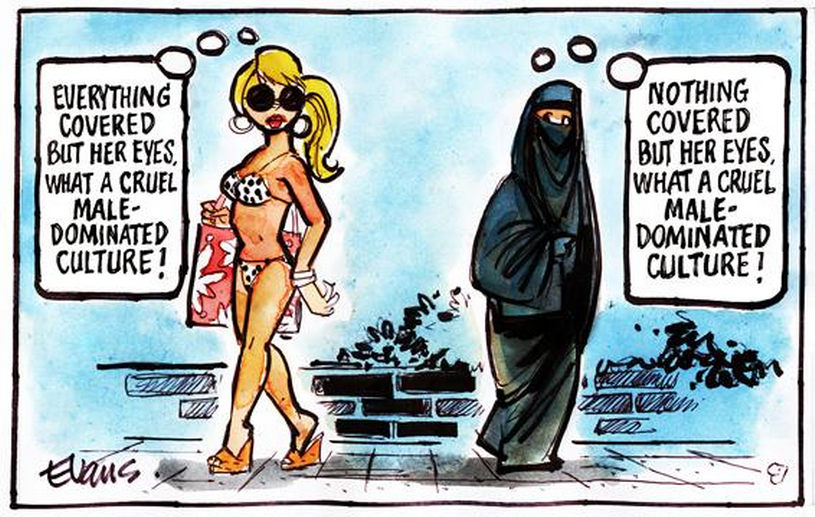
On Burqas and Being Subordinate
 By Zaineb Alkhaleef
Last Halloween I saw a white teenage boy dressed as an Arab man. His friend wore a burqa — and a rope around (his/her?) neck, which the “Arab man” held as a leash. He kept pulling “her” around and shouting orders. I was shocked and wondered what their motive could be.
It got me thinking about women and rights.
I am a devout Muslim woman who wears hijab, a scarf to cover my hair.
Why do I do this? Because I am inferior and subordinate? Because it is my job to control men’s sexuality?
No.
I grew up hearing that men are sexual predators who are incapable of looking at a woman who isn’t covered from head to toe without wanting to rape them, or “mentally rape” them.
But that’s not why I cover my hair.
In fact, while some say women must dress modestly to keep uncontrollable men from sinning, I don’t buy it.
Share this:

Turning Indian Girls Into Boys
 Indian parents are paying to have their daughters turned into sons through sex-change operations that cost about 145,000 rupees ($3,200). Up to 300 girls have been surgically turned into boys in one city.
The procedure involves fashioning a penis from the little girls’ female organs. Afterwards they are injected with male hormones, which they will need to take throughout their lives. The procedure will leave these children impotent and infertile in adulthood. No sons or daughters for them.
The Madhya Pradesh government is investigating.
Share this:

Trayvon Martin’s Right to ‘Stand His Ground’
We’re told over and over that if Zimmerman was afraid of Martin, according to Florida law, he had the right to put a bullet in the chamber of his concealed handgun, get out of his car after being told not to by the 911 dispatcher and follow and confront Martin and shoot him to death.
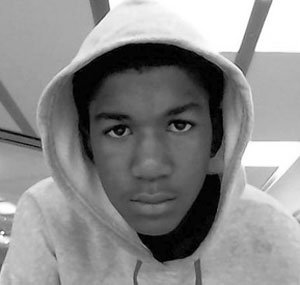
That’s from CNN opinion writer, Miller Francis. He continues:
At the same time, we are told that Martin, who had far greater reason to fear Zimmerman, practically and for reasons of American history, did not have the right to confront his stalker, stand his ground and defend himself, including by using his fists. We are told that this was entirely unjustified and by doing so, Martin justified his own execution.
Talk about victim-blaming!
The contradiction-in-rights likely arises because we tend to see through the eyes of the powerful and not through the eyes of the powerless. After all, the powerless have little control over media or the political or religious pulpits. With that in mind, I’m reposting the following as the Martin v. Zimmerman jury deliberates:
The Crimes of Hoodies, Short Skirts and Fannie Mae
“More guns, fewer hoodies” and we’d all be safer, Gail Collins advised in a New York Times piece after Trayvon Martin was gunned down for “eating skittles while black” – and while wearing said hoodie – in a gated community. A clear threat that had to be stopped.
That’s right. Guns don’t kill people, hoodies do: Trayvon Martin’s “hoodie killed him as surely as George Zimmerman did,” claimed Geraldo Rivera (who later apologized).
Sounds familiar. When women are raped short skirts become the culprit.
Yet few rape victims are wearing short skirts. And even nicely dressed black men can create fear. Journalist Brent Staples noticed that people got out of his way when he nonchalantly walked about. Amazed at his ability to alter public space, he tried humming Mozart to project his innocence. Seemed to help.
But why aren’t pricey cars, fancy suits and expensive watches blamed when rich, white men get robbed? What thief could resist?
Why? Because making more powerless members of society the culprit is meant to distract from the sins of the powerful. It’s women’s fault if men rape them, and it’s black men’s fault if lighter men kill them.
In another example, some blamed liberals for foolishly using Fannie Mae and Freddie Mac to help Blacks and Hispanics “buy homes they couldn’t afford,” leading to the banking crises that nearly drove the U.S. economy off a cliff.
What really happened is that rich bankers gave rich campaign contributions to government officials, who in gratitude disposed of pesky regulations. That helped bankers get mega-rich by devising complex financial packages that no one could comprehend.
Used to be that when someone bought a home bankers made sure they’d get paid back. But under deregulation it didn’t matter because the loan was sold to someone else. And that investor sold the loan again. And financial packages were created and sold, composed of fractions of many people’s mortgage loans. They were rated AAA since they were 1) diversified – and hence “safe” investments and 2) the housing market never goes down. (Yeah, right!)
Fannie and Freddie entered the process late, thinking they’d better join in or lose out.
When the housing market dropped and people couldn’t afford their homes, or sell them for a profit, the banks began collapsing. Lucky for them, the taxpayers bailed them out (or the whole economy likely would have collapsed).
Did deregulation get blamed for the fiasco? By some. But plenty of the “powers that be” — and especially “hate radio” — blamed Blacks and Latinos.
Because blaming more powerless members of society distracts from the sins of the powerful.
The crime does not lie with the man who pulls the trigger, nor with the man who rapes, and certainly not with the fat cat who pays to rig the game. No, the crime lies with those who wear hoodies, short skirts and who bank while black or brown.
Popular Posts on BroadBlogs
Cheerleader Ordered To Cheer Her Rapist, and Other Stories
Markets Must Be Free; Women Must Be Constrained
8-Year-Old Called “Whore” for Long Sleeves, Skirts
Share this:

Racism: Genetic or Learned?
 Evolutionary psychology says racism is in our genes — a genetic adaptation that helps groups survive by favoring themselves over others. Skin color cues us in to who’s “in” and who’s “out.” (Yet the most prosperous areas of the world are those that cooperate and trade with each other?)
When I explain the theory, my students are appalled. (Though they readily accept evolutionary psych when it comes to explaining supposed sex differences.)
I once wrote a comment questioning evolutionary psychology on Slate and got the following response:
And what about all of those studies on doctors that found they treat patients differently because of race? What about those studies that show that we show preference to people wearing the same color of shirts as us?
Then shouldn’t children prefer parents who have their same hair/eye color? Not in my case. My mom has brown eyes and very light skin like me and my dad has green eyes and darker skin. Yet as a child I preferred him because mom was the disciplinarian.
And doctors could treat patients differently because they learn prejudice and not because they are genetically programmed to discriminate.
You also have to wonder why so many brown-haired, brown-eyed people have a preference for blonde, blue-eyed looks if our genes cause us to prefer our own type. But then, we’re all bombarded with messages that teach us that blue eyes and blond hair are best, at least on women.
Relatedly, about half of the Black people who take Harvard’s test of unconscious prejudice show a preference for Whites. If evolutionary psychology is right, shouldn’t they have a preference for Blacks? But again, Black Americans (just like the rest of us) are barraged with unfortunate messages that White is prettier, smarter, and less criminal.
Meanwhile, some people show “no preference” for either race when they take Harvard’s “implicit” test of unconscious bias.
Or consider the most recent presidential elections. The younger a person was, the more likely she or he cast a ballot for Barack Obama. Was there a mass genetic mutation that caused younger voters to be less racist? Or has society changed enough through the years that young people have simply learned less racism?
Evolutionary psychology says racism is in our genes. Looks more like it’s learned.
You inherited you grandmother’s eyes. Did you inherit her racism, as well?
February is Black History Month
Related Posts on BroadBlogs
Are Women Naturally Monogamous?
Black Isn’t Beautiful Claims Evolutionary Psychologist
Women Want Casual Sex? Yes and No
Share this:

The Crimes of Hoodies, Short Skirts and Fannie Mae
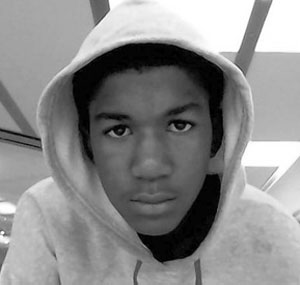
“More guns, fewer hoodies” and we’d all be safer, Gail Collins advised in a New York Times piece after Trayvon Martin was gunned down for “eating skittles while black” – and while wearing said hoodie – in a gated community. A clear threat that had to be stopped.
That’s right. Guns don’t kill people, hoodies do: Trayvon Martin’s “hoodie killed him as surely as George Zimmerman did,” claimed Geraldo Rivera (who later apologized).
Sounds familiar. When women are raped short skirts become the culprit.
Yet few rape victims are wearing short skirts. And even nicely dressed black men can create fear. Journalist Brent Staples noticed that people got out of his way when he nonchalantly walked about. Amazed at his ability to alter public space, he tried humming Mozart to project his innocence. Seemed to help.
But why aren’t pricey cars, fancy suits and expensive watches blamed when rich, white men get robbed? What thief could resist?
Why? Because making more powerless members of society the culprit is meant to distract from the sins of the powerful. It’s women’s fault if men rape them, and it’s black men’s fault if lighter men kill them.
In another example, some blamed liberals for foolishly using Fannie Mae and Freddie Mac to help Blacks and Hispanics “buy homes they couldn’t afford,” leading to the banking crises that nearly drove the U.S. economy off a cliff.
What really happened is that rich bankers gave rich campaign contributions to government officials, who in gratitude disposed of pesky regulations. That helped bankers get mega-rich by devising complex financial packages that no one could comprehend.
Used to be that when someone bought a home bankers made sure they’d get paid back. But under deregulation it didn’t matter because the loan was sold to someone else. And that investor sold the loan again. And financial packages were created and sold, composed of fractions of many people’s mortgage loans. They were rated AAA since they were 1) diversified – and hence, “safe” investments and 2) the housing market never goes down. (Yeah, right!)
Fannie and Freddie entered the process late, thinking they’d better join in or lose out.
When the housing market dropped and people couldn’t afford their homes, or sell them for a profit, the banks began collapsing. Lucky for them, the taxpayers bailed them out (or the whole economy likely would have collapsed).
Did deregulation get blamed for the fiasco? By some. But plenty of the “powers that be” — and especially “hate radio” — blamed Blacks and Latinos.
Because blaming more powerless members of society distracts from the sins of the powerful.
The crime does not lie with the man who pulls the trigger, nor with the man who rapes, and certainly not with the fat cat who pays to rig the game. No, the crime lies with those who wear hoodies, short skirts and who bank while black or brown.
Popular Posts on BroadBlogs
Cheerleader Ordered To Cheer Her Rapist, and Other Stories
Markets Must Be Free; Women Must Be Constrained
8-Year-Old Called “Whore” for Long Sleeves, Skirts
Share this:

Prejudiced People Are Stupid
Prejudiced people are stupid. That’s not me pre-judging. That’s science.
An article published in the Journal of Psychological Science, and reported in Live Science says children who have low IQs tend to become prejudiced adults who are drawn to socially conservative beliefs that – in turn – encourage prejudice, adherence to hierarchy and authority, and promote resistance to change.
The researchers suggest that low intelligence makes it difficult to grasp the complexity of the world, which could explain the appeal of oversimplifications like, “Poor people are lazy.”
But you also have to wonder if the appeal of prejudice comes partly from a desire to feel like you are better (and smarter?) than someone.
John Dean wrote a book (which he had begun writing with Barry Goldwater just before Goldwater died) called Conservatives Without Conscience. These two conservatives presented a list of characteristics that are common among right-wing authoritarian “followers” (as opposed to “leaders”). The traits seem to fall into two categories: those that would appeal to the less intelligent and those that are just mean. Right-wing authoritarian “leader” traits fell almost entirely into the “mean” category.
Examples of beliefs and behaviors that fit well with not thinking too hard include: conventional, submissive to authority, highly religious (follow God’s authority), prejudiced, narrow-minded, inconsistent and contradictory (“Get your government hands off my Medicare!”) and having little self-awareness.
The “mean” list includes these traits: prejudiced, aggressive on behalf of authority, dogmatic, mean-spirited, intolerant, bullying, and highly self-righteous. All suggest a desire to feel bigger and stronger than someone else — as in overcompensating for insecurities?
Ahhh, that was fun for a liberal like me who gets so annoyed by both right-wingers and prejudiced people.
But there is a crimp in the analysis. First, the researchers recognize, not all liberals are brilliant, nor are all conservatives dense. We’re talking averages here. Certainly there are smart conservatives, including John Dean and Barry Goldwater. Also, the less intelligent are drawn to social and not fiscal conservatism.
And of course, extremists on the left and the right may both be simplistic. As the authors admit:
A study of left-wing liberals with stereotypically naïve views like “every kid is a genius in his or her own way,” might find that people who hold these attitudes are also less bright. In other words, it might not be a particular ideology that is linked to stupidity, but extremist, over-simplified views in general.
The main advantage of this research is finding clues to decreasing fear and hatred. For instance, many anti-prejudice programs ask people to see things from others’ perspectives, but that might be too hard for those with low IQ. And since prejudice is more emotionally than intellectually rooted, it’s probably better to change feelings instead of thoughts.
Who knows, perhaps the fear of appearing dimwitted will itself advance the cause against fear and hatred.
Popular Posts on BroadBlogs
Think You’re Not Racist?
Mind of a Rapist: Trying to Bridge a Gap between a Small Self and a Big Man
Do Kids Bully from Low Self-Esteem? Or Because they’re Popular? No and No
Share this:

How Does Racism Hurt Racists? The Case of Emmett Till
How does racism hurt racists? In many ways, actually. Here’s one:
The case of Emmett Till.
In 1955 this 14-year-old African-American left Chicago to visit his cousin in Mississippi.
One day his cousin dared him to flirt with a white woman. Accepting, he whistled at a woman who was working at a grocery counter, and called her “baby.”
Later that night the woman’s husband and his half-brother hunted Emmett down, kidnapped him, and the torture began. They cut off one of his ears, gouged out an eye, and put a bullet through his head before throwing him into a river.
The men were arrested. At the trial witnesses placed them at the site where Emmett was tortured, and the two men admitted the kidnapping.
But they faced a jury of white men in a Mississippi courtroom. After deliberating for less than an hour, they acquitted the case. One juror told a reporter, “If we hadn’t stopped to drink a pop, it wouldn’t have took that long.”
We easily see how racism hurt the young minority in this case. But how did it also hurt the white people who were involved?
When one person can torture another, with no conscience or concern, and when others dismiss the behavior, we see that racism dehumanizes its target, but it also dehumanizes the racist.
February is Black History Month
Popular Posts on BroadBlogs
Think You’re Not Racist?
Learning to See Ourselves as Inferior
Black Isn’t Beautiful Claims Evolutionary Psychologist
Share this:

“Why I Left the KKK”: One Man’s Revelation
In The Republic, Socrates asked whether we should be good and just, and why.
A listener suggested that if we are trusted we’ll do better in our business and personal relationships.
But what if no one knows you are a good person?
“The gods will know, and reward us,” observed another.
But what if the gods don’t know that you’re good? Socrates pressed.
Later, I read Emerson on the same topic. His Minister had lectured that while the wicked are often successful, and while the righteous can be miserable, at least compensation would be made in the next life.
Emerson felt that the fallacy lay in conceding that the base estimate of the market constitutes success, and assuming that justice is not done now.
What really makes us happy? Doing ill to others? Stepping on others so we can get ahead?
What Emerson and Socrates were getting at was made more real to me when I heard a man talk about why he had left the KKK.
He and his wife had become so filled with hatred in that organization that misery had overtaken their lives. They left because acting hatefully, hurting others, had ended up mostly hurting themselves.
As it turns out, when we work to harm others we harm ourselves.
Share this:

Saudi Women Can Vote. West, Middle East Can Learn From Each Other
Saudi women got the right to vote and run in municipal elections this week. It’s a big step forward.
There are limitations. It’s hard to run for office when you can’t drive or show your face. Some fear political stalling. And men could keep their wives and daughters from voting. But the women are optimistic. Let’s hope for the best.
Interestingly, only about five years ago George W. Bush sent Karen Hughes to Saudi Arabia to express her hope that one day Saudi women would be able to vote and drive. She was surprised when many said they didn’t want to do either.
Past relations between Western and Middle Eastern feminists have sometimes been strained with Western feminists lecturing Middle Eastern women, and Middle Eastern women rejecting what they see as Western arrogance.
Yet the road to women’s rights presents plenty of opportunity for all of us to learn from one another.
There is plenty that Westerners could have, and may have, learned from our Arabian sisters and brothers in the early years of Islam. When we were in the Dark Ages.
Back in the 7th century the Koran gave women the right to work, own property and inherit, and provided protections from domestic violence. Women were also granted the right to give their consent to marry.
But lately Arab women have been taking some cues from us. Both the Arab Spring and Saudi women’s suffrage were inspired by Western democracies.
And perhaps now it is time for us to learn from them, again. The Arab Spring has inspired many Americans who wonder at our current state of democracy which is marked by legalized bribery (large campaign contributions) that make important matters like environmental sustainability and economic renewal political impossibilities.
Too often Western women think they have nothing to learn from their Middle Eastern sisters, while Middle Eastern women reject Western notions out of hand.
Perhaps we would do better to have dialogue and learn from each other.
Popular Posts on BroadBlogs
Early Islam’s Feminist Air
It’s Ok To Be A Tomboy But Not A Sissy. Why?
Baby Named “Storm.” Sex Unknown
Share this:

Ways of Seeing: Ravaged or Ravishing?
By Robert Rees
We are bombarded with thousands if not tens of thousands of images every day. Occasionally, two images come into such sharp contrast that they can’t be ignored. Such was the case when I opened the New York Times on Sunday, May 2. On page ten of that issue is a color photo of a 23 year old Congolese woman. The caption says her lips and right ear have been cut off by rebels of the Lord’s Resistance Army. Her shorn head, the blackness of her face, the swollen pink oval around her mouth where her lips had once been (like the exaggerated lips of “Sambo” or minstrel characters once popular in American culture), and the sideway glance of her eyes as someone (perhaps her mother) touches her remaining ear with what seems tenderness. It is an image so heartbreaking as to make one weep.

In Ways of Seeing John Berger says, “The meaning of an image is changed according to what one sees immediately beside it or what comes immediately after it. Such authority as it retains is distributed over the whole context in which it appears.” Thus . . .
 Immediately across the page from this photo is a full page Lord & Taylor ad of a beautiful white woman with long flowing dark hair, green eyes, perfect lips and two ears from which dangle long bejeweled earrings. She is arrayed in such opulence—necklace, pendant, bracelets, a giant opaline or turquoise ring, that the contrast with the Congolese woman is shocking. The juxtaposition of the two images is heightened by the fact that the Congolese woman wears a simple hand-crafted red and black blouse whereas the model wears what looks like an expensive hand-knitted ivory-colored chemise over a pink lace skirt. She holds in each hand a knitted handbag (“only $89”), each covered with roses and each holding a small dog, so laden that she seems barely able to hold them up. This cornucopia of luxury, this picture of desire would never be found in the Congo, Joseph Conrad’s Heart of Darkness. The ad’s caption—“We all have our creature comforts. . . Some of us more than others”—is so ironic as to be almost beyond irony. The motto compounds the irony: “Shop more. Guilt less.”
Again, John Berger, “A woman’s presence expresses her own attitude to herself, and defines what can and cannot be done to her. Her presence is manifest in her gestures, voice, opinions, clothes, chosen surroundings, taste—indeed there is nothing she can do which does not contribute to her presence. . . . To be born a woman has been to be born, within an allotted and confined space, into the keeping of men.”
The Congolese woman, like the Greek Princess Philomela whose husband Terus cut out her tongue so she could not reveal that he had raped her, has likewise likely been raped and brutally silenced. The severing of her left ear compounds the violation. She will be so disfigured that probably no man will ever touch her again and no compassionate god will turn her into a nightingale.
The woman in the Lord and Taylor ad will be ravaged by the eyes of a million men who will yet never touch her skin except in their imaginations. And yet in her wildest imagination this white goddess could never see herself in the place of the black tongueless Congolese woman, nor the Congolese woman ever imagine herself in such a space as the woman in the ad inhabits.
Both of these images are part of the world we live in, although we tend to keep them in separate compartments of our consciousness. The one is horribly real, the other an unreal arrangement by Madison Avenue designers. On another day when they are not juxtaposed, we might consider each separately, but when they are thrust before us in such stark relief, we can turn from neither–only ponder what they tell us about how some of us have more creature comforts than others and how we can remain “guilt less”—and that we are somehow complicit in both.
Robert A. Rees teaches at Graduate Theological Union in Berkeley.
This piece was first posted Sept. 17, 2010
Popular Posts on BroadBlogs
Rape Epidemic in South Africa. Why?
You Are “Less Than”?
Women Want Emotionally Connected Sex. Why?

 BroadBlogs