Blog Archives
The Burqa and Individual Rights: It’s Complicated
“Burqa bans” are arising throughout Europe, with France voting their approval this past Tuesday. But many are concerned that the prohibitions limit the individual rights of Muslims.
It’s complicated.
First, the garment itself limits individual rights – women’s. Second, to what extent is the burqa wearer exercising actual choice? Finally, is a ban the best way to go?
Let’s start with the question of women’s choice.
When a society’s way of seeing becomes our own – even when it harms us – the belief is “internalized.” My interest in this phenomenon was sparked by my upbringing. In the early years of the feminist movement women from my church were bused to various conventions to vote down things like equal pay for equal work. I spent afternoons listening to women in my church talk about keeping battered women’s shelters from opening. They were against women receiving priesthood authority, and they were for male leadership in the home.
I didn’t understand why they worked so hard to disempower themselves, their daughters, and other women. But people don’t tend to question the taken-for-granted notions of their culture. It’s simply what you do. So choice disappears.
The same phenomenon arises in other settings. Saudi women say they don’t want to vote or drive. Many 19th Century American women didn’t want the vote, either. In North Africa women defend the genital mutilations that kill and cripple them.
Burqas limit women’s autonomy and power. Yet some women voluntarily don them, keeping with their culture.
Burqas – or niqabs (face coverings) – prevent wearers from gaining driver’s licenses when they are strictly worn, since identity can’t be confirmed via picture ID. When a city or village lacks public transportation it is hard to get around without a car. That makes it tough to get a job.
Even with transportation it’s not easy finding work in a facemask. The mask seems dehumanizing and eerie, as does the subjugation it represents.
But ethnocentrism is thought weightier than sexism. “Isms” that affect men seem more important than those that affect women – even when women are harmed, as when a female German judge denied a Muslim woman’s appeal for divorce, claiming that being beaten was part of her culture.
Did women have equal power to create the cultures that harm them?
Some women do resist, but feel pressured, as one of my Muslim students told me when we discussed the matter of covering.
But bans may not be the best way to deal with burqas or niqabs. Bans can backfire since people cling more tightly to their groups when they feel persecuted. As restrictions go into effect more women might actually embrace the burqas that limit them.
A better way may lie in creating conversation so that different cultures can consider a variety of perspectives. I am sure that Westerners and Muslims can learn from each other and our different ways of seeing.
Georgia Platts
Also see: Early Islam’s Feminist Air Did Women Create Burqa Culture? Cultural Relativism: Must We Be Nazis to Criticize Them? Why Are We More Offended By Racism Than Sexism?
Share this:

Did Women Create Burqa Culture?
The upcoming French vote on the burqa ban has got me thinking. We hear talk of how women should keep their culture. But did women have equal power to create the burqa? And who benefits from this garment?
Meanwhile, some charge that rejecting the burqa comes from fear of the other, or ethnocentrism. I’m in sync with cultural relativism, so long as no one is being hurt. But buqas and “burqa cultures” don’t give women equal power. And women certainly did not have equal sway in creating the customs of these societies.
Think about the laws that exist in places where women are required to cover up in garments like burqas or niqabs (facemasks).
Is it likely that women decided that men could easily demand a divorce, but women could get one only with difficulty?
Is it likely that women created the notion that sharing a husband with other women might be nice?
Did women create the idea that an adulterous man be punished by burial up to his waist before being stoned, while a woman must be buried to her breasts – and the one who escapes, escapes the stoning?
In these cultures, when a woman is raped it is her fault. She obviously let some hair fall from her covering, or she allowed an ankle to show. Everyone knows that no man could resist such things. Did women decide that women, and not men, are responsible for men’s sexuality?
Did women originate the notion that after rape, the victim must be killed to restore the family honor?
Did women clamor for a burqa that limits their power and autonomy – keeping them from driving and getting jobs that are far from home? Did women design this garment that prevents small pleasures like seeing clearly or feeling the sun and the wind?
And who benefits?
Men benefit from easily obtaining a divorce, but not allowing their wives the same privilege. Men benefit from the sexual variety of having many wives, while women are left to share one man. Men benefit by more easily escaping a stoning. And men can rape with impunity since women fear reporting sexual assault, lest their families kill them. Men gain power when women are incapable of getting jobs and income. How much easier is it to beat women for the infraction of straying outside the home, or letting a wrist show, when they are black and blue blobs, and not human beings?
It is common to make accusations of ethnocentrism when one culture rejects the practices of another. Often the fears are valid.
But if a powerful group creates a culture that benefits themselves to the detriment of others, the critique is not about ethnocentrism. It is about human rights.
Georgia Platts
Also see: Early Islam’s Feminist Air
Don’t Reject Your Culture, Even When It Mutilates You
The Burqa and Individual Rights: It’s Complicated
Cultural Relativism: Must We Be Nazis to Criticize Them?
Why Are We More Offended By Racism Than Sexism?
Share this:

Ways of Seeing: Ravaged or Ravishing?
We are bombarded with thousands if not tens of thousands of images every day. Occasionally, two images come into such sharp contrast that they can’t be ignored. Such was the case when I opened the New York Times on Sunday, May 2. On page ten of that issue is a color photo of a 23 year old Congolese woman. The caption says her lips and right ear have been cut off by rebels of the Lord’s Resistance Army. Her shorn head, the blackness of her face, the swollen pink oval around her mouth where her lips had once been (like the exaggerated lips of “Sambo” or minstrel characters once popular in American culture), and the sideway glance of her eyes as someone (perhaps her mother) touches her remaining ear with what seems tenderness. It is an image so heartbreaking as to make one weep.

In Ways of Seeing John Berger says, “The meaning of an image is changed according to what one sees immediately beside it or what comes immediately after it. Such authority as it retains is distributed over the whole context in which it appears.” Thus . . .
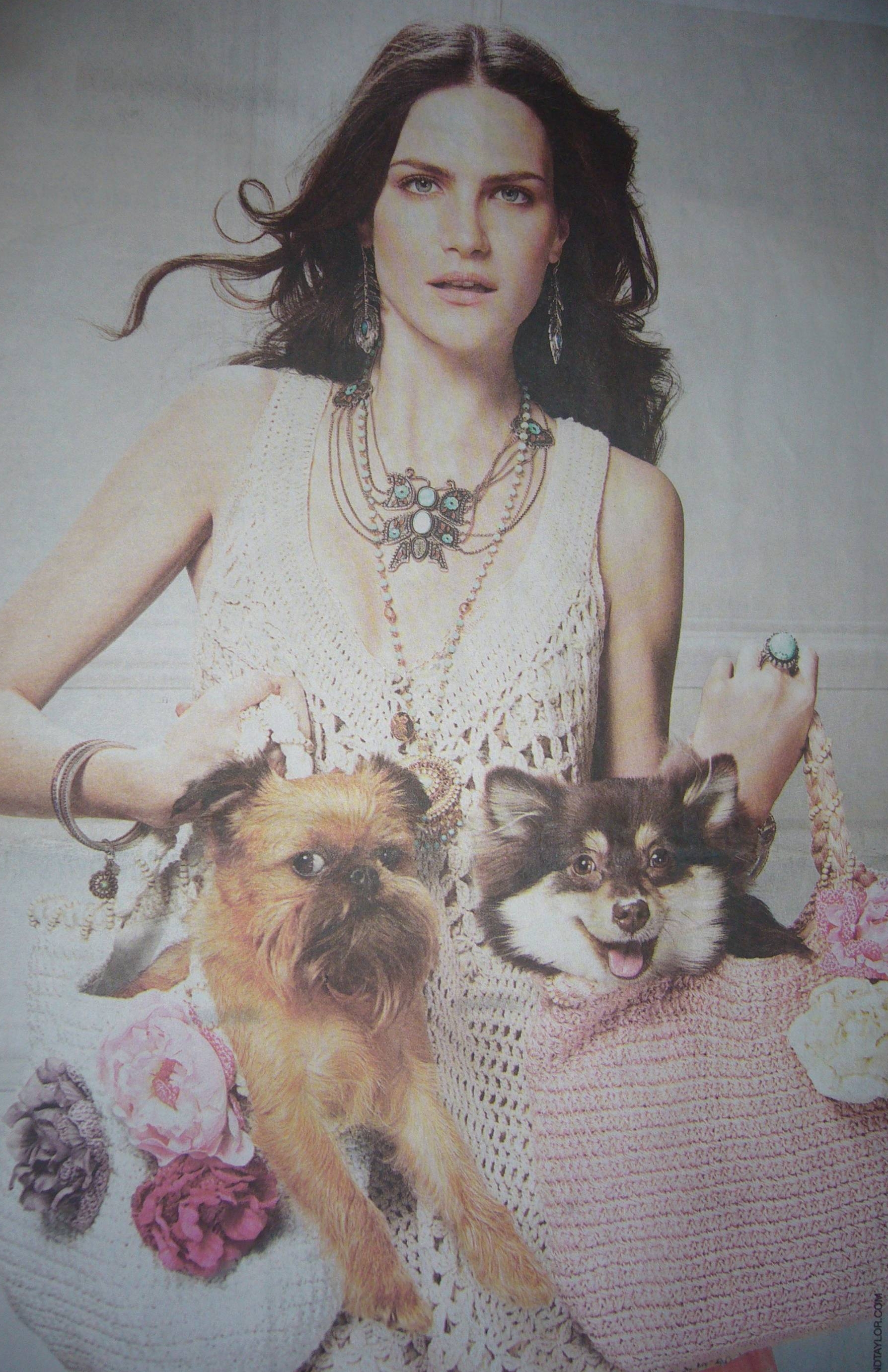
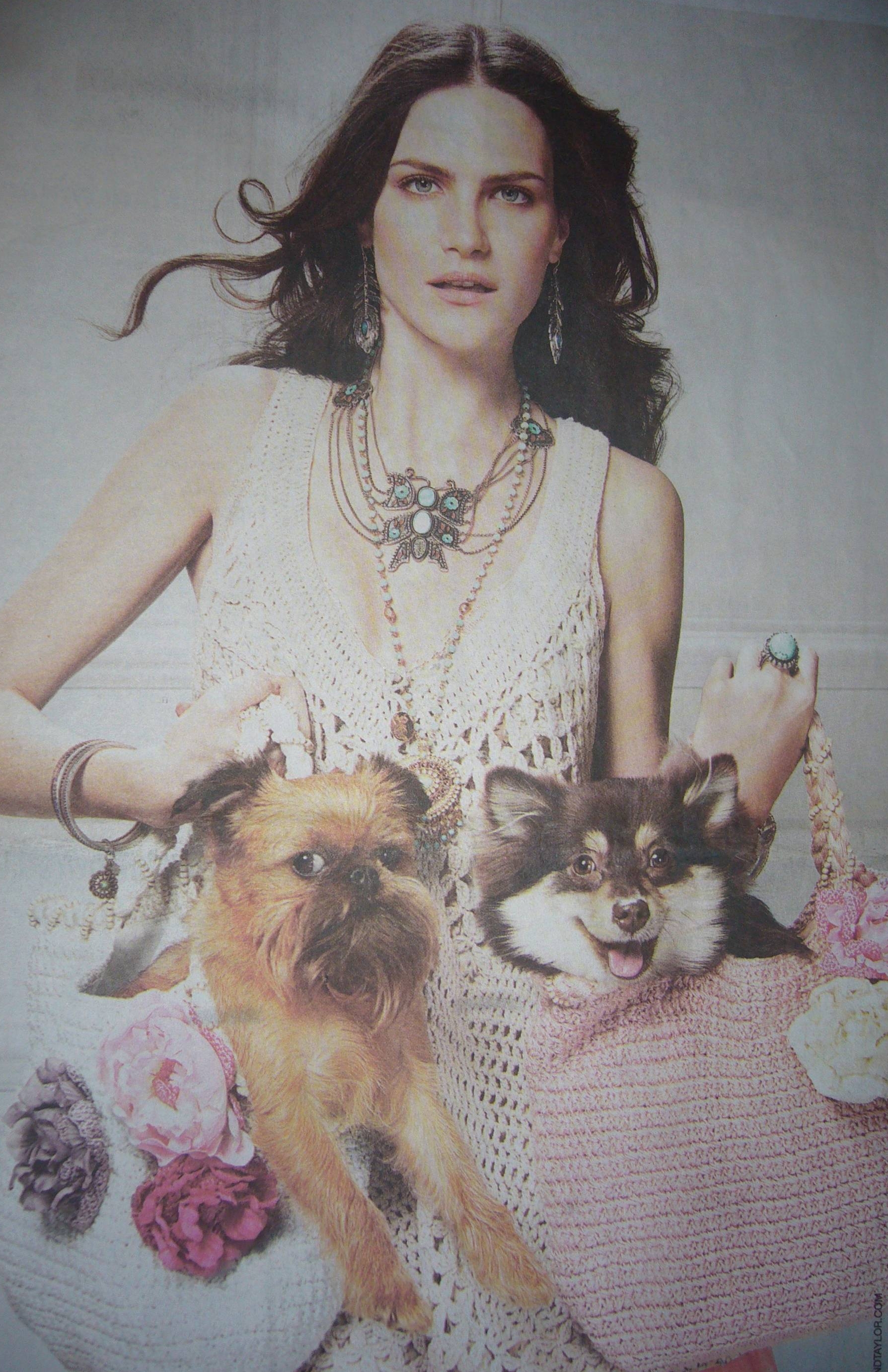
Immediately across the page from this photo is a full page Lord & Taylor ad of a beautiful white woman with long flowing dark hair, green eyes, perfect lips and two ears from which dangle long bejeweled earrings. She is arrayed in such opulence—necklace, pendant, bracelets, a giant opaline or turquoise ring, that the contrast with the Congolese woman is shocking. The juxtaposition of the two images is heightened by the fact that the Congolese woman wears a simple hand-crafted red and black blouse whereas the model wears what looks like an expensive hand-knitted ivory-colored chemise over a pink lace skirt. She holds in each hand a knitted handbag (“only $89”), each covered with roses and each holding a small dog, so laden that she seems barely able to hold them up. This cornucopia of luxury, this picture of desire would never be found in the Congo, Joseph Conrad’s Heart of Darkness. The ad’s caption—“We all have our creature comforts. . . Some of us more than others”—is so ironic as to be almost beyond irony. The motto compounds the irony: “Shop more. Guilt less.”

Again, John Berger, “A woman’s presence expresses her own attitude to herself, and defines what can and cannot be done to her. Her presence is manifest in her gestures, voice, opinions, clothes, chosen surroundings, taste—indeed there is nothing she can do which does not contribute to her presence. . . . To be born a woman has been to be born, within an allotted and confined space, into the keeping of men.”
The Congolese woman, like the Greek Princess Philomela whose husband Terus cut out her tongue so she could not reveal that he had raped her, has likewise likely been raped and brutally silenced. The severing of her left ear compounds the violation. She will be so disfigured that probably no man will ever touch her again and no compassionate god will turn her into a nightingale.
The woman in the Lord and Taylor ad will be ravaged by the eyes of a million men who will yet never touch her skin except in their imaginations. And yet in her wildest imagination this white goddess could never see herself in the place of the black tongueless Congolese woman, nor the Congolese woman ever imagine herself in such a space as the woman in the ad inhabits.
Both of these images are part of the world we live in, although we tend to keep them in separate compartments of our consciousness. The one is horribly real, the other an unreal arrangement by Madison Avenue designers. On another day when they are not juxtaposed, we might consider each separately, but when they are thrust before us in such stark relief, we can turn from neither–only ponder what they tell us about how some of us have more creature comforts than others and how we can remain “guilt less”—and that we are somehow complicit in both.
Robert A. Rees teaches at Graduate Theological Union in Berkeley.
Share this:

Early Islam’s Feminist Air
The founders of three great religions, Buddha, Jesus, and Mohammed (in order of appearance) were remarkably feminist in their leanings. In the month of Ramadan I would like to explore the feminist air of early Islam.
For centuries Muslim women enjoyed greater rights than most women in the world. The Koran gives women the right to work and to own property. Mohammed abolished female infanticide, slavery, and a widow’s obligation to marry her husband’s brother. Indeed, women were given the right to give their consent to marry.
Some things that look sexist today were a great step forward at the time. Women could become heir to one third of what a male inherited. (Since men’s role was to support women they were given extra help.) Muslim women were able to inherit much sooner than their Western sisters.
Islamic men are also allowed to marry up to four wives, and each wife must be treated equally. Doesn’t sound too heavenly to our ears, but this was progress from a time when men could marry as many women as they wanted.
Even the most problematic scripture in the Koran was an improvement. Chapter 4 verse 34 reads, “As for those women whose rebellion you justly fear, admonish them first; then leave their beds; then beat them.” This scripture actually gave women some protection against abuse in that men were cautioned against battering as the first response.
Some Islamic feminists note that there are other definitions for the word “daraba,” than “to beat,” one of which is “to go away.” Something to think about.
With early feminist beginnings it is not surprising that one of the largest, most egalitarian and peaceful societies is West Sumatra, Indonesia.
Yet over time the religion has become increasingly patriarchal in most corners of the world.
In what is claimed “countering Westernization,” Islamic states have kept busy restricting women’s rights, sometimes going against the Koran, as when the Taliban took away women’s right to work, or when the right to consent to marriage is ignored.
As one Islamic feminist put it, “Islam needs to go back to its progressive 7th century roots if it is to move forward into the 21st century.”
Sources:
Asra Q. Nomani. “A Gender Jihad for Islam’s Future.” The Washington Post. November 6, 2005
Neil MacFarquhar. “Translation of Koran Verse Spurs Debate.” San Jose Mercury News. March 25, 2007. (Originally published in the New York Times.)
Share this:

Don’t Reject Your Culture, Even If It Mutilates You

Aisha on Time’s Cover
This week’s cover of Time shows an 18 year old Afghani named Aisha gazing from behind her mutilated nose. Punishment for running away from home. She left because she feared she would die from her in-laws’ abuse.
Eventually discovered, a Taliban-run court issued what was in effect a death sentence. For simply running away? From abuse and possible death?
Declaring she must be made an example, the Taliban ordered her nose and ears cut off.
Her husband took her to a mountain clearing where her brother-in-law held her down as her spouse slashed Aisha and left her to die.
Yet she lived. After passing out from pain, she eventually awoke, choking on her own blood. Aisha summoned her strength and crawled to her grandfather’s house. Fortunately, her father managed to get her to an American medical facility.
The Taliban tell their people that women’s rights are a Western concept that breaks away from Islamic teaching. (Though the Quran says nothing of cutting away ears or noses, and leaving relatives to die.)
I’ve often thought that if Asian women had gained the vote before American women, the powers that be would warn us away from rejecting our religion or our culture.
Is it really a loss of culture or “religion” that is feared? Or do these men just worry that women will gain equal footing?
Meantime, beware: Don’t reject the culture that mutilates you body, mind and soul.
Related Posts on BroadBlogs
Must We Be Nazis to Criticize Them?
Why Do Women Fight Against Their Own Interests?
Share this:

What Might a Burqa Wearer and an Anorexic Have in Common?
What might a burqa wearer and an anorexic have in common? Usually, not much. They can be at opposite poles. A student from Iran once told me that the loose clothing (not burqas) Iranian women wear can lead to weight gain. “You just don’t have to worry about your weight,” she said, “because you’re so covered up.”
But the two can overlap in surprising ways.
Some burqa wearers and some anorexics are responding to the same thing: difficult aspects of a culture that judges women by their appearance, and that sexually objectifies them.
But they are responding in very different ways.
Some anorexics conform to the cultural notion that beauty equals thinness, and embrace the view to extreme. Others are hoping to rid themselves of the curves that make them into sex objects, often because sexual abuse began when the curves appeared.
The burqa wearer may also have a strong reaction to beauty judgments and objectification, but she simply covers what could be judged or ogled. One woman who commented on a post on burqas told me, “I am a typical American woman who lives in Texas. I own a burqa. I have worn it out numerous times, mostly as a way to see how it feels to be out and about and not be seen as a face or body. Because I live in a culture that values youth and beauty and where people don’t hesitate to judge you by your appearance I have often wished that there was a neutralizing agent, like a burqa, that could help dissipate those judgments.”
At the same time, the burqa wearer and the anorexic are both disappearing. The burqa lets the wearer escape into a mesh of unshaped fabric.
And consider these words from a recovered anorexic:*
When I graduated from college crowned with academic honors, professors praised my potential. I wanted only to vanish.
It took me three months of hospitalization and two years of outpatient psychotherapy for me… (to accept) my right and my obligation to take up room with my figure, voice, and spirit.
A few days ago I watched the movie Penelope. Penelope, played by Christina Ricci, is cursed with a snout instead of a nose. Her parents hide her at home. She finally escapes but uses a scarf to cover her snout. The spell is broken when she finally comes to love herself as she is.
We live in an imperfect world. People objectify and make judgments.
But how would we learn and grow and gain inner strength, character and compassion if there were no need to strive to improve the world or to grow in self-acceptance?
Georgia Platts
*Abra Fortune Chernik. “The Body Politic.” Listen Up: Voices from the Next Feminist Generation, edited by Barbara Findland. 1995
Share this:

I Want to Wear a Burqa
Here is a thought provoking comment from a reader in response to my post: The Burqa: Limiting Women’s Power and Autonomy
I am a typical American woman. I was born and raised LDS in the Intermountain West and now live in Texas. I own a burqa. I have worn it out numerous times, mostly as a way to see how it feels to be out and about and not be seen as a face or body. I felt so self conscious that I dont think I was able to fully appreciate the experience. Because I live in a culture that values youth and beauty and where people don’t hesitate to judge you by your appearance I have often wished that there was a neutralizing agent, like a burqa, that could help dissipate those judgments. Kind of like what a school uniform is to clothing in a school, of course the burqa being an extreme form of that.
Comments, anyone?
Share this:

The Burqa: Limiting Women’s Power and Autonomy
As European countries step up to ban the burqa, many protesters don’t understand that the burqa is neither a religious requirement nor a simple cultural costume. The burqa is about limiting women’s autonomy and power.
The Koran only asks women to be modest and to veil their breasts (24:30 31).
If the burqa is not a religious requirement, how did it arise? Let’s take a look at how covering affects women in the countries in which it is law, which points to its intent.
In Saudi Arabia women cannot drive because they cannot get a driver’s license (no face picture for identity purposes).
Meanwhile, Sheikh Abdul Mohsin al-Abaican recently declared that women should give breast milk to their male drivers so that they can symbolically become their sons. Not sure that this means breastfeeding, which would neither enhance modesty nor separate the sexes. But it would keep non-lactating women from driving. (Or could they feed their drivers formula?) Women who cannot afford drivers are pretty much doomed to stay close to home.
Reflecting their lack of power, Saudi women make up only 5% of the workforce. Maybe it’s hard to get to work when you can’t drive? This low number reflects a social norm that women’s place is in the home, leaving the larger society largely safe from their influence.
In Afghanistan, women political candidates cannot speak or give speeches face-to-face in mixed company. If there is enough money for campaign posters, a burqa amidst men’s faces would certainly stand out, I suppose. But it would look very odd. Meanwhile, the bulk of Taliban-style culture is designed to limit women’s power, whether keeping them from venturing outside the house or keeping them from education and work.
The Burqa is not a fashion statement. It is not a religious requirement. It is not really about morality. Why should free societies support the lack of freedom and power that the burqa was intended to create?
Georgia Platts
Also see: Early Islam’s Feminist Air Did Women Create Burqa Culture? The Burqa and Individual Rights: It’s Complicated

 BroadBlogs