Category Archives: body image
David Beckham’s Sex Sells
 This Super Bowl Sunday the tables turned — at least a little — as “sex sells” warped into the alluring form of David Beckham, who flaunted his buffed bod to promote his H&M bodywear.
As Mary Elizabeth Williams over at Salon described it:
He flexes his numerous tattooed muscles to the tune of “Please Don’t Let Me Be Misunderstood,” glowers in an “I mean business here” way that’s remarkably persuasive, and uh, I forget what I was talking about.
See the ad here.
Does Beckham bring balance to the scales of objectification? From Ryan Reynolds to Ryan Gosling to Taylor Lautner men’s bodies are increasingly drooled over.
While we are seeing more sexy guys, the fact that it’s newsworthy says it’s a bit unusual.
 But last November DETAILS’ tackled men’s rising fixation with their bodies. Their slide show traced the phenomenon from 1986 home gym informercials through Mark Wahlberg’s giant Times Square boxer briefs ad (that snarled traffic in ‘92) to the emergence of light beer and the “the slim silhouette.” By 2002 Us, In Touch, Star and OK! eagerly exposed men’s six-packs. In 2008 Beckham’s Armani briefs overtook giant billboards on Main Street. And Emma Stone could be heard shrieking, “Seriously?! It’s like you’re Photoshopped!” as she gaped at Ryan Gosling’s rippled abs in Crazy, Stupid, Love.
So is this a turn for the good?
I don’t think it’s a problem to see some sexy men and women in ads. The problem comes when this is the main way people (okay, women, in reality) are portrayed.
And when ALL we see is sexy women, even women start to see females as “the sexy ones.” What are we supposed to look at? It’s hot to see some sizzle emerge in a male form.
And so long as men continue to be portrayed in plenty of other ways Beckham, et al., will hardly transform men-at-large into sex objects.
On the other hand, men are becoming more body-conscious and young men are increasingly falling victim to anorexia and exercise addiction, while cosmetic surgery has increased 88% among men between 1997 and 2011.
Some had hoped that if men were objectified they wouldn’t like it and would stop objectifying us. Instead, men and women now both obediently follow body “perfecting” dictates.
But then, it’s not men so much as marketers, male and female, who know that 1) pretty bodies draw attention, even when they have nothing to do with the thing being sold and 2) inciting insecurity moves a lot of product as we spend endless sums hoping to embody a phantom perfection.
Popular Posts on BroadBlogs
Man as Object: Reversing the Gaze
Men, Women React to Male/Female Nudity
How to Look Like a Victoria’s Secret Angel
Share this:

Anorexia: Physically and Spiritually Dying
 I wouldn’t sit with daddy when he was alone in the hospital because I needed to go jogging; I told Derek not to visit me because I couldn’t throw up when he was there; I almost failed my comprehensive exams because I was so hungry; I spent my year at Oxford with my head in the toilet bowl; I wouldn’t eat the dinner my friends cooked me for my 19th birthday because I knew they had used oil in the recipe; I told my family not to come to my college graduation because I didn’t want to miss a day at the gym or have to eat a restaurant meal.
I would swear I did not miss the world outside. Lost within myself, I almost died.
During her recovery from anorexia, Abra Fortune Chernik filled three and a half Mead marble notebooks – five years’ worth of reflection on how her eating disorder had tangled her life and thwarted her relationships. You can read more on her struggle in “The Body Politic.”
I had always known that anorexia diminished women physically, and too often led to their deaths. But I hadn’t stopped to realize that the disease shrank them socially, emotionally, and mentally, too – leaving their world revolving solely around their bodies and their food – or the lack thereof.
I hadn’t realized that anorexia meant both a physical and spiritual ridding of the self. And yet it surely does.
Abra continued:
As my body shrank, so did my world. I starved away my power and vision, my energy and inclinations. Obsessed with dieting, I allowed relationships, passions, and identity to wither.
The name of her piece, “The Body Politic,” tells us that anorexia is not just about Abra’s own struggle, but the struggle of women who live in a world that seems to applaud their constriction, and perhaps even their disappearance.
A push toward constricting women, or “disappearing them”? In an earlier piece I talked of political pressures to deny women life-saving vaccines, cancer screenings, tests for H.I.V., emergency abortions to save a woman’s life, and nutrition programs, along with decriminalizing domestic violence. Women’s control over their bodies is being increasingly constricted by attempts to limit access to contraception and the right to choose.
Applauding women who sufficiently shrink their bodies, minds and souls is perfectly consistent.
And perfectly deranged.
Popular Posts on BroadBlogs
500 Calories + Pregnancy Hormones = Perfect Body
What Abusers and “Pro-Family” Conservatives Have in Common
Doctors Let Woman Die to Protect Fetus
Share this:

You’re Hotter Than You Think

Jennifer Grey "Before"
You’re probably hotter than you think you are. Especially if you fall into one of the following categories, according to Psychology Today:
You compare yourself to models
Fashion magazines are all about unachievable ideals (and pushing products to “help” you meet them). Those who buy these glossies have worse body images than those who don’t.
But as UC-Davis psychology professor, Richard Robins, points out:
When women evaluate their physical attractiveness, they compare themselves with an idealized standard of beauty, such as a fashion model. In contrast, when both men and women evaluate their intelligence, they do not compare themselves to Einstein, but rather to a more mundane standard.
Women with better body image don’t feel inferior to a starved and airbrushed standard.
You must be perfect all the time
Along these lines, some feel they must be perfect all the time. These folks are intensely concerned with how they appear to others. As Carlin Flora, over at Psychology Today put it, “We all know someone like this—a friend who never runs out of the house to grab coffee without fixing herself up first.”
While most people find these women very attractive, they don’t. Their point of comparison is the very best-looking people. And their inability to live up to perfection brings them down.
You think everyone’s judging your flaws
Some people think their flaws are always in the spotlight.
Psychologists, Ann Demarais and Valerie White had a client who thought everyone was focused on his crooked teeth. They helped him see that other people were actually more worried about their own supposed faults than his, and suggested he try smiling broadly when he met new people. He took their advice and was surprised that no one drew back in horror. In fact, they were actually friendly! It was very freeing.
Your parents put you down
If your parents said you were ugly, that can be difficult to overcome. Exhibit A is Michael Jackson who spent years going to plastic surgeons as a result of his father pointing out his supposed flaws. Fortunately, this is pretty uncommon. A more likely scenario occurs when parents fail to light up when they see us and appreciate our individual wonderfulness.
It doesn’t mean you’re unattractive. It means you have poor parents.
Your parents praised your looks
Surprisingly, kids who are praised only for their looks can become very critical of themselves, feeling attractive only if they meet very high expectations. If they aren’t Angelina Jolie, they’re “ugly.”
You got chuckles and stares as a kid
Some get teased as kids for being too tall, too short, too heavy, for having a big nose… And the childhood label can last a lifetime.
When they grow up, others may see the same feature as making them interesting, giving them character.
I don’t know if Jennifer Grey, of Dirty Dancing fame, experienced anything like this, but many feel that when she “fixed” her nose she became more conventionally beautiful, but lost some spark, some allure.
Just remember
Women are especially concerned with looks because their social status so often hangs on their appearance. And we seem to think there’s one universal standard. Yet beauty varies by culture. Some prefer taller, others shorter, some thinner some thicker, some smaller-busted, others large.
And we tend to be our own harshest critics.
If you are especially body-focused, or if you are uncomfortable in public due to worries about your looks, you are surely hotter than you think.
Popular Posts on BroadBlogs
Hit the Least Attractive Woman with an Egg
Men Prefer Great Hair Over Big Breasts?
Men Are Naturally Attracted To Unnatural Women
Share this:

Must We All Look The Same? Variety Is The Spice Of Life

Variety is the spice of life
“Find fits for every body type,” the ad says.
Hmmm, I see tall and skinny in the first frame. Tall and skinny in the second frame. Tall and skinny in the third frame. And tall and skinny in the last frame.
Lisa Wade over at Sociological Images wonders,
Are they actually mocking us? Do they really think we are so stupid as to not find the text and visuals in this ad laughably mis-matched? Are they trying to offend all people outside of this “range” of body types so that they don’t wear their clothes? I just… I don’t know.
She goes on to observe that fashion advice almost always aims at “Getting women’s bodies, whatever shape they might be, to conform with one ideal body type: the skinny hourglass figure.”
The advice is all about trying to hide the shape of a woman’s actual body so that everyone looks just one way. Here’s advice for women with a “pear” shape. Use clothing to:
- slim your hips and thighs
- draw attention to the upper part of your body
- balance your figure with shoulder pads
- a roomy top will de-emphasize your bottom
- offset your hips
- avoid side pockets, they add bulk where you least need it
“Why not highlight that awesome booty and tiny waist and shoulders?” Lisa asks. “Work that pear-shape!”
Others celebrate variety as the spice of life. Check out these lines from a piece called, “That Girl: What Makes You Different Makes You Beautiful” @ Absurd Grace.
I want to teach my daughter appropriate and healthy ways of seeing herself so that she doesn’t have to go through the same self-deprecating madness that I went through. It horrifies me that she could possibly grow up to be fearful of being perfectly herself, imperfections and all.
I think I will start with making a rule that she doesn’t look at Teen magazines in order to know what beauty is. Instead I am going to teach her that to look differently is real beauty. To use your natural physical attributes that are unlike everyone else is what makes you charming. And to have a balanced, kind, compassionate soul is desirous. If you can look deep inside of yourself, into your heart, and know that you’ve acted with those characteristics – that is beauty.
Everything else is just detail that can and will change. But who you are, inside, and what makes you different on the outside, that is where the stunning comes in.
Popular Posts on BroadBlogs
Spoon Fed Barbie
I Can’t Believe I Ate A Whole Head Of Lettuce!
Self-Esteem Falls with Rise in Power? Blame Beauty Ideals
Share this:

Lose Weight, Stop Dieting
“Can a feminist diet?” wondered Kjerstin Gruys, a UCLA sociology grad student. “The question haunts me. I’m a feminist, a recovered anorexic and, yes, I’m on a diet.”
She knows the horrors of obsessing over “bad food.” Women become starving anorexics or binging/vomiting bulimics or fall into the most common food ailment: binge-eating disorder which is marked by overeating in secret, lying about eating, craving unhealthy foods, and putting food first.
Feminists pan diets that “drain women’s energy, happiness, and wallets – often while risking our health,” Gruys notes. And in the end, diets usually fail.
Still, slim women are rewarded and heavy women are punished. So what’s a girl to do?
Gruys has chosen to forgo both mirrors and dieting.
I don’t know if avoiding mirrors will help, but when I stopped dieting I lost weight because I also lost my food obsession.
So I don’t believe in diets. But I do believe in healthy eating – which brings satisfaction without feeling uncomfortably full.
Since I’ve found that poor food choices leave me hungry even if I overeat, I appreciate new food guidelines that recommend lots of delicious fruits, vegetables and whole grains, along with yogurt, nuts, and peanut butter. Milk and cheese don’t seem to affect weight, so add them too.
Foods to enjoy more sparingly include French fries, red meat, processed meats, refined grains, sweets, sugary drinks, fruit juice (who knew?), fried foods, and butter. Potatoes make this list, but the butter and sour cream we put on them are the real problem.
I’ve found that labeling foods “bad” just leads to obsession – you want what you can’t have. So I have my burgers and fries (a couple times a week) and a little candy too. But I’ve also learned that whole foods are luscious.
And don’t forget to exercise and get plenty of sleep.
The starvation beauty ideal is ridiculous – and unattractive, if you ask me. But living healthfully will help us to lead fuller lives.
Popular Posts on BroadBlogs
I Overate Because I Felt Guilty Eating
500 Calories + Pregnancy Hormones = Perfect Body
Beautiful Women’s Hips Are Thinner Than Their Heads?
Share this:

Yo, Mama—These Jugs Make Milk!
By Elizabeth Hall Magill @ Yo, Mama
 Breasts are fun. They’re so fun that we’ve named them funbags, squeezeboxes, jugs, hooters, racks, boobs, and tits. They’re fun to look at, fun to touch and squeeze. They bounce. Men like them, and that is a good thing.
Breasts can be fun to own. They give a woman pleasure, and that is a good thing. They are an important part of a woman’s body—emblematic of her femininity, her sexuality. When a girl begins to develop breasts, it is her body’s way of saying she will one day be a woman, and a girl listens to that. She listens as the growing pains shoot through her chest, she listens as her mother and grandmother talk about finding a bra. Breasts are such an important part of the transition from girlhood to womanhood that we sometimes call them girls.
Breasts can be a total drag to own. You have to figure out what to do with them—hike ‘em up, pump ‘em up, flatten ‘em out, air ‘em out, cover ‘em up. They’re sensitive, and if one of them gets kicked or pinched or squashed it hurts like hell. Growing them hurts too. Sometimes they grow too fast, and a girl hates being teased for it. Sometimes they grow too slow, and a girl wonders when she will look like other girls. Breasts always grow just right, but girls don’t always know that. It’s confusing to grow breasts.
It’s confusing to own breasts, because breasts are great at selling things. They are FABULOUS at selling beer… a cheeseburger, a car, some soda, a TV show, a video game, or most anything a man could want. Oh, yes, and bras. Breasts are good at selling bras.
It’s confusing to own breasts, because on a deeply subconscious level (or maybe not so subconscious) a woman has to wonder—if breasts are so great at selling things, does that mean the ones on her body would be? What if the ones on her body are smaller than most of the ones that sell stuff—or bigger? What if they bounce less, or more? What if they’re not simultaneously perky and exceedingly large—is that natural, and sexy? Yes, the cultural interest in breasts can be confusing to a woman.
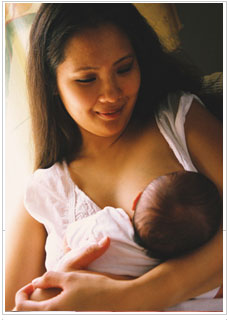
Of all these breasts we see, very few are ever doing what they were made to do: feed children.
There are periodic outcries against women who breastfeed in public. Sometimes women are made to feel ashamed—asked to cover up, as if they were doing something indecent. Facebook has removed pictures of breastfeeding women, labeling them obscene. Breastfeeding has been, in a variety of contexts and for many years, seen as obscene. However, using breasts to sell beer or cheeseburgers does not violate any societal code of conduct. Breasts are for fun, silly. Not for food.
Why, in the name of all that is pleasurable and seductive, do we freak out when a woman wants to feed her child in public, but we don’t freak out when she wants to use her breasts to sell something?
Moving along, then—the breast can be pleasurable for a woman (and for a man), and the breast can feed a baby. If exhausted, overwhelmed, sometimes shamed nursing mothers can figure this out, I think it’s about time we asked the question:
How, in the name of all that is vulnerable and resilient, can we continue to pretend that the breast is anything other than what it is—a beautiful part of a woman’s body that can and sometimes does help another human being to survive, and even to thrive?
A longer version of this piece was originally posted on Yo, Mama
Popular Posts on BroadBlogs
Men Aren’t Hard Wired To Find Breasts Attractive
Women Learn the Breast Fetish, Too
Staring at Breasts Is Good For Men’s Health? And Women’s?
Share this:

Miss Representation: Girls are Pretty, Boys Are Powerful

Powerful Man Pretty Woman
Girls get the message that what’s important is how they look. And boys get the message that what’s important about girls is how they look. That’s one of the observations made in the film, Miss Representation.
Girls and boys both buy into this belief system. And then boys become men, step into power, and perpetuate a social order that favors them. Most CEOs are male, most of Congress is male, most publishers and editors are male, and we’ve never had a female President of the United States. Girls become women and go with the flow, too. Yes, there are many exceptions. But these large patterns remain.
Our world incessantly whispers – or shouts: women are more body than brain. Women are emotion, not rationality and action. Women are sex.
And sex sells, they say. Sex sells products. Sex sells the message that women are all about sex.

Now add demeaning and violent images.
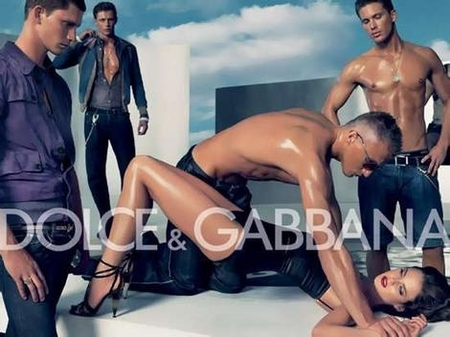
The message: men are powerful, and better than women.
And when women try to move out of the box to gain power?
Well look what happens on conservative networks like Fox, where men dress conservatively while female anchors wear plunging necklines, short skirts, and say things like, “Hillary Clinton looked so haggard and, like what? 92 years old?!” Or Greta Van Susteren asks VP candidate, Sara Palin, whether she has gotten breast implants. When women aren’t co-conspiring, Rush Limbaugh complains that no one wants to see a woman age in office.
Even when women do become powerful a headline runs, “Condi Rice, Dominatrix.”

Condi Rice, dominatrix
Perhaps alongside an ad for a nutcracker shaped as Hillary Clinton.

Hillary Clinton nutcracker
Any wonder 51% of Americans are women, but only 17% of Congress members are?
Jennifer Siebel Newsom, Miss Representation’s writer-director says this is unfortunate since research shows that:
The more diversity and more women you have in leadership, both in government and business, the greater the productivity, the creativity and the bottom line.
And:
There’s this new transformative leadership that’s embracing empathy, collaboration, empowerment… those are more feminine qualities and those are now more associated with success in the global landscape than the traditional sort of command-and-control male leadership traits. So I think we’re going to start to see a shift.
Let’s stop misrepresenting women and their potential. We all lose out when the talents and vision of half our population are stifled. Women and girls are not less important than men and boys.
Newsom urges us to empower both young women and young men to create an equitable society together, making sure that girls are mentored and have a plenty of good role models.
And as Miss Representation points out:
The most common way people give up their power is by thinking they don’t have any.
— Alice Walker
Popular Posts on BroadBlogs
Miss Representation: How I Look Is What Matters
Self-Esteem Falls with Rise in Power? Blame Beauty Ideals
Why Do Women Fight Against Their Own Interests?
Share this:

Being Sexual vs Looking Sexual

Is “beauty” really sex? Does a woman’s sexuality correspond to what she looks like? Does she have the right to sexual pleasure and self-esteem because she’s a person, or must she earn that right through “beauty”?
– Naomi Wolf
A lot of women and men confuse looking sexual with being sexual. We look at an attractive woman and think, oh, she’s really sexual. Then we see a not-so-pretty woman and suppose she’s not.
But “pretty” and “sexuality” are actually two different things. Sex is all about feeling, not the surface experience of just existing, however beautifully.
But as Naomi Wolf points out in The Beauty Myth, too many women don’t enjoy sex because they think they don’t look sexy enough. And since a lot of women think they don’t look sexy because of their body type, age, or low self-esteem, a lot of women miss out on great sex.
Because a woman’s ability to enjoy sexuality can be so closely tied to how she looks, many cut their breasts to get implants just so that they can experience eroticism. Even when their partners don’t want them to. As Wolf put it, “In a diseased environment, they are doing this ‘for themselves.’”
And about one-third of women lose sensitivity in their nipples, post surgery, becoming less capable of enjoying the sensations of the breast.
And even then a lot of “hot” women spend their time thinking about how they look and not experiencing how they feel. So there you have pretty sex objects who don’t enjoy sex.
Women think they need to look a certain way because men are hardwired to be visual. Yet it’s not true. In tribal societies women walk around nearly nude, and no one cares. Those men aren’t visually attuned to the breast as erotic. In our culture men learn to be aroused by breasts through the strategic revealing and covering of them, creating the allure.
Wolf says beauty is not the same as sexuality. Instead:
Wherever we feel pleasure, all women have “good” bodies. We do not have to spend money and go hungry and struggle and study to become sensual; we always were. We need not believe we must somehow earn good erotic care; we always deserved it.
Popular Posts on BroadBlogs
Men Aren’t Hard Wired To Find Breasts Attractive
Sex Objects Who Don’t Enjoy Sex
Cartoonish vs Authentic Sexuality
Share this:

Miss Representation: How I Look Is What Matters

Girls get the message early on that the most important thing is how they look. Too often their self-worth depends upon it.
Miss Representation premiered last week on Oprah Winfrey’s OWN network, seeking to combat that unfortunate reality. The film opens our eyes to all that creates the message. And offers change.
From the time they’re small, little girls are told they’re pretty – or notice that they’re not told that. They receive gifts of play makeup and vanity sets. They watch endless repeats of Disney princesses on DVD, buy beautiful princess dolls, and then graduate to Barbie or Bratz. All of whom have extensive wardrobes. It’s all about being pretty. Meanwhile, girls and women are bombarded with media images of impossibly beautiful women who are photoshopped up the wazoo, modeling what they’re supposed to look like.
Who’s popular in middle school and high school? Pretty girls. By the time they’re in college young women are under relentless pressure to be hot, as if that’s the most important thing in the world.
Media creates consciousness, but women don’t have much control over media. As Miss Representation tells us, women hold only 3% of the clout positions in publishing, advertising, telecommunications, and entertainment. And women comprise only 16% of producers, writers, directors and editors.
And so women come to see themselves through men’s eyes.
Meanwhile, media makes its money through advertising. And advertising works by making people feel bad about themselves so that they’ll buy products to “help.” But if the feminine ideal is impossible to achieve, women can buy an endless stream of products and still feel eternally insecure.
Jennifer Siebel Newsom, Miss Representation’s writer-director, makes this observation:
When youth are engaging in cutting and other forms of self-injury, when 65% of American women have eating disorders, when depression rates have doubled in the past ten years, when plastic surgery has tripled in the past decade amongst youth in particular; when you look at that you think Something is wrong. This is not healthy.
Fashion magazines are especially harmful. Girls and women who read them have worse body images than those who don’t. But women aren’t the only ones affected. Just looking at those “perfect” models can leave men finding real women less attractive, too.
So women and men who compare women to unattainable ideals both end up dissatisfied and estranged from each other.
Too many women sit in their inadequate, one-dimensional corners opposite too many men who do the same thing.
And no one is better off.
Popular Posts on BroadBlogs
Grade School Lingerie
500 Calories + Pregnancy Hormones = Perfect Body
Women Want Good Sex, Men Want Cuddling
Share this:

Man as Object: Reversing the Gaze

Della Calfee. Ass Like That
“Men act and women appear. Men look at women. Women watch themselves being looked at,” art critic John Berger famously observed.
Now some feminist artists are turning the tables in the exhibit, Man as Object: Reversing the Gaze:
With a gallery filled with men stripped naked this body of work exposes women’s cheeky, provocative and sometimes shocking commentaries on the opposite sex (which) may make the viewer squirm a little. But that is precisely the point.
The exhibit reveals sundry masculinities from female/feminist/
transgender perspectives, moving from sensuous rear views of the male buttocks to gender-bending to daughters gazing at fathers. Featured artists include Juana Alicia, Nancy Buchanan, Guerrilla Girls on Tour!, Lynn Hershmann, Jill O’Bryan, ORLAN, Carolee Schneemann, Sylvia Sleigh, Annie Sprinkle, Elizabeth Stephens, May Wilson, and Melissa Wolf.
Man as object strikes a pose, buttocks pushed out, offered to us as bedroom eyes shoot a backward glance. Men flex in awkward positions, or bend gracefully into compliant cants. Some men turn submissively into tables.
Others lie down. Natural enough, yet rarely seen in art. Too sensually passive… waiting… vulnerable… or “on the bottom” for mainstream viewing?
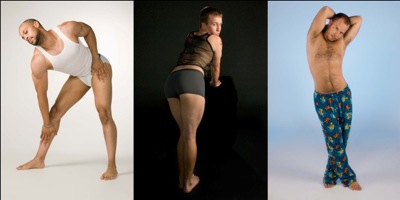
Karen Zack, Man As Object
The visions can come across as “gay.” Since sexual pose is so often meant for the male gaze, on some unconscious level we may see it all through male eyes. And that is jarring, too.
The camera pleasurably zooms in on erotic man-parts. Images of male autoeroticism and penises abound, including a piece called “Where’s His Head?” that depicts a giant phallus-man fondling his much smaller man-phallus. Indeed! And when Pinocchio tells a lie, it’s not his nose that grows. More like a woody that “lasts more than four hours.” Actual penises are rarely displayed, apparently unable to live up to what Richard Dyer called “the mystique implied by the phallus.”
The exhibit includes a lenticular postcard (turn it one way and it’s a woman, turn the other and it’s a man) that juxtaposes Courbet’s “Origin of the World” with a close-up vagina shot versus ORLAN’s “Origin of War” with a penis close-up.
At times men are objectified in one-dimensional, controlling and demeaning ways. But sex-positive feminist photographer Shiloh McCabe explores the other side, working to ensure that her gaze does not consume or dominate. She takes a wide view, seeing those who are usually not. Her subjects help create their own representation so they can retain their power. “I’m not here to objectify or harm; I’m here to nurture and document,” she explains.
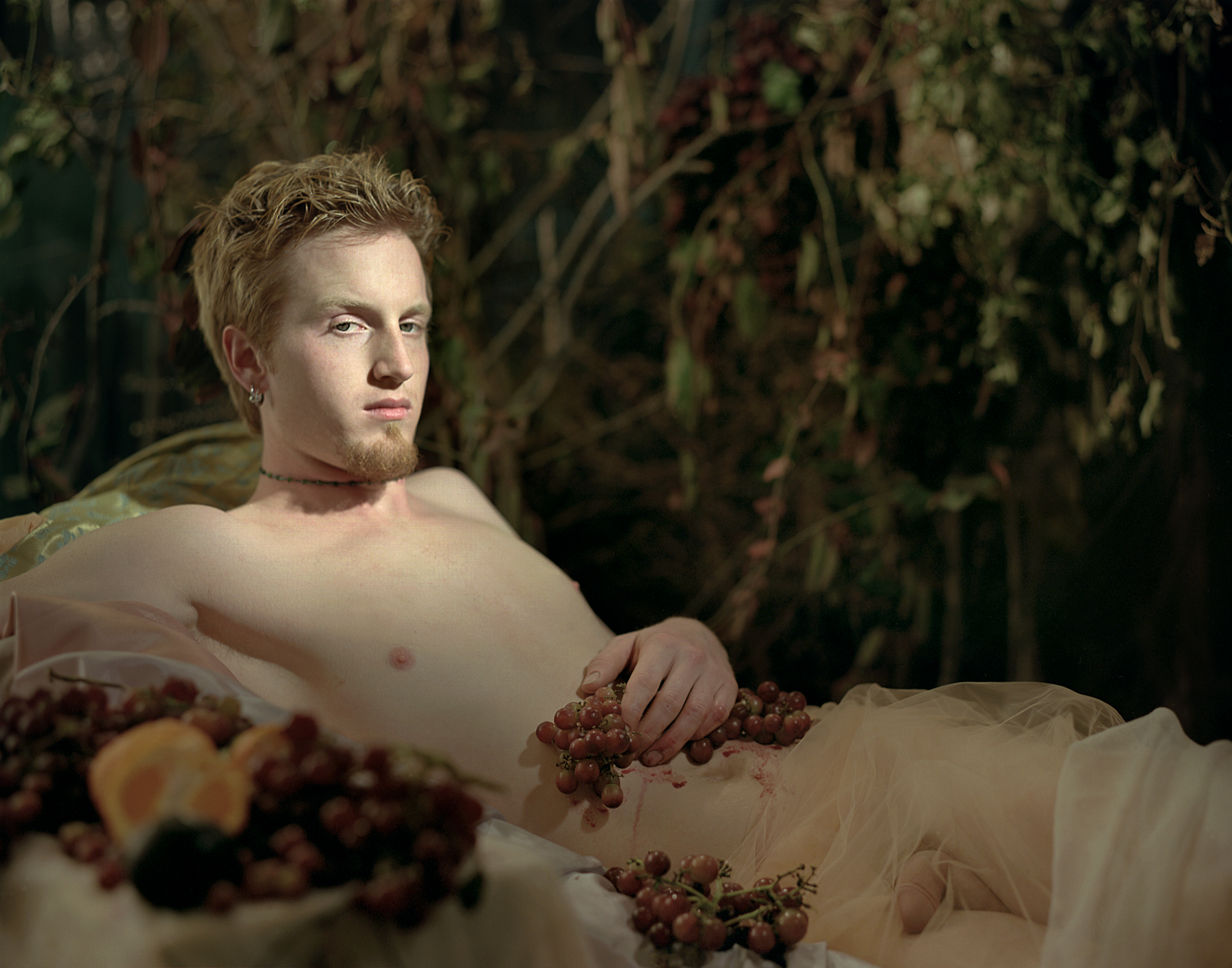
Laura Hartford. Graham Reclining
Man as object, Rubenesque, reclining, bathing, cooking, lounging, washing up before bed. Man as Madonna and Child, patriarchal man, veiled man, man as cowboy bunny, trans man. Blonde man in short shorts. Bodybuilder, Founding Father. Homeless man. Nude and vulnerable. Empowered. Bound and submissive. Striking a pose. Objectified.
So much to gaze at. And so much to see.
“In the past it was totally taboo for women to gaze upon the male, yet it was appropriate and common in the reverse,” observes artist Marian Yap. “Do you think that things are changing?”
Good question. This exhibit pushes us out of our taken for granted ways of seeing to explore that path.
Check out a video on the exhibit here.
Man as Object: Reversing the Gaze. Opening Friday, November 4th at SOMArts Cultural Center in San Francisco and running through the end of November. The show will travel to the Kinsey Institute Gallery, Bloomington, IN and will open April 13, 2012 through the end of June.
This exhibition was created by The Women’s Caucus for Art – the founding organization promoting feminist art and art as activism since 1972.
For more information click here.
Ms. Magazine reposted this piece on their blog October 28, 2011
Popular Posts on BroadBlogs
Does Sexual Objectification Lead to Bad Sex?
Men, Women React to Male/Female Nudity
Anything Good About Being A Sex Object?

 BroadBlogs