Monthly Archives: April 2013
Why Are Fictional Moms Sick Or Dead?
 As Harry Potter’s Hermione grew up, her brainy, brave persona turned more sexy, less threatening and less magical, says Sarah Jane Stratford in The Guardian. She continues:
Did Hermione Granger really say “I can’t” during the climactic battle in the final chapter of the Harry Potter film saga? Presented with her chance to destroy one of the horcruxes she had put her life on the line to hunt, she backs away and needs her almost-boyfriend Ron to insist that of course she can.
The transformation of a brave, adventurous girl into a young woman who becomes weakened by, or defined by, her sexuality, has a long literary tradition. The next step, it seems, is to become a mom who is sick or dead.
I discovered this pattern one year when I let fiction take over my usual nonfiction reading habit.
In The Sound and the Fury we meet adventurous, determined and nurturing little Caddy Compson who is busy exploring the local countryside, climbing trees and sometimes bossing her brothers. Later, she becomes a promiscuous woman, shamed and rejected by her family. And the mother in this story? She’s a neurotic hypochondriac.
Faulkner introduces us to a mother who is dying, and later dead, in the appropriately titled, As I Lay Dying. Her daughter is upset and fixated on her out-of-wedlock pregnancy (instead of her dying/dead mom).
In Atonement creative young Briony Tallis has an over-active imagination that leads to serious trouble. Her older cousin gets raped, and her older sister is overcome by romance. Mom is constantly bedridden with headaches.
Plain Song revolves around a shy 17-year-old whose mother kicked her out after learning she was pregnant. Two young boys have a mom who spends her days locked away, depressed.
I could go on, but you get the point.
If strong, adventurous girls grew up to become strong, adventurous young women,who were also sexual, that would be fine. But too often, sexuality diminishes them or becomes the only thing they’re about.
Maybe that explains why older women (moms) end up sick or dead. Upon reaching womanhood the grown girl leaves behind everything that had empowered and engaged her to become defined by her sexuality. When her allure fades, there’s nothing left.
Which suggests a lesson for real live women. Best to avoid a one-dimensional focus on sexuality that rests on narrow beauty notions. Instead, stay strong and develop many facets of yourself, including an ageless and radiant beauty and sexuality (a la Meryl Streep and Hellen Mirren, et al) to enjoy over a lifetime.
Popular Posts on BroadBlogs
Woman, Not the Sum of Flawed Parts
Anything Good About Being A Sex Object?
Boob: A Breast? Or a Fool?
Share this:

Men Watch Porn, Women Read Romance
![porn-for-women[1]](https://broadblogs.com/wp-content/uploads/2011/05/porn-for-women1.jpg) Years ago I met a man who intrigued me. He was my first real love. But I didn’t go headlong into a relationship, I wanted to get to know him, understand him.
Years ago I met a man who intrigued me. He was my first real love. But I didn’t go headlong into a relationship, I wanted to get to know him, understand him.
I became the detective, trying to determine whether he was right for me. Was he devoted, caring? Empathetic? Did he appreciate me? Was he in love with me or was I just a passing fancy?
He thought understanding each other was overrated.
My sleuthing confirmed my initial attraction – that he was deep. Unless the subject was sex and relationship, which he thought were the same thing. Big problem!
I eventually learned that this dynamic – men seeking sex and women seeking answers – is not unusual. It is even reflected in the erotica we seek.
Cognitive neuroscientist, Ogi Ogas says that men search the internet for two-minute clips that are all about skin and explicit sex. Women’s erotica is more like detective novel meets romance, and takes hours to read and digest. (The number of women romance readers and male online porn viewers are about the same. About one in 10 men are into romance while one in 10 women check out porn clips.)
The men’s interest is simple, uncomplicated. But women more likely want character-driven stories that reveal the lover’s nature. Sex is not for its own sake, and not with impersonal strangers.
As Ogas notes, the female cortex is highly developed and skillfully scrutinizes all available evidence – social, emotional and physical, somewhat consciously but largely not. All this leads to a general feeling of favorability or suspicion: Is he committed and kind? Is he a rouge? A player? Only if the detective work leads to a stamp of approval will physical and psychological arousal unite.
Men’s desire has been likened to an on/off switch, while women’s to a complex circuit board.
Why? Who knows? Some will point to evolutionary psychology: To best reproduce themselves women need a man who will stick around and support their children with resources. So women must be careful, picky. But men (having a great deal of sperm) best reproduce themselves by willy-nilly spreading their seed. It’s a popular theory, but I have my doubts since women in some cultures behave a lot like our sexual stereotype of men. American Indians prior to European contact, for instance.
Others say that in a world where women have less power, women’s lives are more affected by men than vice-versa, so they need to be more careful, even if their sleuthing isn’t very conscious. Women are more likely to follow husbands who are transferred in their careers than vice-versa, for instance. Also, men’s social status affects women more than women’s status affects men’s. When a waitress marries a dentist, her social status immediately rises to his. Not so much for the trucker who marries a female business executive.
And since men are typically bigger and stronger, abused women suffer greater injuries and have more difficultly defending themselves.
Women are also more likely to depend on men, financially, because they are more likely to stay home full-time with kids. Is he dependable? Can he keep a job? If men leave, women in our society bear all the responsibility for children (versus Ancient American Indians who parented communally).
Also, women’s sex drive is typically lower in our culture (largely due to repression, which is due to sexism), perhaps leaving women wanting emotionally connected sex more than variety and experimentation.
And of course, women were raised on a diet of Disney princesses living happily ever after with their one and only true love. Could have an effect.
Meanwhile, bombarded by women-as-object images, men come to see women’s bodies as objects that are all about sex, and women’s body parts sex-signals. Hence the simple look-arousal response. (Surprisingly, the breast fetish seems to be learned, not natural.)
When women and men so often have contradictory ways of seeing and being, you have to wonder why (for about 95% of the population) women and men are thrown together in the first place.
Yet, when it comes to relationships — and not mere erotica — there is more coming together. In fact, guys are getting more romantic and seem to be quite relationship-oriented. So maybe in real life it’s more often a match, after all.
Related Posts on BroadBlogs
Women Want Emotionally Connected Sex. Why?
Women Want Casual Sex? Yes and No
Guys Just Wanna Have Relationships?
Share this:

I Can’t Believe I Ate A Whole Head Of Lettuce!
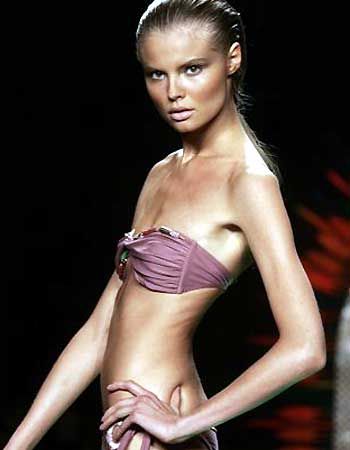 Once upon a time I wanted to look like a cover girl, despite whatever feminist consciousness I may have had.
It had not occurred to me that that wasn’t an option. It’s what my culture said I was supposed to look like. What I needed to look like to be truly valued.
Full of contradictions, I began my supermodel project. But in a healthy sort of way, I told myself. Wasn’t going to starve. No anorexia or bulimia for me.
I later came to see that I did end up with an eating disorder.
I became obsessed with food. How much had I eaten that day? Constantly counting calories. My worth depended upon how well I had kept my calories down.
At times I swung between overeating and starving. Very little starving – I wasn’t good at it.
I next developed an exercise obsession. You can’t get too much exercise, right? After developing a knee injury from jogging, I tried Nordic Track. Another knee injury. Next, I began walking three miles a day at a brisk pace. Yet another knee injury. Apparently, you can rub your cartilage too much from over-exercise and lack of rest. My physical therapist told me to start biking instead – and don’t overdo it! No more than four days a week, and no hills.
After all the food and exercise mania, I still looked nothing like a supermodel. One day standing in line at a grocery store I picked up People Magazine and read a story on how supermodels did it. I finally understood why I didn’t look like them, and never would.
Kim Alexis had tried every fad diet and at one point starved herself for four days straight.
Carol Alt went on a fruit-only diet. Later, she drank eight cups of coffee a day, and ate salad for dinner.
Andie Macdowell said many models took drugs to deal with the stress of starving.
What struck me most was when Kim Alexis said:
When I first started out, I was rooming in a New York City hotel with (supermodel) Kelly Emberg. One night I came home, and I was eating only a head of lettuce for dinner. Kelly walked in and said, “You’re eating a whole head of lettuce? How could you?” I cried and said, “But it’s all I’ve had all day. It’s not even 50 calories!”
To which I say, “Are you freaking kidding me?!” That big “cheat” would be insane dieting in my book. In anyone’s book, one would hope.
That’s when my hopes for supermodel slim were dashed.
Yes, I had been insane. But not that insane.
And it’s not just me. It’s society. What kind of crazy culture says women must feel guilty about eating a head of lettuce — or she won’t “look good”?
So I determined to gain my mental and physical health back. I’ve had ups and downs, but so far so good.
Related Posts on BroadBlogs
How to Look Like a Victoria’s Secret Angel
Beautiful Women’s Hips Are Thinner Than Their Heads?
Spoon Fed Barbie

 BroadBlogs