Blog Archives
Racism: Genetic or Learned?
 Evolutionary psychology says racism is in our genes — a genetic adaptation that helps groups survive by favoring themselves over others. Skin color cues us in to who’s “in” and who’s “out.” (Yet the most prosperous areas of the world are those that cooperate and trade with each other?)
When I explain the theory, my students are appalled. (Though they readily accept evolutionary psych when it comes to explaining supposed sex differences.)
I once wrote a comment questioning evolutionary psychology on Slate and got the following response:
And what about all of those studies on doctors that found they treat patients differently because of race? What about those studies that show that we show preference to people wearing the same color of shirts as us?
Then shouldn’t children prefer parents who have their same hair/eye color? Not in my case. My mom has brown eyes and very light skin like me and my dad has green eyes and darker skin. Yet as a child I preferred him because mom was the disciplinarian.
And doctors could treat patients differently because they learn prejudice and not because they are genetically programmed to discriminate.
You also have to wonder why so many brown-haired, brown-eyed people have a preference for blonde, blue-eyed looks if our genes cause us to prefer our own type. But then, we’re all bombarded with messages that teach us that blue eyes and blond hair are best, at least on women.
Relatedly, about half of the Black people who take Harvard’s test of unconscious prejudice show a preference for Whites. If evolutionary psychology is right, shouldn’t they have a preference for Blacks? But again, Black Americans (just like the rest of us) are barraged with unfortunate messages that White is prettier, smarter, and less criminal.
Meanwhile, some people show “no preference” for either race when they take Harvard’s “implicit” test of unconscious bias.
Or consider the most recent presidential elections. The younger a person was, the more likely she or he cast a ballot for Barack Obama. Was there a mass genetic mutation that caused younger voters to be less racist? Or has society changed enough through the years that young people have simply learned less racism?
Evolutionary psychology says racism is in our genes. Looks more like it’s learned.
You inherited you grandmother’s eyes. Did you inherit her racism, as well?
February is Black History Month
Related Posts on BroadBlogs
Are Women Naturally Monogamous?
Black Isn’t Beautiful Claims Evolutionary Psychologist
Women Want Casual Sex? Yes and No
Share this:

The Crimes of Hoodies, Short Skirts and Fannie Mae
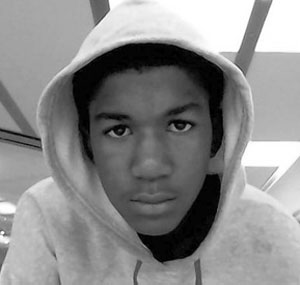
“More guns, fewer hoodies” and we’d all be safer, Gail Collins advised in a New York Times piece after Trayvon Martin was gunned down for “eating skittles while black” – and while wearing said hoodie – in a gated community. A clear threat that had to be stopped.
That’s right. Guns don’t kill people, hoodies do: Trayvon Martin’s “hoodie killed him as surely as George Zimmerman did,” claimed Geraldo Rivera (who later apologized).
Sounds familiar. When women are raped short skirts become the culprit.
Yet few rape victims are wearing short skirts. And even nicely dressed black men can create fear. Journalist Brent Staples noticed that people got out of his way when he nonchalantly walked about. Amazed at his ability to alter public space, he tried humming Mozart to project his innocence. Seemed to help.
But why aren’t pricey cars, fancy suits and expensive watches blamed when rich, white men get robbed? What thief could resist?
Why? Because making more powerless members of society the culprit is meant to distract from the sins of the powerful. It’s women’s fault if men rape them, and it’s black men’s fault if lighter men kill them.
In another example, some blamed liberals for foolishly using Fannie Mae and Freddie Mac to help Blacks and Hispanics “buy homes they couldn’t afford,” leading to the banking crises that nearly drove the U.S. economy off a cliff.
What really happened is that rich bankers gave rich campaign contributions to government officials, who in gratitude disposed of pesky regulations. That helped bankers get mega-rich by devising complex financial packages that no one could comprehend.
Used to be that when someone bought a home bankers made sure they’d get paid back. But under deregulation it didn’t matter because the loan was sold to someone else. And that investor sold the loan again. And financial packages were created and sold, composed of fractions of many people’s mortgage loans. They were rated AAA since they were 1) diversified – and hence, “safe” investments and 2) the housing market never goes down. (Yeah, right!)
Fannie and Freddie entered the process late, thinking they’d better join in or lose out.
When the housing market dropped and people couldn’t afford their homes, or sell them for a profit, the banks began collapsing. Lucky for them, the taxpayers bailed them out (or the whole economy likely would have collapsed).
Did deregulation get blamed for the fiasco? By some. But plenty of the “powers that be” — and especially “hate radio” — blamed Blacks and Latinos.
Because blaming more powerless members of society distracts from the sins of the powerful.
The crime does not lie with the man who pulls the trigger, nor with the man who rapes, and certainly not with the fat cat who pays to rig the game. No, the crime lies with those who wear hoodies, short skirts and who bank while black or brown.
Popular Posts on BroadBlogs
Cheerleader Ordered To Cheer Her Rapist, and Other Stories
Markets Must Be Free; Women Must Be Constrained
8-Year-Old Called “Whore” for Long Sleeves, Skirts
Share this:

Rape Epidemic in South Africa. Why?
More than one in three South African men admits committing rape, one in seven has joined a gang rape, and more than three quarters admit committing violence against women.
More than half of South African women have experienced violence at the hands of men, and one-quarter will be raped by age sixteen.
Why? Two thirds of rapists felt sexually entitled. Some wanted to punish women who had angered or rejected them. Others wanted to turn lesbians straight. And some were just bored.
These “reasons” may only get at surface issues. What else is going on?
Rachel Jewkes, a lead researcher on the study of violence in South Africa, feels that racism lies behind the abuse.
Rape holds a sexual component, but it is essentially about power. When a large population is oppressed, say through racism – even as manhood is defined as “dominant and powerful” – men may use rape as a weapon to gain a sense of personal empowerment. Rapists are often trying to bridge a gap between their impotent selves and the dominant men they seek to be. Imagine the control they feel when they restrain, take over, and invade another person’s body. Imagine how high and mighty they feel in creating humiliation.
Gay bashing is another weapon whereby some men try to create a sense of male superiority. If women act like men (sexually/stereotypically) how can men keep their sense of dominance? Hence, the need for “corrective rape” in South Africa that seeks to turn lesbians straight.
In one attack Millicent Gaika was beaten and raped for five hours as her assailant screamed, “I know you are a lesbian. You are not a man, you think you are, but I am going to show you, you are a woman. I am going to make you pregnant.” Since the women are often murdered “correction” sounds less likely than gay-bashing as motive.
Others were simply bored. So the eroticized violence of patriarchy comes in handy: Oh, let’s have some fun!
This is helped when women are seen as sex objects, and not people who have their own lives, goals, thoughts and emotions. When women become nothing but objects for sexual pleasure, it’s no wonder that one third of the rapists said they did not feel guilty.
So here we have powerless men beaten down by racism who are trying to feel powerful, who live in a world where violence against women is eroticized, and where women are seen as mere objects. A recipe for epidemic rape.
Originally posted on January 14, 2011 by BroadBlogs
Related Posts on BroadBlogs
Mind of a Rapist: Trying to Bridge a Gap between a Small Self and a Big Man
It’s Ok To Be A Tomboy But Not A Sissy. Why?
Yale Fraternity Chants “No Means Yes.” Men? Or Scaredy Cats?
Share this:

How Does Racism Hurt Racists? The Case of Emmett Till
How does racism hurt racists? In many ways, actually. Here’s one:
The case of Emmett Till.
In 1955 this 14-year-old African-American left Chicago to visit his cousin in Mississippi.
One day his cousin dared him to flirt with a white woman. Accepting, he whistled at a woman who was working at a grocery counter, and called her “baby.”
Later that night the woman’s husband and his half-brother hunted Emmett down, kidnapped him, and the torture began. They cut off one of his ears, gouged out an eye, and put a bullet through his head before throwing him into a river.
The men were arrested. At the trial witnesses placed them at the site where Emmett was tortured, and the two men admitted the kidnapping.
But they faced a jury of white men in a Mississippi courtroom. After deliberating for less than an hour, they acquitted the case. One juror told a reporter, “If we hadn’t stopped to drink a pop, it wouldn’t have took that long.”
We easily see how racism hurt the young minority in this case. But how did it also hurt the white people who were involved?
When one person can torture another, with no conscience or concern, and when others dismiss the behavior, we see that racism dehumanizes its target, but it also dehumanizes the racist.
February is Black History Month
Popular Posts on BroadBlogs
Think You’re Not Racist?
Learning to See Ourselves as Inferior
Black Isn’t Beautiful Claims Evolutionary Psychologist
Share this:

“Why I Left the KKK”: One Man’s Revelation
In The Republic, Socrates asked whether we should be good and just, and why.
A listener suggested that if we are trusted we’ll do better in our business and personal relationships.
But what if no one knows you are a good person?
“The gods will know, and reward us,” observed another.
But what if the gods don’t know that you’re good? Socrates pressed.
Later, I read Emerson on the same topic. His Minister had lectured that while the wicked are often successful, and while the righteous can be miserable, at least compensation would be made in the next life.
Emerson felt that the fallacy lay in conceding that the base estimate of the market constitutes success, and assuming that justice is not done now.
What really makes us happy? Doing ill to others? Stepping on others so we can get ahead?
What Emerson and Socrates were getting at was made more real to me when I heard a man talk about why he had left the KKK.
He and his wife had become so filled with hatred in that organization that misery had overtaken their lives. They left because acting hatefully, hurting others, had ended up mostly hurting themselves.
As it turns out, when we work to harm others we harm ourselves.
Share this:

If Gays Can’t Rule on Gays, Can Whites Rule on Whites?
Anti-gay rights activists want to overturn a ruling to allow same-sex marriage in California. In their most recent attempt, they maintained that because San Francisco Chief Judge Vaughn Walker is gay, and could personally benefit, he acted with bias when he rendered his decision. This week Judge James Ware rejected the claim, calling it warrantless.
No one calls “bias” when whites or men make rulings that benefit them. Affirmative action cases, for instance. White Justices have been known to rule in ways that would benefit their own white children and grandchildren.
Meanwhile, Chief Justice John Roberts seems to vote consistently
in ways that benefit Republicans, and therefore himself, as a member of that
party. As court watcher, Jeffrey Toobin, observes, “In every major case
since he became the nation’s seventeenth Chief Justice, Roberts has sided with
the prosecution over the defendant, the state over the condemned, the executive
branch over the legislative, and the corporate defendant over the individual
plaintiff… Roberts has served the interests, and reflected the values, of the
contemporary Republican Party.” Yet no one says that Roberts should recuse
himself from said cases.
Worries of bias seem only to rise when members of the LGBT community, women and people of color hold positions of judicial power. Many wondered whether Sonia Sotomayor could judge without favoritism as a Latina.
Meanwhile, in their search for justice gays, women and ethnic minorities have usually been at the mercy of white, straight, males. In the past it’s been argued that minority judges can’t be objective on affirmative action. Why would a white judge be fairer? It has been claimed that women can’t be objective on abortion rights. Why would a male judge be fairer? And now accusations that gays cannot rule objectively on gay marriage. Why is
the privileged perspective constantly deemed more fair-minded?
Why? Because most of our information has come to us over the years through straight, white men’s eyes, whether via the media or over the political, corporate, or religious pulpit. We are so inundated that after a lifetime, their view comes to seem like the “normal” and unbiased way of seeing.
But really, if gays can’t rule on issues affecting gays, should whites be allowed to rule on matters that impact whites?
June is LGBT Month
Popular Posts on BroadBlogs
Higher Suicide Rates in Conservative “Values Voters” States
Gay Marriage Protects Marriage
Gay Marriage Helps Families
Share this:

Black Isn’t Beautiful Claims Evolutionary Psychologist
 Somalian-born supermodel, Iman
Evolutionary psychologist, Satoshi Kanazawa, claims Black women are less attractive than others. It’s apparently such good science that Psychology Today posted his piece on their website. Maybe not. They quickly took it down and recently apologized.
Hmmmm. Thinking about Black women, there’s
Somalian-born supermodel, Iman or Sudan-born supermodel, Alek Wek. And then
there’s Halle Berry, Naomi Campbell, Tyra Banks, Thandie Newton, Beyonce, Janet
Jackson, Lisa Bonet, Jada Pinket Smith… Beautiful Melia Obama fits right in
with these folks.

Lupita Nyong’o
A few years back FX had a reality show called “Black. White.” in which a White family’s coloring and features were changed to Black, while a Black family’s coloring and features were changed to White. I thought the White girl looked great Black.
 Black. White.
Really, we need to take evolutionary psychology with a grain of salt. Some research from this field may have some basis. But much carries cultural bias. Indeed, as Tami Winfrey Harris over at Ms. points out, others have demonstrated Kanazawa’s bad methodology and his taste for fashioning racism, sexism and conservatism as science. As much of evolutionary psychology is prone to do, I might add.
 Supermodel, Alek Wek
That said, as Harris eloquently observers:
All women bear the burden of the European beauty standard and the fact that, as women, our value as human beings is too often defined by how closely we fit the
standard—how close we are to being white, blond, blue-eyed, thin, with long, straight hair, and a keen nose and lips. Narrow standards of beauty are oppressive to all but a few, but it is Black women as a whole who are held up as the opposite of the ideal.
 Ethiopian woman
On Harris’ point, people do tend to prefer the features and fashions of powerful groups, but the bias is about power, not innate beauty. Just a couple examples:
When prosperous and influential Chinese families bound the feet of their daughters to signal wealth (what woman could work with bound, dysfunctional feet?) small feet came to be seen as beautiful. Unfortunately, poor Chinese soon imitated the fashion in pursuit of this excruciating “beauty.”
Or, when tanned skin indicated outdoor, poorly-paid, physical labor, Americans avoided the sun. But when Coco Chanel came back deeply tanned after vacationing in St. Tropez, her sun-kissed skin – now linked to wealth and privilege – appeared beautiful.
 Sudanese woman
Blacks do have less power than other ethnic groups due to intense prejudice which was created to support their enslavement and the discrimination that followed. (It’s easier to feel okay about enslaving someone if they’re not quite seen as people.) Due to a history of educational and occupational discrimination, it has been more difficult for the Black community to gain and pass on wealth.
And yet, looking at all the women on this page all I can say is black is truly beautiful.
Lupita Nyong’o on Black as Beautiful here.
More beautiful black women here:
Related Posts on BroadBlogs
(racism)
How Does Racism Hurt Racists? The Case of Emmett Till
“Why I Left the KKK”: One Man’s Revelation
(Evolutionary Psych)
Women Want Casual Sex? Yes and No
Are Women Naturally Monogamous?
Share this:

Inflaming Feminazis: BEING Powerful? Or just FEELING Powerful?
As Women’s History month winds down I’d like to ponder the difference between being powerful and merely feeling powerful. Too often people chase the feeling and give up the real thing.
I sensed the phenomenon in a highly publicized event last year.
Last October a Yale fraternity chanted “No means yes, yes means anal” in front of the campus Women’s Center. One man concluded it was all meant to stir up feminazis. “The sole purpose of that building,” he opined, “is to give hatemongering academic feminists a base to spread their propaganda and recruit new members… They most likely (chanted there) because feminazis always go out of their way to harm men. Just about every policy implemented by academic feminazis is meant to incite misandry and marginalize men.”
Interesting tactic. “Who looks worse?” I asked.
“The guys will come across as arseholes, but they don’t care. All they care about is stirring up the feminazis.”
The commenter has a blog which seems to have the same goal. I just don’t know whether any feminazis go to his site so that he can stir them up.
Let’s give him the benefit of the doubt that his theory could be true. Do you think the Yale frat staged a blow to feminism? Or to sexism, instead?
While some seek to feel strong by chanting rape fantasies, real rapists and wife batterers are involved in the same loop. They want to feel powerful, so they beat down a woman or invade her body. Or both. They feel dominant in the moment. But their potency is actually pretty limited. And the acts are only destructive, not constructive.
Any time gang members beat or kill someone they probably feel formidable. But in the long run, how mighty are they sitting in jail, or dead?
A few early feminists made the error of feeling powerful over the real thing when they spewed man-hating rhetoric. In the moment they likely felt pretty tough. But the strategy did not create real muscle and feminists at large gave it up. For the effect was to repel potential female and male allies, alike.
Now we are left with the brand “feminazis.”
To all of the above I ask, why don’t you do something with your efforts and your lives that are both powerful and constructive, instead of beating others down in a basically weak attempt to feel better about yourselves?
And next time you seek power, consider whether you are being powerful only in your own head.
Georgia Platts
March is Women’s History Month
Popular Posts on BroadBlogs
Cultural Relativism: Must We Be Nazis to Criticize Them?
Don’t Reject Your Culture, Even When It Mutilates You
Why Are We More Offended By Racism Than Sexism?
Share this:

Learning to See Ourselves as Inferior
“I asked my teachers not to tell anyone that I was doing well in school because I was afraid I’d get beaten up.”
This quote comes from a young black man, freshly admitted to Brown University, who was telling a reporter about his struggle to get good grades at a high school where academic attempts were punished for “acting white.”
Why would doing well in school take on a sense of “whiteness”? Or merit punishment?
It all goes back to something called “internalization,” which happens when society ends up embedded in our own minds.
When children are born they don’t know much of anything, and are faced with a seemingly chaotic world that lacks meaning. But we need to cope. So the mind unconsciously categorizes what it observes. And the vast majority of the following appear white: Presidents of the United States, Congress, scientists, doctors, CEOs, major historical figures, teachers, professors. On the other hand, majorities, or large numbers, of the following seem to be black: basketball players, football players, baseball players, rappers and entertainers. In movies, TV shows, music videos, and in the news criminals, gang members and the poor are often black.
Unconsciously fitting a complex world into simple categories, stereotypes arise. We all do it. After a while – somehow in the back of our minds – smart successful people too often come to be associated with whiteness, while sports stars, rappers, criminals and the poor can come to be connected to blackness. And early in life the mind doesn’t discern the history of discrimination that lies beneath the patterns.
We grow up hearing we shouldn’t stereotype, shouldn’t be racist, but the messages can linger unless we become conscious of them and work hard to rid them. We find evidence of this in psychological tests like Harvard’s Implicit Bias test, which I wrote about a couple of weeks ago. When people take this test, most learn that they’re more racist than they had thought. So much so that about half of the black test-takers also have a preference for whites.
So consider young African Americans in school, having internalized these stereotypes. Jeff Howard and Ray Hammond, a black sociologist and a black physician, wrote a piece called “Rumors of Inferiority” for The New Republic a few years back. The stereotype gnaws at the minds of young black kids, they said. And people tend to live up to – or down to – expectations.
Howard and Hammond suggest that the children unconsciously fear competing academically for fear of failing, and proving the stereotype. They refuse to play on a field where they think they can’t win, rejecting the value of academics outright. And, they punish anyone who doesn’t go along. Instead, valor in areas like sports is praised. Unfortunately, academic achievement is a much surer route to success.
Interestingly, the threat of “acting white” arises primarily in integrated schools. Perhaps when children are competing in all-black communities they don’t fear doing worse than whites and proving the rumor of inferiority true. They may also have more black role models and a greater focus on the achievements of African-Americans, boosting the children’s faith in themselves.
The only way to overcome the loss of faith that accompanies the stereotype is to become aware of its existence and critique it. When prejudice plays on the unconscious mind, it doesn’t occur to us to rethink. But when we understand the history of discrimination that led to privilege for some and underprivilage for others, and when we see what many Black people have accomplished despite the obstacles, we understand that the stereotypes are not true. And faith can be restored.
Georgia Platts
February is Black History Month
Related Posts on BroadBlogs
“Why I Left the KKK”: One Man’s Revelation
How Does Racism Hurt Racists? The Case of Emmett Till
Rise Up or Beat Others Down: Reactions to Oppression
Share this:

Think You’re Not Racist?
Think you’re not racist?
Go to https://implicit.harvard.edu/implicit/ to find out.
First you’ll fill out a survey asking how racist you are. You’ll probably think you aren’t. But a test of unconscious attitudes will likely suggest otherwise.
In the test you will be asked to quickly categorize whether a face that appears on screen is black or white. Next you will be asked to categorize whether a word is negative or positive. All this is very quick and easy. Then you will see a screen like the following:
Black Person White Person
or criminal or
Bad Good
Your job is to categorize words like “criminal” as belonging to either the left or right side of the screen. The categorization process must go very quickly in order to measure the unconscious mind and not our conscious efforts to deliberately act against our prejudices.
People quickly categorize negative words like “criminal” (or “harm” or “depraved”) as belonging on the left hand side. Positive words like “smart” are quickly assigned to the right.
But then the test switches so that “black person” is paired with “good,” while “white person” is paired with “bad.”
Black Person White Person
or criminal or
Good Bad
Suddenly, most people take more time to correctly place “criminal” on the right side of the screen. They also make more mistakes, assigning negative words like “violence” to the left.
When the test is done you will be placed into one of the following categories:
Strong preference for whites Strong preference for blacks
Moderate preference for whites Moderate preference for blacks
Slight preference for whites Slight preference for blacks
No preference
80% of people show pro-white associations – and that includes about half of the black test-takers, too. Yet few of us think we are racist.
People take the test over and over again, trying to change their score, but they usually end up in the same place every time.
If you show a preference for whites, are you a bad person? With 80% of the population, and about half of blacks, registering that preference, what it really tells you is that you live in a racist society filled with messages that whites are better.
Our minds unconsciously notice that presidents of the U.S. and large companies are usually white, that supermodels are usually white, and that doctors are usually white. So we unconsciously bring positive connotations to that color. Our minds also unconsciously notice that the poor and the disparaged are often black, creating negative associations.
Any hope for change?
Yes.
Some people end up categorized as “no preference” for either race. Others move around from, say, “moderate preference for whites” to “moderate preference for blacks,” suggesting they lack (much) bias. (I’m one of those who move around. Truth be told, I most often end up at “slight preference for whites,” suggesting some unconscious lasting residue of cultural prejudice. I still have work to do!)
People with little or no bias have generally made more conscious efforts to see the world in unbiased ways. They become aware of their unconscious prejudices and critique them.
Focusing on the accomplishments of great Black leaders, thinkers, poets, and scientists like Nelson Mandela, Sojourner Truth, Barack Obama, Maya Angelou, Oprah Winfrey, Fredrick Douglas, Harriet Tubman, Alice Walker, George Washington Carver, and many more, can help people appreciate the talents and intellect of our brothers and sisters of African descent.
Popular Posts on BroadBlogs
Should Business Owners Have More Rights than Blacks?
Men Watch Porn, Women Read Romance. Why?
Cartoonish vs Authentic Sexuality

 BroadBlogs