Category Archives: race/ethnicity
How Does Racism Hurt Racists? The Case of Emmett Till
How does racism hurt racists? In many ways, actually. Here’s one:
The case of Emmett Till.
In 1955 this 14-year-old African-American left Chicago to visit his cousin in Mississippi.
One day his cousin dared him to flirt with a white woman. Accepting, he whistled at a woman who was working at a grocery counter, and called her “baby.”
Later that night the woman’s husband and his half-brother hunted Emmett down, kidnapped him, and the torture began. They cut off one of his ears, gouged out an eye, and put a bullet through his head before throwing him into a river.
The men were arrested. At the trial witnesses placed them at the site where Emmett was tortured, and the two men admitted the kidnapping.
But they faced a jury of white men in a Mississippi courtroom. After deliberating for less than an hour, they acquitted the case. One juror told a reporter, “If we hadn’t stopped to drink a pop, it wouldn’t have took that long.”
We easily see how racism hurt the young minority in this case. But how did it also hurt the white people who were involved?
When one person can torture another, with no conscience or concern, and when others dismiss the behavior, we see that racism dehumanizes its target, but it also dehumanizes the racist.
Georgia Platts
Share this:

Must We Be Nazis to Criticize Them?
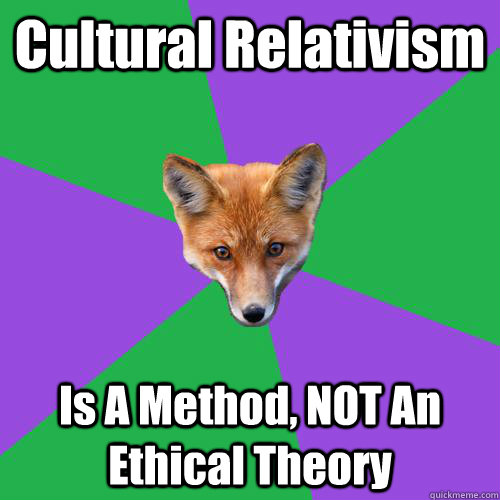 Don’t judge one culture from the perspective of another. That’s cultural relativism in a nut shell.
When I ask my students what they think of this, they nod in agreement.
Then I tell a story that I first heard from Nick Kristof in the New York Times.
A young Pakistani man was accused of having an affair with a high-status woman. As punishment, a tribal council chose to gang rape his older sister. They kidnapped her, took turns raping her, and then forced her to walk home naked in front of 300 villagers. Her next duty was clear. Sexually impure, she was expected to commit suicide.
But it’s not just Pakistan. Right here in America slavery was once “Southern culture.” So should Northerners complain? States rights, and all.
Or… must we be Nazis to can criticize them?
In each of these instances one group benefitted by hurting a less powerful group. The Pakistani men danced for joy as they gang raped the girl. After these rapes the men weren’t punished, the girls were. Plantation owners exploited slaves, who worked for free. Meanwhile, Nazis acquired the assets of the Jews.
And were women and men, black and white, Jew and Nazi equally powerful in creating these cultures?
Cultural relativism provides a useful perspective, unless someone is being exploited and hurt. I’m not a moral relativist.
Studies show that even very young children have a rudimentary sense of justice. It is based on whether one person is hurting another. Researchers showed babies a figure struggling to climb. One figure tried to help it and another tried to hinder it. Babies as young as six months old preferred the helper over the hinderer. Eight-month-olds preferred those who punished a hinderer over those who were nice to it.
When I take issue with matters like “honor killings” in which girls are murdered by their families to remove the stain of sexual impurity — which stems from being with a male without chaperone, having sex outside of marriage, or being raped, I’m sometimes told: You can’t judge one culture by another. You’re imposing Western values. You’ve simply internalized your own culture.
Or, non-Western patriarchal men warn women that they are rejecting their culture (one that weakens them). And everyone backs down.
Yet these women are harmed in the worst way by the murders. And did women have equal voice in creating a culture that punishes them more than men?
Meanwhile, Islamic feminists voice frustration with Western fears of offending.
I’m in sync with cultural relativism, unless someone is being hurt. But when it comes to communicating that message, it’s best to have a dialogue instead of a lecture. Surely we can learn something from them, too.
See Related Posts:
Did Women Create Burqa Culture?
The Burqa and Individual Rights: It’s Complicated
Early Islam’s Feminist Air
Share this:

Why Are We More Offended By Racism Than Sexism?
As a culture we are more offended by racism than sexism – which is not to say that we’re more sexist than racist.
But sexist jokes are more easily traded. Nearly anyone at a U.S. University knows the punch line to, “What’s the difference between a slut and a bitch?” (I’ll answer that in a later blog post.) I attended a university in which jokes about women students prevailed. Typical “coed joke”: “What’s the difference between a coed and the trash? The trash gets taken out once a week.”
When Don Imus called Rutger’s women’s basketball team “nappy headed hos,” we were offended by the racism. But the sexism was mostly overlooked.
In fact, sitcoms rarely have mixed-race casts, possibly because they fear a racist joke cropping up, or a comment coming across as such. Meanwhile, I’ve watched a couple of seemingly feminist shows that used the word “bitch” (and not in a good way) in nearly every episode: Ugly Betty and Life Unexpected. Some TV shows’ raison d’etre seems to be spewing sexism. Family Guy and The Man Show come to mind.
Gangsta’ rap is full of sexism, but few complain. If a genre of music talked about people of color the way that women are labeled in rap we would be outraged.
During the last presidential election mainstream media took way more shots at Hillary than Barack, as with Tucker Carlson’s well known crack, “When she comes on television, I involuntarily cross my legs.”
There’s a reason for the difference in offense.
Basically, women put up with sexism more than ethnic groups put up with racism. But why?
First, ethnic groups are aware of times and places when whites haven’t ruled, from present-day Japan to pre-imperial Africa. People of color know that things can be, and have been, different. U.S. racism is glaring by comparison.
On the other hand, most women are unaware of cultures that have existed with gender equality. Knowing nothing else, the inequity they face can seem natural and normal to them.
Many women attend churches that teach that men should be in charge. These women don’t want to go against God. I’m not aware of any ethnic minority churches that preach God wants whites to rule.
Men are women’s lovers, husbands, sons, fathers, and brothers. They love them and want to keep relationship with them. They don’t want to offend them.
Meanwhile, our culture does much to make sexism seem sexy, from Eminem, Rihanna, and Megan Fox sexing up domestic violence to a Rolling Stones billboard depicting a woman sprawled on the floor, mouthing, “I’m black and blue and loving it,” to Justin Timberlake slapping Janet Jackson around and ripping her blouse in a so-called “wardrobe malfunction.” Yeah, right.
All of this leaves ethnic minorities unified in their offense against inequality, while attitudes among women are more mixed. I’ve heard women say that they don’t want to be equal to men, but I’ve never heard an ethnic minority say they don’t want to be equal to whites.
So racism is more difficult to spew, as it meets greater indignation.
As women become more aware of sexism, and come to understand that their silence sounds like acceptance, things will more quickly change.
Georgia Platts
See related post: Eminem Makes Sexism Seem Sexy – And That’s A Problem
Share this:

What Might a Burqa Wearer and an Anorexic Have in Common?
What might a burqa wearer and an anorexic have in common? Usually, not much. They can be at opposite poles. A student from Iran once told me that the loose clothing (not burqas) Iranian women wear can lead to weight gain. “You just don’t have to worry about your weight,” she said, “because you’re so covered up.”
But the two can overlap in surprising ways.
Some burqa wearers and some anorexics are responding to the same thing: difficult aspects of a culture that judges women by their appearance, and that sexually objectifies them.
But they are responding in very different ways.
Some anorexics conform to the cultural notion that beauty equals thinness, and embrace the view to extreme. Others are hoping to rid themselves of the curves that make them into sex objects, often because sexual abuse began when the curves appeared.
The burqa wearer may also have a strong reaction to beauty judgments and objectification, but she simply covers what could be judged or ogled. One woman who commented on a post on burqas told me, “I am a typical American woman who lives in Texas. I own a burqa. I have worn it out numerous times, mostly as a way to see how it feels to be out and about and not be seen as a face or body. Because I live in a culture that values youth and beauty and where people don’t hesitate to judge you by your appearance I have often wished that there was a neutralizing agent, like a burqa, that could help dissipate those judgments.”
At the same time, the burqa wearer and the anorexic are both disappearing. The burqa lets the wearer escape into a mesh of unshaped fabric.
And consider these words from a recovered anorexic:*
When I graduated from college crowned with academic honors, professors praised my potential. I wanted only to vanish.
It took me three months of hospitalization and two years of outpatient psychotherapy for me… (to accept) my right and my obligation to take up room with my figure, voice, and spirit.
A few days ago I watched the movie Penelope. Penelope, played by Christina Ricci, is cursed with a snout instead of a nose. Her parents hide her at home. She finally escapes but uses a scarf to cover her snout. The spell is broken when she finally comes to love herself as she is.
We live in an imperfect world. People objectify and make judgments.
But how would we learn and grow and gain inner strength, character and compassion if there were no need to strive to improve the world or to grow in self-acceptance?
Georgia Platts
*Abra Fortune Chernik. “The Body Politic.” Listen Up: Voices from the Next Feminist Generation, edited by Barbara Findland. 1995
Share this:

I Want to Wear a Burqa
Here is a thought provoking comment from a reader in response to my post: The Burqa: Limiting Women’s Power and Autonomy
I am a typical American woman. I was born and raised LDS in the Intermountain West and now live in Texas. I own a burqa. I have worn it out numerous times, mostly as a way to see how it feels to be out and about and not be seen as a face or body. I felt so self conscious that I dont think I was able to fully appreciate the experience. Because I live in a culture that values youth and beauty and where people don’t hesitate to judge you by your appearance I have often wished that there was a neutralizing agent, like a burqa, that could help dissipate those judgments. Kind of like what a school uniform is to clothing in a school, of course the burqa being an extreme form of that.
Comments, anyone?
Share this:

Bias on the Supreme Court?
Supreme Court nominations bring worries about bias, “left” and “right.” But only women and people of color are thought to have gender or ethnic biases. When white men are nominated the issue never arises. The upcoming vote on Elena Kagan and the nomination of an Asian woman, Tani Gorre Cantil-Sakauye, to the California Supreme court have got me thinking about this.
What is the record of a white man who was not thought to be biased and a Latina woman who was: John Roberts and Sonia Sotomayor?
Discussing the issue, one of my women’s studies students politely raised his hand to say, “Well, Sotomayor did say that a wise Latina would make better decisions than white men.”
Her actual quote is as follows:
“I would hope that a wise Latina woman with the richness of her experiences would more often than not reach a better conclusion than a white male who hasn’t lived that life.”
So I asked, “Do you think biased judgments would more likely come from someone who is aware or unaware of her bias? If a person is unaware, she won’t be able to take it into account or assess it. But if a person is aware of a bias, she has the possibility of checking her thinking.
The student nodded his agreement.
So what is the record of Sonia Sotomayor? Prior to joining the Supreme Court studies found her to be moderate in her political leanings with 38% of her opinions liberal and 49% conservative. Clearly her experience as a Latina woman did not show a clear bias. Still, after a year on the Supreme Court she has voted with the liberal wing about 90% of the time.
But John Roberts, a white male who has lived with great privilege, and who was never questioned on the matter, has fared no better. John Roberts has shown a clear partiality for the privileged side of society. Court watcher, Jeffrey Toobin, has noted that, “In every major case since he became the nation’s seventeenth Chief Justice, Roberts has sided with the prosecution over the defendant, the state over the condemned, the executive branch over the legislative, and the corporate defendant over the individual plaintiff… Roberts has served the interests, and reflected the values, of the contemporary Republican Party.”
Yes, there is bias on the court. I find I can generally predict with great accuracy how the Court will rule, and who will vote with each side. Even when it turns out 7-2 I can figure out which two.
At the very least we need a diversity of experience and opinion on the court – and hopefully dialogue, with people sharing their differing ways of seeing – since it is likely impossible for anyone to be unbiased. This can happen. Sandra Day O’Connor talked of how much she learned from hearing Thurgood Marshall’s perspective.
Today we can only hope.
Georgia Platts
Share this:

The Burqa: Limiting Women’s Power and Autonomy
As European countries step up to ban the burqa, many protesters don’t understand that the burqa is neither a religious requirement nor a simple cultural costume. The burqa is about limiting women’s autonomy and power.
The Koran only asks women to be modest and to veil their breasts (24:30 31).
If the burqa is not a religious requirement, how did it arise? Let’s take a look at how covering affects women in the countries in which it is law, which points to its intent.
In Saudi Arabia women cannot drive because they cannot get a driver’s license (no face picture for identity purposes).
Meanwhile, Sheikh Abdul Mohsin al-Abaican recently declared that women should give breast milk to their male drivers so that they can symbolically become their sons. Not sure that this means breastfeeding, which would neither enhance modesty nor separate the sexes. But it would keep non-lactating women from driving. (Or could they feed their drivers formula?) Women who cannot afford drivers are pretty much doomed to stay close to home.
Reflecting their lack of power, Saudi women make up only 5% of the workforce. Maybe it’s hard to get to work when you can’t drive? This low number reflects a social norm that women’s place is in the home, leaving the larger society largely safe from their influence.
In Afghanistan, women political candidates cannot speak or give speeches face-to-face in mixed company. If there is enough money for campaign posters, a burqa amidst men’s faces would certainly stand out, I suppose. But it would look very odd. Meanwhile, the bulk of Taliban-style culture is designed to limit women’s power, whether keeping them from venturing outside the house or keeping them from education and work.
The Burqa is not a fashion statement. It is not a religious requirement. It is not really about morality. Why should free societies support the lack of freedom and power that the burqa was intended to create?
Georgia Platts
Also see: Early Islam’s Feminist Air Did Women Create Burqa Culture? The Burqa and Individual Rights: It’s Complicated

 BroadBlogs