Monthly Archives: May 2011
“Mankind”: Placing Men Foremost in our Minds
Women, we are a part of the brotherhood of mankind. We are man. We are men.
Sounds odder than usual when you put it that way. Yet women can still be expected to live with the notion that we are “men” in our daily lives.
Man, mankind, brotherhood, fellowship. The generic “he,” as in Will Rogers declaration, “I never met a man I didn’t like.” With women it’s a different story?
I heard women called men during William and Kate’s nuptials (yep, I watched the royal wedding). The egalitarian Unitarian congregation I attend calls itself a “fellowship.” And I found it especially strange when Hillary Rodham Clinton stated in a campaign speech, “Kitchen table issues … are ones the next president can actually do something about if he actually cares about it.” He? She had little expectation of winning?
Some say it’s just generic. No one interprets all this as meaning men, in particular.
But how does this sound: “Problems arise when a player runs onto the field and his cleats catch the Astroturf and she falls on her face.” My husband asked, “Who are they talking about, a man or a woman?” Anyone still think “he/his/him” are understood as gender-neutral?
When I was a kid I heard that dogs were man’s best friend, and wondered why men like dogs so much.
Turns out, this manner of speaking has psychological effects.
Drake University sociologists asked college students to bring in pictures to illustrate chapters in a textbook. One group was given titles like “Culture,” “Family,” and “Urban Life.” The other group’s titles included, “Urban Man,” “Political Man,” and “Social Man.” Two thirds of those asked for “man” titles brought in male-only pictures. But only half of the students assigned generic labels did.
Another study found that men and women who used more male pronouns in their term papers drew more male than female images when asked to draw pictures illustrating sentences.
Even women’s interest in job positions is affected by male terms. So “mailman” has been changed to “mail carrier.”
With all the “he/him/his” and “man/mankind/brotherhood” still bandied about is it any wonder that when a group of students were asked to think of a typical person, most thought of a male?
As a result, men are seen as people, but women are seen as women.
That has all sorts of other effects, in turn. Medical and other research are more often geared toward men because they are people. Women are only half the population – a little more than half, actually! On the human scale, women fall a bit lower, and it becomes easier to see them as objects or property. (Or sex objects. Language will strike again when we’ll look at the difference in how women and men are portrayed sexually.)
And that affects how women are treated and what they will accept. More on all that later.
The way to break out of this problem is to consciously see what is currently below consciousness – and make change, including gender-inclusive language.
Georgia Platts
Related Posts on BroadBlogs
Words: Sticks and Stones? Or Shaping How We See Ourselves?
Boob: A Breast? Or a Fool?
“Bitches and Dudes,” a.k.a. “Women and Men” on College Campuses
Share this:

Cartoonish vs Authentic Sexuality
 “I believe we should afford our daughters and ourselves a right to our own authentic sexuality,” to paraphrase psychoanalyst and author Joyce McFadden. “Not the cartoonish MTV kind, but the kind where we respect ourselves enough to listen to what our bodies and hearts feel is right for us.”
What is authentic sexuality? In a recent post I suggested it is neither shameful nor a crutch for powerlessness or low self-esteem. But what else?
Young women are flooded with images screaming “sexy is” which can feel foreign or unpleasant. Or the market offers limited choice. Some have a hard time finding anything they feel comfortable wearing because sexy is all that’s offered.
Cartoonish sexuality is all about surface. It’s about plastic and peroxide, feeling famished and wearing clothing – or even implants – that don’t quite fit.
Actor Gabriel Olds tells a story about a woman he met at a party who blurted out, “By the way, these fake boobs are so not me.” He asked why she’d gotten them. A former boyfriend had awoken her one morning with the romantic proposition, “Hey, you ever think about getting better tits?” So she bought D-cups. He left her soon after. Eventually, she got the implants removed because they had never felt like “her.”
I asked my students how they imagined cartoonish sexuality. They saw it as a freakish figure not found in nature: Huge boobs combined with small waist and hips, big lips, bleached blond hair. Also, how society sees sexy – not what comes from inside. Artificial and superficial.
Taking it further, how cartoonish are seven-year-olds wearing Abercrombie and Finch padded bras or ten-year-olds in thongs? (Do parents actually buy these or does Abercrombie just stock them knowing they’ll bring plenty of free publicity?)
And authentic sexuality? When it came to looks, my students described it as natural, appreciating a range of sizes and body types, including your own. Light makeup (or none), a real smile, good personality, a sense of humor and confidence. Who you really are. I’ve got some pretty wise students.
Let’s turn to what inauthentic sexuality feels like. Having sex out of feeling pressured from friends or boyfriends. Having sex because it seems like the “right time,” but not because you want to.
Experiencing sexuality through the male gaze is not authentic, either. Women too often focus on how they look instead of how they feel in the bedroom. They are observing (and often criticizing) but not experiencing.
Inauthentic sexuality involves unhappily acting like porn stars for your partner’s pleasure, but not your own. (If you’re both enjoying it, that’s different). Some do things they don’t like just to keep the guy. One woman called these experiences “harrowing.”
We can all take a page from our ancient sex-positive Tahitian sisters who were not objectified in the way Western women are today, who learned the beauty of sexuality, and who did not act only for others. Of course, we live in a complex world so our sexuality must be conscientious. We must protect ourselves and others from sexually transmitted diseases. We must take care not to bring lives into the world when we are not ready for the responsibility.
Here’s what one commenter on Part I of this series wrote.
Personally, I’m constantly questioning myself when I get dressed; am I choosing this outfit for attention or simply because I genuinely like it? I try to embrace my sexuality and my femininity and dress/act in a way that’s natural for me. I don’t like playing games or feeling like I have to put on a show for others… Perhaps one small step towards liberation is dressing and acting for oneself rather than for others.
Georgia Platts
Related Posts on BroadBlogs
“Dressing Like Prostitutes”? Authentic Sexuality?
Men Are Naturally Attracted To Unnatural Women
Beautiful Women’s Hips Are Thinner Than Their Heads?
Share this:

New Line of Tween Panties Promotes … Abstinence?
By Annie Shields @ Ms. Magazine Blog
 .
.
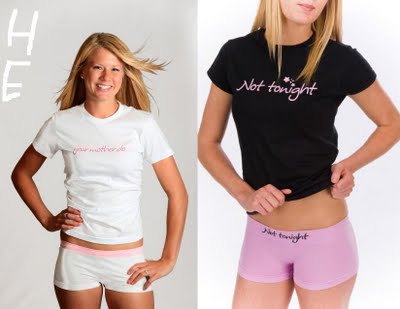 What better way to reinforce family morals than by wearing underwear that doubles as a conversation starter, right? If the junior prom after-party starts to get dull, just take off your pants and encourage a dialogue! Awkward first date? Lift up your dress and ask for some feedback!
On the one hand, these panties were created by parents to encourage their teens to remain abstinent. On the other hand, these are panties. A strange choice of merchandise to hawk in the name of chastity.
Stranger still, these 75-percent “frisky” garments seem to be closely tied to a religious agenda. The very name of the line implies a Christian affiliation–subbing “your mother” for Jesus in the familiar WWJD. So what’s really going on here? Let’s take a closer look at some of the site’s offerings.

The essages on these panties–”Dream On,” “Zip It!” and “Not Tonight”–coyly indicate non-consent to a potential romantic partner. The marketing campaign confirms this:

But the whole concept of abstinence-promoting underwear makes about as much sense as commemorating sobriety with flasks instead of coins at AA meetings.
It isn’t just dumb, it’s dangerous. There’s nothing wrong with encouraging your children to choose abstinence before marriage; there is something wrong, however, with not empowering them with the knowledge and tools to make that choice and confidently communicate it to romantic partners. Without pulling down their pants.
What’s more, the panties can really muddy the notion of “consent” in young people’s minds. What if a teen girl wears “Not Tonight” panties and decides at some point in the evening that she actually does want to have sex? Nothing wrong with that, but the dissonance between the panty-message and her ultimate decision may well reinforce the mistaken idea that “no means yes” in her partner’s mind.
This bizarre line of undergarments calls to mind what Jessica Valenti dubbed The Purity Myth in her book of the same name. In an interview, she argues that oversexualization of women in the media and pop culture has begun to intersect with the conservative movement, resulting in the fetishization of virginity:
If you are telling young women over and over that what’s most important is their virginity … then you’re sending the message that it’s the body and sexuality that defines who they are … With the virginity movement it’s adults–and a lot of men–deciding what appropriate sexuality is for younger women. It’s anyone and everyone except young women themselves defining (their) sexuality.
This is ridiculously displayed in WWYMD’s promotional videos, which feature abstinence-friendly songs and wind-blown girls posing suggestively in their skivies next to fully-clothed young men. Here are some of the choice lyrics:
No kiss, no touch, no makin’ out hey, hey, hey, hey, hey, hey… When men see a body like this, they have a tendency to dismiss that I got anything upstairs, but I got me a lot of brains up there … Let me make it clear, so there’s no mistake my life’s goin’ good, there’s too much at stake to just hand it over, to any man…
The second video is even more explicit and confusing, combining gratuitous crotch shots with pro-chastity song lyrics:
I am waitin’, for my time in life, I am waitin’ for love. I am waitin’ on the world to change I am waitin’ on you
Abstinence-promoting strategies as ineffective as these will certainly prove to be are, unfortunately, not unprecedented. Just last week it was reported that the Candies Foundation paid Bristol Palin more than $260,000 to be a pro-abstinence spokesperson–seven times the amount they spent on actual teen pregnancy prevention programs. With the rise of what’s been called the chastity-industrial complex, peddling purity is big business. Once again, social and religious conservatives say one thing, do another and wait for the money to roll in.
ABOVE, TOP TO BOTTOM: Screenshot of Twitter message, WWYMD logo, Items from WWYMD line, Promotional flyer from the What Would Your Mother Do? Facebook page.
This was originally posted on the Ms. Magazine Blog on April 14, 2011. The above post was slightly edited, leaving out the intro on the piece’s relevence to the Ms. “Click!” blog carnival.
Popular Posts on BroadBlogs
Sex Objects Who Don’t Enjoy Sex
Women Want Casual Sex? Yes and No
Men Have Higher Sex Drive. Why?
Share this:

Transgender Woman Beaten at McDonald’s. Why?
Video of a transgender woman getting beaten at a McDonald’s has gone viral and received plenty of media attention. I would like to explore why these crimes happen. What lies behind bashing our transgender sisters and brothers?
In case you missed it. Here are the details:
After a 22-year-old trans woman named Chrissy Lee Polis used a McDonald’s bathroom, two female customers punched and kicked her until she had a seizure. An older woman tried to help, but other customers and employees stood by or cheered on the brutality. One employee videotaped the beating and posted it on YouTube, saying the assault was okay because the victim “was a man dressed like a woman.”
The video is available here.
So far, a 14-year-old girl has been charged as a juvenile and charges are pending against an 18-year-old woman.
In the U.S. the transgendered are continually subjected to, and must worry about, verbal or physical abuse when using facilities like public restrooms.
Why does this happen?
Chrissy’s case is not typical. Usually men are the assailants and they bash from feeling threatened by biologically-born males who blur gender lines. Why threatened? Men hold higher status, as evidenced by our cultural preference for sons, or by the fact that women will wear pants but men won’t wear dresses or carry purses. Meanwhile, those who succeed might be praised, “You the man!” but those who fail may be taunted, “You’re a girl!” So men who act like women are seen as demeaning themselves, while those who resemble women in any way threaten the divide between the sexes, and with that, male superiority.
Some of this may have been going on at McDonald’s as male employees cheered and proudly posted the video, while claiming cruelty against the transgendered is justified.
Yet females were the main culprits of this crime. What were they trying to accomplish by their violence?
Chrissy thought they wanted to pick a fight (see Chrissy’s account here). Before entering the bathroom a man asked how she was doing, and she brushed him off. As soon as she came back out a women spit in her face and accused her: “You tried to talk to my man!” just before the battering began.
The young brutes may well have detected Chrissy’s gender status. According to the Baltimore Sun, the attackers reportedly said, ‘That’s a dude. That’s a dude. And she’s in the female bathroom.” These women likely didn’t have the motivations of male attackers. So what were they trying to accomplish?
Their motivation was certainly aligned with trans-bashers, with both working so hard to create a sense of superiority. By the simple act of beating someone down these young thugs likely felt empowered and better than the person they pummeled. If they figured out that Chrissy was transgender, she likely seemed an especially desired target as they could easily latch onto her devalued status, leading the persecutors to feel both disdainful and called to punish (punishment meted out by a superior, of course.)
But all this suggests that the tormentors don’t feel as good about themselves as they would like. Otherwise they wouldn’t need to work so hard to feel self-important. Yes, those higher on the pecking order are more likely to bully, but they do so only because they don’t feel superior-enough as is. Meanwhile, it’s unfortunate that our society makes cruelty so easy by failing to recognize the human worth and dignity of each human being.
Georgia Platts
Popular Posts on BroadBlogs
Men: More Homophobic Than Women?
My Son Likes Girl-Things. Is He Gay?
Do Kids Bully from Low Self-Esteem? Or Because they’re Popular? No and No

 BroadBlogs